Munich Keeps Its Promises
Destination: Munich, Germany
Category: Destination Guides
Munich Keeps Its Promises
Every city makes promises it can't keep. Munich keeps all of them.
It promises beer, and delivers it in quantities and qualities that make the rest of the world's beer culture look like a rough draft. It promises history, and gives you two thousand years of it — Roman foundations, medieval towers, Baroque palaces, the darkest chapter of the 20th century, and a postwar reconstruction so thorough and so beautiful that the city feels simultaneously ancient and effortlessly modern. It promises mountains, and on a clear day you can see the Alps from the English Garden. It promises food, and then serves you a white sausage breakfast that you will think about for years.
Munich is the capital of Bavaria, the largest and most culturally distinct of Germany's sixteen states, and it operates with a confidence that comes from knowing exactly what it is. It is not Berlin — it has no interest in being Berlin. It is not Hamburg. It is Munich: a city of 1.5 million people that has been one of Europe's great cultural capitals for four centuries, that hosts the world's most famous festival every autumn, that contains some of the finest museums in Europe, and that manages to be simultaneously one of the most livable and one of the most visited cities on the continent.
This is how to understand it.
The Old Town: Where Munich Began
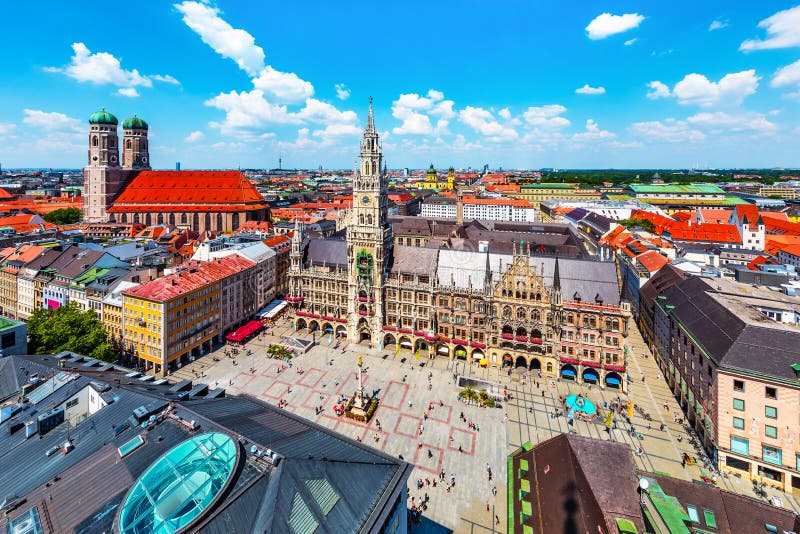
The heart of Munich is Marienplatz, the central square that has been the city's gathering point since 1158. The square is dominated by the Neues Rathaus — the New Town Hall, which is neither new nor a town hall in any conventional sense but rather a neo-Gothic fantasy of towers and turrets built between 1867 and 1909 — and its famous Glockenspiel, the carillon that chimes daily at 11 AM and noon (and at 5 PM in summer) with a mechanical pageant of jousting knights and dancing coopers that draws crowds of thousands. The Glockenspiel is, by any objective measure, not that impressive. The crowds gather anyway, because some things are worth doing simply because everyone does them.
Behind the Neues Rathaus, the Altes Rathaus — the Old Town Hall, a Gothic structure from the 15th century — now houses a toy museum that is more interesting than it sounds. The Frauenkirche, Munich's cathedral, is two blocks away: the twin-towered brick church whose onion domes are the city's most recognizable silhouette, visible from almost everywhere in the old town. The interior is Gothic and austere, with the tomb of Holy Roman Emperor Ludwig IV and a legend about the Devil's footprint near the entrance — the story goes that the Devil visited the church during construction and, seeing no windows from where he stood, stamped his foot in triumph at the darkness, not realizing the windows were simply hidden by the columns.
The Viktualienmarkt, Munich's daily outdoor food market, is a five-minute walk from Marienplatz and is one of the great urban markets of Europe. It has been operating on the same site since 1807, and it sells everything from Bavarian white asparagus in spring to fresh pretzels year-round, from artisanal cheeses to the Maypole that stands at its center, decorated with the symbols of Munich's traditional trades. The market's beer garden — one of the oldest in the city — operates in the center of the market, and drinking a Mass (a one-liter stein) of beer surrounded by market stalls at noon on a weekday is one of Munich's most civilized pleasures.
The Hofbräuhaus is a five-minute walk from Marienplatz and is, depending on your perspective, either a tourist trap or a genuine institution that happens to attract tourists. The answer is both. The Hofbräuhaus was founded in 1589 as a royal brewery, has been in continuous operation ever since, and serves 10,000 liters of beer per day in its three floors of halls and beer garden. It is loud, crowded, and entirely unapologetic about being exactly what it is. The beer is excellent. The pretzels are the size of steering wheels. The oompah band plays from a balcony. Go once, stay for two Maß, and leave with a story.
The English Garden: The Park That Ate the City
The Englischer Garten — the English Garden — is 3.7 square kilometers of parkland in the middle of Munich, making it larger than Central Park in New York and Hyde Park in London. It was created in 1789 by an American-born British count named Benjamin Thompson (later Count Rumford), who designed it on the principles of the English landscape garden — naturalistic, informal, with meadows and streams and woodland rather than the geometric formality of French gardens.
The English Garden is where Munich goes to be itself. On a summer afternoon, the meadows are covered with sunbathers, many of them nude — Munich has a long tradition of Freikörperkultur (free body culture) and the English Garden is one of the few places in a major European city where public nudity is not only tolerated but entirely unremarkable. The Chinesischer Turm (Chinese Tower), a five-story pagoda built in 1789, anchors the park's most popular beer garden, which seats 7,000 people and is one of the largest in the world. The Monopteros, a Greek temple on a hill, offers the best view of the Munich skyline with the Alps behind it on clear days.
But the English Garden's most extraordinary feature is the Eisbach wave — an artificial standing wave created by the flow of the Eisbach stream under a bridge near the Prinzregentenstraße entrance. The wave has been surfed continuously since the 1970s, and on any given day you can watch surfers riding a wave in the middle of a landlocked European city, one at a time, rotating through a queue that forms on the bank. It is one of Munich's great surreal pleasures, and the surfers are genuinely skilled — the Eisbach wave is fast, powerful, and unforgiving.
The Museums: Munich as Cultural Capital
Munich's museum district — the Kunstareal, the art quarter — is concentrated around the Maxvorstadt neighborhood north of the old town, and it contains a density of world-class museums that rivals any city in Europe.
The Deutsches Museum, on an island in the Isar River, is the world's largest science and technology museum, with 73,000 exhibits covering everything from mining and metallurgy to aviation, space travel, chemistry, and musical instruments. It is the kind of museum where you can spend an entire day and leave feeling that you've seen perhaps a third of it. The full-scale replica of a coal mine in the basement, the Wright Brothers-era aircraft hanging from the ceiling of the aviation hall, and the working model of a submarine are among the highlights.
The Alte Pinakothek (Old Picture Gallery) contains one of the finest collections of European painting from the 14th to 18th centuries in the world — Dürer, Rubens, Rembrandt, Raphael, Titian, El Greco — assembled by the Wittelsbach dynasty, the royal family that ruled Bavaria for seven centuries. The Neue Pinakothek (New Picture Gallery) covers the 18th and 19th centuries, with an exceptional collection of German Romanticism and French Impressionism. The Pinakothek der Moderne brings the story into the 20th and 21st centuries, with Picasso, Klee, Kandinsky, Warhol, and Beuys alongside a design collection that covers everything from Bauhaus furniture to BMW concept cars.
The Nymphenburg Palace, four kilometers west of the city center, is the summer residence of the Wittelsbach dynasty — a Baroque palace complex that sprawls across 200 hectares of formal gardens, canals, and parkland. The palace itself is magnificent, with the Great Hall painted in trompe l'oeil frescoes and the Gallery of Beauties — a collection of 36 portraits of beautiful women commissioned by King Ludwig I, including the famous portrait of Lola Montez, the Irish dancer whose affair with the king contributed to his abdication in 1848. The gardens are extraordinary in every season: formal parterres in summer, golden and red in autumn, snow-covered and silent in winter.
The Beer Halls and Beer Gardens: An Education
Munich's beer culture is not a tourist attraction. It is a civic institution, a social infrastructure, a way of organizing community life that has been operating continuously for centuries. The Reinheitsgebot — the Bavarian Beer Purity Law of 1516, which mandated that beer could only be brewed from water, barley, and hops — is the oldest food quality regulation in the world still in use, and it shaped the character of Bavarian beer in ways that are still felt in every glass.
There are six major Munich breweries — Augustiner, Hacker-Pschorr, Hofbräu, Löwenbräu, Paulaner, and Spaten — and each has its own character and its own devoted following. Augustiner is the oldest (founded 1328) and is considered by many Münchners to be the finest — its Helles (pale lager) is the benchmark against which all other Munich beers are measured. The Augustiner beer hall on Neuhauserstraße is the most local-feeling of the major halls, less touristy than the Hofbräuhaus, with wooden booths and a beer garden that fills with office workers at lunchtime.
The beer garden culture deserves its own explanation. In Munich, beer gardens are not just outdoor seating areas attached to restaurants. They are a specific institution with specific rules: you are permitted to bring your own food (though not your own beer) to most Munich beer gardens, and the tradition of families arriving with a picnic basket and buying only beer from the garden dates to the 19th century. The Hirschgarten, in the western part of the city, is the largest beer garden in the world, seating 8,000 people, with deer grazing in an enclosure nearby. The Seehaus in the English Garden overlooks the Kleinhesseloher See lake. The Augustiner Keller on Arnulfstraße is the most atmospheric of the city-center gardens, with chestnut trees that have been shading drinkers since 1812.
Oktoberfest requires its own paragraph. The world's most famous festival runs for 16–18 days from late September to the first Sunday in October, on the Theresienwiese fairground southwest of the city center. Six million people attend. The beer tents — massive temporary structures seating up to 10,000 people each — are operated by the six Munich breweries and serve a special Oktoberfest Märzen, a slightly stronger and maltier version of the standard Helles. The festival is simultaneously a genuine Bavarian folk celebration (the opening parade, the traditional costumes, the brass bands) and an enormous international party. Reservations for tent tables are essential and should be made a year in advance for the most popular tents. The best time to experience Oktoberfest as a local rather than a tourist is on a weekday, when the crowds thin and the atmosphere is more relaxed.
The Neighborhoods Beyond the Center
Schwabing, north of the old town and adjacent to the English Garden, was Munich's bohemian quarter in the late 19th and early 20th centuries — the neighborhood where Kandinsky, Klee, and the artists of the Blaue Reiter (Blue Rider) movement lived and worked, where Lenin spent years in exile before the Russian Revolution, where Thomas Mann set his early novels. It is now a prosperous residential neighborhood of wide boulevards and Art Nouveau buildings, with the Leopoldstraße as its main artery — a boulevard of cafés, boutiques, and street life that is Munich's answer to the Champs-Élysées, without the pretension.
Glockenbachviertel, south of the city center, is Munich's most diverse and creative neighborhood — the center of the city's LGBTQ+ community, with a concentration of independent restaurants, bars, and galleries that makes it the best place to eat and drink outside the tourist circuit. The Gärtnerplatz, the hexagonal square at the neighborhood's heart, is surrounded by restaurants and bars that fill with locals on warm evenings.
Maxvorstadt, the university quarter, is where the museums are and where Munich's student population lives. The Münchner Freiheit square at its northern edge is a gathering point for the young and the creative. The streets around the Ludwig-Maximilians-Universität are lined with bookshops, cafés, and the kind of intellectual energy that university neighborhoods generate everywhere.
The Food: Beyond Pretzels and Weisswurst
Bavarian food has a reputation — pretzels, white sausages, pork knuckle, dumplings — that is both accurate and incomplete. The traditional dishes are genuinely excellent, but Munich's food scene has evolved far beyond its regional roots.
The Weisswurst breakfast is the place to start. White sausages — made from minced veal and pork back bacon, flavored with parsley, lemon, mace, onion, and cardamom — are a Munich institution that is eaten only in the morning (traditionally before noon, because before refrigeration they would spoil by midday). They are served in a bowl of hot water with sweet Bavarian mustard, a pretzel, and a Weissbier. You eat them by sucking the meat from the skin — a technique called zuzeln — or by cutting them open. The Weisses Bräuhaus near Marienplatz is the canonical place to eat them.
Schweinshaxe — roasted pork knuckle with crispy crackling — is the dish that defines Bavarian cooking: a massive, glistening, deeply savory thing served with potato dumplings and red cabbage. Obatzda — a Bavarian cheese spread made from Camembert, butter, onion, and paprika — is the beer garden snack that you will eat with a pretzel and wonder why the rest of the world hasn't adopted it. Kaiserschmarrn — a shredded pancake dessert dusted with powdered sugar and served with plum compote — is the dessert that proves Bavarian cooking has a sweet side that is as serious as its savory one.
Beyond the traditional, Munich's restaurant scene reflects the city's international character. The Viktualienmarkt area has some of the best Italian restaurants outside Italy. The Gärtnerplatz neighborhood has excellent Thai, Vietnamese, and Japanese options. The Schumann's Bar on Odeonsplatz is one of the finest cocktail bars in Europe. The Tantris restaurant in Schwabing, which has held two Michelin stars for decades, is the standard-bearer for Munich's fine dining scene.
Day Trips: The Alps Are Right There
Munich's greatest geographical advantage is its proximity to the Alps. On a clear day, the mountains are visible from the city. Within 90 minutes by train or car, you are in them.
Neuschwanstein Castle — the fairy-tale castle built by King Ludwig II in the 1870s, the inspiration for Disney's Sleeping Beauty Castle — is 120 kilometers southwest of Munich, near the town of Füssen. The castle is extraordinary and the setting (perched on a rocky outcrop above a gorge, with the Alps behind it) is genuinely breathtaking. It is also one of the most visited tourist sites in Europe, and the crowds can be overwhelming in summer. Go on a weekday in spring or autumn, book tickets in advance, and arrive early.
Salzburg, Mozart's birthplace, is 90 minutes from Munich by train and is one of the most beautiful small cities in Europe — the Baroque old town, the Hohensalzburg Fortress, the Mirabell Gardens, the Getreidegasse with its wrought-iron shop signs. It is technically in Austria, but from Munich it feels like a day trip to a particularly beautiful neighborhood.
Garmisch-Partenkirchen, 90 kilometers south of Munich, is the gateway to the Zugspitze — Germany's highest mountain at 2,962 meters — and to the Partnachklamm, one of the most dramatic gorges in the Alps. The cable car to the Zugspitze summit offers views across four countries on a clear day.
Chiemsee, the "Bavarian Sea," is 80 kilometers east of Munich — a large lake with islands, including Herrenchiemsee, where Ludwig II built yet another palace, this one modeled on Versailles. The lake is beautiful in every season and is a popular weekend destination for Münchners.
The Guides That Will Build Your Munich Itinerary
The Ask Leif library has four Munich guides covering every type of traveler:
For the first-time visitor who wants to see everything the city has to offer, the 4 Days in Munich: The Ultimate City Break Itinerary covers Marienplatz, the English Garden, the museums, the beer halls, and the day trips in a logical, well-paced sequence.
For couples looking for the romantic side of Bavaria — the Nymphenburg Palace gardens, the candlelit beer halls, the Alpine day trips — the Romantic Munich Getaway: A 4-Day Couple's Guide to Bavarian Charm builds an itinerary around the city's most beautiful and intimate experiences.
For solo travelers who want to move at their own pace and go deep into Munich's neighborhoods, museums, and nightlife, the Munich Solo Travel: A 4-Day Itinerary for Independent Explorers is the guide to follow.
And for travelers who want to experience Munich's beer halls, markets, and museums without spending a fortune, the Munich on a Budget: 4-Day Food & Beer Hall Guide for €65/Day proves that one of Europe's most expensive cities is actually very manageable on a careful budget.
Practical Munich: What You Need to Know
When to go: Munich is excellent in every season, but each has a distinct character. Summer (June–August) is warm, the beer gardens are full, and the English Garden is at its most beautiful. Autumn (September–October) brings Oktoberfest and the golden light of the Bavarian countryside. Winter (November–February) is cold but magical — the Christmas markets on Marienplatz and in the Schwabing neighborhood are among the finest in Germany. Spring (March–May) is when the asparagus arrives and the Alps are still snow-covered but the city is warming up.
Getting around: Munich's public transport system — the MVV — is one of the best in Europe. The U-Bahn (subway), S-Bahn (suburban rail), trams, and buses cover the entire city and the surrounding region. A day ticket covers unlimited travel on all modes and is excellent value. The city center is also very walkable.
Language: German. English is widely spoken in tourist areas, hotels, and restaurants, but learning a few words of German — Bitte (please), Danke (thank you), Prost (cheers) — is appreciated and reciprocated with warmth.
Currency: Euro. Credit cards are accepted almost everywhere, but many traditional beer halls and markets prefer cash.
Beer etiquette: In a beer hall, you wait for a server to come to you — don't go to the bar. You say Prost and make eye contact when clinking glasses (failing to make eye contact is considered bad luck). You do not clink glasses with the bottom of the stein. You do not ask for a half-liter in a beer hall that only serves full liters — this marks you as a tourist more reliably than any other single act.
Why Munich Now
Munich is one of those cities that people keep discovering and then wondering why it took them so long. It is consistently ranked among the most livable cities in the world — safe, clean, efficient, with a quality of life that reflects centuries of civic investment. It is also, for all its polish, a city with genuine soul: the beer garden culture that brings every social class together under the same chestnut trees, the Bavarian identity that is distinct from the rest of Germany in ways that matter to the people who live here, the mountains that are always visible on the horizon, reminding you that the city exists in a landscape of extraordinary beauty.
The Glockenspiel will chime at 11 AM. The Weisswurst will be ready before noon. The English Garden will be full of people doing exactly what they want to do. The Alps will be there on the horizon, waiting.
Munich keeps its promises. Go find out which ones matter most to you.