Monaco Is Not a Country. It's a Dare.
Destination: Monaco
Category: Destination Guides
Monaco Is Not a Country. It's a Dare.
The first thing you notice is the scale — or rather, the lack of it. You step off the train at Monaco-Monte-Carlo station and you expect a country to announce itself. You expect borders, customs, the bureaucratic theater of crossing from one nation into another. Instead, you walk up an escalator, emerge into warm Mediterranean light, and realize you are standing in a place that is simultaneously the most glamorous square mile on earth and the most quietly, stubbornly, defiantly real place you will ever visit.
Monaco is 0.78 square miles. It is smaller than Central Park. It has more millionaires per capita than anywhere else on the planet. Its police force outnumbers its army. Its Formula 1 circuit runs through its streets. Its casino — the one that James Bond made famous, the one that has been photographed from every conceivable angle by every conceivable publication — sits in the middle of it all like a baroque fever dream, and yet somehow, impossibly, it does not feel fake. It feels earned.
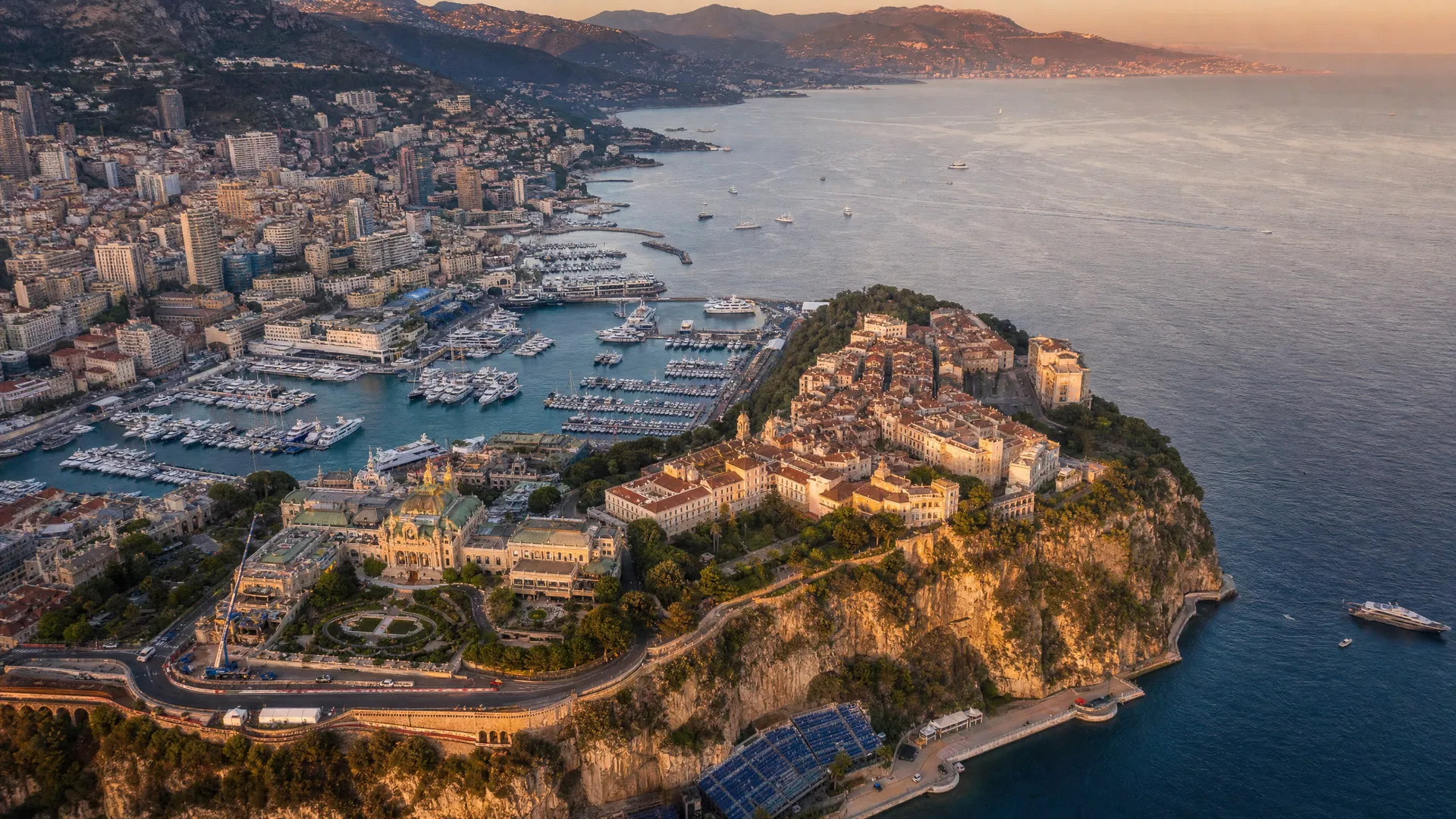
That is the thing about Monaco that no travel article ever quite captures. Everyone writes about the yachts. Everyone writes about the casino. Everyone writes about the Grand Prix. And all of that is true, and all of it is spectacular, and none of it is the point. The point is that Monaco has spent 700 years refusing to be absorbed, refusing to be irrelevant, refusing to be anything other than exactly what it chose to be. And when you stand on the Rock of Monaco at dusk, looking out over the harbor where the superyachts sit like a fleet of floating palaces, you feel that refusal in your bones. This place decided to be extraordinary. And it succeeded.
This is your guide to understanding it — not just visiting it.
The Rock That Started Everything
Monaco's story begins, as so many Mediterranean stories do, with a rock. The Rock of Monaco — Le Rocher — is a 200-foot limestone promontory that juts into the sea at the eastern edge of the French Riviera. It is the kind of geological feature that ancient peoples looked at and immediately understood: this is defensible. This is ours.
The Grimaldi family understood this in 1297, when François Grimaldi disguised himself as a Franciscan monk, knocked on the door of the fortress atop the rock, and seized it by force. The Grimaldis have ruled Monaco ever since — making them one of the oldest ruling dynasties in Europe, older than the United States, older than the concept of most modern nations. The monk with a sword hidden under his habit is still on the Grimaldi coat of arms. They are not a family that forgets where they came from.
The old town that sits atop Le Rocher today — Monaco-Ville, or simply "the Rock" — is a medieval village that has been perfectly preserved inside a modern principality. Its streets are narrow and ochre-walled and smell of jasmine and diesel from the tourist trains that trundle through. The Prince's Palace sits at the western tip, its changing of the guard happening every day at 11:55 AM with the kind of precision that suggests the guards have been doing this since the Grimaldis first took the rock by force. The Oceanographic Museum — founded by Prince Albert I, the "Scientist Prince," in 1910 — hangs over the cliff edge like a monument to curiosity, its tanks full of creatures from the deep that Albert spent decades pulling up from the Mediterranean in his research vessels.
But the thing that will stop you on the Rock, the thing that no photograph adequately prepares you for, is the view. Stand at the southern ramparts and look west toward Cap d'Ail and the French coast. Look east toward Menton and the Italian border. Look down at the harbor — Port Hercule, named for the legend that Hercules once stopped here on his way to the Pillars — and count the yachts. There are always yachts. There are always more yachts than you thought there would be. And beyond them, the Mediterranean stretches out in a shade of blue that painters have been trying to capture for centuries and never quite getting right.
This is where Monaco begins. Not in the casino. Not on the circuit. On the rock, with the sea below and seven centuries of stubbornness behind you.
Monte Carlo: The Myth and the Reality
Monte Carlo is not Monaco. This is the first thing to understand. Monte Carlo is a neighborhood — the most famous neighborhood in the world, perhaps, but still just one of Monaco's ten wards. It sits on the plateau above the harbor, and it is where the casino is, and the Hôtel de Paris, and the Café de Paris, and the Hermès boutique, and the Louis Vuitton boutique, and the Cartier boutique, and approximately forty other boutiques that sell things that cost more than most people's cars.
The Casino de Monte-Carlo opened in 1863, designed by Charles Garnier — the same architect who built the Paris Opéra — and it is, without question, one of the most beautiful buildings in the world. Its Belle Époque façade, its twin towers, its ornate atrium with the stained glass ceiling and the frescoed walls — it was designed to make you feel that you had arrived somewhere that mattered. It succeeded then. It succeeds now. The casino is still Monaco's most visited attraction, and it is still, on any given evening, full of people who have dressed up to be here, who have saved up to be here, who understand that this is not just gambling — this is theater.
You do not have to gamble to enter the casino's public rooms. The entrance fee gets you into the Atrium, the Salle Garnier (the opera house attached to the casino), and the gaming rooms themselves, where you can watch people bet more money on a single hand of baccarat than you might spend on a month of groceries. The atmosphere is extraordinary — hushed and electric at the same time, the way a stage feels in the minutes before the curtain rises. Even if you never place a bet, you will leave feeling like you have witnessed something.
But here is what the travel brochures do not tell you about Monte Carlo: it is also, in the daytime, a neighborhood where people live. The Condamine market, down in the port district, opens every morning with fruit vendors and flower sellers and old men arguing about football. The Fontvieille district, reclaimed from the sea in the 1960s, has a rose garden and a museum of vintage cars that Prince Rainier III collected over his lifetime. The Jardin Exotique, clinging to a cliff face on the western edge of the principality, has cacti and succulents from around the world growing in improbable abundance, and a cave below it full of prehistoric stalactites that has nothing to do with glamour and everything to do with the fact that this rock has been inhabited for a very long time.
Monte Carlo is a myth that happens to be real. The trick is to spend enough time there to find both.
The Formula 1 Circuit: When the Streets Become a Racetrack
Every year in late May, something extraordinary happens to Monaco. The streets — the actual streets, the ones that people drive to work on and park on and walk their dogs along — are transformed into the most famous motorsport circuit in the world. Barriers go up. Grandstands appear. The tunnel under the Fairmont Hotel, which on any other day is just a tunnel, becomes the fastest section of the Monaco Grand Prix circuit, where cars hit 180 mph in near-darkness before exploding back into Mediterranean sunlight.
The Monaco Grand Prix has been held since 1929 (with interruptions for the Second World War). It is the oldest, most prestigious, and most technically demanding race on the Formula 1 calendar. The circuit is 3.34 kilometers. It has 19 corners. The barriers are close enough that a driver who makes a mistake does not spin off into a gravel trap — they hit a wall. There is no room for error. There is no room, full stop. The circuit is so narrow that overtaking is nearly impossible, which means that qualifying — the Saturday session where drivers set their grid positions — is often more important than the race itself. A driver who starts from pole position at Monaco wins the race more often than at any other circuit on the calendar.
You can walk the circuit any day of the year. This is one of Monaco's great gifts to the curious traveler. Start at Sainte Dévote — the first corner, a tight right-hander named for Monaco's patron saint — and follow the circuit up the hill through Beau Rivage, past the Casino Square, through the Mirabeau hairpin, down into the tunnel, out onto the harbor front, through the chicane, and back to the start. It takes about 45 minutes on foot. It will give you a profound respect for what Formula 1 drivers do, because the elevation changes are severe, the corners are tighter than they look on television, and the barriers are very, very close.
If you want to experience the Grand Prix itself — and if you have any interest in motorsport, you should — the planning starts early. Grandstand tickets sell out months in advance. The best views are from the Tribune Virage Anthony Noghès (the final corner before the start/finish straight) and the Tribune Piscine (the swimming pool section, where the cars are moving fast and the barriers are close). If you want to go deeper — Paddock Club access, yacht hospitality, the full Monaco Grand Prix experience — our dedicated Monaco Formula 1 Grand Prix: 4-Day Ultimate Race Weekend & Riviera Escape Guide covers every detail, from grandstand strategy to where to stay in Nice to make the budget work.
Race weekend or not, the circuit is always there. Walk it. Feel it. Understand why drivers call this the greatest race in the world.
The Harbor: Where the Money Floats
Port Hercule is Monaco's main harbor, and it is where the principality's relationship with extraordinary wealth becomes most visible. On any given day, you will see yachts here that are longer than most apartment buildings. During the Grand Prix, the harbor becomes something else entirely — the yachts multiply, the helicopters multiply, the people on the yachts multiply, and the whole thing takes on the quality of a floating city that has materialized specifically for the occasion.
But Port Hercule is also a working harbor. The ferry to the Îles de Lérins departs from here. The cruise ships dock here. The fishermen who still work the Monaco coast bring their catch here. There is a covered market at the port — the Marché de la Condamine — that has been operating since 1880, and on Tuesday, Thursday, and Saturday mornings it is full of the kind of produce that makes you understand why French cooking is what it is: tomatoes that taste like tomatoes, peaches that taste like peaches, cheese that tastes like the specific hillside where the goat was grazing.
The harbor promenade — the Quai des États-Unis — is where Monaco's residents walk in the evenings. Not the tourists. The residents. The people who live here, who have chosen to make their lives in this 0.78-square-mile principality, who walk their dogs past the superyachts the same way people in other cities walk their dogs past parked cars. This is the Monaco that the travel articles miss: the Monaco of daily life, of routine, of the ordinary coexisting with the extraordinary in a way that, after a few days, starts to feel completely normal.
Sit at one of the harbor-front cafés in the early evening. Order a glass of Bellet — the wine made in the hills above Nice, one of the smallest AOC appellations in France, almost impossible to find outside this corner of the world. Watch the light change on the water. Watch the yachts. Watch the people watching the yachts. This is Monaco at its most honest, and its most beautiful.
Eating in Monaco: Beyond the Grand Hotels
Monaco has more Michelin stars per capita than any other country in the world. This is both a fact and a warning. The grand hotel restaurants — Le Louis XV at the Hôtel de Paris, where Alain Ducasse has held three Michelin stars since 1990; Le Grill on the eighth floor of the same hotel, with its retractable roof and its view of the Mediterranean; the Bar Américain, where the cocktails are works of art — these are extraordinary experiences, and if your budget allows, you should have at least one meal at this level. The cooking at Le Louis XV is among the finest in the world. The service is theater. The wine list is a document of human achievement.
But Monaco also has a food culture that exists entirely outside the grand hotels, and it is this culture that will make you understand the place. The Café de Paris, on Casino Square, is a brasserie that has been feeding Monaco since 1882. It is not cheap, but it is not stratospheric, and its terrace is one of the great people-watching perches in Europe. The Marché de la Condamine has a food court on its upper level where you can eat a proper Niçoise lunch — socca, pissaladière, salade niçoise made with the actual ingredients and not the tourist approximation — for a fraction of what you would pay in the casino district.
In the Fontvieille district, away from the tourist trail, there are neighborhood restaurants where Monaco's workers eat lunch. These are the places where the pizza is cooked in a wood-fired oven and the pasta is made fresh and the bill is reasonable and the conversation at the next table is in Monégasque — the principality's own language, a blend of Ligurian Italian and Provençal French that fewer than 10,000 people speak fluently. These restaurants will not appear in the Michelin guide. They will be the meals you remember.
Three Ways to Do Monaco: Choose Your Adventure
Monaco is not a one-size-fits-all destination. It rewards travelers who come with a clear sense of what they want from it. Here are the three approaches that work best — and the guides that will help you execute each one perfectly.
The First-Timer: You want to see everything. The casino, the palace, the circuit, the harbor, the museum. You want to understand what Monaco is and why it exists and why people talk about it the way they do. You have three days and a moderate budget, and you are willing to stay in Nice or Menton to make the numbers work. Our 3-Day Monaco First-Timer's Itinerary is built exactly for you — it covers the Rock, the casino, the circuit walk, and a day trip to Èze and Cap Ferrat without requiring you to take out a second mortgage.
The Romantic Escape: You want Monaco as a backdrop for something special. An anniversary, a proposal, a trip that you will describe to people for the rest of your life. You want the Hôtel de Paris, or at least the Hôtel Hermitage. You want dinner at a Michelin-starred restaurant. You want to walk the harbor at midnight when the yachts are lit up and the water is still and the whole principality feels like it was designed specifically for this moment. Our Monaco Luxury Couples Guide covers every detail of doing Monaco at the level it was designed to be experienced — from the best suite categories to the restaurants worth the splurge to the day trips that will make the trip feel like a journey rather than a checklist.
The Formula 1 Pilgrim: You have been watching the Monaco Grand Prix on television since you were a child. You know the names of the corners. You have watched Senna's 1984 drive in the rain more times than you can count. You want to stand at Rascasse and feel the cars go by close enough to feel the air displacement. You want to understand what it means to race here. Our Monaco Formula 1 Grand Prix: 4-Day Ultimate Race Weekend Guide is the most comprehensive F1 weekend planning resource available — covering grandstand selection, Nice-based logistics, race weekend timing, and how to experience the Grand Prix at every budget level from general admission to Paddock Club.
Day Trips: The Riviera Is Monaco's Backyard
Monaco's location is its greatest practical asset. Within 30 minutes in any direction, you have some of the most spectacular coastline in the world.
Èze: The medieval perched village above the Grande Corniche, 15 minutes from Monaco by car. It sits 1,400 feet above the sea on a rock that makes Monaco's own rock look modest. The views from the cactus garden at the summit are among the best on the entire Riviera. Nietzsche walked the path from the sea to Èze while writing Thus Spoke Zarathustra. You can walk the same path — the Chemin de Nietzsche — in about 90 minutes. It is steep and beautiful and worth every step.
Cap Ferrat: The peninsula between Nice and Monaco that contains, per square meter, more extraordinary villas than anywhere else in the world. Somerset Maugham lived here. David Niven lived here. The Rothschilds built the Villa Ephrussi de Rothschild here, a pink Belle Époque palace surrounded by nine themed gardens that is open to the public and is one of the most beautiful houses in France. The coastal path around the cape takes about two hours and passes beaches that are accessible only on foot.
Menton: The last French town before the Italian border, 10 minutes east of Monaco. It is quieter than Nice, less glamorous than Monaco, and more beautiful than either. Its old town climbs a hillside in layers of yellow and orange and pink, and its lemon festival in February — the Fête du Citron — is one of the great spectacles of the Riviera calendar. The Musée Jean Cocteau, in a 17th-century fort on the harbor, contains the artist's work alongside the collection he assembled over a lifetime of living on this coast.
Antibes and Juan-les-Pins: An hour west of Monaco, Antibes has the best-preserved old town on the Riviera, a Picasso museum in the castle where the artist spent the summer of 1946, and a daily market in the Cours Masséna that is the best in the region. Juan-les-Pins, attached to Antibes, is where the Jazz à Juan festival has been held every July since 1960 — Miles Davis played here, Ella Fitzgerald played here, Ray Charles played here. The pine-shaded beach at Juan-les-Pins in July, with jazz drifting over the water, is one of those experiences that makes you understand why people came to the Riviera in the first place.
Practical Monaco: The Details That Matter
Getting there: The nearest airport is Nice Côte d'Azur (NCE), 30 minutes by taxi or helicopter (the helicopter is 7 minutes and costs about €150 — it is, objectively, the most fun way to arrive). The train from Nice takes 20 minutes and costs €4. The train from Ventimiglia (Italy) takes 30 minutes. Monaco is extraordinarily well-connected for a country of its size.
Getting around: Monaco is small enough to walk everywhere, but it is also extremely vertical — the difference in elevation between the harbor and the casino district is significant, and the difference between the harbor and the Rock is more significant still. The principality has a system of public elevators and escalators built into the hillside that are free to use and genuinely useful. The public bus system (CAM) covers the entire principality for €2 per ride.
When to go: May is the obvious answer — the Grand Prix transforms the principality into something you have to see to believe. But May is also the most expensive and most crowded month. September and October are the Riviera's secret season: the water is still warm from the summer, the crowds have thinned, the light is extraordinary, and the prices are significantly lower. January and February are quiet and mild by northern European standards, and the Fête du Citron in Menton is worth building a trip around.
Money: Monaco uses the euro, but it mints its own euro coins — which are legal tender throughout the eurozone and are collected by numismatists worldwide. If you get Monaco euro coins as change, keep them. The €2 Monaco coin is worth considerably more than €2 to a collector.
The casino: You must be 18 to enter the gaming rooms. You must show your passport. You cannot enter in shorts or flip-flops. The dress code in the evening is smart casual at minimum; many people dress formally. The entrance fee for the public gaming rooms is €17. The Salle Garnier (the opera house) requires a separate ticket for performances.
The Question Everyone Asks: Is Monaco Worth It?
Yes. But not for the reasons you think.
Monaco is worth visiting not because of the yachts or the casino or the Grand Prix, though all of those things are extraordinary. It is worth visiting because it is a place that chose to be exactly what it is, and has spent 700 years defending that choice. It is worth visiting because it sits at the intersection of French and Italian culture and has created something that is neither, something that is entirely its own. It is worth visiting because the light on the Mediterranean from the Rock at dusk is one of the most beautiful things you will ever see.
It is worth visiting because it is 0.78 square miles and it contains multitudes.
The people who come to Monaco expecting a theme park — a gilded, artificial place where the super-rich perform wealth for the benefit of tourists — leave disappointed. The people who come expecting a real place, a place with history and character and daily life and a harbor market and a medieval village and a casino that has been standing since 1863 — those people leave transformed.
Monaco is not a country. It is a dare. It dares you to look past the surface. It dares you to find the real thing underneath the glamour. It dares you to stay long enough to understand it.
Take the dare.
Plan Your Monaco Trip with Ask Leif
Whether you're coming for three days as a first-timer, planning a luxury escape with your partner, or making the pilgrimage for the Formula 1 Grand Prix, Ask Leif has a guide built specifically for your trip. Tell Leif your travel style, your budget, and your dates — and get a complete, personalized Monaco itinerary in under 60 seconds.
- 3 Days in Monaco: The Perfect First-Timer's Itinerary — Casino, Palace, circuit walk, and Côte d'Azur day trips without breaking the bank.
- Monaco for Couples: A 3-Day Luxury Escape — The Hôtel de Paris, Michelin-starred dinners, and the most romantic itinerary on the Riviera.
- Monaco Formula 1 Grand Prix: 4-Day Ultimate Race Weekend Guide — Everything you need to experience the greatest race in the world, at every budget level.
Monaco is waiting. The rock has been there for 700 years. The casino has been there for 160. The Grand Prix has been running since 1929.
Your itinerary starts now.