The Last Supper, the Aperitivo, and the City That Invented Modern Italy
Destination: Milan, Italy
Category: Destination Guides
Every experienced Italy traveler has heard the advice. Rome for history. Florence for art. Venice for romance. Skip Milan — it's just a business city, gray and expensive, with one painting worth seeing and a cathedral you can admire in an afternoon. Then go south.
It is, without question, the worst travel advice in Europe.
Milan is not the Italy of postcards. It will not hand you a sun-drenched piazza and a glass of Chianti and ask you to relax. It will not slow down for you, perform for you, or make it easy. What it will do — if you're paying attention — is show you something that no other city in Italy can: what happens when one of the world's oldest civilizations decides to become the future.
This is the city that invented the aperitivo ritual now copied in every cocktail bar from Brooklyn to Berlin. The city where Leonardo da Vinci did some of his greatest work. The city where Italian fashion was born, where the country's financial engine runs, where the best chefs in Italy come when they want to cook at the highest level. Milan is not a consolation prize on an Italian itinerary. It is, for a certain kind of traveler, the main event.
The City That Rewards the Curious
There is a reason the locals here have a saying: Milano non si vede, si scopre. Milan is not seen — it is discovered. Unlike Rome, where the Colosseum announces itself from across the city, or Florence, where the Duomo rises above the rooftops like a declaration, Milan keeps its best things behind closed doors, down unmarked alleys, inside courtyards you'd walk past without a second glance.
The Galleria Vittorio Emanuele II — the world's oldest shopping mall, opened in 1877 — announces itself grandly enough, its iron-and-glass barrel vault soaring above the mosaic floor where Milanese tradition demands you spin three times on the testicles of the bull mosaic for good luck. But step through the Galleria and you're in the Piazza della Scala, facing one of the world's great opera houses. Turn left and you're in the Brera, where the cobblestoned streets narrow and the art galleries multiply and the aperitivo bars fill up at six o'clock with a crowd that looks like it stepped out of a Vogue editorial. Turn right and you're walking toward the Castello Sforzesco, the 15th-century fortress of the Sforza family, where Michelangelo's final, unfinished sculpture — the Pietà Rondanini — sits in a room that feels almost too small for what it contains.
This is Milan's rhythm: one discovery leading to another, each one earned rather than handed to you.
The Last Supper: Why You Need to Book Three Months in Advance (and Why It's Worth It)
Let's start with the obvious. Leonardo da Vinci's The Last Supper is one of the most important works of art in human history, and it is painted directly onto the wall of a former convent refectory at Santa Maria delle Grazie. Not on canvas. Not in a museum. On a wall, in the room it was made for, in the city where it has always been.
You get fifteen minutes. That's it. The viewing is timed, the groups are small, and the booking system is notoriously difficult — tickets sell out months in advance, and the official booking site (cenacolovinciano.org) is the only legitimate source. There are no shortcuts. There are no walk-ins. Plan accordingly.
What those fifteen minutes give you is something that no reproduction, no matter how high-resolution, can prepare you for: the scale of it. The painting is nearly nine meters wide. The figures are life-sized. The perspective — Leonardo's revolutionary use of converging lines drawing your eye to Christ at the center — works on you physically, pulling you into the scene. The damage from centuries of humidity and a World War II bomb that destroyed the adjacent wall but somehow left the painting intact only adds to the weight of standing in front of it.
Book the tickets. Book them now, before you do anything else for this trip. The rest of Milan will still be there when you come up for air.
The Duomo: Italy's Most Ambitious Cathedral
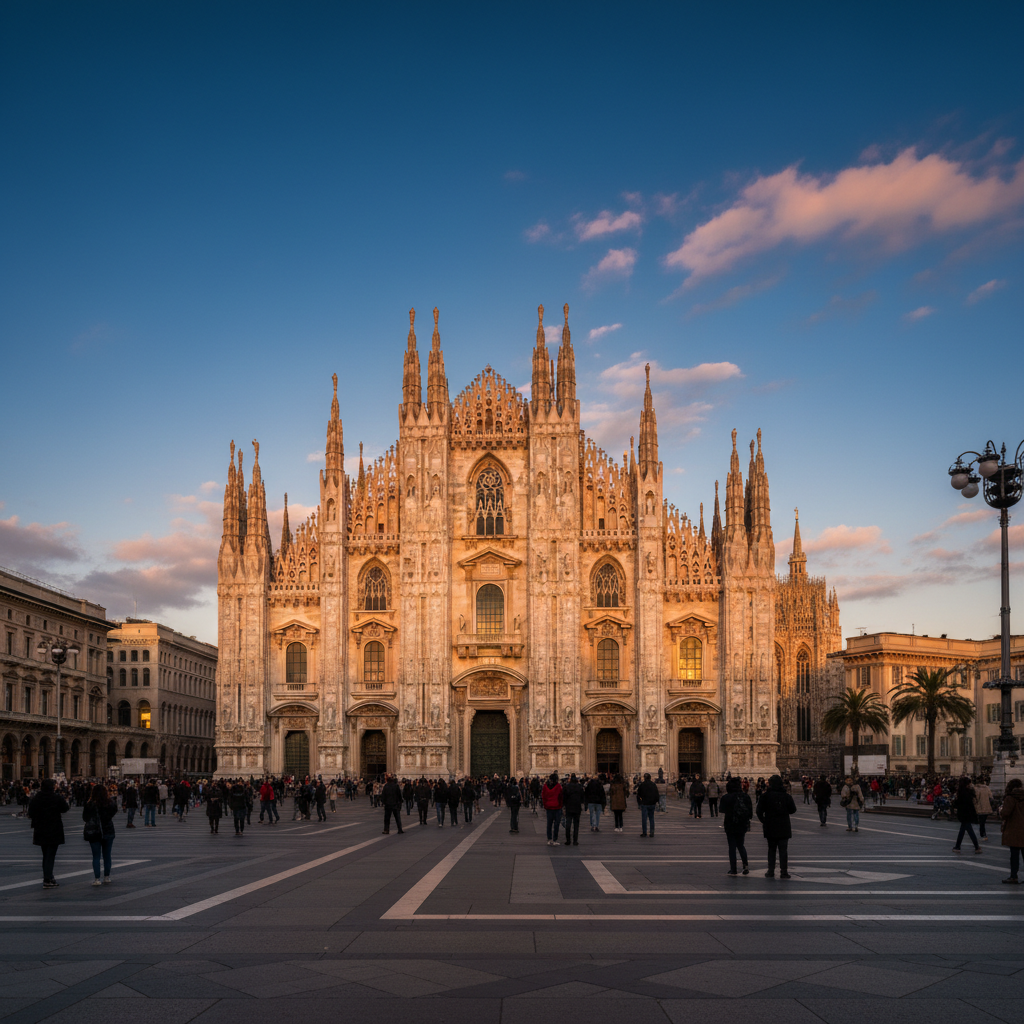
The Duomo di Milano took nearly six centuries to complete. Construction began in 1386 under Gian Galeazzo Visconti, and the final details weren't finished until 1965. The result is the largest Gothic cathedral in the world by floor area — 135 spires, 3,400 statues, a forest of white marble pinnacles that catches the light differently at every hour of the day.
Most visitors see it from the piazza below, take a photo, and move on. This is a mistake. The rooftop walk is one of the great experiences in Italian travel — you climb up among the spires, walk between the marble saints and gargoyles, and look out over a city that stretches to the Alps on a clear day. The views north toward the mountains are extraordinary. The detail of the stonework, seen up close rather than from the ground, is staggering — individual faces carved into stone 500 years ago, still sharp, still expressive, never meant to be seen by anyone standing this close.
Inside, the cathedral is cool and dim and enormous. The stained glass windows — some of the oldest in the world — filter the light into something otherworldly. The Treasury contains relics and vestments spanning a thousand years of Milanese religious history. The archaeological area beneath the cathedral reveals the foundations of earlier churches going back to the 4th century. Give the Duomo a full morning. It deserves it.
The Neighborhoods: Where Milan Actually Lives
Brera is where Milan's soul lives closest to the surface. The neighborhood takes its name from the Pinacoteca di Brera, one of Italy's great art museums — Raphael's Betrothal of the Virgin, Mantegna's Dead Christ, Caravaggio, Bellini, Tintoretto, all in a single palazzo. But the neighborhood around it is equally worth your time: cobblestoned streets, independent bookshops, galleries showing contemporary work alongside Renaissance masters, and aperitivo bars that fill up at six with a crowd that has clearly been coming here for decades. The Brera is also where Milan's art academy has been since 1776, which means the neighborhood has a creative energy that feels earned rather than manufactured.
Navigli is Milan's canal district, and it is the best place in the city to understand the aperitivo ritual that Milan invented and the world has been trying to replicate ever since. The Naviglio Grande and the Naviglio Pavese — remnants of a once-extensive canal system that Leonardo da Vinci helped engineer — are lined with bars and restaurants that begin filling up around six in the evening. Buy a drink, and a spread of food appears: bruschetta, olives, small plates of whatever the kitchen has been working on. This is not a happy hour gimmick. This is a genuine social institution, a daily ritual of decompression and connection that has been happening in this neighborhood for generations. On Sunday mornings, the Naviglio Grande hosts one of Italy's great antique markets, stretching for hundreds of meters along the canal.
Isola is the neighborhood that Milan's creative class moved to when Brera got expensive, and it has the energy of a place that hasn't quite been discovered yet — which means you should go now. Street art covers the walls of former industrial buildings. Independent boutiques sell things you won't find anywhere else. The restaurants are serious without being precious, and the bars stay open late.
Via Paolo Sarpi — Milan's Chinatown — is one of the city's great underrated pleasures. The street food here is extraordinary, the restaurants are excellent, and the neighborhood has a vitality that feels genuinely different from the rest of the city. La Ravoliera di Sarpi is a standout: fresh ravioli made in front of you, sold by weight, eaten standing up.
The Art Beyond the Last Supper
Milan's art scene extends far beyond Leonardo's masterpiece, and most visitors miss it entirely. The Pinacoteca Ambrosiana holds Leonardo's Portrait of a Musician — the only portrait by Leonardo in Italy outside of the Last Supper — alongside Raphael's full-scale cartoon for The School of Athens and a collection of drawings that includes Leonardo's Codex Atlanticus, the largest collection of his drawings and writings in the world. The museum is small enough to see in two hours and significant enough to justify an entire trip.
The Castello Sforzesco contains not just Michelangelo's Pietà Rondanini but a series of museum collections that would be major attractions in any other city: Egyptian antiquities, medieval armor, prehistoric artifacts, musical instruments, decorative arts. The castle's courtyards are free to enter and worth an hour of wandering even if you skip the museums.
The Fondazione Prada is Milan's most important contemporary art institution — a complex of renovated industrial buildings and new architecture designed by Rem Koolhaas, housing a permanent collection that includes work by Louise Bourgeois, Walter De Maria, and Damien Hirst alongside temporary exhibitions that regularly draw international attention. The bar inside, designed by Wes Anderson, is worth visiting on its own terms.
The Food: Why Milan Is Italy's Most Exciting Culinary City
Milan is not the producer of Italy's greatest ingredients — that honor belongs to Emilia-Romagna, to Sicily, to the farms and vineyards of Tuscany and Piedmont. But when Italy's best chefs want to cook at the highest level, for the most demanding audience, with access to the best ingredients from across the country, they come to Milan. The city is Italy's culinary capital in the same way that New York is America's — not because it grows the best food, but because it attracts the best people to cook it.
Risotto alla Milanese — saffron risotto, golden and rich, cooked with bone marrow and finished with Parmigiano — is one of the great dishes of Italian cuisine, and it is almost impossible to find done properly outside of Milan. Cotoletta alla Milanese — a bone-in veal cutlet, breaded and pan-fried in butter until golden — is not the same as Wiener Schnitzel, despite what Austrian tourists will tell you. The bone matters. The butter matters. The thickness matters. Ossobuco — braised veal shanks with gremolata, traditionally served with risotto alla Milanese — is the dish that defines Milanese cooking: rich, slow, generous.
Peck, on Via Spadari near the Duomo, is one of the great food shops of the world — a Milanese institution since 1883, selling cured meats, cheeses, wines, prepared foods, and truffles in a space that feels like a cathedral to Italian gastronomy. Go hungry. Buy things you don't know. Ask the staff what to do with them.
The aperitivo circuit — Navigli for the canal-side bars, Brera for the more refined version, Isola for the creative-class interpretation — is not optional. It is the best way to eat in Milan on a budget, the best way to understand how the city socializes, and the best way to spend the hours between four and eight in the evening.
Day Trips: The Lakes and Beyond
Lake Como is forty-five minutes by train from Milan's Centrale station, and it is exactly as beautiful as the photographs suggest — perhaps more so. The lake is surrounded by mountains, the villages are connected by ferries, and the villas that line the shores include some of the most extraordinary private gardens in Europe. Villa del Balbianello, on a promontory above the lake, was used as a filming location for Star Wars: Episode II and Casino Royale. Bellagio, at the point where the lake divides, is the most famous village and the most crowded; Varenna, on the eastern shore, is quieter and equally beautiful.
Bergamo, an hour east of Milan, is one of Italy's best-kept secrets — a medieval upper city (Città Alta) perched on a hill above a modern lower city, connected by a funicular, its Venetian walls so well-preserved that UNESCO added them to the World Heritage List. The Piazza Vecchia is one of the finest medieval squares in Italy.
Lake Maggiore and its Borromean Islands — three islands in the middle of the lake, each with a different character, one dominated by a baroque palace and gardens, one by a fishing village, one by a garden of rare plants — are ninety minutes from Milan and completely unlike anything else in northern Italy.
If you're building a longer northern Italy itinerary, Monaco is a logical extension: three hours by train from Milan via the Italian Riviera coast. The principality packs the Casino de Monte-Carlo, the Prince's Palace, and the Formula 1 circuit into a single walkable square mile. Our 3-Day Monaco First-Timer's Itinerary shows you how to do it without the luxury price tag.
Building Your Milan Itinerary
The guides below are built around specific travel styles and will help you plan the version of Milan that fits your trip. Whether you're coming for the art and architecture, the food scene, a romantic weekend, or a solo adventure, each one maps out the city in detail.
If you're traveling on a budget, the Milan Budget Guide shows you how to do the city properly for €70 a day — including the aperitivo circuit that turns a €10 drink into dinner, and the neighborhoods where Milanese people actually eat.
For couples, the Milan Couples Guide builds a four-day romantic itinerary around the Duomo, the Last Supper, the Navigli canals, and a day trip to Lake Como that is one of the most beautiful things you can do in Italy.
Traveling with children? The Milan Family Guide centers on the Leonardo da Vinci National Museum of Science and Technology — the largest science museum in Italy — alongside Parco Sempione and the Castello Sforzesco's free courtyards.
The Milan Food Guide is built for serious eaters: risotto alla Milanese at the restaurants that do it properly, cotoletta at the institutions that have been serving it for generations, the aperitivo circuit mapped by neighborhood, Peck, and the modern restaurants where Milan's culinary ambition is most visible.
Solo travelers will find the Milan Solo Guide maps the city for independent exploration — the museums that reward solitary attention, the neighborhoods best discovered on foot, and the social spaces where solo travel feels natural rather than conspicuous.
When to Go, How Long to Stay, and What to Know
The best time to visit Milan is April through June and September through October — the shoulder seasons when the weather is mild, the tourists are manageable, and the city is operating at full capacity. July and August are hot and increasingly empty: many restaurants close, the Milanese leave for the lakes and the coast, and the city loses something essential.
Fashion Week — held in February/March and September/October — brings the city to a different kind of life, but it also triples hotel prices and fills the restaurants with people who are not there for the food. If you're not in the industry, plan around it.
Three days is the minimum to see the major sights without rushing. Four or five days allows for a day trip to Lake Como or Bergamo and the kind of slow afternoon wandering that Milan rewards. Milan is not the Italy you expected. It is better than that — more complex, more demanding, more rewarding. It is the Italy that Italians built for themselves, not for tourists, and that is precisely why it is worth the effort of understanding it.