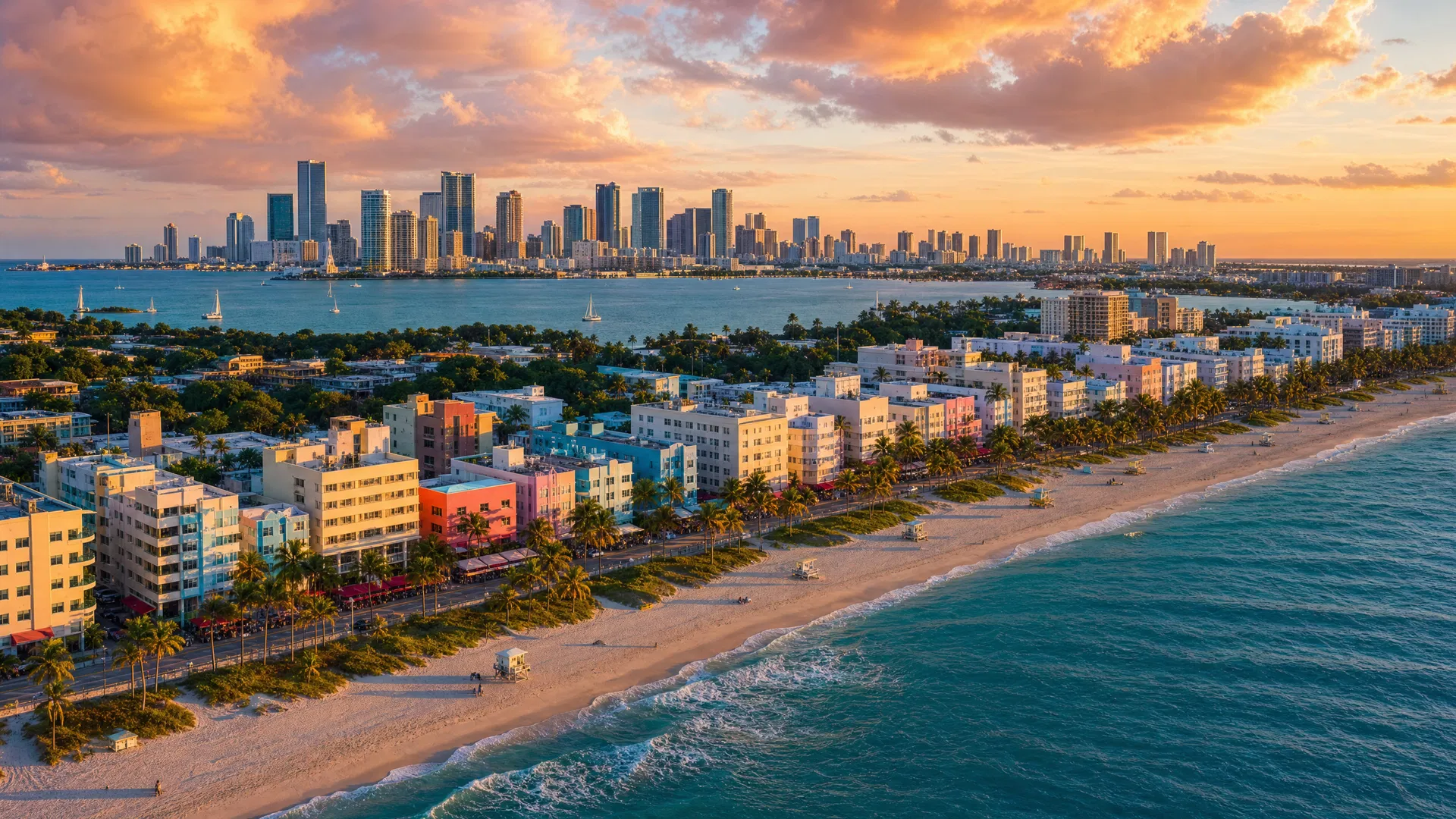
Miami Doesn't Seduce You Slowly. It Hits You All at Once.
Destination: Miami, Florida
Category: Destination Guides
Miami Doesn't Seduce You Slowly. It Hits You All at Once.
You step off the plane and the air is different. Heavier. Warmer. Laced with something you can't quite name — salt, maybe, or the ghost of a thousand perfumes from a thousand different countries. The light is different too. It has weight here. It bounces off the water and the white buildings and the chrome bumpers of cars idling on Ocean Drive, and it makes everything look slightly overexposed, like a photograph taken by someone who couldn't believe what they were seeing.
This is Miami. And it doesn't ease you in.
There is no city in America quite like Miami — and that's not a tourism tagline, it's a geographic and cultural fact. Miami is the only major American city founded by a woman (Julia Tuttle, 1896). It's the only American city where the majority of residents speak a language other than English as their primary tongue. It sits closer to Havana than to Orlando. Its skyline rose from swampland in less than a century. Its art scene is internationally significant. Its food culture is a living, breathing argument for the beauty of immigration. And its beaches — those long, flat, impossibly blue stretches of Atlantic coastline — are among the finest urban beaches on the planet.
But Miami is also misunderstood. Most people arrive with a postcard in their head: South Beach, neon lights, bottle service, the kind of excess that looks better in a music video than in real life. And yes, that Miami exists. But it's one layer of a city that has at least a dozen, stacked on top of each other like the floors of a building where every level is playing different music.
The Miami that locals love is the one that tourists rarely find: the early-morning silence of Brickell before the finance crowd arrives, the smell of café cubano drifting out of a ventanita in Little Havana at 7am, the way Wynwood feels on a Tuesday night when the weekend crowds have gone and the murals are just there, enormous and vivid, for whoever bothers to show up. The Miami that earns its reputation isn't the one you see in the club — it's the one you discover when you stop trying to perform the trip and just let the city happen to you.
This guide is for that Miami. The real one.
The Neighborhoods That Actually Define the City
South Beach: The Icon You Have to Earn
South Beach is unavoidable and, when approached correctly, genuinely magnificent. The mistake most visitors make is treating it as a nightlife destination first and a neighborhood second. Come for the morning instead. The Art Deco Historic District — a 1.5-square-mile stretch of Ocean Drive, Collins Avenue, and Washington Avenue — contains the largest concentration of Art Deco architecture in the world. These buildings, mostly constructed between 1923 and 1943, are painted in the pastel palette that has become synonymous with Miami: seafoam green, coral pink, butter yellow, sky blue. They are extraordinary. Walk them before 9am when the light is low and the streets are empty and you'll understand why architects and photographers make pilgrimages here.
The beach itself is free, wide, and consistently beautiful. The water is warm from May through November. The sand is white and powdery. Locals swim at the northern end near 72nd Street, away from the tourist concentration around 10th-14th Streets. If you want the full South Beach experience without the full South Beach price, this is where you go.
For food on South Beach, skip the Ocean Drive tourist traps entirely. Joe's Stone Crab (11 Washington Avenue) has been serving the same stone crab claws since 1913 and is worth every penny of the wait. Yardbird Southern Table & Bar on Lincoln Road does fried chicken that would make a Nashville pitmaster nervous. And the Lincoln Road Mall, despite its outdoor-mall aesthetics, has some genuinely excellent people-watching and a farmers' market on Sundays that draws the whole neighborhood.
Wynwood: The Art District That Became a Neighborhood
Wynwood was a warehouse district. Then, in the mid-2000s, a developer named Tony Goldman had an idea: commission the world's best street artists to paint the walls. What followed was one of the most remarkable urban transformations in American history. The Wynwood Walls — a curated outdoor gallery of massive murals by artists including Shepard Fairey, Os Gemeos, and KAWS — turned a forgotten industrial zone into one of the most photographed neighborhoods in the world.
But Wynwood has grown beyond its murals. It is now a full-service neighborhood with world-class restaurants, independent boutiques, cocktail bars, coffee shops, and a creative energy that feels genuinely earned rather than manufactured. Kyu, a wood-fired restaurant on NW 2nd Avenue, has been on every serious food publication's Miami list since it opened. Coyo Taco, despite its casual setting, makes tacos that would hold their own in Mexico City. The Margot Natural Wine Bar is the kind of place you walk into for one glass and leave three hours later, having made friends with strangers from four different countries.
The Wynwood Jungle — a free, lush, tropical garden tucked inside the art district — is one of those local secrets that locals are increasingly annoyed to see in travel guides. Go anyway. It's extraordinary.
Little Havana: The Soul of the City
If you want to understand Miami, you have to understand Little Havana. This neighborhood, centered on Calle Ocho (SW 8th Street), is the cultural heart of the Cuban exile community that has shaped Miami's identity since the 1960s. It is not a theme park. It is a living, working neighborhood where people have built entire lives in the shadow of a homeland they were forced to leave.
Walk Calle Ocho on a weekday morning. Stop at Versailles Restaurant (3555 SW 8th Street) — the self-proclaimed "world's most famous Cuban restaurant" — for a café cubano and a pastelito. Sit at the counter. Listen to the conversations happening around you. This is Miami's heartbeat. The coffee is served in tiny cups and is so strong it feels like a medical procedure. The pastelitos are flaky and warm and filled with guava and cream cheese. The conversations are in Spanish and fast and full of laughter.
Continue west to Domino Park (Máximo Gómez Park), where elderly Cuban men have been playing dominoes in the shade since the 1970s. It is one of the most genuinely moving public spaces in America — a place where community and memory and ritual intersect in a way that no Instagram caption can adequately describe.
The Tower Theater on Calle Ocho, a 1926 Art Deco movie house that was one of the first in Miami to show Spanish-language films, now screens independent and international cinema. The Ball & Chain, a legendary jazz and salsa club that opened in 1935 and was once a hangout for Billie Holiday and Chet Baker, has been restored to its original glory and hosts live music nightly.
Brickell: The City That Grew Up
Brickell is Miami's financial district and, increasingly, its most cosmopolitan neighborhood. The skyline here is genuinely impressive — towers of glass and steel rising from Biscayne Bay, connected by the elevated Metromover (free to ride) and anchored by Brickell City Centre, a shopping and dining complex designed by the architects behind the Tate Modern extension in London.
But Brickell's best feature is its waterfront. The Brickell Key island, connected to the mainland by a single bridge, offers a 1.1-mile walking loop around the perimeter with unobstructed views of the bay and downtown skyline. Early morning joggers and dog walkers share the path with finance workers on their phones. It is one of the most pleasant urban walks in the city.
For dinner in Brickell, Zuma (270 Biscayne Blvd Way) is the gold standard — a Japanese izakaya concept that has been drawing Miami's most discerning diners since 2010. The robata grill items are exceptional. The sake list is serious. The views of the Miami River are stunning.
Coconut Grove: The Original Bohemian
Coconut Grove is Miami's oldest neighborhood and its most quietly beautiful. Established in the 1870s by Bahamian settlers and later adopted by artists, writers, and intellectuals, the Grove has a canopy of banyan trees that makes it feel like a different city entirely — cooler, greener, slower. The Vizcaya Museum and Gardens, a 1916 Italian Renaissance villa built by industrialist James Deering, sits on the edge of Biscayne Bay and contains one of the most extraordinary formal gardens in the United States. The Deering Estate, further south, offers kayak tours to Chicken Key and nature walks through one of the last remaining virgin hardwood hammocks in South Florida.
The Grove's main commercial strip, Coconut Grove Village, has independent bookshops, wine bars, and restaurants that feel genuinely local rather than chain-managed. GreenStreet Café has been the neighborhood's living room since 1992 — outdoor tables, strong coffee, and a clientele that ranges from local politicians to visiting artists.
The Food: A Culinary Argument for Open Borders
Miami's food scene is one of the most underrated in America, and the reason is simple: it is the product of genuine immigration rather than culinary tourism. The Cuban, Haitian, Colombian, Venezuelan, Brazilian, Peruvian, and Caribbean communities that have made Miami their home have built food cultures that are authentic, deeply rooted, and constantly evolving.
Cuban food is the foundation. The Cuban sandwich — pressed, layered with roast pork, ham, Swiss cheese, pickles, and mustard — is a Miami institution. The best versions are found not in restaurants but in ventanitas (walk-up windows) in Little Havana and Hialeah. El Mago de las Fritas (5828 SW 8th Street) serves the frita cubana, a Cuban-style burger with crispy potato strings, that is one of the great street foods in America.
Haitian food is Miami's best-kept culinary secret. Griot (fried pork) with pikliz (spicy pickled cabbage) at any of the Haitian restaurants along NE 2nd Avenue in Little Haiti is extraordinary. The flavors are bold, the portions are enormous, and the prices are laughably low.
Peruvian food has exploded in Miami over the past decade. Ceviche, lomo saltado, and tiradito are everywhere, and the quality is consistently high. Cvi.che 105 in downtown Miami has been the benchmark for years.
Venezuelan food — arepas, pabellón criollo, cachapas — is available on virtually every block in Doral, Miami's Venezuelan neighborhood, and increasingly throughout the city.
The food trucks that congregate in Wynwood on weekend nights represent the full spectrum of this culinary diversity. A single evening can take you from Korean BBQ to Haitian griot to Venezuelan arepas to Colombian empanadas without walking more than a hundred yards.
The Beach Beyond South Beach
South Beach gets the attention, but Miami's coastline extends far beyond it, and the further you go, the better it often gets.
Virginia Key Beach is a hidden gem that most visitors never find. Located on Virginia Key, accessible by a short causeway from downtown Miami, it was historically a segregated "colored beach" during the Jim Crow era and is now a beautifully preserved public park with calm waters, nature trails, and a fraction of the crowds of South Beach. The Virginia Key Beach Park Trust has done extraordinary work preserving both the natural environment and the historical significance of the site.
Haulover Beach (north of Bal Harbour) is famous for its clothing-optional section, but the rest of the beach is simply excellent — wide, clean, with consistent waves that make it popular with surfers and bodyboarders. The kite-flying area near the parking lot is a local institution.
Key Biscayne offers the most pristine swimming in the Miami area. Bill Baggs Cape Florida State Park, at the southern tip of the island, has clear, calm water, a 19th-century lighthouse you can climb, and a beach that consistently ranks among the best in Florida. The lighthouse keeper's cottage, destroyed by Seminole warriors in 1836 and rebuilt in 1846, is one of the oldest structures in Miami-Dade County.
Miami After Dark: The Real Story
Miami's nightlife reputation is both accurate and misleading. Yes, the clubs are real, the bottle service is real, the 3am crowds on Ocean Drive are real. But the city's after-dark culture is far richer and more varied than the party narrative suggests.
Jazz and live music: The Ball & Chain in Little Havana hosts live salsa and jazz nightly. The Faena Hotel's Faena Forum hosts some of the most ambitious performance art and live music events in the country. The New World Symphony, housed in a Frank Gehry-designed building on Lincoln Road, is one of the finest orchestras in America and tickets are genuinely affordable.
Cocktail culture: The Bar at the Setai Hotel (2001 Collins Avenue) is one of the most beautiful bars in the world — a 1930s Art Deco building with three pools and a bar that serves cocktails with the seriousness of a fine dining restaurant. The Broken Shaker, a craft cocktail bar in the Freehand Miami hostel, has been named one of the best bars in the world by Tales of the Cocktail.
The late-night food scene: Miami's ventanitas stay open until 2am or later. The best late-night meal in the city is a Cuban sandwich and a café con leche at a 24-hour ventanita in Little Havana. It costs less than $10 and tastes better than anything you'll eat in a club.
The Art Scene: More Than Just Art Basel
Miami's relationship with contemporary art is one of the most significant in the world, and it extends far beyond the annual December spectacle of Art Basel. The Pérez Art Museum Miami (PAMM), a Herzog & de Meuron-designed building cantilevered over Biscayne Bay, houses one of the finest collections of international contemporary art in the United States. The Institute of Contemporary Art Miami (ICA), in the Design District, is free admission and consistently presents some of the most challenging and interesting contemporary exhibitions in the country. The Bass Museum of Art in South Beach has been collecting and exhibiting since 1964 and recently completed a major renovation that has made it one of the most architecturally interesting museum spaces in Florida.
The Design District — a neighborhood just north of Wynwood — is Miami's luxury retail and design hub, but it's also home to some of the city's best public art. The Fly's Eye Dome by Buckminster Fuller sits in a courtyard surrounded by Hermès and Louis Vuitton boutiques. Murals by Retna, Typoe, and other internationally recognized artists cover the walls of buildings that also house Cartier and Dior. It is one of the more surreal juxtapositions in American urban life.
The Rubell Museum, which relocated from Wynwood to a 100,000-square-foot former DEA warehouse in Allapattah in 2019, houses one of the most important private contemporary art collections in the world. The Rubells have been collecting since the 1960s and their holdings include major works by Cindy Sherman, Keith Haring, Jean-Michel Basquiat, and hundreds of other artists. Admission is $20 and the experience is genuinely world-class.
The Everglades: Miami's Wild Backyard
Most visitors to Miami don't realize that one of the most extraordinary wilderness areas in the world is less than an hour from South Beach. Everglades National Park — 1.5 million acres of subtropical wetland, the largest tropical wilderness in the United States — begins where the suburbs end, and the transition is abrupt and astonishing.
The Anhinga Trail at the Royal Palm area is the single best short wildlife walk in Florida. In less than a mile, you will see alligators sunning on the path (literally on the path — step around them), anhingas drying their wings in the trees, herons stalking through the shallows, and turtles stacked on logs in the sun. The density of wildlife is extraordinary. Rangers compare it to an African game park in terms of the probability of wildlife encounters.
For a more immersive experience, an airboat tour through the sawgrass prairies north of the park in the Everglades proper gives you a sense of the scale and strangeness of this landscape. The sawgrass extends to every horizon. The sky is enormous. The silence, when the airboat engine cuts, is profound.
Big Cypress National Preserve, adjacent to the park, offers backcountry camping and canoe trails through cypress swamps that feel genuinely primordial. This is not a day trip for the faint-hearted, but for travelers who want to understand what South Florida looked like before the developers arrived, it is unmissable.
When to Go, How to Get Around, What to Know
Best time to visit: November through April is Miami's golden season — warm (75-85°F), low humidity, minimal rain, and the city is at its most vibrant. December through March brings Art Basel Miami Beach, which transforms the city into the world's most important contemporary art fair and fills every hotel, restaurant, and bar with collectors, artists, and curators from every country on earth. If you want Art Basel without the Art Basel prices, go the week before — the satellite fairs (NADA, Untitled, Scope) are often more interesting than the main event and the crowds are manageable.
Hurricane season runs June through November, with peak risk in August and September. Travel insurance is strongly recommended for summer trips.
Getting around: Miami is a car city, and fighting that fact will make you miserable. Rent a car. Parking is expensive in South Beach but manageable everywhere else. The Metromover (free) connects downtown, Brickell, and Edgewater. The Miami Beach Trolley (free) covers South Beach. Uber and Lyft are reliable and reasonably priced. Cycling is increasingly viable — the city has invested heavily in protected bike lanes, and Citi Bike has stations throughout Miami Beach and downtown.
Money: Miami is expensive, but it doesn't have to be. The city's best food — Cuban ventanitas, Haitian restaurants, Venezuelan arepas — costs almost nothing. The beaches are free. The Wynwood Walls are free. The Metromover is free. A Miami trip on $80/day is entirely possible if you eat local and avoid the tourist-trap restaurants on Ocean Drive.
The Miami That Stays With You
Every city has a version of itself that lives in the memory long after the trip is over. For Miami, it's usually something small and specific: the way the light hits the water at 6pm from the Venetian Causeway, turning Biscayne Bay into hammered gold. The sound of salsa coming out of a car window on Calle Ocho. The smell of gardenias in the Coconut Grove evening air. The feeling of being in a place that is simultaneously American and not American, familiar and completely foreign, excessive and deeply human.
Miami is the only city in America where you can eat a $4 Cuban sandwich at a ventanita, watch a $4,000 bottle of champagne get paraded through a nightclub, and see a Basquiat painting in a world-class museum — all in the same afternoon. That range, that refusal to be only one thing, is what makes it extraordinary.
It hits you all at once. And then it doesn't let go.
Plan Your Miami Trip with Ask Leif
Ready to build your Miami itinerary? We've created in-depth guides for every type of traveler:
Miami Magic: The Ultimate 5-Day Guide for Couples & Solo Travelers — The definitive first-timer's blueprint covering South Beach, Wynwood, Little Havana, Brickell, and beyond.
Miami Food Lover's Guide: 4 Days of Cuban Sandwiches, Ceviche & Latin Flavors — A deep dive into the city's extraordinary culinary landscape, neighborhood by neighborhood.
Miami Family Vacation: 5-Day Kid-Friendly Adventure Guide — Everything from the Miami Seaquarium to the Everglades, designed for families with children of all ages.
Miami Solo Travel Guide: 4 Days of Art, Culture & Nightlife — The solo traveler's companion to Miami's neighborhoods, galleries, and social scene.
Miami on a Budget: 4-Day Itinerary for Free Art Deco, Little Havana & Wynwood Walls — Proof that Miami's best experiences cost almost nothing.
Miami on a Dime: 4-Day Budget Travel Guide Under $80/Day — The complete budget breakdown with accommodation, food, and transport costs.
4-Day Miami to Key West Road Trip: Driving the Atlantic on the Overseas Highway — The iconic Florida Keys road trip, starting from Miami and ending at the southernmost point in the continental United States.
Or let our AI build a completely personalized Miami itinerary based on your travel dates, budget, travel style, and interests. Start planning your Miami trip →
Miami doesn't seduce you slowly. It hits you all at once. And the best thing you can do is stop resisting and let it.