The Most Intentional City in the World Is in Australia
Destination: Melbourne, Australia
Category: destination
The Decision That Made Melbourne
The most important thing to understand about Melbourne is that it has an inferiority complex that it has spent sixty years converting into a competitive advantage. Sydney has the harbor, the Opera House, the Bondi Beach, the weather. Melbourne has the laneways, the coffee, the food, the AFL, and the NGV. Sydney got its identity from geography. Melbourne built its identity from scratch, and the result is a city that takes culture more seriously than almost any other city in the world.
This is not a small thing. Most cities treat culture as a byproduct — something that happens when enough people live in the same place for long enough. Melbourne treats culture as a project. The National Gallery of Victoria is the oldest and most visited art museum in Australia, and it is free. The Melbourne International Film Festival is one of the oldest film festivals in the world. The Melbourne Symphony Orchestra performs in a concert hall, Hamer Hall, that sits on the Southbank of the Yarra River and looks like it was designed to be the most important building in the city — because it was. The Melbourne Writers Festival, the Melbourne Food and Wine Festival, the Melbourne Fashion Festival — the city runs a festival for every form of culture it has decided to take seriously, which is all of them.
What this means for the visitor is that Melbourne rewards engagement in a way that few cities do. You can go to Melbourne and do the tourist things — Hosier Lane, the Queen Victoria Market, the MCG — and have a perfectly good time. Or you can go to Melbourne and actually engage with what the city is doing, and have an experience that is genuinely unlike anything else in the world. The difference is the same as the difference between visiting a museum and looking at the art.
Pellegrini's and the Coffee That Changed Everything
In 1954, two Italian immigrant brothers named Leo and Vildo Pellegrini opened a café on Bourke Street in the Melbourne CBD. They installed an espresso machine — the first in Australia — and began making coffee the way they had made it in Italy. The café is still there. The décor has barely changed. The coffee is still made the same way. And the line outside, on any given morning, still stretches down the block.
Pellegrini's is not the best coffee in Melbourne. It is not even close to the best coffee in Melbourne. But it is the origin point of the best coffee culture in the world, and that is worth understanding. What Pellegrini's started in 1954 became a city-wide obsession that has produced, over the following seventy years, a café culture so sophisticated and so specific that Melbourne baristas are now recruited by coffee shops in New York, London, and Tokyo. The city has a coffee vocabulary that does not exist anywhere else — a "flat white" was invented here, a "magic" (a double ristretto with steamed milk in a small cup) exists almost nowhere else on earth — and the standard of espresso in a random Melbourne café is higher than the standard in the best coffee shops in most other cities.
What this means practically is that you should not order a cappuccino in Melbourne. Not because it is wrong, but because it marks you immediately as someone who does not understand what is happening. Order a flat white, or a long black, or ask the barista what they recommend, and you will get something extraordinary. The coffee culture in Melbourne is not about showing off. It is about craft, and the city takes craft seriously.
The cafés worth knowing: Pellegrini's on Bourke Street, for the history and the experience of being in a room that has not changed in seventy years. Market Lane Coffee, which has multiple locations and is where serious coffee drinkers go. ONA Coffee, which is where competitive baristas go when they want to be challenged. And the unnamed hole-in-the-wall cafés in the CBD laneways — Degraves Street, Centre Place, Hardware Lane — where the coffee is often better than anywhere with a sign.
The Laneways
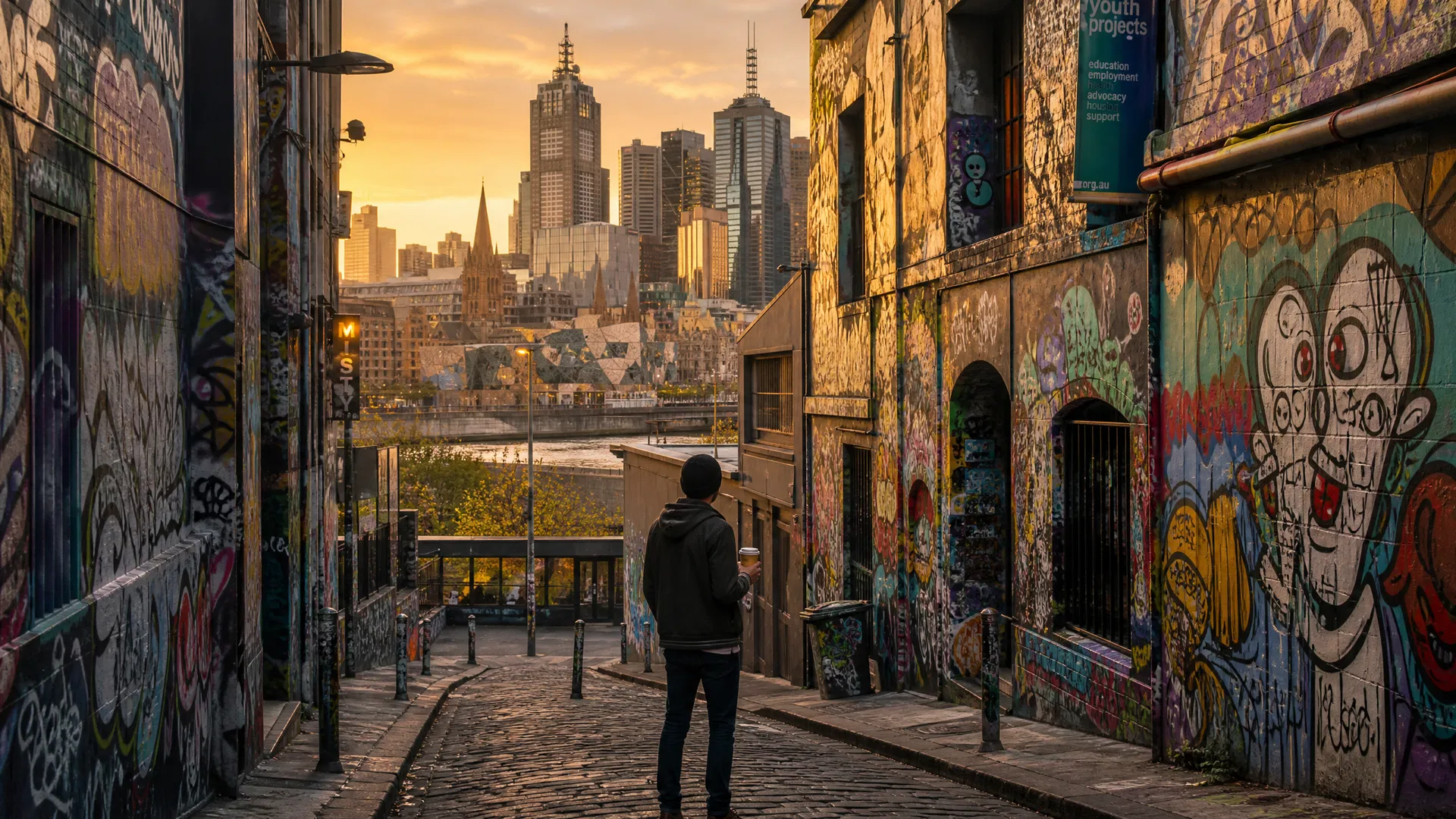
Melbourne's laneways are the physical expression of the city's decision to be interesting. The Victorian-era grid that underlies the CBD was built with a network of service lanes running between the main streets — lanes for deliveries, for garbage collection, for the unglamorous logistics of a nineteenth-century city. When other cities demolished their equivalent laneways to build parking structures, Melbourne kept them. And then, slowly, the cafés moved in. Then the bars. Then the street art. Then the restaurants. Then the boutiques. And the laneways became the thing that Melbourne is most famous for in the world.
Hosier Lane is the one everyone photographs, and it deserves the attention. The cobblestones, the constantly changing murals, the way the light falls on the art in the morning — it is genuinely beautiful. But Hosier Lane is also the most crowded and the most touristy, and the laneways that matter most to Melbourne are the ones that don't have signs pointing to them. Degraves Street, which runs between Flinders Lane and Flinders Street, is where the café culture is most concentrated — narrow, covered, lined with tables and the smell of coffee, it is the laneway that most closely resembles what people imagine when they think of Melbourne. Centre Place is the one that looks like a film set. AC/DC Lane, named after the band that formed in Melbourne, is where the rock and roll history lives.
The rule for navigating the laneways is to have no plan. Walk into any laneway that looks interesting. If there is a door that looks like it leads somewhere, open it. Melbourne's best bars are behind unmarked doors, down staircases, in basements that have no signage. The city built this culture deliberately — the hidden bar, the unmarked café, the restaurant with no menu posted outside — as a way of rewarding curiosity and punishing passivity. If you are the kind of traveler who only goes to places that are easy to find, Melbourne will seem ordinary. If you are the kind of traveler who opens unmarked doors, Melbourne will seem like the best city in the world.
AFL at the MCG: The City's Religion
On a Saturday afternoon in winter, when the Melbourne Football Club is playing at the Melbourne Cricket Ground, the city changes. The trams fill up with people in red and blue scarves. The pubs around the MCG become so crowded that the noise spills out onto the street. The MCG itself — the largest stadium in the Southern Hemisphere, with a capacity of 100,000 — fills up in a way that makes the air feel different, heavier, charged with something that is not quite excitement and not quite religion but is somewhere between the two.
Australian Rules Football is the hardest sport in the world to explain to someone who has never seen it. It is played on an oval field the size of a cricket ground. There are eighteen players on each side. The ball can be kicked, handballed, or carried, but if you carry it more than fifteen meters you have to bounce it. There are no offside rules, no set plays, and the game moves at a speed that makes most other team sports look slow. It is also, in Melbourne, not just a sport. It is the organizing principle of the city's social life, the framework around which friendships and families and neighborhoods are structured, the thing that Melburnians talk about the way people in other cities talk about the weather.
Going to an AFL game at the MCG is one of the best things you can do in any city in the world. Not because of the sport — though the sport is extraordinary once you understand it — but because of the experience of being inside a stadium where 80,000 people are watching something they care about with their entire bodies. The MCG is not just a stadium. It is the place where Melbourne goes to be Melbourne, and attending a game there is the closest thing to understanding the city from the inside that a visitor can achieve.
Practical note: AFL season runs from March to September. Tickets are available through the AFL website and are generally not difficult to get for regular season games. Sit in the outer — the cheaper, uncovered sections — for the most authentic experience. Bring a scarf in the team's colors if you want to be adopted immediately.
The Food: Queen Victoria Market and Beyond
The Queen Victoria Market has been operating on the corner of Victoria and Elizabeth Streets since 1878. It is the largest open-air market in the Southern Hemisphere, and on a Tuesday or Thursday morning — the fresh produce days — it is one of the great sensory experiences of any city in the world. The stalls run in long covered sheds: fruit and vegetables in colors that seem too vivid to be real, fish laid out on ice, butchers who have been in the same spot for three generations, cheese vendors who will let you taste everything before you buy anything.
The Queen Vic, as locals call it, is worth visiting for the experience rather than the shopping, unless you have a kitchen. What is worth buying: the coffee from the café at the south end of the market, the pastries from the European deli section, and the produce if you are staying somewhere with cooking facilities. What is not worth buying: the souvenir section, which is indistinguishable from souvenir sections in every other market in every other city in the world.
For eating rather than shopping, the neighborhoods that matter are Fitzroy and Collingwood, which sit north of the CBD on either side of Smith Street. Fitzroy is where the artists and the writers and the people who have been in Melbourne long enough to know where to eat actually go. Brunswick Street is the main drag, but the restaurants worth finding are on the side streets and in the converted warehouses behind them. Collingwood's Smith Street has become one of the best eating streets in Australia — Jim's Greek Tavern has been there since the 1970s and is still the best Greek food in the city, and the Smith Street Alimentari is the kind of Italian café that makes you want to move to Melbourne permanently.
The Vietnamese food in the northern suburbs — Richmond, Footscray, Springvale — is among the best outside Vietnam. This is not a small claim. Melbourne's Vietnamese community arrived in the 1970s and 1980s and built a food culture that has been refining itself for forty years. The pho in Footscray is better than the pho in most cities in Southeast Asia. This is worth going out of your way for.
The NGV and the Arts
The National Gallery of Victoria, on St Kilda Road, is the oldest and most visited art museum in Australia. It is also free. The permanent collection includes works by Rembrandt, Monet, Picasso, and Warhol, alongside an extraordinary collection of Australian and Aboriginal art that is among the best in the world. The building itself — a 1968 brutalist structure with a water wall at the entrance that you walk through to get inside — is one of the great pieces of architecture in Australia.
The NGV runs major international exhibitions throughout the year, and the queues for these exhibitions are long in a way that tells you something about how seriously Melbourne takes art. The city does not treat the NGV as a tourist attraction. It treats it as a public resource, the way a city treats its parks or its libraries, and the result is a museum that feels genuinely alive rather than merely prestigious.
Beyond the NGV: the Australian Centre for Contemporary Art (ACCA), which is in a building that looks like a rusted steel sculpture and shows work that is genuinely challenging; the Ian Potter Centre, which is the NGV's Australian art annex in Federation Square and is also free; and the Melbourne Museum, which has the best natural history collection in Australia and a permanent exhibition on Melbourne's cultural history that is worth three hours of anyone's time.
When to Go and How to Move
Melbourne's weather is the most honest thing about the city. Locals will tell you it has four seasons in one day, and they are not exaggerating. A morning that begins with clear skies and 22 degrees can end with a southerly wind, rain, and 12 degrees. The city is located at the bottom of the Australian mainland, where cold fronts from the Southern Ocean arrive without warning, and the result is a climate that is genuinely unpredictable. The correct response is to dress in layers and carry a light jacket at all times, regardless of what the morning looks like.
The best time to visit is March through May (autumn) or September through November (spring). The weather is mild, the AFL season is either finishing or starting, and the city is operating at full capacity without the summer heat that can push temperatures above 40 degrees. December through February is hot and can be extreme — the city has recorded temperatures above 46 degrees — but it is also when the Australian Open tennis is played, which is one of the great sporting events in the world and worth planning a trip around.
Getting around Melbourne is straightforward. The tram network is the most extensive in the world, and the CBD tram zone is free — you can ride any tram within the city center without paying. For trips beyond the CBD, load a Myki card (available at 7-Elevens and train stations) and tap on and off. The trams are slow but they are the correct way to move through Melbourne, because the city was built around them and the experience of riding a tram through the CBD is part of understanding the city.
Planning Your Melbourne Trip
Three days is the minimum to understand Melbourne. Four or five is better. Here is how to build it.
Start in the CBD and work outward. Day one belongs to the laneways, the coffee, and the Yarra River precinct — Federation Square, Birrarung Marr (the park along the river, named from the Wurundjeri word for "river of mists"), and the NGV. Walk everywhere. Open every unmarked door. Drink more coffee than you think is reasonable. Day two belongs to Fitzroy and Collingwood — take the tram north on Smith Street, walk Brunswick Street, eat at Jim's Greek Tavern for lunch, and spend the afternoon in the side streets and vintage shops that make this part of Melbourne feel like a city that has been lived in rather than designed. Day three: the Queen Victoria Market in the morning, the MCG in the afternoon if there is a game, and the Southbank restaurant strip in the evening.
If you have a fourth day, go to St Kilda — the beach suburb twenty minutes south of the CBD by tram, with a famous pier, the Esplanade Hotel (a live music venue that has been running since 1878), and a café culture that is slightly more relaxed than the CBD. If you have a fifth day, take the train to the Yarra Valley, which is an hour east of the city and produces some of the best Pinot Noir in the world.
AskLeif's Melbourne guides can help you build this out in full detail. The Melbourne food and culture guide covers the Queen Vic Market, the restaurant neighborhoods, and the café culture across four days. The Melbourne solo traveler guide covers the laneways, the day trips, and the city's social infrastructure across five days. The Melbourne couples guide covers the cultural and coastal experience across five days. And the Melbourne budget guide covers the city's extraordinary free and low-cost offerings — the NGV, the tram network, the markets, the parks — across four days.
The Honest Version
Melbourne is not for everyone. It is a city that rewards patience and curiosity and a willingness to walk down laneways that don't look like they lead anywhere. It is a city where the best things are often the least obvious — the unmarked bar, the café with no sign, the AFL game that looks like chaos for the first twenty minutes and then suddenly makes complete sense. It is also a city with a weather system that will test your commitment to outdoor activities and a public transport network that is excellent but requires a Myki card and a basic understanding of how trams work.
What Melbourne offers in return for this investment is the experience of being in a city that has decided what it wants to be and has spent sixty years becoming it. The coffee is not an accident. The laneways are not an accident. The AFL obsession, the food scene, the NGV, the street art — none of it is an accident. Melbourne is the most intentional city in the world, and the result of all that intention is a place that feels, when you are inside it and paying attention, like the city is doing something that no other city is doing.
Nobody talks about Melbourne the way they talk about Paris or Tokyo or New York. They should. It is one of the great cities of the world, and it got there the hard way — by deciding to.