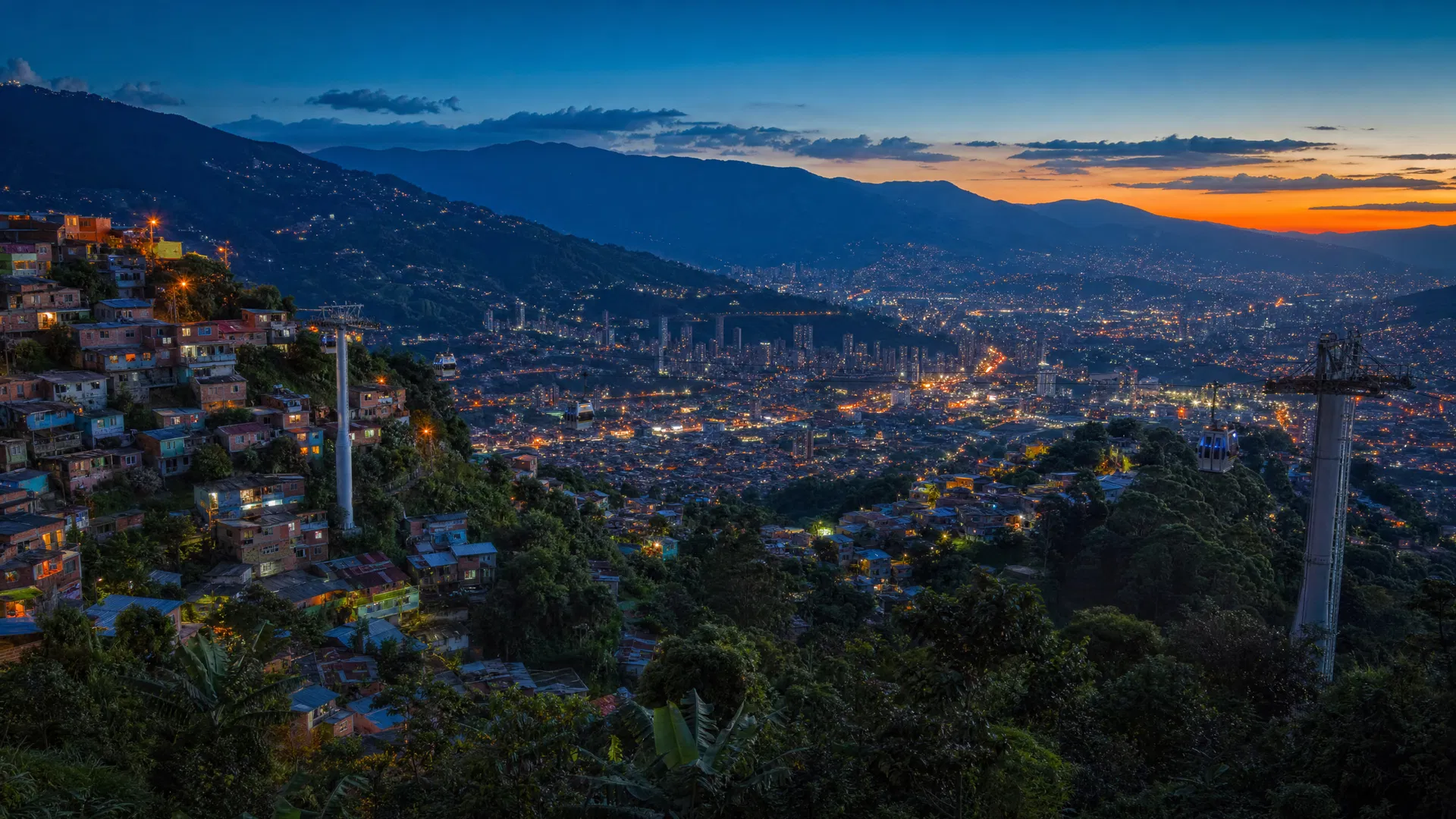
Medellín Was the Most Dangerous City on Earth. Now It Might Be the Most Inspiring.
Destination: Medellín, Colombia
Category: Destination Guides
Medellín Was the Most Dangerous City on Earth. Now It Might Be the Most Inspiring.
There is a story that Medellín tells about itself, and it is one of the most remarkable urban narratives of the 21st century. In 1991, this city in the mountains of Colombia recorded 6,349 homicides — a rate of 381 per 100,000 people, the highest of any city in the world. The name Medellín was synonymous, globally, with one man and one industry: Pablo Escobar and cocaine. The city was a war zone. Its hillside comunas were controlled by cartels and paramilitaries. Its wealthiest residents were leaving. Its future was, by any reasonable assessment, catastrophic.
Today, Medellín has a homicide rate lower than many American cities. It has a cable car system that connects its poorest hillside neighborhoods to the city center. It has outdoor escalators — the only ones in the world built for urban mobility rather than shopping malls — that climb the steep slopes of the comunas where the violence was worst. It has a library park designed by a world-class architect in a neighborhood that was once a no-go zone. It has a metro system that is the cleanest and most efficient in Latin America. It has a food scene that has made it one of the most talked-about culinary destinations in South America. It has a flower festival that fills the city with color and music for ten days every August. It has a spring that never ends — the city sits at 1,495 meters above sea level, and its climate is so consistently perfect that the locals call it the City of Eternal Spring.
It has, in short, transformed itself so completely and so deliberately that urban planners, architects, and city officials from around the world come here not to see what Medellín was, but to understand what it became — and to ask how.
The answer is complicated and contested and ongoing. But the result is undeniable: Medellín is one of the most interesting cities in the Americas, and it is waiting for you to arrive with an open mind and a willingness to be astonished.
Understanding the Transformation: Why It Matters
Before you walk the streets of Medellín, it is worth spending a few minutes understanding what those streets have been through — not because the city wants you to dwell on its past, but because the transformation is the context for everything you will see.
The violence of the 1980s and early 1990s was not random. It was the product of a specific set of conditions: extreme inequality, a geography that divided the wealthy valley floor from the poor hillside comunas, a state that had lost control of significant portions of its own territory, and the catastrophic economic logic of the cocaine trade, which made violence a rational business strategy. When Escobar was killed in 1993, the violence did not end immediately — the cartels fragmented into smaller, more numerous groups, and the killing continued through the 1990s.
What changed was a combination of factors that urban scholars are still debating: a peace process that demobilized some of the paramilitary groups, a sustained investment in the comunas that had been most neglected, a series of architectural and infrastructure interventions that physically connected the hillside neighborhoods to the rest of the city, and — perhaps most importantly — a shift in civic culture that began to take pride in the city rather than shame.
The Metrocable — the aerial gondola system that connects the comunas of the northeastern hillsides to the metro network below — was opened in 2004 and is the most visible symbol of this transformation. It was not built primarily as a tourist attraction. It was built because the residents of the comunas, who had been effectively cut off from the economic life of the city by the steep terrain and the violence, needed a way to get to work. The cable car reduced a journey that had taken 90 minutes on foot to 10 minutes in the air, and it changed the economic calculus of an entire neighborhood overnight.
The outdoor escalators in the Comuna 13 neighborhood — six sections of escalator covering 384 meters of vertical distance — were completed in 2011 and have become one of the most photographed urban interventions in the world. They were built in a neighborhood that had been the site of some of the worst violence of the paramilitary era, and their construction was accompanied by a program of community investment, arts programming, and social services that has transformed the neighborhood from a place of fear into a place of pride. The murals that cover the walls of the escalator corridor — painted by local artists, telling the story of the neighborhood's history and transformation — are among the most powerful pieces of public art in Latin America.
El Poblado: Where the World Comes to Stay
Most visitors to Medellín arrive in El Poblado, the upscale neighborhood in the southeastern corner of the city that has become the center of the expat and tourist scene. It is easy to understand why: the streets are lined with restaurants, bars, coffee shops, and boutique hotels; the nightlife is concentrated and accessible; the safety is reliable; and the general atmosphere is that of a city that has figured out how to be cosmopolitan without losing its Colombian identity.
Parque Lleras is the heart of El Poblado's social life — a small park surrounded by restaurants and bars that fills up in the evenings with a crowd that is genuinely international. The streets radiating from the park are where you find the best restaurants in the neighborhood: Carmen for modern Colombian cuisine at its most refined, Alambique for traditional Antioquian cooking elevated to something extraordinary, Mondongo's for the bandeja paisa that is the defining dish of the region — a plate of beans, rice, ground beef, chicharrón, fried egg, plantain, and arepa that is essentially the entire food culture of Antioquia on a single plate.
But El Poblado is also where you can fall into the trap of staying in the tourist bubble — spending a week in Medellín and never really leaving the neighborhood, never taking the metro, never going to the comunas, never eating in a local restaurant where the menu is in Spanish only and the price of a meal is what it costs for Colombians rather than what it costs for visitors. El Poblado is a fine base. It is not the whole story.
The Metro: The City's Spine and Its Soul
The Medellín Metro is not just a transportation system. It is, for the people of Medellín, a symbol of what the city has become — clean, efficient, safe, and a source of genuine civic pride. The metro opened in 1995, in the middle of the violence, and its maintenance and cleanliness became a point of honor for the city: a statement that Medellín was capable of building and sustaining something good.
Riding the metro from El Poblado to the city center and then connecting to the Metrocable up to the comunas is one of the essential experiences of Medellín — not because it is scenic (though the cable car section is extraordinary), but because it is the physical experience of the city's transformation. You move from the wealthy south to the historic center to the hillside neighborhoods that were once the most dangerous places in the city, and the transition is smooth and unremarkable and entirely the point.
The Metrocable Line K rises from the Acevedo station in the north of the city through three stations — Andalucía, Popular, and Santo Domingo Savio — to the Parque Arví, a 1,600-hectare nature reserve in the mountains above the city. The views from the cable car are extraordinary — the city below, the mountains above, the density of the comunas visible in a way that makes their scale and their complexity comprehensible in a way that no map can convey.
Santo Domingo Savio, the neighborhood at the upper end of Line K, is where the España Library was built in 2007 — a striking building designed by architect Giancarlo Mazzanti that sits on a promontory above the neighborhood like a dark rock formation, housing a library, a community center, and a public space that has become one of the most visited sites in the city. The library was damaged by a landslide in 2013 and has been closed for renovation, but the neighborhood around it — the murals, the community gardens, the views, the people — is worth the cable car ride regardless.
Comuna 13: The Neighborhood That Became a Symbol
Comuna 13 is the neighborhood that most visitors to Medellín want to see, and it is worth understanding why before you go.
In 2002, the Colombian military conducted Operación Orión — a military assault on the neighborhood that was controlled by a combination of guerrilla groups and paramilitaries. The operation was controversial, involving allegations of human rights abuses, and the neighborhood remained dangerous for years afterward. It was, by any measure, one of the most violent places in one of the most violent cities in the world.
Today, Comuna 13 is a neighborhood of murals and escalators and community gardens and street art tours and coffee shops and a hip-hop scene that has become internationally recognized. The transformation is real and it is remarkable, and it is also complicated — the gentrification that has followed the investment has displaced some of the original residents, and the question of who benefits from the neighborhood's new fame is one that the community is still working through.
The outdoor escalators are the starting point for any visit. The six sections of escalator climb 384 meters of vertical distance through the heart of the neighborhood, and the corridor they create is lined with murals that tell the story of the community — its history, its violence, its resilience, its transformation. The artists who painted them are local, and many of them are still in the neighborhood, still painting, still telling the story.
The hip-hop scene of Comuna 13 is not a tourist attraction — it is a genuine cultural movement that emerged from the neighborhood's experience of violence and transformation. Groups like Crew Peligrosos and Kolacho's Legacy have been using hip-hop as a tool for community building and conflict resolution for decades, and the music that comes out of the neighborhood has an authenticity and an urgency that is immediately apparent. The Casa Kolacho community arts center is the hub of this scene, and visiting it — or attending one of the regular performances in the neighborhood — is one of the most genuinely moving experiences Medellín offers.
The best way to experience Comuna 13 is with a local guide from the neighborhood — someone who can provide context, who knows the history, who can introduce you to the people who live there rather than just the murals they live next to. There are several community-run tour operations that do exactly this, and the difference between a community-run tour and a generic tourist tour is the difference between understanding a place and photographing it.
Guatapé: The Rock That Demands to Be Climbed
An hour and a half east of Medellín, through a landscape of green hills and reservoirs and small towns, is Guatapé — a town built around a reservoir and dominated by a 200-meter monolith of granite called La Piedra del Peñol (or simply El Peñón) that rises from the surrounding landscape with the abruptness of something that has no business being there.
The rock is climbable via a staircase of 740 steps that winds up a crack in the granite face. The climb takes about 20 minutes and is entirely worth it: the view from the top — the reservoir below, the islands scattered across it, the green hills extending to the horizon in every direction, Medellín visible in the distance on a clear day — is one of the great views in Colombia.
The town of Guatapé itself is worth the trip independently of the rock. The streets are lined with colorful buildings decorated with zócalos — three-dimensional bas-relief panels that cover the lower sections of the facades in patterns that represent the history and culture of the town. The main square, the waterfront, the restaurants serving fresh trout from the reservoir — Guatapé is the kind of small Colombian town that makes you want to stay longer than you planned.
The Food: Bandeja Paisa and Beyond
Antioquian cuisine — the food of the region of which Medellín is the capital — is one of the most distinctive regional food cultures in Colombia, and it is built on a set of ingredients and techniques that have been refined over centuries: beans, rice, plantain, arepa, pork, beef, and the particular combination of flavors that comes from cooking with hogao (a sauce of tomatoes and scallions) and cumin and achiote.
The bandeja paisa is the defining dish — a plate so large and so complete that it functions less as a meal than as a statement of cultural identity. The combination of red beans cooked with pork belly, white rice, ground beef, chicharrón (fried pork rind), a fried egg, a slice of avocado, sweet plantain, and a corn arepa is simultaneously simple and extraordinary, and eating it at a good local restaurant — not a tourist restaurant, but the kind of place where the tables are plastic and the portions are enormous and the price is what it costs to feed a Colombian worker — is one of the essential Medellín experiences.
Beyond the bandeja, the city has developed a food scene that reflects its broader transformation: sophisticated, internationally aware, and deeply rooted in local ingredients. The Mercado del Río — a food market in the Laureles neighborhood that brings together dozens of food stalls under one roof — is the best single expression of where Medellín's food culture has arrived: street food elevated, local ingredients celebrated, the full diversity of Colombian cuisine represented in a space that is simultaneously a market and a social gathering place.
The coffee deserves its own paragraph. Colombia is one of the world's great coffee-producing countries, and Antioquia is one of its great coffee-producing regions. The coffee in Medellín — particularly in the specialty coffee shops that have proliferated in El Poblado and Laureles over the past decade — is extraordinary: complex, clean, and served by baristas who understand the relationship between altitude, variety, processing method, and cup quality with the same seriousness that a sommelier brings to wine. Pergamino in El Poblado is the institution, but the neighborhood around it has developed a density of excellent coffee shops that makes it worth an entire morning of caffeinated exploration.
The Flower Festival: Ten Days in August
Every August, Medellín hosts the Feria de las Flores — the Flower Festival — a ten-day celebration that is one of the most spectacular festivals in South America and one of the least known outside Colombia. The centerpiece is the Desfile de Silleteros — the Parade of Flower Carriers — in which hundreds of campesinos from the flower-growing villages of the surrounding mountains descend into the city carrying elaborate floral arrangements called silletas on their backs. The silletas range from simple bouquets to elaborate architectural constructions of flowers that weigh up to 80 kilograms and represent months of preparation.
The parade is not a tourist spectacle — it is a genuine cultural tradition that has been running since 1957, rooted in the history of the flower trade that has been central to the economy of the Antioquia region for generations. The silleteros are not performers — they are farmers, and the pride they take in their silletas is the pride of craftspeople who have spent months creating something beautiful.
The festival also includes concerts, exhibitions, horse parades, and the general transformation of the city into a place of flowers and music that is, by any measure, one of the great urban festivals in the Americas.
Your Ask Leif Medellín Guides
Medellín rewards the traveler who arrives with curiosity and leaves the tourist bubble behind. The Ask Leif team has built a comprehensive set of guides for every kind of Medellín trip:
The Medellin Family Adventure: 4-Day Itinerary with Metrocable, Guatape & Parks is for families who want to experience the city's transformation through the eyes of its most remarkable infrastructure — the cable cars, the escalators, the parks — alongside the natural beauty of Guatapé and the surrounding mountains.
For those who want to eat their way through the city, the Medellín Food & Culture: A 4-Day Culinary Journey Through Antioquia's Flavors and the Medellín Food Tour: 3-Day Culinary Journey for Foodies offer two takes on a food scene that is far more sophisticated and far more interesting than most visitors expect.
For couples, the Medellín for Couples: A Romantic 4-Day Itinerary in the City of Eternal Spring finds the romance in a city that offers it in the most unexpected ways — in the views from the cable car at dusk, in the flower-filled streets of El Poblado, in the shared experience of understanding a city that has survived something extraordinary and emerged, improbably, as one of the most beautiful places in South America.
The Medellín on a Budget: 4-Day Itinerary for $25/Day demonstrates that Medellín remains one of the most affordable major cities in the Americas — a place where the best experiences (the metro, the cable car, the comunas, the food markets) cost almost nothing and the quality of life available on a modest budget is extraordinary.
And the Medellín's Remarkable Comeback: 4-Day Urban Transformation & Culture Guide is the guide that takes the city's transformation as its central theme — a four-day journey through the neighborhoods, the infrastructure, and the cultural institutions that have made Medellín one of the most studied and most admired urban transformations in the world.
Before You Go: What Nobody Tells You
The altitude is real. Medellín sits at 1,495 meters above sea level, and while this is not high enough to cause altitude sickness, it does affect the climate in ways that make the city genuinely comfortable year-round. The temperature rarely exceeds 28°C or drops below 16°C. Pack layers for the evenings.
The safety situation has transformed, but context matters. Medellín is genuinely safe for tourists in the neighborhoods where tourists go — El Poblado, Laureles, the city center, the comunas with established tour operations. The same common-sense precautions that apply in any major city apply here. The narrative of Medellín as a dangerous city is decades out of date, but it is worth being informed rather than naive.
Learn some Spanish. Outside El Poblado, English is not widely spoken, and the effort of attempting Spanish — however imperfect — is noticed and appreciated. The people of Medellín are among the warmest and most welcoming in Colombia, and a few words of Spanish opens doors that would otherwise remain closed.
Go to the comunas. The single biggest mistake visitors make in Medellín is staying in El Poblado and treating the comunas as a day trip rather than as the heart of the city. The transformation that makes Medellín remarkable happened in the comunas, not in the upscale neighborhoods. Go there, go with a local guide, and go with the understanding that you are visiting a community, not a museum.
The coffee is not optional. Colombia produces some of the finest coffee in the world, and Medellín is one of the best places to drink it. The specialty coffee scene in the city is world-class, and the difference between a cup of Colombian coffee drunk in Colombia and a cup drunk anywhere else is the difference between a photograph and the thing itself.
The City That Refused to Stay Broken
There is a word in Spanish — resiliencia — that means resilience, but carries a weight in Medellín that the English translation doesn't quite capture. It is not just the ability to recover from adversity. It is the active, deliberate, collective decision to build something better from the wreckage of something terrible. It is the cable car that rises above the comunas where the killing happened. It is the escalator that climbs the hillside where the paramilitaries held court. It is the mural that covers the wall where a bullet hole used to be. It is the library in the neighborhood that the city forgot, and the coffee shop in the building that used to be a safe house, and the flower festival that fills the streets with color every August as if to say: we are still here, and we are still beautiful.
Medellín did not become the most inspiring city in the Americas by accident. It became it through a combination of political will, community organizing, architectural ambition, and the particular stubbornness of a people who decided that their city was worth saving.
Go to Medellín. Go with your eyes open and your assumptions suspended. Go ready to be surprised by a city that has earned the right to surprise you.
Ready to start planning? Create your personalized Medellín itinerary with Ask Leif — built by travelers, for travelers.