Maui Has Six Personalities. Most Visitors Only Meet One.
Destination: Maui, Hawaii, USA
Category: Travel Guides
The Island That Is Actually Six Islands
Maui is formed by two volcanoes. The older one, Mauna Kahalawai, makes up the western quarter of the island — the West Maui Mountains, ancient and deeply eroded, their peaks almost always wrapped in cloud. The younger one, Haleakalā, dominates the eastern two-thirds — a dormant shield volcano that last erupted around 1600 and still defines everything: the weather, the soil, the altitude, the silence at the summit.
Between them, a low isthmus — Central Maui, where the airport is, where the working town of Kahului sits, where most visitors pass through without stopping. And radiating outward from these two volcanic anchors: six distinct regions, each one a different version of what an island can be.
West Maui is the resort coast most people picture — Ka'anapali, Napili, Kapalua, and the town of Lāhainā, which is still rebuilding after the catastrophic August 2023 wildfire that destroyed much of its historic waterfront. The Hawaii Tourism Authority's guidance since the fire has been direct: "Respect the west, visit the rest." The rest of West Maui — its beaches, its snorkeling, its whale-watching waters — is open and needs visitors. Lāhainā itself is a community in recovery, not a tourist destination right now.
South Maui is the other resort coast — Kīhei, Wailea, Mākena — drier and sunnier than almost anywhere else on the island, with the best consistently swimmable beaches and the departure point for Molokini snorkel tours. This is where most visitors stay, and it's genuinely beautiful. It's also, by itself, about twenty percent of what Maui is.
The other eighty percent is where this post lives.
Upcountry: The Maui Nobody Booked
Drive east from Kahului on the Haleakalā Highway and the island starts doing something unexpected. The temperature drops. The vegetation changes — first dry scrub, then pasture, then eucalyptus, then something that looks almost like the Scottish Highlands if the Scottish Highlands had a view of the Pacific. By the time you reach Makawao, at roughly 1,500 feet, you're in a different world entirely.
Makawao is a paniolo town — Hawaiian cowboy country, a legacy of the ranching culture that King Kamehameha III established in the 1800s when he brought Mexican vaqueros to Maui to teach Hawaiians to manage cattle on Haleakalā's slopes. The rodeo tradition is still alive here; the Makawao Rodeo, held every Fourth of July, is one of the oldest in Hawaii. The main street has art galleries, boutiques, and a handful of restaurants, but the reason to come to Makawao is not the shopping. It's the bakery.
T. Komoda Store and Bakery, at 3674 Baldwin Avenue, has been open since 1916. Calvin and Betty Shibuya — Betty's maiden name was Komoda — are the owner-operators, and they will tell you, with evident pride, that Komoda is the last surviving mom-and-pop shop in Makawao. The store sells approximately 400 cream puffs a day and about 200 malasadas. The line starts before the doors open at 7am. The cream puffs sell out. The stick donuts sell out. If you arrive at 10am thinking you'll grab something on the way to Haleakalā, you will find empty trays and a polite shrug. Two things to know: the bakery is closed on Wednesdays and Sundays. Plan accordingly.
Beyond Makawao, the road continues up through Kula — where the air is cool enough for protea farms and the lavender fields of Ali'i Kula Lavender — and eventually to Ulupalakua, where the MauiWine winery sits on a historic ranch at 2,000 feet, producing pineapple wine and red blends from grapes grown on volcanic soil. The tasting room is open daily, the views are extraordinary, and almost no one from the resort coast makes it here.
Upcountry is not a day trip. It's a different island. The people who live here — farmers, ranchers, artists, the families who have been here for generations — have a relationship with Maui that has nothing to do with the beach. Spending a morning in Makawao and an afternoon in Kula recalibrates your understanding of what the island actually is.
The North Shore: Where the Island's Soul Lives
Pā'ia is twelve minutes from Kahului Airport and feels like it's from a different century. The town is small — one main street, a handful of cross streets, storefronts painted in faded colors — and it has the particular energy of a place that has been discovered and decided not to care. Surfers, windsurfers, yogis, farmers, and the occasional celebrity who bought land on the North Shore all coexist in Pā'ia with a studied indifference to impressing anyone.
The reason Pā'ia matters, beyond its own considerable charm, is that it's the last real town before the Road to Hana begins. And the way you prepare for the Road to Hana in Pā'ia determines the quality of the entire experience.
Stop at Mana Foods, at 49 Baldwin Avenue, before you leave. It's a local grocery and deli that has been feeding the North Shore since 1983 — organic produce, a hot deli counter, fresh sandwiches, the kind of food that actually sustains you on a long drive rather than the gas station snacks most Road to Hana guides suggest. The people in line at Mana Foods at 7:30am are the people who live here. That's the version of the Road to Hana preparation that doesn't appear in the travel blogs.
A mile east of Pā'ia, Ho'okipa Beach Park is the world capital of windsurfing. Not metaphorically — literally. The combination of consistent trade winds and powerful north swells that hit this stretch of coast has made it the proving ground for professional windsurfers since the 1980s, and the international competitions held here draw the best in the world. You cannot swim at Ho'okipa on most days; the conditions that make it perfect for windsurfing make it dangerous for everyone else. But watching from the bluff above the beach — the sails carving through the air, the riders launching off waves — is one of the most specific, unrepeatable experiences on the island.
The North Shore also marks the beginning of East Maui, where the landscape becomes something else entirely.
Haleakalā: The House of the Sun
The name means "House of the Sun" in Hawaiian. The legend says that the demigod Māui — the island's namesake — climbed to the summit and lassoed the sun as it rose, slowing its journey across the sky so his mother would have enough daylight to dry her tapa cloth. The sun agreed to move more slowly. The mountain kept its name.
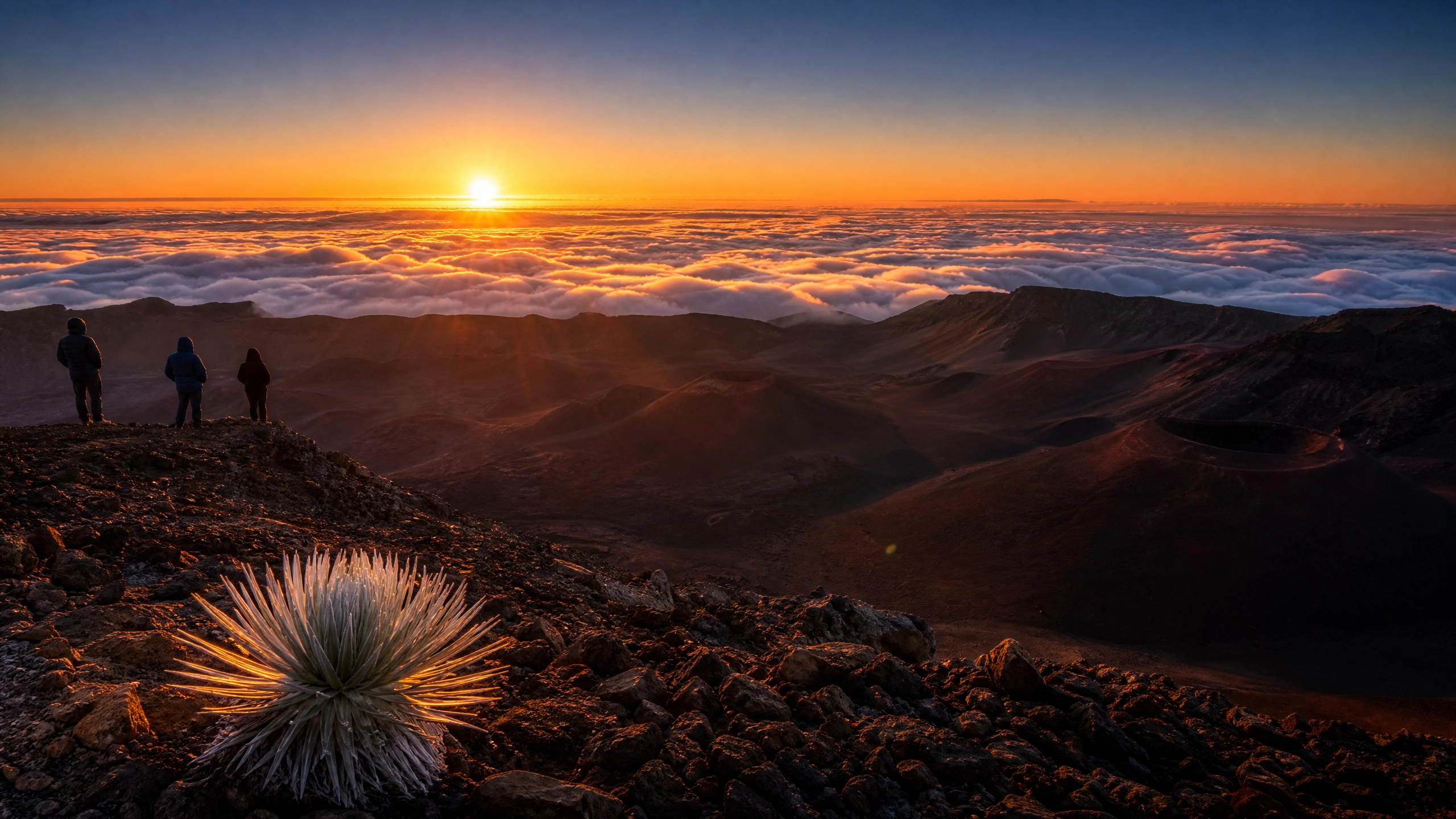
What the legend captures, and what no photograph fully conveys, is the quality of the light at the summit of Haleakalā. At 10,023 feet, you are above the clouds. The sunrise — if you've reserved a spot (required, and the reservation system opens 60 days in advance) — happens below you and around you simultaneously. The clouds glow from beneath. The crater, 7 miles wide and 2,600 feet deep, fills with color. The silversword plants — found nowhere else on Earth — catch the first light on their silver-gray leaves.
It is cold. This is the detail that surprises everyone who doesn't prepare. The summit temperature at sunrise is typically between 30°F and 50°F (-1°C to 10°C), while the beach you left an hour ago is 85°F. You need a beanie, gloves, a proper jacket, base layers. The people who arrive in flip-flops and a t-shirt — and there are always some — spend the sunrise shivering rather than watching. The cold is part of the experience. It makes the sunrise feel earned.
The drive up takes about 90 minutes from the coast, which means leaving by 3am for a sunrise arrival. This is not a casual excursion. It is a commitment, and it pays off in a way that very few travel experiences do. The Haleakalā sunrise is one of the few things in travel that lives up to its reputation — not because it's beautiful (it is), but because it's disorienting in a way that recalibrates something. You stand above the clouds on a dormant volcano in the middle of the Pacific and watch the sun rise over a crater that looks like Mars, and for a moment the ordinary scale of things dissolves.
The Haleakalā National Park guide maps the full experience — sunrise logistics, the crater hike, the Kīpahulu district on the eastern coast — for anyone who wants to go deeper than a single morning.
The Road to Hana: A Journey, Not a Drive
Every travel guide about Maui mentions the Road to Hana. Most of them describe it as a scenic drive with waterfalls and banana bread. This is accurate the way saying the Pacific Ocean is a large body of water is accurate — technically true and completely insufficient.
The Hana Highway is 64 miles of road with 620 curves and 59 bridges, most of them one lane. It takes three to four hours to drive without stopping, which is not how you drive it. You stop at Twin Falls, where a short trail leads to a swimming hole under a waterfall. You stop at the Garden of Eden Arboretum, where the road curves through tropical forest. You stop at Wai'anapanapa State Park — the black sand beach, the sea caves, the coastal trail along lava cliffs — which requires an advance reservation ($5 per vehicle, book weeks ahead). You stop in Hana town itself, which is small and quiet and has a gas station that charges accordingly.
The banana bread stands are real. The best-known is at the Aunty Sandy's stand near mile marker 17, where the bread comes out of the oven warm and the line moves fast. But the food stop that matters most is the one you make in Pā'ia before you leave — at Mana Foods, with a cooler in the car, because the Road to Hana is not a day trip with restaurant stops. It's a journey with a picnic.
Most visitors drive the Road to Hana and turn around at Hana town, missing the back road entirely. The Piilani Highway — the road that continues past Hana, around the southern coast of East Maui, through Ulupalakua and back to Kīhei — is rougher (some sections require a 4WD or high-clearance vehicle, and some rental car companies prohibit it), less traveled, and passes through a completely different landscape: lava fields, cattle ranches, the Kaupo Gap, the southern flank of Haleakalā. It adds two to three hours to the drive. It is worth it.
The Road to Hana guide sequences the full two-day experience — including where to stay in Hana and how to do the back road properly.
The Coast: South and West Maui Done Right
None of this is an argument against the coast. The coast is extraordinary. The argument is against treating the coast as the entirety of the island.
South Maui's beaches — Wailea Beach, Polo Beach, Mākena Beach (Big Beach) — are among the finest in the Pacific. The water is warm, clear, and consistently calm on the south-facing shores. Molokini Crater, a partially submerged volcanic caldera three miles offshore, offers snorkeling in visibility that can exceed 150 feet. The boats leave from Mā'alaea Harbor, and the early tours (departing by 7am) get there before the wind picks up and the visibility drops.
For snorkeling without a boat, Ahihi-Kinau Natural Area Reserve, at the end of the road south of Mākena, is one of the most productive snorkeling spots on the island. It's a protected marine reserve — no fishing, no chemical sunscreen — and the fish population reflects that protection. There's a turtle cleaning station in the bay where green sea turtles come to have parasites removed by cleaner wrasse. You can watch this from the surface. It's the kind of thing that makes you forget you were supposed to be back at the hotel by noon.
Whale season runs from December through April, when humpback whales migrate from Alaska to the warm waters around Maui to breed and calve. The channel between Maui, Lāna'i, and Moloka'i — the 'Au'au Channel — is one of the most significant humpback breeding grounds in the North Pacific. You don't need a boat to see them; on a clear day in January, you can watch them breach from the beach. But the whale-watching tours out of Mā'alaea Harbor, with naturalists on board, are a different experience entirely.
West Maui's Ka'anapali Beach is three miles of white sand backed by resort hotels, and it's genuinely beautiful. The snorkeling at Black Rock (Pu'u Keka'a), at the north end of Ka'anapali, is accessible directly from the beach. Kapalua Bay, further north, is one of the most protected and swimmable bays on the island. And the Honolua Bay Marine Life Conservation District, at the far north of West Maui, is a world-class surf break in winter and a world-class snorkeling spot in summer — the same bay, two different seasons, two completely different reasons to be there.
The Wailea luxury guide covers the resort coast in full — where to stay, where to eat, how to sequence the south shore experiences. The Maui couples guide and Maui family guide both sequence the full island across seven days, integrating coast, Upcountry, and Hana into a single arc.
When to Go, Getting Around, and What to Know
When to go: April through May and September through October are the sweet spots — past peak season crowds, before the winter whale season brings the biggest influx, with warm water and consistent weather. December through April is whale season and also the most popular time to visit; book everything — hotels, Haleakalā sunrise reservations, Road to Hana accommodation — months in advance. June through August is peak summer, warm and busy. November is shoulder season with occasional rain.
Getting around: You need a car. There is no meaningful public transportation on Maui, and the distances between regions — Kahului to Hana is 64 miles, Kahului to Haleakalā summit is 38 miles — make rideshare impractical. Rent a car at the airport. If you plan to drive the back road around Hana, check your rental agreement; some companies prohibit the Piilani Highway. A standard sedan handles everything else.
Haleakalā reservations: Sunrise visits to Haleakalā National Park require an advance reservation through Recreation.gov. The reservation window opens 60 days in advance and sells out within hours. Set a reminder. The $1 reservation fee is separate from the park entrance fee ($30 per vehicle). If you miss the reservation window, sunset visits do not require a reservation, and the crater at sunset is a different but equally extraordinary experience.
Lāhainā context: As of 2026, Lāhainā is still in active recovery from the August 2023 wildfire. The burn zone is not a visitor destination. The rest of West Maui — Ka'anapali, Napili, Kapalua — is fully open and actively needs visitor support. If you're staying in West Maui, you're contributing to the economic recovery of a community that lost everything. That's worth knowing.
Planning Your Maui Trip
The mistake most first-time visitors make is treating Maui as a single destination with a single itinerary. The island rewards a different approach: choose your base, then plan excursions outward into the other five worlds. Stay in Wailea for the beach, but spend a morning in Makawao. Stay in Ka'anapali for the west coast sunsets, but do the Road to Hana as an overnight. Stay in Pā'ia on the North Shore and use it as the base for both Haleakalā and Hana. The island is small enough that every region is within 90 minutes of every other — which means there's no excuse for staying in one.
If the Mountain personality called you most, the Haleakalā guide sequences the sunrise experience day by day — including the reservation, the cold, and what to do in the crater after the crowds leave. If the Road was the reason you came, the Hana Highway guide is the difference between doing it right and doing it rushed. If the Coast is your base, the Wailea guide covers the south shore in full; the Lahaina guide handles the west with the post-fire context built in. And if you want the whole island across seven days — all six personalities, sequenced into a single arc — the couples and family guides do exactly that.
- 2-Day Hana Highway Adventure: Maui's Ultimate Scenic Drive Guide
- 3-Day Historic Lahaina Itinerary: Front Street Revival & Maui's Enduring Spirit
- 4 Days in Wailea: Maui's Luxury Resort Coast, Road to Hana & Haleakalā Sunrise
- Haleakalā National Park: 2-Day Sunrise & Adventure Itinerary
- Maui Family Adventure: 7-Day Itinerary with Molokini & Road to Hana
- Maui Romance: 7-Day Couples Guide to Hana, Haleakala & Wailea
The Island That Keeps Revealing Itself
There's a moment that happens to almost everyone who spends more than a few days on Maui — usually somewhere unexpected. At the Komoda Bakery counter at 7:15am, waiting for the cream puffs to come out. On the bluff above Ho'okipa, watching a windsurfer launch off a wave. At the Haleakalā summit, standing above the clouds in a jacket you didn't think you'd need, watching the sun rise over a crater that looks like the surface of another planet.
The moment is the same each time: the realization that the island you thought you were visiting is not the island you're actually on. The resort coast is real and it's beautiful. But it's the entry point, not the destination. The Maui that stays with you — the one you tell people about when you get home, the one that makes you want to come back — is the one you found when you drove away from the beach.
Six personalities. Most visitors only meet one. The other five are waiting.
The island does not advertise its other five personalities. It does not need to. They are there for anyone willing to drive twenty minutes in the wrong direction — away from the resort, away from the beach, up the mountain, around the coast, into the town that has been here since before the hotels arrived. Maui rewards curiosity in a way that very few destinations do. The six personalities are not hidden. They are simply waiting for the traveler who thought to ask.