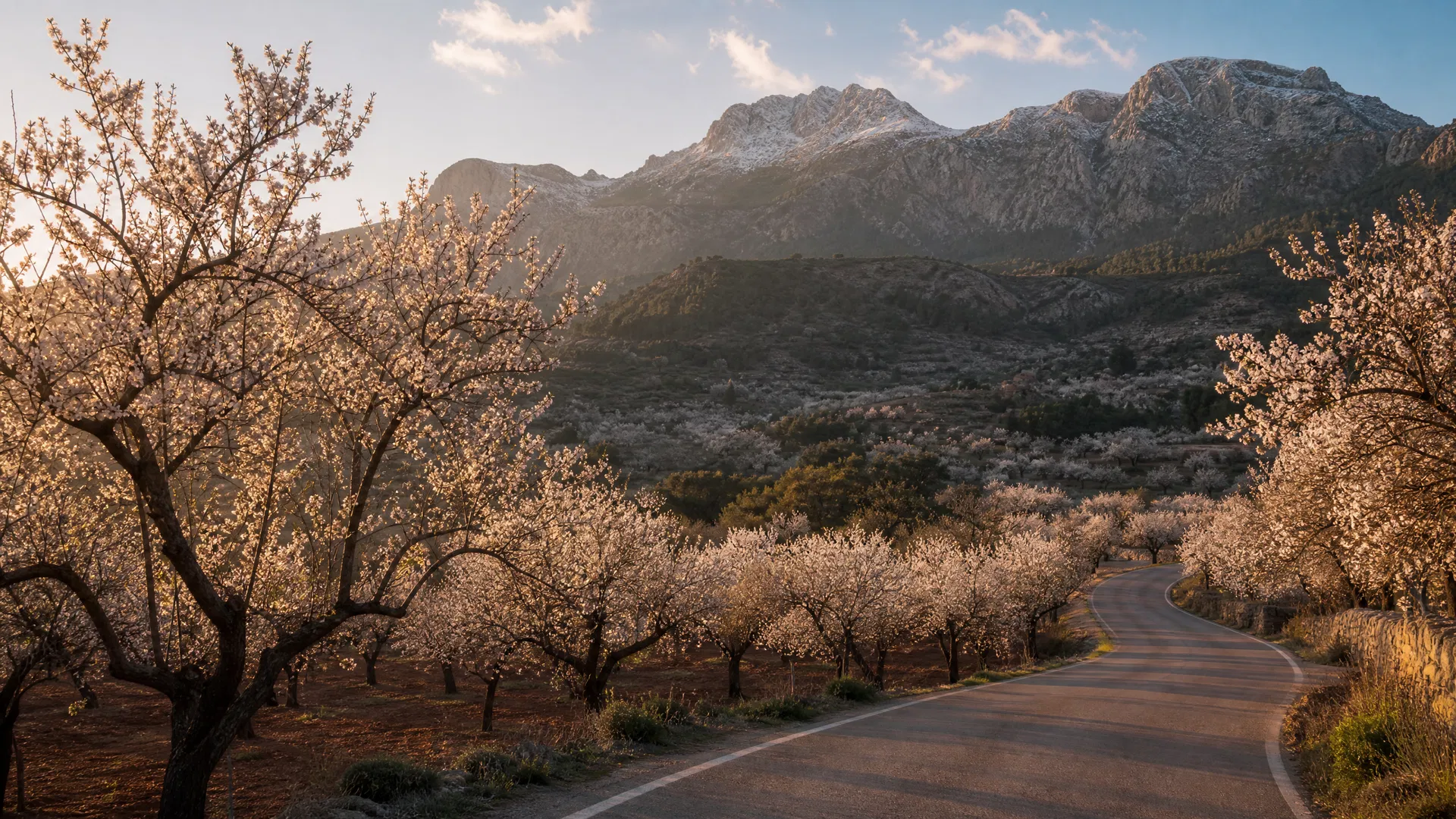
The Almond Trees Bloom in February and Nobody Is There to See It
Destination: Mallorca, Spain
Category: destination
The drive from Pollença to Sineu takes forty minutes in February. In August, it takes forty minutes too — but in August, you spend thirty of them behind a hire car from Hamburg doing fifty kilometers an hour on a road built for donkeys. In February, you have the road. You have the light. And on either side of you, for the entire forty minutes, you have seven million almond trees in full bloom.
They come in two colors: white and the faintest possible pink, the kind of pink that looks like white that has been embarrassed. The Serra de Tramuntana rises behind them to the northwest, its limestone ridgeline occasionally carrying a dusting of snow in the coldest weeks, and the combination — pink blossoms in the foreground, white peaks behind, the low February sun cutting across the valley at an angle that doesn't exist in summer — is the kind of scene that makes you pull over and stand in a field for twenty minutes doing nothing in particular. There is no one to see you do this. That is the point.
Mallorca has spent sixty years building one of the most efficient tourist machines in Europe. It takes in roughly thirteen million visitors a year, routes most of them through Palma airport and into the hotel corridors of Playa de Palma, Alcúdia, and Magaluf, and gives them exactly what they came for: sun, sea, cheap beer, and a pool with a swim-up bar. The machine works. Nobody argues with the machine.
What the machine doesn't advertise is that the island it operates on is one of the most geographically and culturally complex places in the western Mediterranean. That twenty minutes inland from any resort strip, the road climbs into a mountain range designated a UNESCO World Heritage Site for its terraced agricultural landscape built over two thousand years. That the interior contains villages continuously inhabited since the Bronze Age, a market that has been running every Wednesday for seven hundred years, a café in Palma that has been serving the same almond ice cream since 1700, and hiking trails that connect stone-walled farms through valleys where the only sounds are wind and goat bells. That the island has two faces, and the one the charter flights see is the less interesting of the two.
This is the other one.
The Interior That the Package Holiday Never Reaches
Drive to the geographic center of Mallorca and you arrive in Sineu. It is not a dramatic arrival. The town sits on a low hill in the Pla de Mallorca — the flat agricultural plain that runs across the island's middle — and its skyline is dominated by the church of Santa Maria, which was built in the fourteenth century on the site of a royal palace and has been watching over the surrounding farmland ever since. On most days, Sineu is quiet. On Wednesday mornings, it is the most alive place on the island.
The Sineu market has been running every Wednesday since the thirteenth century, making it the oldest continuously operating market in Mallorca. It opens at eight in the morning in Es Fossar square and runs until half past one, and it is the only market on the island where livestock trading still happens weekly — a detail that tells you something about who this market is for. It is not for tourists. It is for farmers, for the people who supply the restaurants in Palma, for the women who have been buying their vegetables here since before the airport existed. You can find fresh produce, local cheeses, sobrassada in its various forms, handmade ceramics, and the kind of agricultural hardware that has no name in English. You can also find tourists, because the secret has been partially out for years — but in February, the ratio is still heavily in favor of the people who live here.
From Sineu, drive north through Petra — birthplace of Junípero Serra, who founded nine of California's twenty-one Spanish missions, a fact the town's signage mentions with considerable pride — and into Pollença, which sits at the northern end of the Tramuntana foothills. Pollença is the kind of town that rewards the decision to park the car and walk. Its old town is a sequence of narrow stone streets that climb toward the Plaça Major, and from the square, a cypress-lined staircase of 365 steps — one for each day of the year, flanked by fourteen three-meter crosses — rises to the Calvary Chapel at the top. Pilgrims once climbed these steps on their knees. You can walk them upright and still arrive at the top slightly winded, with a view over the terracotta rooftops of the town and the bay beyond that justifies every step.
Between Pollença and Sineu, in the villages of Campanet, Sa Pobla, and the scattered farmland of the Raiguer region, the almond blossom is at its most concentrated in mid-February. The trees grow in irregular rows across the red earth, their branches bare except for the flowers, and the effect from a car window is of driving through something that is still deciding whether it is winter or spring. Stop anywhere. Walk into the trees. The scent is faint and clean, nothing like the synthetic almond of a bakery — closer to the smell of cold air and something about to happen.
The Tramuntana: What UNESCO Actually Means Here
The Serra de Tramuntana received its UNESCO World Heritage designation in 2011, not for its scenery — though the scenery is exceptional — but for its cultural landscape: the system of dry-stone terracing, water channels, and mountain paths that Mallorcan farmers built and maintained over two thousand years to make agriculture possible on near-vertical slopes. The designation is for human ingenuity applied to difficult terrain over a very long time. Walking through it, you understand why.
The GR221 — the Ruta de Pedra en Sec, or Dry Stone Route — runs the length of the Tramuntana from Sant Elm in the southwest to Port de Pollença in the north, covering nine stages over roughly a hundred and sixty kilometers. Most people who walk it do so in sections over multiple trips. The full route takes one to two weeks. What matters is not the distance but what you walk through: ancient cobbled paths laid by hand, dry-stone walls enclosing terraces of olive and almond trees, mountain refuges in restored farmhouses, and villages that the road network largely bypasses.
The village of Deià sits on a hillside above the coast between Valldemossa and Sóller, and it has been attracting writers and artists since Robert Graves arrived in 1929 and decided he had found the place he wanted to live. He stayed, with interruptions, for the rest of his life. The house he built with Laura Riding in 1932 — Ca n'Alluny, which translates as "the distant house" — sits on the road between Deià and Sóller and is now a museum open Monday through Friday. Tickets cost seven euros. The house is small, the garden is overgrown in the best possible way, and the view from the study window — the one Graves looked at while writing I, Claudius and Goodbye to All That — is a hillside of olive trees dropping toward a sea that is, in February, the color of pewter.
Deià gets busy in summer mornings. In February, you can walk its stone lanes without navigating around anyone. The same is true of Valldemossa, twelve kilometers to the south, where Frédéric Chopin spent the winter of 1838 in Cell No. 4 of the former Carthusian monastery and wrote several of his Preludes in a state of considerable misery about the cold and the damp. The monastery is now a museum. The cell is preserved. The cold and the damp are still available in February, though less severe than Chopin experienced, and the town — ivy-covered stone walls, terracotta roofs, balconies trailing geraniums even in winter — is at its most navigable when the summer coaches aren't parked three deep outside the entrance.
Sóller, in the valley below the Tramuntana's highest peaks, is the practical base for anyone walking sections of the GR221. It is also the departure point for one of the more specific pleasures the island offers: the tram. The Sóller tram was inaugurated on October 4, 1913 — the first electric tramway in Mallorca — and it still runs the 4.8 kilometers from Sóller town to Port de Sóller on the coast, departing every thirty minutes, in the same wooden cars it has always used. The ticket costs ten euros each way. The journey takes twenty minutes and passes through orange and lemon groves that have been supplying Sóller's famous citrus trade since the nineteenth century. It is not a tourist attraction in the theme-park sense. It is a piece of infrastructure that has been running continuously for over a hundred years and happens to be beautiful.
If you're planning a longer stay in the Tramuntana — or want the full seven-day itinerary through the Serra de Tramuntana's hidden calas and mountain villages — the Mallorca Couples Guide covers the route in detail, including the specific calas that require a walk to reach and the villages worth an overnight.
The Food Argument: What Mallorcan Cuisine Actually Is
Mallorcan cuisine has a problem with its own fame. Pa amb oli — bread rubbed with ripe tomato and olive oil, topped with whatever is available — is genuinely excellent and genuinely ubiquitous, and its ubiquity has allowed the tourist circuit to stop there. Most visitors leave Mallorca having eaten pa amb oli, a mediocre paella that was probably made for tourists, and an ensaïmada from a box at the airport. This is a significant failure of exploration.
The dish that tells you most about Mallorcan cooking is arròs brut — literally "dirty rice," a name that is both accurate and underselling. It is a thick, dark stew built from Mallorcan black pork ribs, rabbit, chicken, and snails, cooked down with tomato, red pepper, garlic, peas, beans, and sobrassada — the island's spiced cured sausage, made from the native porc negre, the black pig that has been raised in Mallorca since before the Romans arrived. The rice goes in late, absorbs the stock, and the whole thing is finished with a pinch of cinnamon that shouldn't work and does. It is a winter dish, a farmhouse dish, the kind of thing that has been feeding people through February in the Tramuntana for centuries. You will not find it on the menu at any restaurant within walking distance of a beach hotel. You will find it in the interior, in the kind of place where the menu is handwritten and the tablecloths are paper.
Sobrassada itself deserves more attention than it typically receives. The version made from porc negre — the protected-designation product, the one that carries the black label — is different in texture and depth from the industrial version sold in supermarkets. It is spreadable, deeply spiced with paprika and black pepper, and eaten on bread with honey in a combination that sounds wrong and is correct. The best place to understand this is a market rather than a restaurant: the Sineu Wednesday market sells it from producers who have been making it the same way for generations.
In Palma, the place that earns the most specific loyalty from the people who live there is Can Joan de S'Aigo, on Carrer Can Sanç in the old city. It has been open since 1700, making it the oldest café in the Balearic Islands, and it serves two things that matter: the ensaïmada — the spiral pastry that is Mallorca's most exported food product, light and slightly sweet and best eaten warm — and almond ice cream made from the island's own almonds. On Sunday mornings, the locals come here with newspapers and children and stay for an hour. In August, there is a queue. In February, you walk in and sit down.
The Calas: What the Walk Filters Out
Mallorca has approximately fifty named calas — the small, enclosed coves that punctuate the limestone coastline — and the quality of any given cala is inversely proportional to how easy it is to reach by car. This is not a coincidence. The island's road network was built for agriculture and expanded for tourism, and the calas that ended up with parking lots became the calas that ended up in every travel magazine photograph. The ones that didn't are still there.
Cala Varques, on the east coast near the resort town of Calas de Mallorca, is the clearest example of the access logic. There is no road to it. There is a dirt track from a roadside parking area near Cala Romantica, and from the end of that track, a thirty-to-forty-minute walk over limestone and through scrub pine. The walk is not difficult. It is simply long enough, and hot enough in summer, to filter out everyone who came to the beach by accident. What it leaves is a cove of turquoise water over white sand, sea caves in the limestone cliffs on either side, and, in February, the reasonable possibility of having it entirely to yourself.
The same logic applies to Cala Matzoc, further north on the Artà peninsula, which requires a longer walk from the road and rewards it with a beach that appears on almost no tourist maps. And to the smaller, unnamed inlets along the GR221 coastal sections, which are accessible only on foot and therefore accessible only to people who are already walking.
The rule is simple: if you can drive to it, it will be full in summer. If you have to walk to it, it might not be. In February, the distinction barely matters — but understanding it is what separates a Mallorca trip from a Mallorca experience.
When to Go
February is the argument of this post, and it deserves to be stated plainly: February is the best month to visit Mallorca if what you want is the island rather than the resort. The almond blossom peaks in mid-February. Temperatures run between twelve and twenty degrees Celsius. The island gets roughly three hundred days of sunshine per year, and February contributes its share. Most coastal towns are quiet to the point of emptiness — some smaller hotels close entirely — but Palma, Sóller, Pollença, and the interior villages remain open and functioning. Flights and accommodation are a fraction of summer prices.
The honest caveat: some restaurants in smaller villages operate reduced hours or close on weekdays in winter. The GR221 mountain refuges require advance booking year-round. The sea is too cold for swimming for most people, though the Mallorcans themselves have a higher threshold for this than visitors typically expect.
March and April offer the tail end of the blossom season and warming temperatures. October and November offer the same quiet as February without the blossom, but with the sea still warm enough to swim. The shoulder seasons are the island's best-kept secret, and February is the sharpest edge of that secret.
Getting Around
Mallorca requires a car. This is not a preference — it is a structural fact. The bus network connects the major towns but runs infrequently and stops entirely in the evening. The interior villages, the GR221 trailheads, the unmarked roadside parking areas for the hidden calas — none of these are accessible without a vehicle. In February, car hire is inexpensive. Book in advance anyway; the island's rental fleet is smaller in winter.
The exception is Palma itself, which is walkable and has a reasonable city bus network. The train from Palma to Sóller — a separate, historic wooden train that predates the tram — is worth taking once as an experience in itself. But for the island beyond the city, the car is the instrument.
Planning Your Mallorca Trip
The Mallorca that this post describes — the interior villages, the Tramuntana trails, the February blossom, the calas that require a walk — is not the Mallorca that most itinerary tools are built to plan. Most tools route you through the resort towns and the obvious landmarks. The Mallorca Couples Guide on AskLeif is built around the version of the island described here: the Serra de Tramuntana, the hidden calas, the villages worth an overnight. It covers seven days in enough detail to be useful without being prescriptive, and it includes the specific accommodation and logistics for the mountain sections that are easy to get wrong.
If Mallorca is part of a broader Spain itinerary, the Andalusia Couples Guide covers the south of the country with the same level of specificity — the kind of trip where Mallorca is the island chapter and Seville or Granada is the mainland chapter. And if the Canary Islands are on the list — a different Spanish archipelago with a different character entirely, warmer in February and worth comparing — the Canary Islands Guide covers the five-day version.
The Island That Earns Its Silence
There is a photograph that doesn't exist yet of the drive between Pollença and Sineu in mid-February. It would show the road disappearing into a tunnel of almond blossom, the Tramuntana ridgeline in the background carrying its occasional snow, the light at the angle that only exists in winter. It would show no other cars.
The reason this photograph doesn't exist is that the people who have taken it don't post it. They come back the following February instead. They tell one or two people. They keep the road to themselves.
Mallorca has been hiding this version of itself for decades, and it has been doing so successfully because the machine — the airports, the hotels, the all-inclusives, the package tours — is so efficient at routing people away from it. The machine is not malicious. It simply gives people what they ask for. Most people ask for the beach and the pool and the sun, and the machine delivers.
If you're reading this, you're probably asking for something else. The almond trees bloom in February. Nobody is there to see them. That's the point — and it's yours if you want it.
Ready to plan your Mallorca trip? The AskLeif Mallorca Couples Guide builds a full seven-day itinerary through the Serra de Tramuntana, the hidden calas, and the interior villages — personalized to your travel style and dates.