Los Angeles: The Complete Guide to the City That Invented Reinvention
Destination: Los Angeles, California, USA
Category: Destination Guides
There is a moment — and every person who has ever truly fallen for Los Angeles knows exactly the one — when the city stops being a place you're visiting and becomes something you're inside of. It might happen at 6:47 in the evening on the Pacific Coast Highway, when the sun is dropping into the ocean and the sky turns a shade of tangerine that no filter has ever accurately reproduced. It might happen at 2 AM in a Silver Lake taqueria, eating the best thing you've ever tasted while a table of musicians debates chord progressions in three languages. It might happen on a Tuesday morning in Griffith Park, when you crest a hill and the entire basin spreads out below you — ocean to the west, mountains to the north, the downtown skyline catching the early light — and you understand, viscerally, why 13 million people decided this was the place.
Los Angeles doesn't ease you in. It doesn't have a single front door, a central square, a logical starting point. It is, famously, not one city but dozens — a loose confederation of neighborhoods, each with its own personality, its own food scene, its own unwritten dress code, its own relationship with the rest of the city. This is what confuses first-time visitors and what keeps everyone else coming back. You can spend a week in LA and never scratch the surface. You can spend a decade and still find yourself in a neighborhood you've never explored, eating food you didn't know existed, watching a sunset from a hillside you didn't know was public land.
This is not a guide that will tell you to see the Hollywood sign and go home. This is a guide for people who want to understand what Los Angeles actually is — the real city, the complicated city, the city that has been reinventing itself for a century and shows no signs of stopping. Whether you're planning your first visit or your fifteenth, whether you have three days or three weeks, whether you're here for the beaches or the food or the art or the hiking or all of it at once — this is where you start.
The Geography of Feeling: Understanding LA Before You Arrive
The single most important thing to understand about Los Angeles before you book a hotel is that the city does not function the way other cities function. There is no "center" in the traditional sense. Manhattan has Midtown. Paris has the 1st arrondissement. London has the City. Los Angeles has the 405 freeway, and the 405 freeway will humble you.
The city is organized — loosely — into regions that each feel like separate destinations. The Westside (Santa Monica, Venice, Brentwood, Culver City) is beach-adjacent, fitness-obsessed, and home to the tech industry's LA outpost. Hollywood and the Hills (Los Feliz, Silver Lake, Echo Park, Silverlake) are the creative heartland — musicians, writers, filmmakers, the people who moved here to make something. The San Fernando Valley (Studio City, Burbank, Sherman Oaks) is where the industry actually lives and works, behind the cameras rather than in front of them. Downtown LA has undergone a genuine renaissance over the past decade, transforming from a place people avoided after dark into one of the most interesting urban neighborhoods in the country. And then there is the Eastside — Boyle Heights, Highland Park, El Sereno — the neighborhoods that have been Latino for generations and are now navigating the complicated pressures of a city in flux.
Traffic is real. The 405 at 5 PM on a Friday is not a metaphor — it is a genuine test of character. The key to navigating LA is to plan your days geographically: spend a morning in one neighborhood, an afternoon in an adjacent one, and don't try to cross the city more than once per day. The visitors who hate LA are almost always the ones who tried to do Santa Monica in the morning and Koreatown at lunch and Pasadena in the afternoon. The visitors who love LA are the ones who picked a neighborhood and stayed in it long enough to find the good stuff.
The Neighborhoods: Where to Actually Spend Your Time
Venice Beach and Santa Monica: The Mythological LA
Venice Beach is the Los Angeles that the rest of the world imagines when it thinks of Los Angeles. The boardwalk, the muscle beach weight pit, the street performers, the skate park, the palm trees casting long shadows across the sand at magic hour — it is exactly as cinematic as advertised, and it is also genuinely, authentically itself. The people doing pull-ups on the outdoor gym are not performing for tourists. The skaters in the bowl are not there for the Instagram. Venice has been this way for decades, and the fact that it has become one of the most photographed places on earth has not changed what it fundamentally is.
Abbot Kinney Boulevard, a few blocks inland from the boardwalk, is where Venice's other identity lives — boutiques, galleries, coffee shops with $8 lattes that are genuinely worth $8, restaurants that have been written up in every food publication on earth. On the first Friday of every month, the street transforms into an outdoor market and block party that is one of the best free experiences in the city. The food trucks that line up on First Fridays represent a cross-section of LA's extraordinary culinary diversity: Korean BBQ next to Oaxacan tlayudas next to a wood-fired pizza operation run by a former Michelin-starred chef who decided he'd rather cook outdoors.
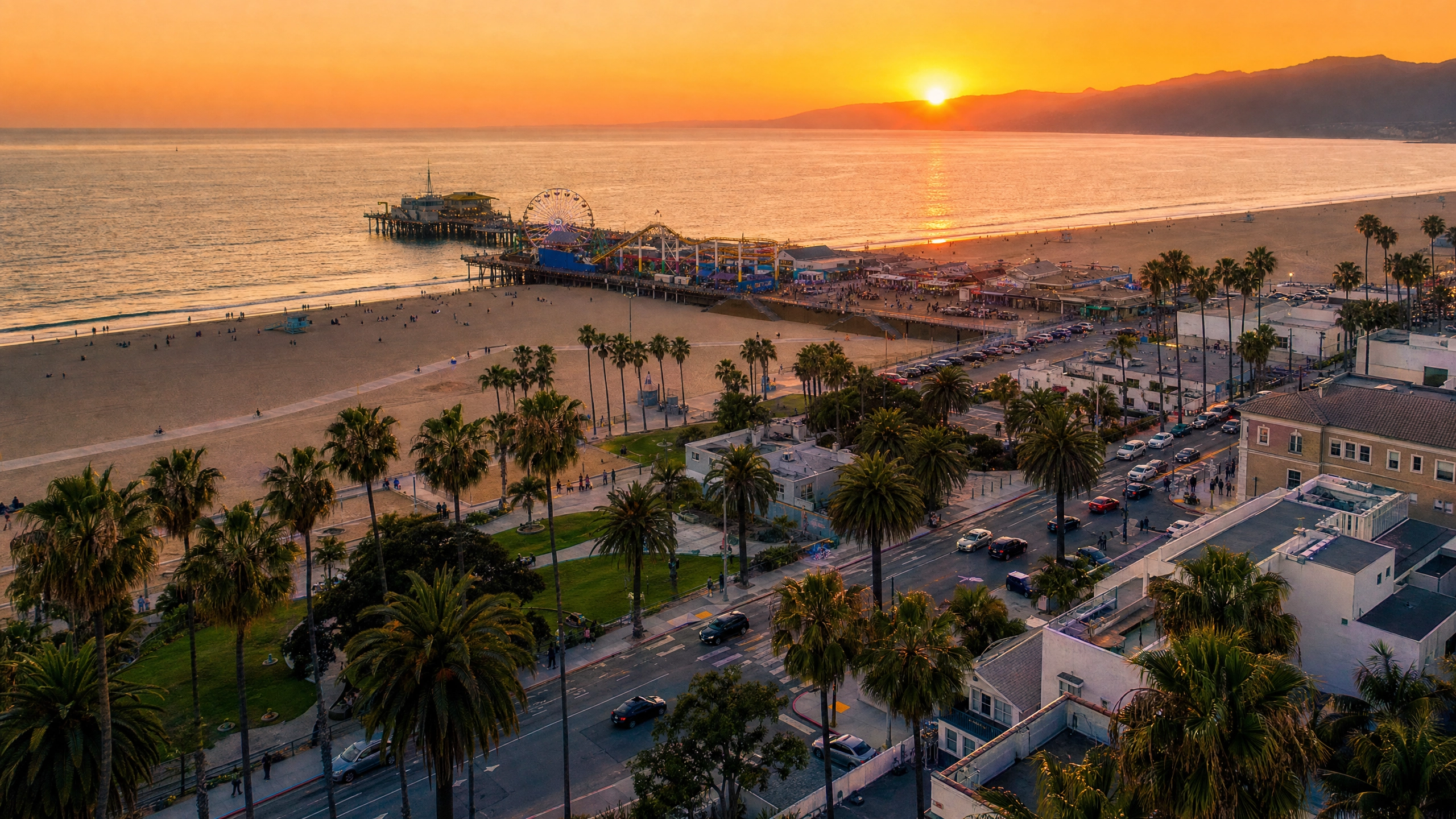
Santa Monica, just north of Venice, is the more polished sibling — the Third Street Promenade for shopping, the Santa Monica Pier for the quintessential LA photograph, Palisades Park for a sunset walk above the Pacific. The farmers market at Arizona Avenue on Wednesday and Saturday mornings is one of the best in the country, drawing chefs from restaurants across the city to shop alongside regular people buying heirloom tomatoes and fresh-cut flowers.
If you're planning a full week in LA and want a structured itinerary that covers the Westside properly, our 7-Day Los Angeles Itinerary for Couples and Solo Explorers builds in the right amount of time for each neighborhood without trying to do everything at once.
Silver Lake and Los Feliz: The Creative Heartland
If Venice is the LA that tourists imagine, Silver Lake is the LA that creative people move to. The neighborhood sits on the eastern edge of Hollywood, centered on a reservoir that catches the light differently at every hour of the day, surrounded by Craftsman bungalows and mid-century modern houses perched on hillsides that require a certain commitment to reach. The streets are steep, the parking is impossible, and the coffee is extraordinary.
Sunset Junction — the intersection of Sunset Boulevard and Santa Monica Boulevard — is the neighborhood's commercial heart, and it is one of the most genuinely interesting stretches of street in Los Angeles. Intelligentsia Coffee, which essentially invented the third-wave coffee movement in LA, has its flagship here. Sqirl, the restaurant that made Instagram-worthy toast a thing before Instagram-worthy toast was a thing, is a few blocks away (the ricotta toast with jam is not a joke — it is one of the best things you will eat in this city). Botanica, which opened in 2017 and has become one of the most beloved neighborhood restaurants in LA, serves vegetables in ways that make you reconsider your entire relationship with vegetables.
Los Feliz, just north of Silver Lake, has a slightly more settled, slightly less self-consciously hip energy. The neighborhood is anchored by Vermont Avenue, which runs south from the hills to Hollywood Boulevard and is lined with bookshops, wine bars, and the kind of restaurants that have been there for twenty years and will be there for twenty more. The Dresden, a bar and restaurant that has been operating since 1954, is the kind of place that exists nowhere else — a time capsule of mid-century LA where the house band has been playing the same show since the 1980s.
Griffith Park, which sits above both neighborhoods, is one of the great urban parks in the world — 4,310 acres of chaparral and oak woodland and hiking trails, with the Griffith Observatory perched on its southern slope like a temple to the cosmos. The view from the observatory terrace at night, with the city spread out below and the Milky Way (on a clear night) above, is the kind of thing that stays with you. The hike to the top of Mount Hollywood, which takes about 45 minutes from the observatory, rewards you with a 360-degree view that encompasses the entire basin, from the Pacific to the San Gabriel Mountains.
For solo travelers who want to experience this side of LA properly, our LA for One: 5-Day Solo Travel Guide to Silver Lake, Echo Park and the Eastside is built specifically around the neighborhoods that make LA worth living in, not just visiting.
Downtown LA: The Reinvention
Downtown Los Angeles in 2026 is one of the most interesting urban stories in America. Twenty years ago, it was a place that emptied out at 6 PM when the office workers went home. Today it is a genuine neighborhood — people live here, eat here, drink here, make art here — and the density of excellent things to do within walking distance of each other is unlike anywhere else in the city.
The Grand Central Market on Broadway is the best single food destination in Los Angeles, and possibly in the country. The market has been operating since 1917, and it has evolved from a neighborhood grocery into a curated collection of food stalls that represents the full breadth of LA's culinary identity: Egg Slut (the breakfast sandwich that launched a thousand imitators), Eggslut (yes, there are two), Sarita's Pupuseria (which has been there since the market was a neighborhood grocery), Horse Thief BBQ, Sticky Rice, Wexler's Deli. The combination of century-old market architecture and 21st-century food culture is something that could only exist in Los Angeles.
The Arts District, just east of downtown, is where the city's creative energy has been concentrating for the past decade. The neighborhood is built on the bones of a former industrial zone — warehouses and factories converted into galleries, studios, restaurants, and bars. Bestia, which opened in 2012 and has been fully booked every night since, serves Italian-influenced food that is among the best in the city. Bavel, from the same team, does Middle Eastern food with the same level of ambition. The Row DTLA, a mixed-use development built in a former warehouse complex, houses some of the most interesting retail and dining in the city.
The Broad, the contemporary art museum that opened in 2015, has a permanent collection that includes major works by Jeff Koons, Cindy Sherman, Jean-Michel Basquiat, and Kara Walker. The Infinity Mirrored Room by Yayoi Kusama — one of the most photographed artworks in the world — is here, and the timed tickets sell out weeks in advance. Book early.
Koreatown: The City Within the City
Koreatown is not a tourist destination. It is a neighborhood where people live and work and eat, and the fact that visitors have discovered it does not change its fundamental character. The neighborhood is the most densely populated in Los Angeles, a vertical city of apartment towers and strip malls that contains, within its relatively compact geography, some of the best food in the country.
Korean BBQ is the obvious entry point — the experience of cooking your own meat over a charcoal grill at the table, accompanied by an array of banchan (small side dishes) that arrive without being ordered and are refilled without being asked, is one of the great communal eating rituals in the world. Quarters Korean BBQ and Park's BBQ are the names that come up most often, but the honest answer is that almost any Korean BBQ restaurant in Koreatown that has been operating for more than five years is going to be excellent.
Beyond BBQ, Koreatown is home to some of the best Korean fried chicken in the country (Kyochon, which originated in Korea, has its American flagship here), extraordinary Korean-Chinese fusion (jjajangmyeon, the black bean noodle dish, is one of the great comfort foods of the Korean diaspora), and a late-night food culture that operates on a different schedule from the rest of the city — the best places don't get busy until midnight.
The Food: Why LA Is the Best Food City in America
This is not a controversial statement among people who have eaten seriously in Los Angeles. The city's food culture is the product of its geography (year-round growing season, proximity to the Pacific), its demographics (the largest Mexican population outside Mexico, significant Korean, Japanese, Chinese, Thai, Ethiopian, Armenian, and Persian communities), and its particular relationship with health and pleasure (LA manages to be simultaneously the most health-conscious and the most hedonistic food city in the country).
The taco situation alone would justify a trip. LA's taco culture is not Mexican food adapted for American palates — it is Mexican food made by Mexican people for Mexican people, and the fact that everyone else gets to eat it too is one of the great gifts the city offers. The best tacos are not in restaurants. They are at trucks and stands, operating on schedules that are not always predictable, in neighborhoods that are not always on the tourist map. Mariscos Jalisco, a truck that has been operating in Boyle Heights for decades, makes a fried shrimp taco that has been called the best taco in America by people who have eaten a lot of tacos. Leo's Tacos, with its al pastor cooked on a vertical spit and served with a slice of pineapple, operates out of a truck on La Brea Avenue and is open until 3 AM.
The ramen scene is extraordinary — Tsujita LA in Sawtelle Japantown makes a tsukemen (dipping ramen) that requires a two-hour wait on weekends and is worth every minute of it. The sushi is world-class — Nobu Malibu, perched over the Pacific, is the most beautiful restaurant in the city; Sushi Park in West Hollywood, which doesn't take reservations and seats twelve people, is the most technically accomplished. The Ethiopian food in Little Ethiopia on Fairfax Avenue is among the best in the country. The Persian food in Westwood, where the Iranian diaspora has been concentrated for decades, is unlike anything you'll find elsewhere in the United States.
For travelers who want to eat their way through LA systematically, our Los Angeles Food Guide: 4-Day Culinary Journey Through LA's Diverse Flavors is built around the neighborhoods and the specific dishes that define the city's food identity — not the celebrity restaurants, but the places where LA actually eats.
The Outdoors: The Part Nobody Talks About Enough
Los Angeles is one of the great outdoor cities in the world, and this is consistently underappreciated by people who have never been here. The combination of year-round mild weather, proximity to the Pacific, and the Santa Monica Mountains running through the middle of the city creates outdoor opportunities that most cities can only dream about.
Runyon Canyon, in the Hollywood Hills, is the most famous urban hike in LA — a 160-acre park with trails that climb from the city floor to ridge-top views of the basin, the Hollywood sign, and on clear days, the Pacific. It is also one of the most social outdoor spaces in the city, a place where people bring their dogs and their friends and their headphones and their ambitions. The view from the top at sunrise, with the city still quiet below, is one of the best free experiences in Los Angeles.
Topanga Canyon, in the Santa Monica Mountains above Malibu, is where the city's outdoor culture reaches its most concentrated form. The canyon is home to a community that has been living alternatively since the 1960s — artists, musicians, surfers, farmers — and the hiking in the surrounding state park is among the best in Southern California. The Backbone Trail, which runs 67 miles along the crest of the Santa Monica Mountains from Will Rogers State Historic Park to Point Mugu State Park, is one of the great urban hiking trails in the country.
The beaches deserve more than a passing mention. LA has 75 miles of coastline, and each beach has a distinct personality. Zuma Beach in Malibu is the cleanest and least crowded, with consistent surf and a parking lot that fills up by 10 AM on summer weekends. El Matador State Beach, accessible via a steep trail down a cliff face, is one of the most beautiful beaches in California — sea stacks, sea caves, and the kind of dramatic scenery that makes you feel like you've discovered something. Manhattan Beach has the best beach volleyball in the country and a downtown that is genuinely charming. Hermosa Beach is where the surf culture is most concentrated and most authentic.
For travelers who want to spend their time in LA outdoors, our 5-Day Los Angeles Outdoor Adventure: Hiking Trails and Nature Escapes covers the full range — from Griffith Park to the San Gabriel Mountains to the beaches — with specific trail recommendations and the logistics of getting there without a car.
LA With Kids: The City Is Better Than You Think
Los Angeles is an underrated family destination, and the reason is simple: the city has more genuinely excellent children's attractions per square mile than almost anywhere in the country. Universal Studios Hollywood is the obvious starting point — the Wizarding World of Harry Potter and the Jurassic World ride are as good as anything at any theme park in the world — but the city's offerings extend far beyond the theme parks.
The Natural History Museum of Los Angeles County, in Exposition Park, has one of the best dinosaur halls in the world and a live butterfly pavilion that is genuinely magical. The California Science Center, next door, houses the Space Shuttle Endeavour — the actual spacecraft, standing vertical in its launch configuration, which is one of the most awe-inspiring things you can show a child. The La Brea Tar Pits, in the middle of Miracle Mile, is the only active paleontological excavation site in an urban setting in the world — you can watch scientists excavate Ice Age fossils through a glass wall while standing on a sidewalk in the middle of Los Angeles.
The beaches are obviously excellent for families — the calm water at Santa Monica and the lifeguard presence at most LA beaches makes them safe for children, and the combination of sand, waves, and the Santa Monica Pier's amusement rides is a full day's entertainment. Griffith Park has a carousel, a miniature train, a pony ride, and a travel museum, in addition to the observatory and the hiking trails.
Our 6-Day Los Angeles Family Vacation Guide: Universal Studios, Beaches and Kid-Friendly Fun is built around the specific logistics of navigating LA with children — which neighborhoods to stay in, how to sequence the theme parks, and the hidden gems that most family travel guides miss entirely.
LA on a Budget: The Expensive City That Doesn't Have to Be
Los Angeles has a reputation for being expensive, and it is not entirely unearned — the hotels are pricey, the parking is absurd, and the restaurants that get written up in national publications will cost you. But the city also has a parallel economy of extraordinary free and cheap experiences that most visitors never find.
The beaches are free. The hiking is free. The farmers markets are free to walk through and cheap to eat at. The Getty Center, one of the great art museums in the world, charges nothing for admission (only for parking, and the bus from Westwood is $1.75). The Hammer Museum in Westwood is always free. The LACMA (Los Angeles County Museum of Art) has free admission on the second Tuesday of every month. The Griffith Observatory is free.
The best food in LA is not at the expensive restaurants. It is at the trucks and the stands and the strip mall restaurants that don't have publicists. A meal at Mariscos Jalisco costs $4. A bowl of pho at one of the dozens of excellent Vietnamese restaurants in the San Gabriel Valley costs $12. The best Korean BBQ experience in the city — the kind where the meat is excellent and the banchan keeps coming and the soju flows freely — costs about $30 per person.
Our LA for Less: 5-Day Budget Travel Guide to Los Angeles Under $80/Day is built around the principle that the best of LA is not behind a velvet rope — it is on the street, in the park, at the truck, and in the neighborhoods that the guidebooks haven't discovered yet.
Romance in Los Angeles: The City for Two
Los Angeles is, quietly, one of the most romantic cities in the world. The combination of extraordinary sunsets, world-class restaurants, private beaches, and the particular magic of a city that operates at a slightly slower pace than New York or London creates conditions for romance that are hard to replicate.
The Pacific Coast Highway at sunset is the most cinematic drive in America. The restaurants in Malibu — Nobu, Moonshadows, Geoffrey's — have views of the Pacific that make dinner feel like an event. The rooftop bars in downtown LA (the Perch, the Ace Hotel rooftop) offer views of the city that are genuinely spectacular at night. The Getty Villa in Pacific Palisades, a Roman-style villa overlooking the Pacific that houses the Getty's collection of Greek and Roman antiquities, is one of the most beautiful places in the city for an afternoon.
The hidden beaches are the secret weapon. El Matador State Beach, Leo Carrillo State Park, Point Dume — these are places where you can be genuinely alone with the Pacific, away from the crowds, with nothing but the sound of waves and the light changing on the water. They require a little effort to reach, but that effort is the point.
Our Romantic Los Angeles: A 3-Day Couples' Weekend Itinerary is built around the specific experiences that make LA romantic — not the tourist checklist, but the moments that make people fall in love with the city and with each other.
When to Go: The Honest Answer
The conventional wisdom is that LA is always good, and the conventional wisdom is mostly right. The city has approximately 284 days of sunshine per year, and the temperature rarely drops below 50°F or rises above 90°F in the coastal neighborhoods. But there are distinctions worth knowing.
June Gloom is real. The marine layer that settles over the coast from late May through early July can make mornings gray and cool, burning off by early afternoon. It is not unpleasant — the diffused light is actually beautiful — but if you're expecting blazing sunshine every morning, you may be surprised. The beaches are also at their most crowded from late June through Labor Day, when the entire city seems to descend on the coast simultaneously.
The best months are September and October, when the marine layer has dissipated, the summer crowds have thinned, and the Santa Ana winds occasionally blow in from the desert, pushing the air temperature up and the humidity down and creating the kind of clarity that makes the mountains look close enough to touch. The light in October in Los Angeles is unlike anything else — warm and golden and slightly unreal, the light that has been making photographers and cinematographers fall in love with this city for a hundred years.
March and April are also excellent — the hills are green from winter rains, the wildflowers are blooming in the canyons, and the city is operating at a pace that feels sustainable rather than frantic.
Getting Around: The Honest Guide to LA Transportation
You need a car. This is the honest answer, and no amount of wishful thinking about LA's expanding Metro system changes the fundamental reality that the city was designed around the automobile and continues to function primarily around the automobile. The Metro is excellent for specific corridors — the Expo Line from downtown to Santa Monica, the Red Line from downtown to Hollywood — but it does not cover the full geography of the city, and the neighborhoods that are most interesting to explore are often the ones least well-served by transit.
That said, the car-free LA experience is more viable than it was five years ago, particularly if you're staying in one neighborhood and willing to use rideshare for longer distances. The Westside (Santa Monica, Venice, Culver City) is walkable within itself. Downtown is walkable within itself. Silver Lake and Los Feliz are walkable within themselves. The mistake is trying to connect these neighborhoods without a car.
Parking in LA is its own art form. The key rules: never park on a street without reading every sign carefully (the street cleaning schedules are enforced aggressively), use the SpotHero app to find and reserve parking in advance, and accept that parking in certain neighborhoods (Silver Lake, West Hollywood, Santa Monica) will cost you $20–$30 for an evening out.
The Neighborhoods You Haven't Heard Of (But Should)
Leimert Park, in South LA, is the cultural heart of Black Los Angeles — a neighborhood of jazz clubs, art galleries, and community spaces that has been the center of African American creative life in the city for decades. The World Stage, a performance space and music school founded by drummer Billy Higgins, has been nurturing jazz musicians since 1989. The Vision Theatre hosts some of the most interesting live performance in the city. The neighborhood is not on most tourist itineraries, and it should be.
Sawtelle Japantown, on the Westside, is a two-block stretch of Japanese restaurants, shops, and cultural institutions that is one of the best eating destinations in the city. The ramen at Tsujita is the most discussed, but the neighborhood also has excellent izakayas, Japanese curry houses, and a Japanese bookstore that stocks titles you won't find anywhere else in the country.
Highland Park, on the Eastside, is the neighborhood that Silver Lake was fifteen years ago — a working-class Latino neighborhood that has been discovered by artists and young professionals, with a main street (York Boulevard) that is rapidly filling with excellent restaurants, bars, and coffee shops. The Hermosillo, a wine bar that opened in 2016, is one of the best in the city. Café de Leche, a coffee shop that has been there since before the neighborhood changed, is a reminder of what the neighborhood was and still is.
The LA That Stays With You
Every city has a version of itself that exists in the imagination before you arrive and a version that reveals itself after you've been there long enough to stop looking for the version you imagined. Los Angeles is unusual in that the imagined version — the sunsets, the palm trees, the Pacific, the sense that anything is possible — is not entirely wrong. It is just incomplete.
The complete version includes the traffic and the inequality and the neighborhoods that are changing faster than anyone can process and the people who have been here for generations watching the city they grew up in become something they don't always recognize. It includes the extraordinary food and the extraordinary art and the extraordinary outdoor spaces and the extraordinary human diversity that makes the city unlike anywhere else on earth. It includes the particular quality of light at 5 PM in October, when the sun is low and the air is clear and the mountains are close and the city is golden and you understand, for a moment, why everyone who has ever come here has found it so hard to leave.
Los Angeles will not give itself to you all at once. It requires patience, and curiosity, and a willingness to get lost. But the city rewards those qualities more generously than almost anywhere else in the world. Come with time. Come with hunger. Come ready to be surprised.
Plan Your Los Angeles Trip with Ask Leif
We've built a full library of Los Angeles guides for every type of traveler and every kind of trip. Whether you're coming for a long weekend or a full week, traveling solo or with family, working with a generous budget or a tight one — we have a day-by-day itinerary built specifically for you.
- Los Angeles Unveiled: A 7-Day Itinerary for Couples and Solo Explorers — the comprehensive week-long guide that covers the full range of the city
- Los Angeles Food Guide: 4-Day Culinary Journey Through LA's Diverse Flavors — for travelers who want to eat their way through the city
- 5-Day Los Angeles Outdoor Adventure: Hiking Trails and Nature Escapes — for travelers who want to spend their time in the mountains and on the water
- LA for One: 5-Day Solo Travel Guide to Silver Lake, Echo Park and the Eastside — for solo travelers who want to experience the real LA
- 6-Day Los Angeles Family Vacation: Universal Studios, Beaches and Kid-Friendly Fun — for families navigating the city with children
- Romantic Los Angeles: A 3-Day Couples' Weekend Itinerary — for couples who want the most beautiful version of the city
- LA for Less: 5-Day Budget Travel Guide to Los Angeles Under $80/Day — for travelers who want the full LA experience without the full LA price tag
Built by travelers, for travelers — Your Next Adventure Starts Here.