Las Vegas Is a Lie You Choose to Believe. That's What Makes It Brilliant.
Destination: Las Vegas, Nevada
Category: Destination Guides
Las Vegas Is a Lie You Choose to Believe. That's What Makes It Brilliant.
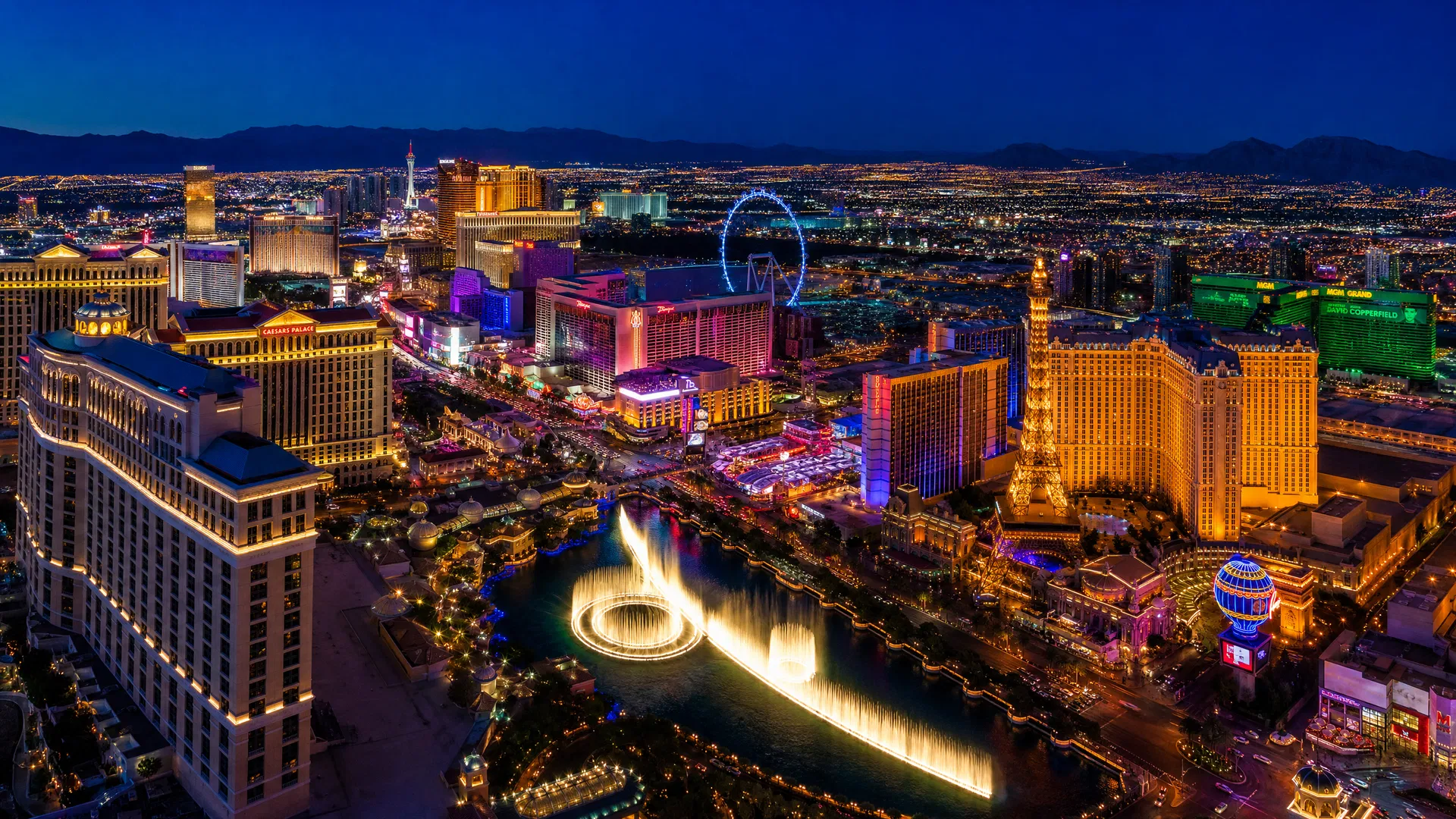
There's a moment, somewhere around midnight, standing on the pedestrian bridge above the intersection of Las Vegas Boulevard and Flamingo Road, when the full absurdity of this place becomes undeniable. The Bellagio fountains are firing across the street — 1,200 water jets synchronized to Andrea Bocelli, lit in blue and white against the black Nevada sky. A man in a sequined Elvis suit is taking a selfie next to a woman in a wedding dress. A bachelor party from Ohio is arguing about which casino to hit next. A couple from Tokyo is watching the fountains in complete silence, holding hands. And somewhere behind you, the Eiffel Tower — a half-scale replica, but still — is glowing orange against the desert dark.
You know it's all fake. The Eiffel Tower is fake. The canals of the Venetian are fake. The pyramid of the Luxor is fake. The volcano at the Mirage, erupting on schedule every hour, is fake. And yet none of it feels cheap. It feels like the most committed, most expensive, most thoroughly executed fantasy in human history. Las Vegas doesn't pretend to be real. It dares you to care.
You don't care. Nobody does. That's the point.
Las Vegas is the most visited city in the United States — 40 million visitors a year, more than New York City, more than Los Angeles, more than any national park. It is the only major American city built entirely on the premise of pleasure, and it has pursued that premise with a focus and a budget that no other city has matched. The Strip — a 4.2-mile stretch of Las Vegas Boulevard South — contains more hotel rooms than any other street on earth. It contains more neon than any other place on earth. It contains more restaurants with Michelin-starred chefs, more world-class entertainment venues, more swimming pools, more bars, more spectacle per square foot than anywhere else in the world.
And yet Las Vegas is also, consistently, one of the most misunderstood cities in America. The people who dismiss it as a shallow exercise in excess have usually only seen the Strip. The people who love it — really love it, the way locals and repeat visitors do — know that Las Vegas is a city of extraordinary depth hiding behind a facade of deliberate superficiality.
This is the guide for both kinds of visitor. The one who wants the full Strip experience, done right. And the one who wants to find the city that exists behind the neon.
Understanding the Strip: How to Do It Right
The Strip is not a neighborhood. It is a machine — a 4.2-mile entertainment complex designed with extraordinary precision to keep you inside, spending money, losing track of time. The casinos have no clocks. The windows are tinted to obscure whether it's day or night. The layouts are deliberately confusing, designed to route you past slot machines and gaming tables on your way to every restaurant, show, and bathroom. Understanding this is not a reason to avoid the Strip. It's a reason to approach it with intention.
The Bellagio is the gold standard of Strip hotels and the one that, more than any other, defines what Las Vegas aspires to be. The conservatory and botanical gardens, which change with the seasons, are free to visit and genuinely beautiful — 14,000 plants arranged in elaborate themed displays by a team of 140 full-time horticulturalists. The Bellagio Gallery of Fine Art has hosted exhibitions of Monet, Picasso, and Warhol. The fountains, choreographed to music ranging from Sinatra to Pavarotti to Beyoncé, fire every 30 minutes in the afternoon and every 15 minutes at night, and they are free to watch from the sidewalk. They are, without qualification, one of the great free spectacles in the world.
The Venetian and Palazzo occupy 67 acres and contain 7,000 suites — no standard rooms, only suites, which makes even the entry-level accommodation feel genuinely luxurious. The Grand Canal Shoppes, with their painted sky ceiling and actual gondolas on actual water, are either the most absurd thing you've ever seen or the most charming, depending on your relationship with irony. The restaurants are exceptional — Bouchon Bistro (Thomas Keller's French bistro), Yardbird, and B&B Burger & Beer (Mario Batali) are all worth seeking out.
The Wynn and Encore are the quietest, most refined properties on the Strip — the choice of visitors who want luxury without spectacle. Steve Wynn's aesthetic is more restrained than his competitors, and the result is a resort that feels genuinely elegant rather than aggressively theatrical. The Wynn's golf course, the only one on the Strip, is open to hotel guests. The Lake of Dreams, a 3-acre lake with nightly theatrical shows projected onto a waterfall, is free to watch from the Parasol Up bar.
The Sphere — the 366-foot-tall spherical entertainment venue that opened in 2023 — is the most significant new addition to the Las Vegas skyline since the Stratosphere. Its exterior LED display, the largest in the world, is visible from the Strip and from the air. Inside, the immersive concert experience (U2 was the inaugural residency) uses a 160,000-square-foot wraparound screen and a haptic system that makes you feel the music physically. It is, by any measure, the most technologically advanced entertainment venue ever built.
Beyond the Strip: The Las Vegas That Locals Know
The Strip is a destination. Downtown Las Vegas is a neighborhood. And the difference matters enormously.
Fremont Street is where Las Vegas began. The first casinos were here — the Golden Gate (1906), Binion's Horseshoe (1951), the Golden Nugget (1946). The Fremont Street Experience, a 1,500-foot LED canopy that covers the pedestrian mall and hosts nightly light shows, is simultaneously tacky and magnificent. The bars are cheaper, the crowds are more diverse, the energy is more genuinely local. The El Cortez, the oldest continuously operating hotel-casino in Las Vegas (opened 1941), still has $5 blackjack tables and a bar that feels like it hasn't changed since Bugsy Siegel was a regular.
The Arts District (18b Las Vegas Arts District) is the city's creative quarter — a neighborhood of galleries, independent restaurants, cocktail bars, and vintage shops centered on South Main Street. First Friday, a monthly street festival that transforms the neighborhood on the first Friday of every month, draws thousands of locals for art, live music, food trucks, and the kind of authentic community energy that the Strip is specifically designed to prevent. The Arts District is where Las Vegas residents actually live and socialize, and it is one of the most genuinely interesting urban neighborhoods in the American Southwest.
The Mob Museum (officially the National Museum of Organized Crime and Law Enforcement) is one of the best museums in Las Vegas and one of the most underrated in the country. Located in the former federal courthouse where the Kefauver Committee hearings on organized crime were held in 1950, it tells the story of the American Mafia with extraordinary depth and detail. The exhibit on Las Vegas's mob history — the Rat Pack, the Teamsters pension fund, the skimming operations, the FBI surveillance — is genuinely riveting. The speakeasy in the basement, accessible through a hidden door, serves Prohibition-era cocktails.
The Neon Museum is a boneyard of Las Vegas's past — a 2-acre outdoor gallery of retired casino signs, from the original Stardust sign to the Moulin Rouge marquee to the Caesars Palace horse-and-chariot. The night tour, "Brilliant!" — a projection-mapped light show that uses the signs as screens — is one of the most memorable experiences in Las Vegas. It is also, in its way, deeply melancholy: a graveyard of neon dreams, each sign representing a casino that no longer exists, a version of Las Vegas that has been demolished and rebuilt and demolished again.
The Arts District's cocktail bars deserve special mention. The Velveteen Rabbit is a craft cocktail bar with a garden patio that feels like it belongs in Portland or Brooklyn. The Silver Stamp is a bookshop and bar combination that hosts readings and live music. Able Baker Brewing is a craft brewery with a tap room that draws a genuinely local crowd. These places exist in a different universe from the Strip — quieter, cheaper, more human.
The Natural World: Las Vegas's Greatest Secret
Forty-five minutes from the Strip, the Mojave Desert begins in earnest. This is Las Vegas's greatest secret and its most underutilized asset.
Red Rock Canyon National Conservation Area is one of the most spectacular landscapes in the American West. The Calico Hills — enormous formations of Aztec sandstone in shades of red, orange, and cream — rise 3,000 feet above the valley floor. The 13-mile scenic drive loops through the canyon and provides access to dozens of hiking trails, from the easy Calico Hills Trail to the strenuous Turtlehead Peak summit (4.5 miles, 1,900 feet of elevation gain, views that extend to the Strip and beyond). Rock climbers come from around the world to climb the sandstone walls. The canyon is also home to desert tortoises, bighorn sheep, and over 200 species of birds.
The best time to visit Red Rock is early morning — the light on the red rock at sunrise is extraordinary, and you'll have the trails largely to yourself before the day-trippers arrive from the Strip. Bring water. The desert is serious about dehydration.
Valley of Fire State Park, an hour northeast of Las Vegas, contains Nevada's oldest state park and some of the most otherworldly landscapes in North America. The red Aztec sandstone formations, some of which date to 150 million years ago, have been shaped by wind and water into arches, domes, and spires that look like they belong on another planet. The Petroglyph Canyon trail passes ancient Native American rock art. The Wave formation — a series of undulating red rock ridges — is one of the most photographed geological features in the Southwest.
Hoover Dam is 35 miles southeast of Las Vegas and is, by any measure, one of the great engineering achievements of the 20th century. Built between 1931 and 1936 during the Great Depression, it employed 21,000 workers, killed 96 of them, and created Lake Mead — the largest reservoir in the United States by volume. The dam tour takes you inside the structure, through the tunnels and generator rooms, and provides a visceral sense of the scale of what was built. The views from the top of the dam, looking down 726 feet to the Colorado River below, are vertiginous and magnificent.
Lake Mead, the reservoir created by Hoover Dam, offers swimming, boating, kayaking, and paddleboarding in the middle of the Mojave Desert. The contrast — blue water surrounded by red rock and desert scrub — is visually stunning. The lake has been severely affected by drought in recent years (water levels have dropped dramatically since 2000), and visiting it is also a sobering lesson in the fragility of water resources in the American West.
The Food Scene: More Than Buffets
Las Vegas's food scene has undergone a complete transformation over the past 25 years. The city that was famous for cheap buffets and free drinks is now home to more celebrity-chef restaurants per capita than any city in America, and the quality is consistently high.
The Strip restaurants worth the splurge: Joël Robuchon at the MGM Grand (the most Michelin-starred chef in history, 3 stars in Las Vegas), é by José Andrés at the Cosmopolitan (a 10-seat tasting menu that is one of the most exclusive dining experiences in America), Twist by Pierre Gagnaire at the Waldorf Astoria (French haute cuisine with Strip views), and Nobu at the Hard Rock (the original celebrity sushi restaurant, still excellent).
The off-Strip restaurants that locals actually eat at: Lotus of Siam (953 E Sahara Avenue) is consistently ranked among the best Thai restaurants in the United States — the Northern Thai dishes (kao soi, sai oua, larb) are extraordinary and the wine list is one of the best in Las Vegas. Esther's Kitchen in the Arts District does Italian-American food with a local, seasonal sensibility that would be at home in any major American food city. Chicas Bonitas on Fremont Street serves Mexican food that draws locals away from the Strip. Carson Kitchen, also downtown, has been a neighborhood anchor since 2014 with a menu that changes seasonally and a bar that makes serious cocktails.
The food halls: The Cosmopolitan's Block 16 Urban Food Hall and the Wynn's Overlook Grill represent a newer model of Strip dining — casual, diverse, and genuinely good. The Grand Bazaar Shops outside Bally's has a rotating selection of food vendors that includes some of the best street food on the Strip.
The 24-hour culture: Las Vegas is one of the few American cities where you can eat a proper meal at 4am. In-N-Out Burger (multiple locations) is the obvious choice, but the Pink Taco at the Hard Rock, Eggslut at the Cosmopolitan, and the Peppermill Restaurant & Fireside Lounge (2985 Las Vegas Blvd S) — a 24-hour diner that has been open since 1972 and looks exactly as it did then — are all worth knowing about.
The Shows: What's Actually Worth Seeing
Las Vegas has always been a city of entertainment, and the current generation of shows is the best in the city's history.
Cirque du Soleil has five permanent shows in Las Vegas, and they remain the gold standard of Strip entertainment. "O" at the Bellagio — performed in, on, and around a 1.5-million-gallon pool — is the most technically ambitious theatrical production in the world. "Mystère" at Treasure Island is the original Las Vegas Cirque show and still one of the best.
The residencies: Las Vegas has become the destination for major artists doing extended residencies. Adele, Bruno Mars, Katy Perry, Usher, and dozens of others have done or are doing residencies at Strip venues. The Colosseum at Caesars Palace (4,300 seats) and the Dolby Live at Park MGM (5,200 seats) are the premier venues. Tickets are expensive but the production quality is extraordinary.
The comedy scene: Las Vegas has one of the best comedy club circuits in the country. The Laugh Factory at the Tropicana, the Comedy Cellar at the Rio, and Brad Garrett's Comedy Club at the MGM Grand all book nationally touring headliners. Tickets are typically $30-50 and the shows are consistently excellent.
The magic shows: Penn & Teller at the Rio have been performing their show for over 25 years and it remains one of the most intellectually engaging entertainment experiences in Las Vegas. They perform with the audience in a way that no other magic act does, and the show is simultaneously funny, subversive, and genuinely astonishing.
When to Go, What to Know, How to Survive
Best time to visit: March through May and September through November are the sweet spots — temperatures are comfortable (65-85°F), crowds are manageable, and hotel rates are lower than peak season. Summer (June-August) is brutal — temperatures regularly exceed 110°F, and the Strip becomes genuinely uncomfortable outside of air-conditioned spaces. December and January are cold (40-55°F at night) but the city is beautifully decorated for the holidays and hotel rates are at their lowest.
Major events to plan around: New Year's Eve (the largest outdoor party in America — 400,000 people on the Strip, book 6 months in advance), the Consumer Electronics Show in January (fills every hotel in the city), March Madness (the city's unofficial holiday — sports books are electric), and the Electric Daisy Carnival in May (the largest electronic music festival in North America, 170,000 people over three days).
Money: Las Vegas is both more and less expensive than you think. Hotel rates on the Strip can range from $50 (midweek, off-season) to $500+ (weekend, major event). The resort fees — typically $30-50 per night on top of the room rate — are the industry's most egregious hidden charge. Budget for them. Food ranges from $5 (In-N-Out) to $500+ (Joël Robuchon tasting menu). The free experiences — the Bellagio fountains, the Conservatory, the Fremont Street Experience, the Arts District, Red Rock Canyon — are genuinely excellent and cost nothing.
The gambling reality: The house always wins. This is not a cliché, it is a mathematical certainty. The best approach to casino gambling is to treat it as entertainment, set a budget you're comfortable losing entirely, and stop when you hit it. The games with the best odds for players are blackjack (0.5% house edge with basic strategy), craps (1.4% on pass line bets), and baccarat (1.06% on banker bets). The games with the worst odds are keno (25-29% house edge) and the big wheel (11-24%). The slot machines are somewhere in between and vary wildly by machine.
The Las Vegas That Stays With You
Every city has a version of itself that lives in the memory. For Las Vegas, it's rarely the gambling or the clubs or the shows. It's usually something smaller and stranger: the way the desert air smells at 5am when the Strip is finally quiet. The moment you realize the Bellagio fountains are making you genuinely emotional. The view of the city from the summit of Turtlehead Peak in Red Rock Canyon — the Strip visible in the distance, absurd and magnificent, surrounded by 200 miles of empty desert in every direction.
Las Vegas is the most honest city in America. It tells you exactly what it is — a machine for pleasure, a city built on the premise that people will pay almost anything to feel alive for a weekend — and then it delivers on that promise with a thoroughness that is, in its own way, admirable. It doesn't pretend to be Paris or Venice or New York. It pretends to be all of them at once, and it does it with such commitment that the pretense becomes its own kind of truth.
The lie you choose to believe. That's what makes it brilliant.
Plan Your Las Vegas Trip with Ask Leif
Ready to build your Las Vegas itinerary? We've created in-depth guides for every type of traveler:
Las Vegas Couples & Friends Getaway: 4-Day Strip, Shows & Nightlife Guide — The definitive blueprint for experiencing the Strip at its best, from the Bellagio fountains to the best shows in town.
Las Vegas Family Vacation: 4-Day Kid-Friendly Adventure Guide — Circus Circus, the Adventuredome, the Discovery Children's Museum, and everything else that makes Las Vegas surprisingly great for families.
Las Vegas Solo Travel: 4-Day Arts District, Fremont Street & Desert Adventure — The solo traveler's guide to the real Las Vegas — beyond the Strip, into the neighborhoods and landscapes that most visitors never find.
Las Vegas Romantic Getaway: 4-Day Luxury, Shows & Desert Escapes — Wynn suites, Joël Robuchon dinners, sunrise at Red Rock Canyon, and everything else that makes Las Vegas one of America's most surprisingly romantic destinations.
Las Vegas on a Budget: 4-Day Guide to Free Shows, Cheap Eats & Desert Day Trips — Proof that Las Vegas's best experiences — the fountains, the Neon Museum, Red Rock Canyon, Fremont Street — cost almost nothing.
Or let our AI build a completely personalized Las Vegas itinerary based on your travel dates, budget, travel style, and interests. Start planning your Las Vegas trip →
Las Vegas is a lie you choose to believe. And the best thing you can do is choose to believe it completely, for exactly as long as you're there.