Kraków Carries More History Than Any City Should Have to Bear — and Wears It Beautifully
Destination: Kraków, Poland
Category: Destination Guides
Kraków Carries More History Than Any City Should Have to Bear — and Wears It Beautifully
There is a moment, somewhere in the Kazimierz district on a warm evening, when the weight of what Kraków has survived becomes almost physical. You're sitting at a table outside a bar that occupies a building that was once a synagogue, on a street where Jewish families lived for five hundred years before 1939, a few kilometers from the largest Nazi death camp ever constructed. The music from the bar is jazz. The beer is cold. The people around you are young and laughing. And you think: how does a city hold all of this at once?
The answer is that Kraków doesn't hold it. It carries it. There is a difference. Holding implies containment — keeping the past in a box, managing it, presenting it at a safe distance. Carrying implies that the past is part of the body, integrated into the way the city moves and breathes and exists in the present. Kraków carries its history the way a person carries a scar: visibly, without apology, and with a kind of dignity that comes from having survived something that should have been unsurvivable.
This is the city that was the royal capital of Poland for five centuries. The city where Copernicus studied and where John Paul II was archbishop. The city that the Nazis chose as the capital of the General Government — the occupied Polish territory — and where they built Auschwitz-Birkenau forty miles away. The city that survived World War II with its medieval core almost entirely intact, while Warsaw was razed to rubble. The city that produced Wisława Szymborska and Stanisław Lem and Krzysztof Penderecki. The city that has been rebuilding its Jewish community since 1989 and now hosts one of the largest Jewish cultural festivals in Europe every summer.
Kraków is not a simple place. It is not a place you can visit in a weekend and feel like you've understood it. But it is a place where every hour you spend reveals something new, and where the density of history and culture and beauty is so high that even a short visit leaves a permanent mark.
The Old Town: A Medieval City That Refused to Die
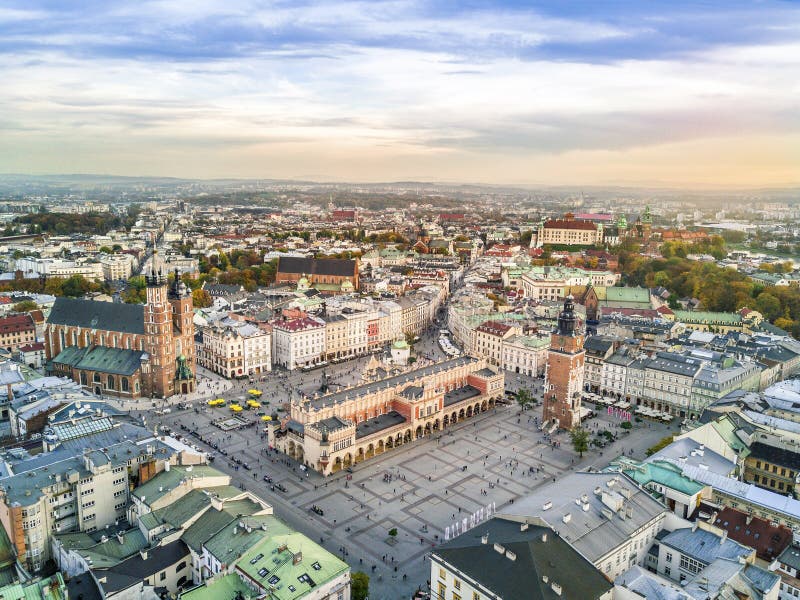
Kraków's Stare Miasto (Old Town) is a UNESCO World Heritage Site, and unlike many such designations, the label is not an overstatement. The medieval core is remarkably intact — the city walls, the market square, the Gothic churches, the Renaissance townhouses — because the German army chose not to destroy it when they retreated in January 1945. The reasons for this decision are still debated by historians. The result is that Kraków is one of the few Central European cities where you can walk through a medieval street and feel, genuinely, that you are in the Middle Ages.
The Rynek Główny — the Main Market Square — is the largest medieval market square in Europe, and it is extraordinary in every season. In summer, the café terraces spread across the cobblestones and the square fills with music and tourists and pigeons. In winter, the Christmas market transforms it into something from a fairy tale, with wooden stalls selling mulled wine (grzaniec) and smoked cheese (oscypek) and hand-carved wooden toys. In spring, the chestnut trees bloom along the edges and the light turns the Gothic towers gold. In autumn, the fog comes in from the Vistula and the square empties by nine in the evening and becomes something private and medieval and yours.
The Cloth Hall (Sukiennice) in the center of the square was built in the 14th century as a trading post for cloth merchants from across Europe. The ground floor is now a market selling amber jewelry and linen and folk art and the kind of tourist merchandise you find in every European city, but the Gallery of Polish Painting on the upper floor contains some of the most important 19th-century Polish art in existence. Jan Matejko's enormous historical canvases — The Battle of Grunwald, Stańczyk — are here, and they are overwhelming in their scale and their emotional intensity.
The St. Mary's Basilica on the northeast corner of the square is one of the great Gothic churches of Central Europe. Every hour, a trumpeter plays the hejnał — a short bugle call — from the tallest tower, breaking off mid-phrase to commemorate a 13th-century trumpeter who was shot through the throat by a Mongol arrow while sounding the alarm. The call has been played every hour, without interruption, for seven hundred years. It is played live by a member of the Kraków fire brigade. At midnight, it is broadcast on Polish national radio. This is the kind of detail that makes Kraków Kraków.
The Barbican and the Florian Gate are the surviving remnants of the medieval city walls — a fortified gatehouse and a round bastion connected by a short stretch of wall that now serves as an outdoor gallery for local artists. Walk through the Florian Gate into the Old Town and you are walking through the same entrance that Polish kings used for five centuries.
Wawel: The Hill That Holds Polish History
Every Polish city has its castle. Kraków's is different. The Wawel is not just a castle — it is the physical and spiritual center of Polish national identity, a hilltop complex that contains the royal castle, the cathedral, and the tombs of Polish kings and national heroes in a single fortified enclosure above the Vistula.
The Wawel Cathedral is where Polish kings were crowned and buried for five centuries. The crypt contains the sarcophagi of Casimir the Great, Władysław Jagiełło, and — in a silver coffin in the Sigismund Chapel — Queen Jadwiga, who was canonized in 1997. The Sigismund Chapel itself, built in the 16th century, is considered the finest example of Renaissance architecture north of the Alps. The gold dome visible from the river is covered in actual gilded copper. The interior is a masterpiece of Renaissance proportion and ornament that would not look out of place in Florence.
The Wawel Royal Castle was the residence of Polish kings from the 11th century until the capital moved to Warsaw in 1596. The State Rooms contain one of the great collections of Flemish tapestries in the world — 136 pieces commissioned by Sigismund Augustus in the 16th century, depicting hunting scenes and biblical narratives with a vividness that has survived five centuries. The Royal Private Apartments are more intimate — the king's bedroom, the council chamber, the treasury — and give a sense of what it meant to live at the center of a major European power in the Renaissance.
The Dragon's Den (Smocza Jama) beneath the castle is a limestone cave where, according to legend, the Wawel Dragon lived before being outwitted by a clever cobbler's apprentice. The cave is real — a 270-meter network of chambers carved by the Vistula over millions of years. At the cave's entrance on the riverbank, a metal dragon sculpture breathes actual fire every few minutes. Children love it. Adults pretend they don't love it. Everyone loves it.
Kazimierz: The Jewish Quarter and the Weight of Memory
Kazimierz was founded in 1335 as a separate city by King Casimir the Great — the king who, according to legend, was so in love with a Jewish woman named Estera that he granted Jews unprecedented rights and protections in his kingdom. Whether the legend is true or not, Kazimierz became one of the most important Jewish communities in Europe, a center of Torah scholarship and commerce and culture that survived for six centuries.
The Nazis liquidated the Kraków ghetto in 1943. Most of Kazimierz's Jewish population was sent to Auschwitz-Birkenau. The neighborhood was left largely empty. The synagogues survived — seven of them, including the Old Synagogue (Stara Synagoga), the oldest surviving synagogue in Poland, built in the 15th century and now a museum of Jewish history and culture. The Remuh Synagogue next to the Remuh Cemetery is still active, one of the few functioning synagogues in Poland. The cemetery contains gravestones from the 16th century, many of them covered in pebbles left by visitors in the Jewish tradition of remembrance.
Since 1989, Kazimierz has undergone a remarkable transformation. The Jewish Cultural Festival, held every June, draws tens of thousands of visitors for a week of concerts, exhibitions, workshops, and klezmer music performed in the streets and courtyards of the old quarter. Jewish-owned restaurants and cultural centers have opened. The neighborhood has become a center of Kraków's creative and nightlife scene — the bars and restaurants on Plac Nowy and the surrounding streets are where the city's young people go on weekend evenings.
This coexistence of memory and vitality is Kazimierz's defining quality. The past is present here in a way that is neither sanitized nor paralyzing. You can eat at a restaurant in a building that survived the war, drink at a bar in a former prayer house, and walk past a memorial plaque on your way home, and all of it is part of the same neighborhood, the same evening, the same city.
Schindler's Factory (Fabryka Schindlera) is a fifteen-minute walk from Kazimierz, across the Vistula in the former Podgórze district — the area where the Nazis established the Kraków ghetto. The factory, where Oskar Schindler employed Jewish workers and saved over a thousand lives, is now a museum of Kraków under Nazi occupation. It is one of the best-designed historical museums in Europe: immersive, intelligent, and devastating. Plan at least two hours. Bring tissues.
Auschwitz-Birkenau: The Day Trip That Changes Everything
Forty-five miles west of Kraków, the Auschwitz-Birkenau concentration and extermination camp complex is the largest cemetery in the world. Over 1.1 million people — the vast majority of them Jews from across occupied Europe — were murdered here between 1940 and 1945. The site is preserved almost exactly as the Soviets found it in January 1945.
This is not a tourist attraction. It is a place of pilgrimage and witness. The obligation to go — to see the barracks, the gas chambers, the mountains of shoes and hair and suitcases — is not about satisfying curiosity. It is about refusing to let the scale of what happened here become abstract. Numbers become abstract. Shoes do not.
The visit is organized as a guided tour (required for Auschwitz I, the main camp; optional for Birkenau). Book in advance — the site receives over two million visitors a year and timed entry is mandatory. Allow a full day. Do not bring children under fourteen. Do not take selfies. Do not speak loudly. The site has its own protocols of behavior that most visitors observe instinctively, because the place itself demands a certain silence.
The return to Kraków in the evening — the city lights, the restaurants, the jazz in Kazimierz — is a complicated experience. The contrast is not inappropriate. It is, in fact, the point. The people who were murdered at Auschwitz were people who ate in restaurants and listened to music and walked through market squares. The ordinariness of Kraków after Auschwitz is not a relief. It is a reminder.
The Food: Pierogi, Żurek, and the Art of Eating Like a Pole
Polish food has a reputation problem. People who have never eaten it associate it with heaviness and grease and the kind of cuisine that exists to fuel hard physical labor in cold weather. People who have eaten it know that this reputation is both partially accurate and completely beside the point.
Pierogi are the foundation. These stuffed dumplings — boiled or pan-fried, filled with potato and cheese (ruskie), sauerkraut and mushroom (z kapustą i grzybami), meat, or sweet fruit — are the most versatile food in the Polish canon. They are street food and restaurant food and grandmother food and hangover food. The best ones in Kraków are made by hand in small restaurants in the Old Town and Kazimierz, and they cost almost nothing.
Żurek is a sour rye soup served in a hollowed-out bread bowl with hard-boiled egg and white sausage. It is the taste of Polish winter — thick and tangy and deeply savory — and it is one of the great soups of the world. Order it everywhere. Compare versions. Form opinions.
Bigos — hunter's stew, made from sauerkraut and fresh cabbage and whatever meat is available, slow-cooked for hours — is the dish that Polish literature has been writing about for centuries. Mickiewicz devoted several stanzas of Pan Tadeusz to it. It tastes better the second day. It tastes best on the third.
The Plac Nowy market in Kazimierz is where you go for zapiekanka — a toasted baguette half covered in mushrooms and cheese and whatever toppings you choose, sold from a circular kiosk in the center of the square. It is the Kraków street food, the thing locals eat at two in the morning after the bars close. It costs two euros. It is perfect.
The craft beer scene in Kraków has exploded in the last decade. The brewpubs in Kazimierz and the Old Town serve IPAs and stouts and sours alongside the traditional Polish lagers, and the quality is genuinely excellent. The Browar Lubicz in the Old Town brews on-site and the unfiltered wheat beer is the best thing to drink in summer. The Omerta bar in Kazimierz has the best whiskey selection in the city and stays open until four in the morning.
The Salt Mines: Wieliczka and the Underground Cathedral
Thirteen kilometers south of Kraków, the Wieliczka Salt Mine has been in continuous operation since the 13th century. It descends to a depth of 327 meters and contains over 300 kilometers of tunnels. It is also, improbably, one of the most beautiful places in Poland.
The miners carved chapels and statues and entire chambers from the salt rock over seven centuries, and the result is an underground world that is part industrial heritage site, part folk art museum, part cathedral. The Chapel of St. Kinga — a full-sized church carved entirely from salt, with chandeliers made from salt crystals and bas-relief carvings of biblical scenes on the walls — is one of the most extraordinary rooms in Europe. The floor is salt. The altar is salt. The chandeliers are salt. The light refracts through the crystals and turns the entire chamber gold.
The mine is a UNESCO World Heritage Site and receives over a million visitors a year. Book in advance. The guided tour takes about two hours and covers about two kilometers of tunnels. The temperature underground is a constant 14°C (57°F) — bring a layer.
Nowa Huta: The Communist Experiment That Became a Neighborhood
Five kilometers east of the Old Town, Nowa Huta is the most unusual district in Kraków — and one of the most unusual urban spaces in Europe. Built from scratch between 1949 and 1956 as a model socialist city, it was designed by Soviet-trained architects to house the workers of the Lenin Steelworks (now the Tadeusz Sendzimir Steelworks), which was itself built as a deliberate counterweight to Kraków's bourgeois, Catholic, intellectual character. The Communists wanted to dilute the old city with a new proletarian one. The plan didn't work. Nowa Huta became one of the most active centers of anti-Communist resistance in Poland.
The architecture is extraordinary in its ambition and its strangeness. The main avenue — Aleja Róż (Avenue of Roses) — is a broad boulevard lined with Socialist Realist apartment blocks that look like they were designed by someone who had seen photographs of Paris and decided to make it more imposing. The central square, Plac Centralny, is a perfect semicircle of six-story buildings arranged around a fountain, with the steelworks visible on the horizon. It is simultaneously beautiful and oppressive, which is exactly what Socialist Realism was supposed to be.
The Nowa Huta Museum in the cultural center on the main square tells the story of the district's construction and its transformation from Communist showpiece to Solidarity stronghold. The exhibits include original furniture from the model apartments, propaganda posters, and a remarkable collection of photographs documenting the steelworks and the workers who built the city. The museum is small and excellent and almost entirely overlooked by visitors who don't venture east of the Old Town.
The Lord's Ark Church (Arka Pana) in the Bieńczyce neighborhood is the physical embodiment of Nowa Huta's resistance. The Communists refused to allow a church to be built in their model atheist city. The residents of Nowa Huta fought for twenty years — marching, petitioning, and eventually rioting — until the church was finally built in 1977. The building, designed by Wojciech Pietrzyk, looks like a concrete ark rising from the ground, its exterior covered in two million pebbles brought by parishioners from the Vistula riverbed. Pope John Paul II — who had been Archbishop of Kraków during the struggle — consecrated it. It is one of the most moving buildings in Poland.
The Tatras: When Kraków Sends You to the Mountains
Two hours south of Kraków by bus or train, the Tatra Mountains rise from the Polish-Slovak border in a wall of granite peaks that looks nothing like the rest of Central Europe. The highest peak, Rysy, reaches 2,499 meters. The valleys are deep and forested. The waterfalls are loud and cold. The mountain sheep (owce) graze on meadows above the treeline and produce the milk for oscypek, the smoked cheese sold at every mountain stall.
Zakopane, the mountain resort town at the foot of the Tatras, is the base for most visitors. It is crowded in summer and winter, and the main pedestrian street (Krupówki) is a gauntlet of souvenir shops and grilled cheese vendors. Push through it. The mountains behind the town are worth everything the town puts you through to reach them.
The Morskie Oko (Eye of the Sea) lake, reached by a nine-kilometer trail through the Rybi Potok valley, is one of the most beautiful places in Poland — a glacial lake at 1,395 meters surrounded by granite walls and fed by waterfalls from the peaks above. The trail is well-marked and manageable for most hikers. The lake at sunrise, before the day-trippers arrive, is something that stays with you.
The Kasprowy Wierch cable car lifts you from the valley floor to 1,987 meters in twenty minutes. At the top, the ridge marks the border between Poland and Slovakia, and on a clear day you can see both countries spreading out below you — the Tatras to the south, the Podhale plateau to the north, and the particular quality of mountain light that makes everything look like it's been painted rather than photographed.
Zakopane has its own food culture — the kwaśnica (sour cabbage soup with ribs) is the mountain version of żurek, and the grilled oscypek with cranberry jam served at every stall on Krupówki is the mountain snack that everyone eats and no one admits to loving as much as they do.
Plan Your Kraków Trip with Ask Leif
Three guides in the Ask Leif library are built specifically for Kraków, each designed for a different type of traveler and pace.
The Kraków City Break: A 3-Day Urban Adventure Guide is the essential Kraków experience — three days that cover the Old Town, Wawel, Kazimierz, and the Schindler's Factory museum, with the Wieliczka Salt Mine as a half-day option. It's the right guide for a long weekend and the right starting point for anyone visiting for the first time.
The 4-Day Krakow Travel Guide: Wawel Castle, Kazimierz, Auschwitz & Pierogi on a Budget adds the Auschwitz-Birkenau day trip and builds in more time for the food scene and the Kazimierz nightlife. The budget focus is real — Kraków is one of the most affordable major cities in Europe, and this guide shows you how to eat and drink well without spending much.
Families traveling with children will find the Kraków Family Adventure: 4-Day Itinerary for Kids & Parents the most useful — it balances the historical sites (Wawel Dragon, the salt mines, the market square) with the practical realities of traveling with young people, and it approaches the more difficult history with age-appropriate framing.
Use any of these as a starting point, then let Ask Leif customize the itinerary to your exact dates, budget, and the specific experiences you want to prioritize.
Why Kraków Stays With You
Most cities are easier to leave than to arrive in. Kraków is the opposite. The arrival — the first view of the market square, the first pierogi, the first walk through Kazimierz — is disorienting in its beauty and its weight. The departure is harder. You find yourself standing at the gate at the airport thinking about the trumpeter in the tower, about the shoes at Auschwitz, about the jazz in the bar that used to be a synagogue, about the way the light came through the salt crystals in the underground chapel.
Kraków is a city that asks something of you. Not just your attention — your willingness to sit with complexity, to hold joy and grief in the same hand, to be present in a place where the past is not past. Most people who visit leave having given it what it asked. Most of them come back.
The ones who don't come back are still thinking about it. That counts too.