In Helsinki, the Sauna Is Not Where You Relax. It's Where You're Honest.
Destination: Helsinki
Category: destination
In Helsinki, the Sauna Is Not Where You Relax. It's Where You're Honest.
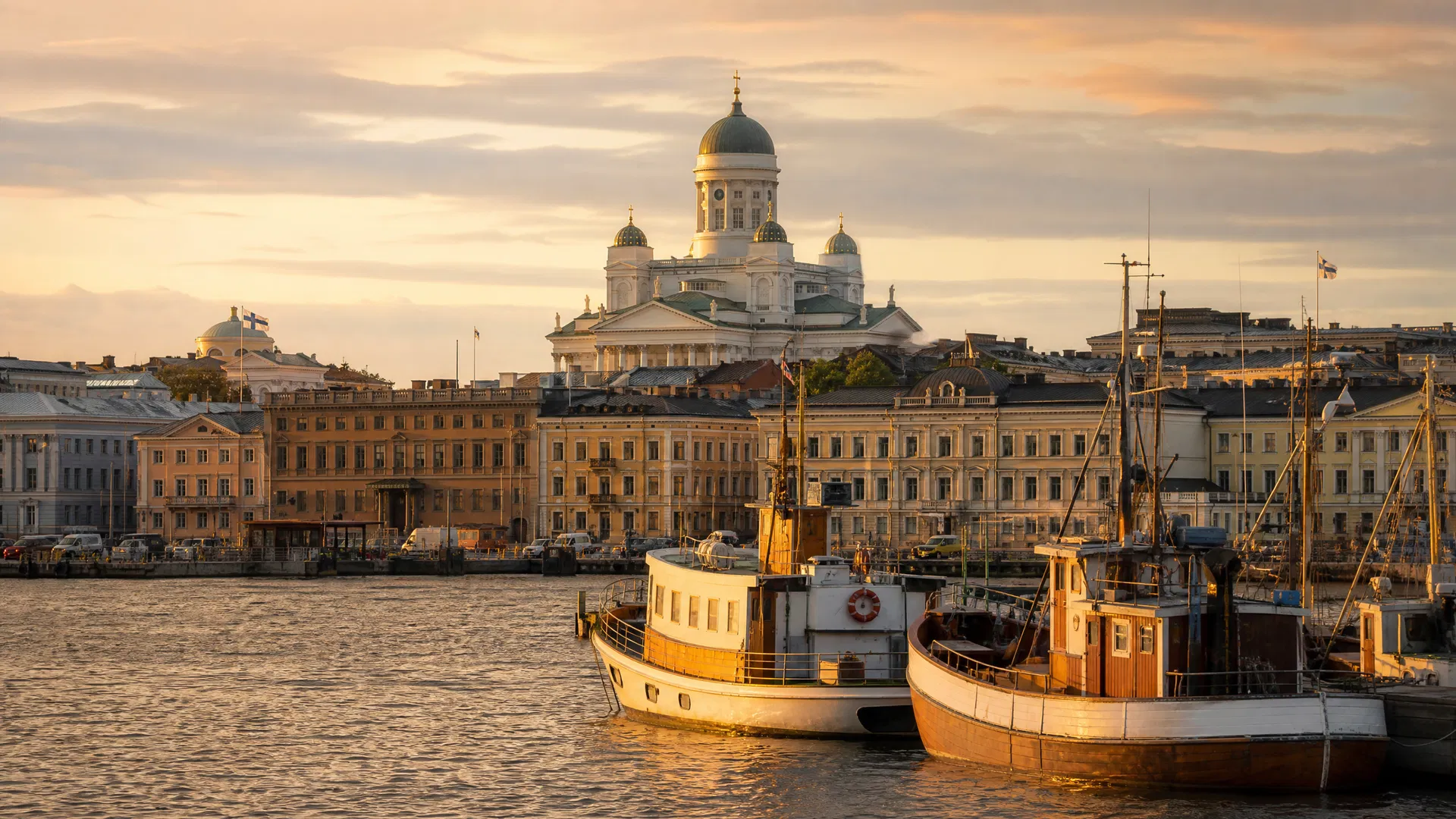
The photographs don't prepare you for Helsinki. Not because the city is more beautiful than the photographs — though it is, in the way that all northern light is more beautiful in person, that specific quality of late-afternoon sun in summer that turns the harbor amber and makes every building look like it was designed specifically for that hour. The photographs don't prepare you because they show you the wrong thing. They show you a city. What Helsinki actually is, is a practice.
The practice is this: you strip away everything that isn't essential. The performance, the small talk, the social armor that most cities require you to wear just to move through them. Helsinki doesn't ask for any of it. The tram runs silently. The strangers on it don't make eye contact. The cafes are full of people sitting alone with their coffee, not performing the act of being in a cafe but simply being in one. And then, at some point during your time here, someone invites you to a sauna — or you find your way to one on your own — and you understand that this is not a wellness trend or a tourist experience. It is the mechanism by which an entire culture processes its inner life.
That is the thesis of Helsinki. Not "here is a city with good design and a ferry to Tallinn." The thesis is that Helsinki is the only major European capital where the most authentic social experience available to a visitor involves sitting naked with strangers in eighty-degree heat, saying almost nothing, and feeling — for the first time in a long time — completely honest. The silence is not the absence of connection. In Helsinki, the silence is the connection.
The Löyly, the Birch, and the Thing That Happens After
There are four saunas you need to know about in Helsinki, and they exist on a spectrum that tells you everything about how Finnish culture works.
At one end is Löyly, on the Hernesaari waterfront. It is architecturally extraordinary — a cascade of weathered timber that spills down to the Baltic, with a terrace restaurant and a view that makes you understand why Finns have an almost theological relationship with the sea. Löyly is where you go if you want to understand what the sauna looks like when it becomes a cultural export. It is beautiful. It is also, by Helsinki standards, a tourist sauna, and the Finns will tell you this without judgment. They are not being snobs. They are making a distinction that matters.
At the other end is Sompasauna, on the Kalasatama waterfront. It was built by volunteers. There is no staff. There are no reservations. It is open twenty-four hours a day, every day, and it costs nothing. Someone built it because they believed that a sauna should be a commons — a place that belongs to everyone and requires nothing from you except that you show up and respect the space. On a Tuesday evening in July, when the sun is still fully up at ten o'clock and the light on the water is doing something that has no name in English, Sompasauna is the most honest place in Europe.
Between them, in Kallio, is Kotiharjun Sauna at Itäinen Viertotie 1. It has been operating since 1928. It is the last wood-burning public sauna in Helsinki — not electric, not gas, but wood, which produces a different quality of heat, a softer steam, a smell that is part smoke and part birch and part something older than any of those things. Entry is sixteen euros. The clientele is local. Nobody is performing anything. This is where Helsinki residents have been going for nearly a century to do the thing that Finnish culture has always understood: that the body needs heat, the mind needs quiet, and both of those things are best experienced in the company of other people who are also not talking.
And then there is Allas Sea Pool, which sits between Löyly and Kotiharjun on the tourist-to-local spectrum — a floating complex of pools and saunas in the South Harbor, with a view of the ferry terminals and the islands beyond. It is excellent. It is also not the point.
The point is the ritual itself, and the ritual has a specific architecture. You enter the sauna. The temperature is between seventy and ninety degrees Celsius — not the dry heat of a gym sauna but a wet, enveloping warmth that comes from the löyly, the steam produced when water is thrown onto the hot stones of the kiuas, the sauna stove. The word löyly has no direct English translation. It refers specifically to the steam that rises from the stones, but it carries a secondary meaning — the spirit of the sauna, the thing that makes it more than a hot room. When someone throws water on the stones, they are not just producing steam. They are, in the Finnish understanding, summoning something.
The birch branch — the vihta or vasta, depending on which part of Finland you're in — is a bundle of fresh birch twigs that you use to lightly whisk your own skin or someone else's. It sounds strange until you've done it. The oils in the birch leaves open the pores, the gentle impact increases circulation, and the smell — green, clean, faintly medicinal — is so specific to this experience that encountering it anywhere else in the world will immediately return you to a Finnish sauna. The whisking is not vigorous. It is rhythmic and unhurried, the way all things in a sauna are unhurried.
And then, when the heat becomes complete — when you have absorbed as much of it as your body wants — you go outside and you get into cold water. At Sompasauna, this means the Baltic Sea. At Kotiharjun, it means a cold shower. At Allas, it means a pool kept at a temperature that will make you gasp. The gasp is the point. The contrast between the heat you've been holding and the cold that receives you produces something that is physiologically real — a flood of endorphins, a sharp clarity, a feeling that your body has been reset to its factory settings — and also something that is harder to name. You feel, briefly, like you have no history. Like you are simply a body in the world, warm and then cold and then warm again, and nothing that happened before this moment is particularly relevant.
This is what the sauna produces. Not relaxation — that word is too passive, too spa-adjacent. The sauna produces honesty. It is almost impossible to maintain a social performance in a sauna. The heat strips it away. The nakedness strips it away. The silence — which is not uncomfortable but simply Finnish — strips away the last of it. What remains is the actual person. This is why Finnish business deals have historically been conducted in saunas. This is why Finnish families process grief in saunas. This is why, if a Finn invites you to their sauna, you have been offered something that has no equivalent in any other culture: access to the version of them that doesn't perform.
Kallio: The Neighborhood That Refused to Become Polished
Every city has a neighborhood that gentrification reached but couldn't fully domesticate. In Helsinki, that neighborhood is Kallio, and the reason it survived is that the Finns who live there are constitutionally resistant to the idea that a place should be made more comfortable for people who don't already live there.
Kallio sits north of the city center, across the Pitkäsilta bridge, and its character is the product of a specific history: it was Helsinki's working-class district, then its red-light district, then its artist district, and now it is all three of those things simultaneously, which is what makes it the most interesting square kilometer in Finland. The rents have risen. The coffee shops have multiplied. There are now natural wine bars on streets that twenty years ago had only räkälät — the Finnish word for dive bars, which translates roughly as "dump" but carries a warmth that the English word doesn't.
The räkälät are still there. Roskapankki on Vaasankatu has been there through every wave of Kallio's transformation and shows no signs of becoming anything other than what it is: a bar where the beer is cheap, the music is loud enough to hear but not so loud that you can't talk, and the clientele is a cross-section of Helsinki that you will not find in the Design District. The name means "Garbage Bank." This is intentional.
Vaasankatu and Helsinginkatu are the two streets that define Kallio's character. On a summer evening, the terraces spill onto the pavement and the light is still bright at nine o'clock and the entire neighborhood has the quality of a city that has decided to be itself rather than to be impressive. This is the highest compliment you can pay a neighborhood.
For coffee, the place that locals know and tourists don't is Kahvila Sävy on Fleminginkatu — a small, unhurried cafe where the pastries are Finnish and the coffee is taken seriously and nobody is on a laptop performing the act of working. For a proper Finnish lunch, the Hakaniemi Market Hall is a ten-minute walk from the heart of Kallio, and it is one of the most underrepresented food experiences in Helsinki.
The Market That Feeds the City Before It Wakes Up
The Old Market Hall on the South Esplanade is what tourists visit. It is beautiful and worth seeing. It is also, by eight o'clock on a Saturday morning, already filling with visitors who have read the same three travel articles.
Hakaniemi Market Hall, a fifteen-minute walk north, is where Helsinki eats. The building is a red-brick hall from 1914, two floors, and the vendors have been there long enough that the market has the quality of a place that has survived by being genuinely useful rather than by being photogenic. On the ground floor: fish vendors, meat vendors, a cheese counter where you can buy leipäjuusto — Finnish oven-baked cheese, squeaky and mild, served with cloudberry jam — and a stall that sells Karelian pies (karjalanpiirakka), the thin rye-crust pastries filled with rice porridge that are the most specific taste of Finnish food culture. The correct way to eat them is with munavoi — a mixture of hard-boiled egg and butter that sounds wrong and tastes exactly right.
The reindeer is on the ground floor too. Sautéed reindeer (poronkäristys) with mashed potatoes, pickled cucumber, and lingonberry jam is the dish that every Finnish grandmother has made and every Helsinki restaurant charges twenty-five euros for. At Hakaniemi, you can eat it at a counter for twelve. The lingonberry jam is not a garnish. It is load-bearing.
Go at eight in the morning on a Saturday. The vendors are setting up. The coffee is fresh. The tourists have not yet arrived. You will be eating breakfast next to Helsinki residents who have been coming to this market for decades, and the silence between you will be comfortable in the way that Finnish silence always is — not hostile, not awkward, simply the acknowledgment that you are both here for the same thing and no further explanation is required.
The Building That Explains the Country
Oodi, the Helsinki Central Library, opened in 2018 and immediately became the most visited building in Finland. This is not a coincidence. Finland has the highest library usage rate in the world — roughly half of all Finnish citizens visit a library every month — and Oodi was built as a statement about what a library is for.
It is not primarily for books, though there are books. It is for the city. The ground floor is a public living room: sofas, a cafe, 3D printers, sewing machines, a recording studio, a tool lending library. The second floor is for events. The third floor is for reading. The rooftop terrace is open to everyone and has a view across Töölönlahti Bay to the National Museum and the Parliament building that is, on a summer evening when the sun is still above the horizon at nine o'clock, one of the best free views in Europe.
The building is also, architecturally, a deliberate argument. It sits directly across from the Finnish Parliament, and its design — curved, open, made of wood and glass — is the physical opposite of the Parliament's granite authority. The library says: this is also what a country is. Not just its laws and its institutions, but the place where its people come to think.
Tourists walk past Oodi because it doesn't look like a tourist attraction. It looks like a building where people are doing things. That is, of course, exactly what it is.
The Island That Holds the Past
Suomenlinna is a sea fortress built on a cluster of islands in Helsinki's outer harbor, and it is the one experience that every travel article about Helsinki mentions and every travel article about Helsinki undersells.
The ferry takes fifteen minutes from Market Square and costs the same as a tram ticket because it is part of the public transit system. This is the detail that changes how you experience it. You are not taking a tourist boat to a tourist attraction. You are taking the number 19 tram route, which happens to cross water, to a place where six hundred people live year-round in eighteenth-century stone buildings surrounded by sea.
The fortress was built by Sweden in the 1740s, transferred to Russia in 1808, and became Finnish in 1918. Its walls have absorbed three centuries of military history, and the result is a landscape that is simultaneously a museum, a residential neighborhood, a park, and a place where Helsinki families come on Sunday afternoons to walk along the ramparts and look at the sea. The coexistence of all these things — the history, the residents, the tourists, the children, the water — is not managed or curated. It simply is.
Go on a weekday in the shoulder season. Bring food from Hakaniemi. Walk the eastern island, which most visitors don't reach. Find the point where the ramparts end and the sea begins and there is nothing between you and the horizon. Stay there longer than you planned to.
The Ferry at the Edge of the City
Tallinn is two and a half hours from Helsinki by ferry, and the crossing is one of the most underwritten travel experiences in northern Europe. The Viking Line and Tallink Silja ferries run multiple crossings daily, and the Finns use them in a way that has no equivalent in any other country's relationship with a neighboring city.
The day crossing is a trip. The overnight crossing — departing Helsinki at eleven at night, arriving Tallinn at six in the morning — is a Finnish social institution. The overnight ferry has a casino, several bars, a duty-free shop, and a sauna. It is, in the Finnish understanding, a floating continuation of the city: a place where the rules of land are slightly suspended and the night is longer than it would otherwise be.
For a visitor, the day crossing is the right choice. Tallinn's medieval Old Town is one of the best-preserved in Europe, and the contrast with Helsinki is instructive: Helsinki is a city of the twentieth century, rational and designed; Tallinn is a city of the fourteenth century, organic and accumulated. Spending a day in Tallinn and an evening back in Helsinki gives you a compressed version of the entire arc of northern European urban history. If you're planning to extend your time in Estonia, the Romantic Tallinn: A 3-Day Couples' Escape to Estonia's Medieval Capital guide covers the city in the depth it deserves, and the Solo Tallinn: 3-Day Medieval Old Town & Digital Nomad Guide is the version for travelers going alone.
When Helsinki Becomes Itself
Helsinki in summer is a different city from Helsinki in winter, and both of them are worth knowing.
In summer — June through August — the sun sets after ten o'clock and rises before four. The city operates on a different clock. Restaurants serve dinner at nine. Saunas are full at midnight. The parks are occupied at eleven at night by people who are simply not ready for the day to end, because the day hasn't ended, because the light is still there. The midnight sun is not a metaphor. It is a physical condition that changes how time feels, and the Finns have built their entire summer culture around it.
In winter — November through February — the sun rises at nine and sets at three. The city becomes something else: darker, quieter, more interior. The saunas are more necessary. The cafes are warmer. The reflectors appear — small light-reflecting pendants that Helsinki residents attach to their clothing so that drivers can see them in the dark. You can buy them at any pharmacy or grocery store for two to five euros. If you are visiting between November and March, buy one. Attach it to your jacket. You will be the only tourist in the city who has one, and every Finn who sees it will know that you have been paying attention.
The shoulder seasons — May and September — are when Helsinki is most itself: the light is good, the crowds are manageable, and the city is operating at its actual pace rather than its summer-performance pace.
Getting Around a City That Moves Quietly
Helsinki's public transit is a tram network supplemented by metro, bus, and ferry, and it is one of the most legible transit systems in Europe. The tram routes are numbered and the stops are announced and the system runs on time in a way that feels almost aggressive in its reliability.
The HSL day ticket covers all transit including the Suomenlinna ferry, which is the single most useful piece of information for a visitor. Buy it at the airport, at any R-Kiosk, or through the HSL app. The city is also walkable in a way that most northern cities are not — the center is compact, the streets are flat, and the distances between the harbor, the Design District, Kallio, and the Central Station are all under thirty minutes on foot.
Tipping is not customary. The prices in restaurants are higher than in most European cities because they include the full cost of the staff's wages. This is not a cultural quirk. It is a policy decision about how labor should be valued, and the food is better for it.
How to Actually Build This Trip
The mistake most visitors make in Helsinki is trying to see too much. Helsinki rewards slowness. It rewards the decision to spend three hours in a sauna instead of visiting two more museums. It rewards the morning at Hakaniemi instead of the afternoon at a fourth church. The city is not withholding its best experiences — it is simply offering them at a pace that requires you to slow down enough to receive them.
For couples, the Helsinki for Couples: A Romantic 3-Day Nordic Escape itinerary is built around the specific rhythm of the city — the sauna evenings, the harbor mornings, the Kallio nights — and it accounts for the fact that the best experiences here are not the scheduled ones. For travelers planning a broader Nordic circuit, the 4-Day Stockholm City Break and Copenhagen City Break: Your Ultimate 4-Day Urban Adventure Guide extend naturally from Helsinki, and the Norway Fjords for Adventure Couples: 7-Day Romantic & Thrilling Itinerary is the right next step for anyone who wants to understand what the Nordic landscape does at its most extreme.
If you want to build the trip rather than follow a fixed itinerary, the AskLeif itinerary generator will take your travel dates, your travel style, and your specific interests — sauna culture, food markets, island day trips, the Tallinn crossing — and produce a day-by-day plan that accounts for the seasonality, the transit logistics, and the specific rhythm of a city that rewards the traveler who arrives without a fixed agenda. The Stockholm Food & Fika: A 4-Day Culinary Journey for the Discerning Palate is worth reading before you go, not because Stockholm and Helsinki are the same — they are not — but because understanding the Nordic relationship with food and communal eating will make you a better visitor to both.
What the Light Does
There is a specific quality of light in Helsinki in late summer — seven o'clock in the evening, the sun still an hour from setting, the harbor reflecting something that is not quite gold and not quite silver — that you will not find anywhere else in Europe. It is a northern light, low-angled and long, and it makes the city look like it was designed for exactly this hour, which in a sense it was: Finnish architecture has always been built in relationship with the light, in the understanding that the light is the most variable and most precious thing about living this far north.
The Finns have a word, kaamos, for the polar night — the period in winter when the sun doesn't rise above the horizon. They have a word, ruska, for the autumn color change. They have a word, talvipäivänseisaus, for the winter solstice. A culture that names its relationship with light this precisely is a culture that has thought carefully about what it means to live in a place where light is not guaranteed.
This is the last thing Helsinki teaches you, and it is the thing that stays with you longest after you leave: that the things you take for granted — warmth, light, the ease of social interaction, the comfort of noise — are not defaults. They are gifts. Helsinki knows this because Helsinki has spent centuries without them, and has built a culture of extraordinary richness in their absence.
The sauna is warm because the winter is cold. The silence is comfortable because the Finns have learned that discomfort is not the only alternative to noise. The light at seven in the evening is beautiful because it will be gone in four months, and everyone in the city knows it, and nobody is wasting it.
You won't waste it either. That's what Helsinki does to people.
Explore Helsinki With AskLeif
- Helsinki for Couples: A Romantic 3-Day Nordic Escape
- Romantic Tallinn: A 3-Day Couples' Escape to Estonia's Medieval Capital
- Solo Tallinn: 3-Day Medieval Old Town & Digital Nomad Guide
- 4-Day Stockholm City Break: Your Ultimate Urban Adventure Guide
- Stockholm Food & Fika: A 4-Day Culinary Journey for the Discerning Palate
- Copenhagen City Break: Your Ultimate 4-Day Urban Adventure Guide
- Norway Fjords for Adventure Couples: 7-Day Romantic & Thrilling Itinerary