The Icefields Parkway Doesn't Prepare You. Nothing Does. A Complete Guide to Banff and the Canadian Rockies.
Destination: Banff, Canada
Category: Destinations
Nobody warned me about the moment the mountains appear.
You're driving west on the Trans-Canada Highway, somewhere between Calgary and Canmore, and the landscape is flat prairie — golden, wide, unremarkable. Then, without ceremony or transition, the Rockies rise out of the earth like something that was always there but had been waiting for you to be ready. They don't ease you in. They don't build gradually. They simply arrive, and they are enormous, and they are jagged in a way that feels almost aggressive, and you realize immediately that every photograph you've ever seen of this place was a lie — not because the photos were inaccurate, but because no photograph has ever successfully communicated scale.
Banff National Park is Canada's oldest national park, established in 1885, and it is one of the most visited places on earth. Roughly four million people come here every year. You will share the Icefields Parkway with tour buses. You will wait in line at Lake Louise. You will find that the parking lot at Moraine Lake fills before 6 AM in summer and that Parks Canada now requires a shuttle reservation just to access it. None of this should discourage you. It should inform how you plan, and planning — done right — means you will experience a version of Banff that most of those four million people never find.
This is that guide.
Why Banff Is Different From Every Other Mountain Destination on Earth
There are beautiful mountain ranges on every continent. The Alps have their grandeur, Patagonia its drama, the Himalayas their altitude. But the Canadian Rockies have something that's harder to name — a combination of scale, color, and accessibility that exists nowhere else. The mountains here are sedimentary, which means they're layered in bands of grey, rust, and cream that catch light differently at every hour. The glacial lakes — and there are dozens of them — are a color that shouldn't exist in nature: turquoise so saturated it looks artificially enhanced, caused by rock flour suspended in glacial meltwater that scatters sunlight in the blue-green spectrum.
Then there's the wildlife. Banff is one of the few places in North America where you can, in a single day, see a grizzly bear, a black bear, a wolf, a moose, an elk, a bighorn sheep, and a mountain goat — all in their natural habitat, all without leaving the main road. This is not a zoo. This is a functioning, intact ecosystem that has been protected for 140 years, and it shows.
And then there's the Icefields Parkway.
The 232-kilometer highway between Banff and Jasper is widely considered the most scenic drive in the world — not by travel writers trying to be hyperbolic, but by people who have driven the Amalfi Coast, the Ring of Kerry, the Pacific Coast Highway, and the South Island of New Zealand and still come back to say: nothing compares. You will drive past 100 glaciers. You will stop at viewpoints where the mountains are so close they block the sky. You will pull over at Peyto Lake and stand at the overlook and feel something that is not quite describable — a combination of smallness and gratitude that the world contains this.
The Honest Seasonal Guide: When to Actually Go
June and July are the sweet spot for most visitors. The snow has melted from the lower trails, the wildflowers are in bloom, the days are long (it doesn't get dark until nearly 10 PM), and the glacial lakes are at their most vivid. The trade-off is crowds — June and July are peak season, and the most famous spots will be busy. Book accommodation six to twelve months in advance for these months. This is not an exaggeration.
August is slightly less crowded than July but still busy. The weather is warm and stable, making it ideal for hiking. Larch season begins in late August and peaks in mid-September — the larches are the only deciduous conifer in the Rockies, and when they turn gold in autumn, the landscape transforms into something that looks like a painting that couldn't possibly be real.
September is, for many experienced Banff visitors, the best month of all. The crowds thin dramatically after Labor Day. The larches are golden. The light is lower and warmer. The elk rut begins, which means you'll hear bull elk bugling at dawn — one of the most primordial sounds in North America. The temperature drops at night, but daytime hiking is perfect. Book accommodation three to six months out.
October through April is shoulder and winter season. The park is open year-round, and winter Banff is spectacular — frozen lakes, snow-covered peaks, and the chance to ski Sunshine Village, Lake Louise Ski Resort, and Mt. Norquay, three world-class ski areas within the park boundary. The northern lights are occasionally visible. The crowds are a fraction of summer. If you ski or snowshoe, winter Banff is one of the great underrated travel experiences in the world.
May is mud season. Snow is melting, trails are wet, and many higher-elevation routes are still closed. It's the quietest month, but it's also the least rewarding for hiking. Skip May unless you're specifically coming for the shoulder-season quiet.
Banff Town: The Base You'll Keep Coming Back To
Banff townsite sits at 1,383 meters elevation inside the national park boundary — the only town in Canada that exists within a national park. It has a permanent population of about 8,000 people, a main street lined with restaurants and gear shops, and a backdrop of mountains so dramatic that first-time visitors often stop in the middle of the sidewalk to stare.
Banff Avenue is the main drag, and it's more charming than you'd expect from a tourist town. The gear shops are legitimate — Mountain Equipment Company, Atmosphere, and a dozen independent outfitters sell everything you need for serious backcountry travel. The restaurants range from casual to genuinely excellent.
The Banff Centre for Arts and Creativity sits on Tunnel Mountain and hosts world-class performances, residencies, and exhibitions year-round. It's easy to miss if you're focused on the outdoors, but the campus views alone are worth the walk up.
Banff Upper Hot Springs on Sulphur Mountain Road is exactly what it sounds like: a natural hot spring pool at 1,585 meters elevation, with mountain views in every direction. After a long day of hiking, soaking in 40°C water while looking at the Rockies is one of the great simple pleasures of the trip.
Banff Gondola on Sulphur Mountain takes you to 2,281 meters in eight minutes. The summit boardwalk connects to Sanson's Peak, where a meteorological station has been recording weather data since 1903. The views from the top are genuinely 360-degree — you can see four mountain ranges simultaneously. Come at sunrise or sunset if you can.
For accommodation, the Fairmont Banff Springs Hotel is one of the great iconic hotels of the world — a castle built into the side of Sulphur Mountain in 1888, with 764 rooms, a world-class spa, and a level of grandeur that is simultaneously over-the-top and completely appropriate for the setting. It is expensive. It is worth it, at least for one night. For more affordable options, the Banff Aspen Lodge and Moose Hotel and Suites offer comfortable rooms at a fraction of the Fairmont price.
Lake Louise: The Most Photographed Lake in Canada (And Why It Still Earns Every Photo)
Lake Louise is 57 kilometers northwest of Banff town, and it is, without question, one of the most beautiful places on earth. The lake is 2.4 kilometers long, 500 meters wide, and a color that defies easy description — turquoise in the morning, blue-green at midday, almost emerald in the late afternoon light. The Victoria Glacier sits at the far end, feeding the lake with meltwater. The Fairmont Chateau Lake Louise sits at the near end, its green copper roof reflected in the water.
The crowds are real. On a summer morning, the parking lot fills before 7 AM, and Parks Canada now runs a mandatory shuttle from the Lake Louise Ski Resort parking area during peak season. Take the shuttle. Don't try to fight for parking — you will lose, and you will be frustrated before you've even seen the lake.
The Lake Louise Lakeshore Trail is 4.2 kilometers round-trip, flat, and accessible to virtually everyone. Walk the full length of the lake to the far end, where you'll be standing at the base of the glacier with the Chateau behind you and the mountains on all sides. This is the moment.
The Plain of Six Glaciers Trail extends beyond the lakeshore, climbing to a teahouse at 2,135 meters that has been serving hikers since 1927. The teahouse is solar-powered, cash-only, and serves homemade soup and pie. The views from the teahouse terrace are extraordinary. This is a 14-kilometer round-trip hike with 365 meters of elevation gain — challenging but manageable for anyone in reasonable fitness.
The Beehive and Lake Agnes Teahouse is the other classic Lake Louise hike — a 7.4-kilometer loop that climbs to Lake Agnes, a smaller alpine lake sitting above a waterfall, with its own teahouse that has been operating since 1905. The Big Beehive viewpoint above the teahouse offers one of the best aerial views of Lake Louise from above. This hike is steep but worth every step.
Moraine Lake: The One That Will Break Your Heart (In the Best Way)
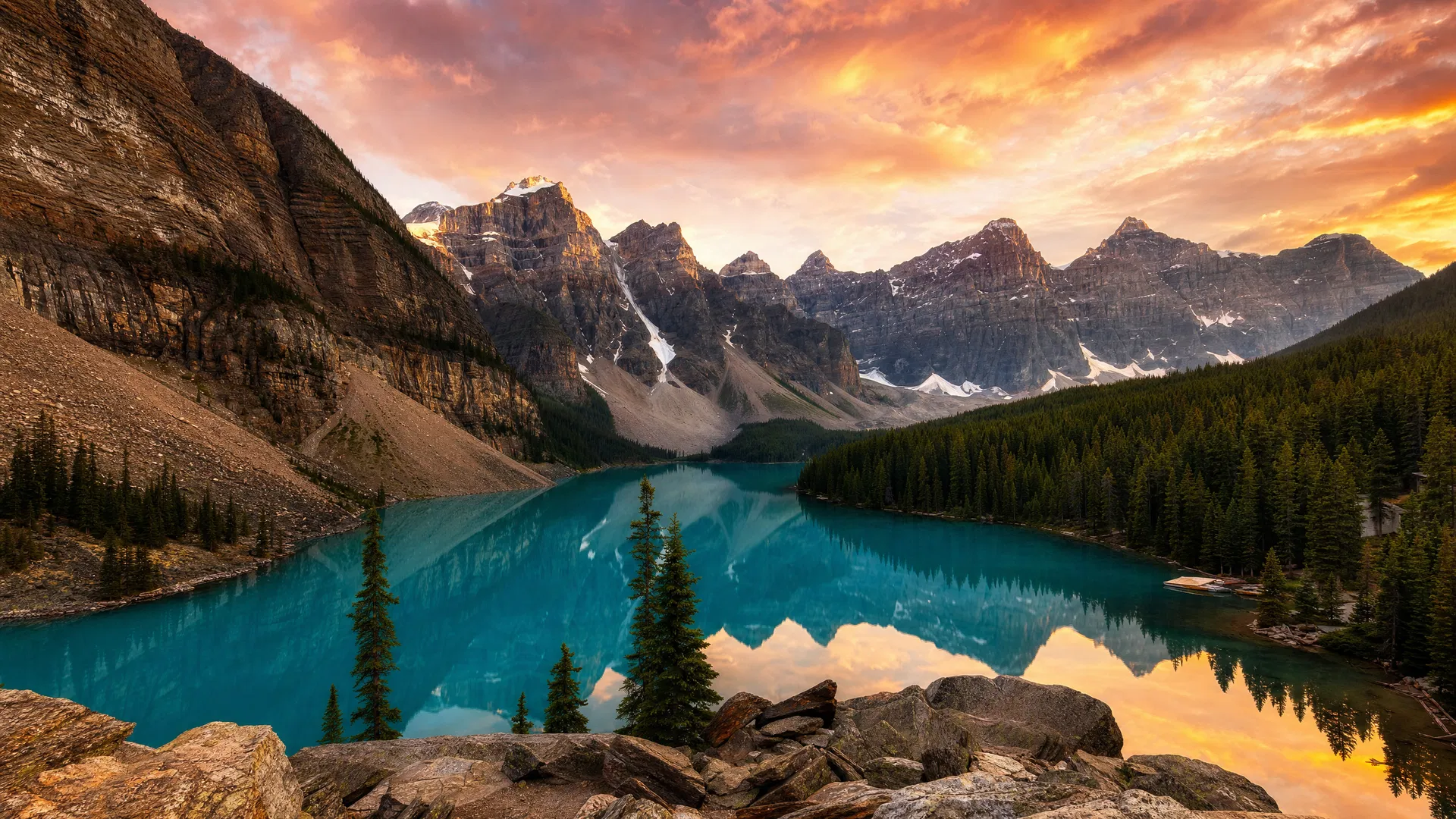
Moraine Lake is 14 kilometers from Lake Louise, and it is, if such a thing is possible, even more beautiful. The lake sits in the Valley of the Ten Peaks — ten mountains over 3,000 meters that form a semicircle around the turquoise water. The image of Moraine Lake was on the Canadian twenty-dollar bill for years. It is one of the most photographed landscapes in the world.
Access is now strictly controlled. Parks Canada closed the road to private vehicles in 2023 and requires visitors to take a shuttle from Banff or Lake Louise. Shuttles sell out weeks in advance during peak season. Book yours the moment you book your accommodation — not after, not when you arrive, but immediately. The shuttle runs from late May to mid-October.
The Rockpile Trail is a 300-meter scramble to the top of the moraine deposit at the lake's edge — the viewpoint that appears in every photograph of Moraine Lake. It takes fifteen minutes. The view from the top is the view. Go at sunrise if you can arrange the shuttle.
The Larch Valley Trail climbs above Moraine Lake into the larch forests that turn gold in September. The 11-kilometer round-trip hike to Sentinel Pass at 2,611 meters is one of the great day hikes in North America — particularly in late September, when the larches are at their peak and the crowds have thinned.
The Icefields Parkway: The Drive That Redefines the Word "Scenic"
The Icefields Parkway (Highway 93 North) runs 232 kilometers from Lake Louise to Jasper, and driving it is one of the defining travel experiences of a lifetime. Set aside a full day — not because the drive takes that long (it's about three hours without stops), but because you will stop constantly. You will not be able to help it.
Bow Lake is the first major stop, 36 kilometers north of Lake Louise. The lake is fed by the Bow Glacier, which sits in a cirque above the far shore. The Num-Ti-Jah Lodge on the north shore has been welcoming travelers since 1937. The 9-kilometer round-trip hike to Bow Glacier Falls is one of the best easy hikes on the Parkway.
Peyto Lake Viewpoint is 40 kilometers north of Lake Louise, and it is, in this writer's opinion, the single most spectacular viewpoint in the Canadian Rockies. The lake is shaped like a wolf's head when viewed from above, and the color — a blue-green so saturated it looks unreal — is caused by glacial flour suspended in the water. The viewpoint is a 20-minute walk from the parking lot. Do not skip this.
The Columbia Icefield is the largest icefield in the Rocky Mountains south of Alaska, covering 325 square kilometers and feeding eight major glaciers. The Athabasca Glacier, the most accessible of these, extends almost to the highway. You can walk to the glacier's edge on your own (follow the marked trail and heed the warning signs about crevasses) or take the Glacier Adventure tour, which drives specially designed Ice Explorer vehicles onto the glacier surface. The Skywalk, a glass-floored observation platform cantilevered over a cliff 280 meters above the Sunwapta Valley, is either thrilling or terrifying depending on your relationship with heights.
Sunwapta Falls and Athabasca Falls are both worth stops in the final stretch before Jasper. Athabasca Falls is particularly dramatic — the Athabasca River funnels through a narrow canyon and drops 23 meters in a roar of white water that you can feel in your chest.
Jasper: The Quieter, Wilder Sibling
Jasper National Park is larger than Banff — 10,878 square kilometers versus Banff's 6,641 — and receives significantly fewer visitors. The townsite is smaller and less polished than Banff, which is either a drawback or an asset depending on what you're looking for. Jasper feels more like a real mountain town and less like a resort. The wildlife viewing here is exceptional — Jasper has one of the highest densities of wildlife in any national park in North America.
Maligne Lake is 48 kilometers southeast of Jasper and is the largest natural lake in the Canadian Rockies. The boat tour to Spirit Island — a tiny forested island in the middle of the lake, surrounded by mountains — is one of the most iconic experiences in the park. Book in advance.
Maligne Canyon is a 55-meter-deep limestone gorge carved by the Maligne River. The canyon walk is accessible year-round, but the winter version — when the river freezes and you can walk through the canyon on ice — is one of the most surreal experiences in the Rockies.
Miette Hot Springs are the hottest natural hot springs in the Canadian Rockies, at 54°C before being cooled to a swimmable 40°C. They sit in a remote valley 61 kilometers from Jasper town, and the drive there passes through some of the most dramatic scenery in the park.
Hiking: The Definitive Short List
Banff and Jasper have hundreds of trails. These are the ones that belong on every serious hiker's list:
Johnston Canyon (Banff): 11.6 kilometers round-trip to the Inkpots, a series of cold springs that bubble up from underground. The lower falls are accessible via a catwalk bolted into the canyon walls. Crowded but justifiably popular.
Sentinel Pass via Larch Valley (Lake Louise): 11 kilometers round-trip, 725 meters elevation gain. The best larch hike in the Rockies in September.
Sulphur Mountain Summit Trail (Banff): 11 kilometers round-trip, 655 meters elevation gain. Hike up instead of taking the gondola and you'll have the summit largely to yourself in the morning.
Ha Ling Peak (Canmore): 6 kilometers round-trip, 730 meters elevation gain. The best view of the Bow Valley and Canmore from above. Steep but short.
Crypt Lake (Waterton Lakes): 17 kilometers round-trip, accessible only by boat. One of the most adventurous day hikes in Canada — involves a ladder, a tunnel, and a chain-assisted traverse. Worth every step.
Wilcox Pass (Icefields Parkway): 8 kilometers round-trip, 335 meters elevation gain. The best view of the Columbia Icefield and Athabasca Glacier from above. Far fewer people than the glacier itself.
Wildlife: What to Expect and How to Behave
Banff and Jasper are home to wolves, grizzly bears, black bears, cougars, wolverines, lynx, coyotes, elk, moose, caribou, bighorn sheep, and mountain goats. You will almost certainly see elk in Banff townsite — they graze on the lawns and walk down the streets with complete indifference to humans. You will likely see bighorn sheep on the road between Banff and Lake Louise. You have a reasonable chance of seeing a bear, particularly in spring and fall.
The rules are simple and non-negotiable: stay 100 meters from bears and wolves, 30 meters from all other wildlife. Do not approach, do not feed, do not try to get a better photo. Carry bear spray and know how to use it. Make noise on the trail. Travel in groups of four or more in known bear country.
If you see a wolf, stop what you're doing and pay attention. Wolves are rarely seen in Banff — when they are, it's a moment people remember for the rest of their lives.
Canmore: The Underrated Base Camp
Canmore sits just outside the national park boundary, 26 kilometers east of Banff, and it deserves more attention than it typically gets in travel writing. The town has a legitimate local culture — artists, climbers, mountain guides, and outdoor athletes who have chosen to live here because the mountains are in their backyard. The restaurant scene is excellent. The accommodation is generally less expensive than Banff. And the views are, if anything, more dramatic — the Three Sisters, a trio of limestone peaks that rise directly above the town, are among the most striking mountains in the Rockies.
Canmore's Main Street has evolved from a former coal-mining town into one of the most liveable mountain communities in Canada. The Grizzly Paw Brewing Company makes excellent craft beer and has a patio with mountain views. Communitea Café is the local breakfast institution. The Iron Goat Pub is where the guides and climbers go after a long day.
If you're planning a week in the Rockies, consider splitting your time between Canmore and Banff — Canmore for the local feel and lower prices, Banff for the park access and iconic lakes.
Practical Guide: Everything You Need to Know Before You Go
Getting There: Fly into Calgary International Airport (YYC), which is served by most major North American carriers and several international ones. The drive from Calgary to Banff is 128 kilometers, approximately 90 minutes. Rental cars are available at the airport, and several shuttle services run between Calgary and Banff.
Parks Canada Pass: You need a Parks Canada Discovery Pass to enter Banff National Park. As of 2025, the daily vehicle permit is CAD $10.50; the annual Discovery Pass (which covers all Parks Canada sites across Canada) is CAD $75.25 per adult or CAD $145.25 per family. Buy it online before you arrive.
Accommodation: Book six to twelve months in advance for summer (June–August). The Fairmont Banff Springs and Fairmont Chateau Lake Louise are the iconic splurge options. Mid-range options include the Banff Aspen Lodge, Moose Hotel and Suites, and Canmore's many excellent hotels and vacation rentals. Camping is available at multiple campgrounds within the park — Tunnel Mountain is the most accessible, Two Jack Lakeside is the most scenic.
Getting Around: A car is essential for the Icefields Parkway and most trailheads. Within Banff townsite, the Roam Transit system connects the town to major trailheads and Lake Louise. The Moraine Lake and Lake Louise shuttles are mandatory during peak season — book in advance through Parks Canada.
Cell Service: Limited inside the park. Download offline maps (Maps.me or Google Maps offline) before you arrive. The Parks Canada app has trail maps and wildlife alerts.
Bear Safety: Carry bear spray. Know how to use it. Make noise on trails. The park provides detailed bear safety information at all visitor centers.
Budget: A week in Banff with accommodation, park pass, food, and activities runs approximately CAD $2,000–4,000 per person depending on accommodation choices. The Fairmont properties will push that higher. Camping and cooking some of your own meals will bring it lower.
The Trip You Need to Plan Right Now
If you're reading this and you haven't been to Banff, let me be direct: this is the trip. Not someday. Not when the kids are older or when work slows down. Now. The glaciers are retreating — the Athabasca Glacier has lost half its volume since 1870 and retreats approximately five meters per year. The landscape you see today is not the landscape your children will see. The Columbia Icefield that feeds the Athabasca, the Bow, and six other glaciers is smaller than it was when your parents were born.
This is not meant to be alarmist. It is meant to be honest. The Canadian Rockies are one of the great natural wonders of the world, and they are accessible, safe, and staggeringly beautiful. The Icefields Parkway is the most scenic drive on earth. Lake Louise is exactly as extraordinary as everyone says. Moraine Lake will make you question every other lake you've ever seen. The wildlife is real and close and humbling.
Plan the trip. Book the car. Get the park pass. Wake up early for Moraine Lake. Drive the Parkway slowly. Stand at the edge of the Athabasca Glacier and put your hand on ice that fell as snow before your grandparents were born.
You will not regret a single kilometer.
Ready to build your Banff itinerary? Our Canadian Rockies 7-Day Road Trip Guide covers the full Banff to Jasper route day by day, and our Banff Couples Adventure Guide is built for those who want the romantic version of this trip — Lake Louise at sunrise, private glacier walks, and the Fairmont Banff Springs. If you're extending into British Columbia, our Whistler Blackcomb Ski Guide and Victoria, BC Couples Guide round out a complete Western Canada itinerary.
Use Ask Leif to build your personalized Banff itinerary — tell us your travel dates, group size, and what you want to prioritize, and we'll give you a day-by-day plan in 60 seconds.