70 Cuisines, Two James Beard Wins, and a City That Keeps Outrunning Its Own Reputation: The Houston Guide
Destination: Houston, Texas, USA
Category: destination
The first thing people say when you tell them you're going to Houston is: "Why Houston?"
It's a fair question, delivered without malice. Houston doesn't have the obvious marquee appeal of New York or LA. It doesn't have the cool-city mythology of Austin or Nashville. It doesn't have the beach. What it has is something harder to market but infinitely more rewarding to experience: a city of four million people that has quietly become one of the most interesting, most diverse, most culinarily extraordinary places in the United States — and has somehow managed to stay off the radar of the travel industry for decades.
That changes the moment you arrive.
Houston is the fourth-largest city in America. It is also, by most measures, the most ethnically diverse. More than 145 languages are spoken within city limits. The restaurant scene — over 10,000 restaurants, representing cuisine from more than 70 nations — is not a marketing claim. It is a lived reality that plays out every night across Montrose, the Heights, Midtown, Bellaire, and Chinatown. In June 2026, Houston chefs walked away from the James Beard Awards — the Oscars of the food world — with two major wins: Adrian Torres of Maximo took Emerging Chef, and Evelyn Garcia and Henry Lu of Jūn took their category. This is not a city with a food scene. This is a city that is a food scene.
And yet, somehow, it keeps getting overlooked.
This guide is for the traveler who is done with the obvious choices. The one who has been to Austin three times and wants something with more texture. The one who wants to eat Vietnamese-Cajun fusion at midnight, walk through a world-class art museum in the morning, and stand in the actual Mission Control room where NASA managed the Apollo 11 moon landing in the afternoon. Houston is that city. It has been that city for years. The rest of the travel world is just catching up.
The Neighborhoods: Where Houston Actually Lives
Houston is a city of neighborhoods, and understanding which ones to spend time in is the difference between a good trip and a great one.
Montrose is the cultural and culinary heart of the city. Walkable by Houston standards (which is saying something in a city built around the car), Montrose is where you find the Menil Collection, the Rothko Chapel, the best independent restaurants, the art galleries, the bookshops, and the kind of neighborhood energy that reminds you that Houston has always been a city of creative people who chose to stay. Hugo's has been serving elevated Mexican cuisine here since 2002. Xochi, its sister restaurant, does Oaxacan food at a level that would be remarkable in Mexico City. The neighborhood also houses some of the best Vietnamese restaurants in the country — a legacy of Houston's large Vietnamese community, which arrived in significant numbers after 1975 and built a food culture that has become one of the city's defining culinary identities.
The Heights is what people mean when they say Houston has a small-town feel. Technically a historic district, the Heights is a grid of Victorian bungalows, independent coffee shops, weekend farmers markets, and restaurants that feel like they belong in a much smaller city. White Oak Music Hall anchors the live music scene here. The Sunday farmers market on Yale Street is one of the best in Texas. The neighborhood sits in the shadow of downtown's skyline, close enough to feel connected but distinct enough to feel like its own world.
Midtown is where the energy is at night — bars, clubs, a walkable grid, and a density of restaurants that makes it easy to spend an entire evening without a plan. It's also where you'll find some of the best late-night food in the city, which is saying something in a place where the question "where do you want to eat?" is never a simple one.
Bellaire and the Beltway 8 Corridor is where Houston's Chinese and Vietnamese communities have built something extraordinary. The stretch of Bellaire Boulevard known informally as Chinatown is not a tourist attraction — it is a working, thriving commercial district with dozens of authentic Chinese, Vietnamese, Korean, and Taiwanese restaurants that have no interest in catering to outsiders. That indifference is exactly what makes it worth seeking out. The pho here is the real thing. The dim sum on weekend mornings rivals anything you'll find in San Francisco or New York.
EaDo (East Downtown) is Houston's fastest-evolving neighborhood — warehouses converted to breweries, art spaces, and restaurants, with a gritty energy that Midtown has largely lost. The Houston Dynamo stadium anchors the eastern edge. The food and bar scene is younger, louder, and more experimental than anywhere else in the city.
The Food: 70 Nations, Zero Apologies
There is a specific kind of culinary confidence that comes from a city that doesn't need to prove anything. Houston has it. The food scene here is not aspirational — it is not trying to become the next great American food city. It already is one. It just hasn't been written about enough.
Start with the Vietnamese-Cajun crawfish, which is a Houston invention and one of the great American food stories. When Vietnamese immigrants arrived in the Gulf Coast region in the 1970s and 1980s, they brought their cooking techniques to the local seafood tradition. The result — live crawfish boiled with lemongrass, garlic, butter, and Cajun spice, served in a bag at a table covered in newspaper — is one of the most satisfying eating experiences in the country. Crawfish & Noodles in Bellaire is the benchmark, but the tradition runs deep across dozens of restaurants throughout the city.
The Tex-Mex here is different from what you'll find in Austin or Dallas. Houston's version is more influenced by the Gulf Coast and by the city's proximity to the Mexican state of Tamaulipas — the tacos are softer, the salsas more complex, the seafood more present. Ninfa's on Navigation is the original, the restaurant that invented the fajita as we know it. The original location, on Navigation Boulevard in the East End, is still there and still worth the trip.
BBQ in Houston doesn't get the same attention as the Central Texas tradition (Lockhart, Taylor, Luling), but it should. Killen's Barbecue in Pearland, just south of the city, is one of the best BBQ restaurants in the state. The beef ribs are the size of a small child's arm and are cooked with the kind of patience that can't be faked.
For fine dining, the James Beard recognition is not an anomaly — it is a reflection of a restaurant scene that has been quietly building for years. Maximo (Adrian Torres) does modern Mexican with a technical precision that would be at home in any major food city in the world. Jūn (Evelyn Garcia and Henry Lu) does a Japanese-Southeast Asian fusion that is one of the most interesting menus in the country right now. Theodore Rex, Chris Shepherd's restaurant in Midtown, is the kind of place that makes you understand why Houston chefs keep winning national awards.
And then there is Bun B's Trill Burgers. The rapper and Houston native opened a burger pop-up that became a permanent restaurant, and the smash burgers here are, without exaggeration, among the best in the country. The line on weekends is long. It is worth it.
The Museum District: 19 Museums, Four Walkable Zones
The Houston Museum District is one of the most underappreciated cultural assets in the United States. Nineteen museums within four walkable zones, anchored by institutions that would be the centerpiece of any other American city's cultural identity.
The Museum of Fine Arts, Houston holds over 65,000 works spanning ancient to modern, with particular strength in European masters, American art, and Latin American collections. The Audrey Jones Beck Building and the Caroline Wiess Law Building are connected by a tunnel, and the combined collection is genuinely world-class.
The Menil Collection is one of the great private art museums in the world. John and Dominique de Menil assembled one of the most significant collections of the 20th century — Surrealism, African art, Byzantine icons, Warhol, Magritte — and then built a museum in a quiet residential neighborhood and made admission free. The building, designed by Renzo Piano, is a masterpiece of natural light. The Rothko Chapel, a few blocks away, is one of the most quietly powerful spaces in American art: fourteen large-scale paintings by Mark Rothko in an octagonal chapel that is simultaneously a work of art, a place of meditation, and a monument to the idea that art can be sacred without being religious.
The Museum of Natural Science is the most visited museum in Texas, and for good reason. The Gems and Minerals Hall is extraordinary — the kind of place where adults slow down and start reading the labels. The Butterfly Center, the Cockrell Butterfly Center, the planetarium, and the rotating special exhibitions make it a full day on its own.
Don't miss the Buffalo Soldier National Museum, which tells the history of African American military service from the Civil War through the Gulf War with a depth and specificity that is rare in American museums. Or the Art Car Museum, where cars have been transformed into rolling sculptures — a stiletto, a rabbit, a mosaic-covered touring car — and displayed with the same seriousness as any fine art institution.
Space Center Houston: Where "Houston, We Have a Problem" Was Answered
"Houston" was the first word spoken from the surface of the moon on July 20, 1969. That fact alone should be enough to put the Johnson Space Center on every itinerary.
Space Center Houston, the visitor complex adjacent to NASA's Johnson Space Center, is one of the best science and history attractions in the country. The Mission Control room — the actual room where NASA managed the Apollo missions, the Space Shuttle program, and continues to manage the International Space Station — has been restored to its 1969 configuration and is open for tours. Standing in the viewing gallery above those consoles, looking at the screens that showed the trajectory of Apollo 11, is one of those rare museum experiences that produces genuine awe in adults who thought they were past being awed.
The Saturn V rocket on display — all 363 feet of it, lying horizontally in a dedicated building — is the largest object most visitors will ever stand next to. The scale is incomprehensible until you're in the room with it.
The tram tour of the active Johnson Space Center campus, which passes the astronaut training facilities and the current Mission Control, is available on most days and adds a dimension that no other space museum in the country can match: the sense that this is not a historical site but an active operation, that people are working in these buildings right now on missions that are still happening.
Plan at least four hours. Bring children if you have them. The experience of watching a child realize that human beings actually went to the moon, and that the people who made it happen worked in a building they can see from where they're standing, is one of the best things travel can produce.
Buffalo Bayou: The Green Thread Running Through the City
Houston is not a city that most people associate with outdoor beauty, and that misconception is one of the great gifts the city offers to visitors who do their research. Buffalo Bayou Park, the 160-acre greenway that runs through the heart of the city along the bayou's banks, is one of the most ambitious urban park projects in the country — a complete transformation of a neglected waterway into a trail system, kayak launch, sculpture park, and gathering space that connects downtown to the Heights and beyond.
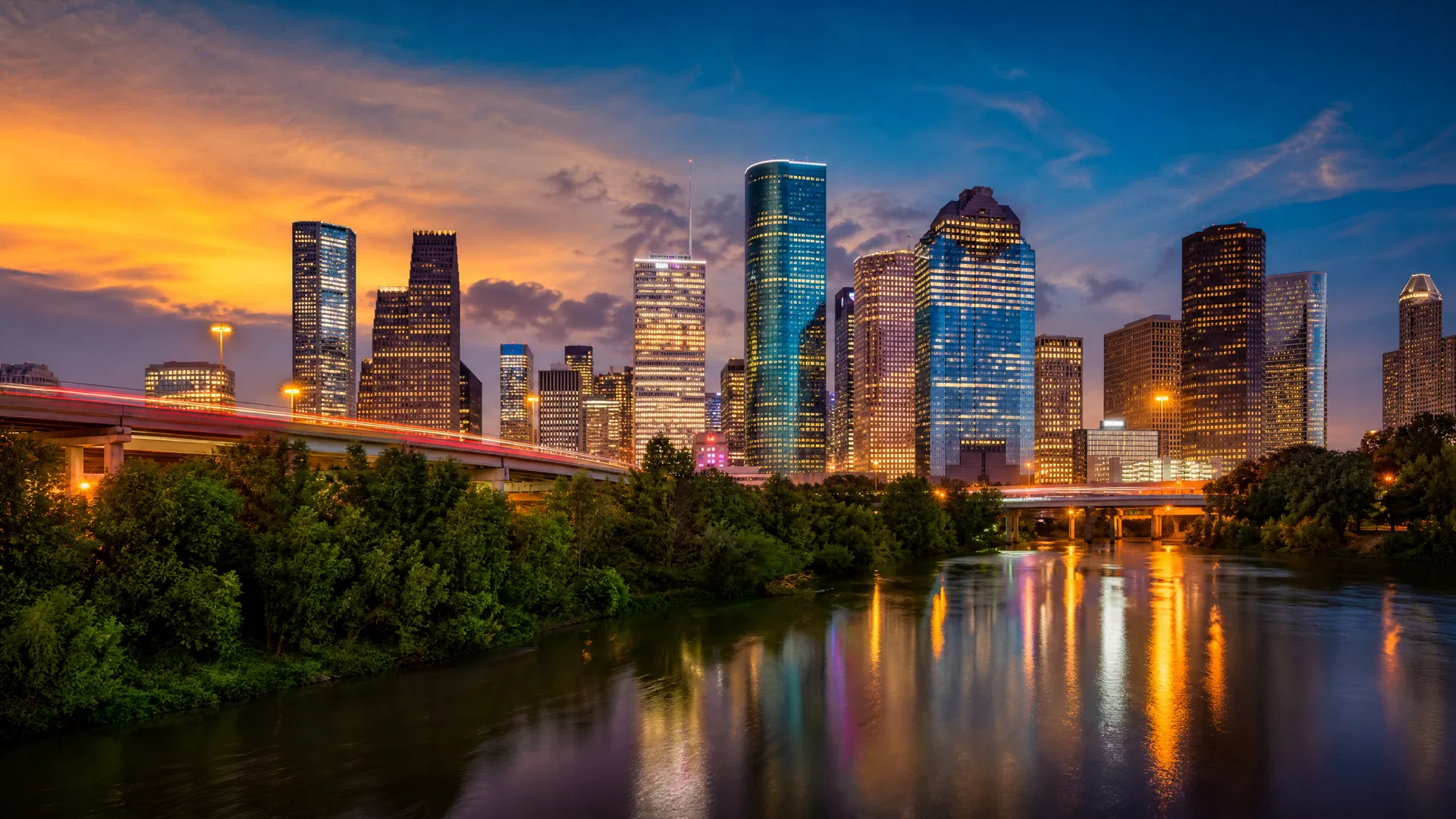
The Sabine to Bagby Promenade is the most scenic stretch — a pedestrian and cycling path that runs along the south bank with views of the downtown skyline that are genuinely striking at dusk. The cistern beneath the park, a 1927 drinking water reservoir that was decommissioned and converted into an art and events space, is one of the most unusual and beautiful spaces in the city: a vast underground chamber of 221 columns reflected in a thin layer of water on the floor, with acoustics that make every sound into music.
Kayaking the bayou is one of the best ways to see the city from a completely different angle. Several outfitters operate out of the park, and the stretch from the Heights to downtown is calm enough for beginners and interesting enough for anyone.
The Practical Guide: When to Go, Where to Stay, What to Know
When to go: Houston's climate is the one honest argument against visiting in summer. July and August are brutally hot and humid — the kind of heat that makes outdoor activity genuinely unpleasant. The sweet spot is October through April, when temperatures are mild, the outdoor spaces are accessible, and the city's event calendar is at its most active. The Houston Livestock Show and Rodeo, held in February and March, is one of the largest events of its kind in the world and a genuinely extraordinary cultural experience — part agricultural fair, part concert series, part Texas mythology made real.
Where to stay: The Montrose and Museum District area is the best base for first-time visitors — central to the cultural attractions, walkable to the best restaurants, and well-connected to the rest of the city. The Hotel ZaZa Museum District is the most distinctive property in the neighborhood, with individually designed rooms and a pool scene that is very Houston. For a more boutique experience, the Hôtel Swexan in the Galleria area is one of the best new hotels in the city. Downtown hotels (Marriott Marquis, Hyatt Regency) are convenient for the convention center and sports venues but less interesting as a base.
Getting around: Houston is a car city. The light rail system (METRORail) connects downtown, Midtown, the Museum District, and the Medical Center, but it does not reach most of the neighborhoods worth visiting. Uber and Lyft are reliable and inexpensive by major-city standards. If you're staying in Montrose or the Heights, you can walk within those neighborhoods, but getting between them requires a car or rideshare.
Day trips: Galveston Island, 45 minutes south on I-45, is the Gulf Coast beach option — not the Caribbean, but a historic island with Victorian architecture, good seafood, and a particular kind of faded grandeur that has its own appeal. The Kemah Boardwalk, 30 minutes southeast, is a waterfront entertainment district that works better as an evening outing than a full-day destination. For a more serious day trip, the San Jacinto Battleground State Historic Site, where Texas won its independence from Mexico in 1836, is one of the most historically significant sites in the American Southwest and is almost entirely unknown outside of Texas.
The Guides: Plan Your Houston Trip with Ask Leif
Houston rewards the traveler who plans intentionally — there is too much here to discover by accident, and the city's size and car-dependent layout mean that a good itinerary makes the difference between a great trip and a frustrating one. Ask Leif has built four Houston guides to help you plan exactly the trip you want:
Whether you're coming for the food and culture, bringing the family for a Space Center and museum weekend, traveling solo through the arts districts, or planning a couples escape through the Heights and bayou parks — there is a Houston itinerary built for your specific trip.
- 4 Days in Houston: Space City, World-Class Food & Southern Culture — The complete first-timer's guide, covering the Museum District, Space Center, Montrose, and the essential food stops.
- Houston Family Vacation: 4-Day Itinerary with Kids — Space Center Houston, the Houston Zoo, the Children's Museum, Hermann Park, and the Kemah Boardwalk, structured for families with children of all ages.
- Houston Solo Travel: 4-Day Arts, Food & Space Exploration Guide — The Montrose arts district, Museum District deep-dives, the Heights food scene, and the NASA Johnson Space Center solo experience.
- Houston for Couples: A 4-Day Arts, Food & Garden Escape — Hermann Park's Japanese Garden, Buffalo Bayou sunset kayak, the Menil Collection, and upscale dining in the Galleria area.
Why Houston Now
There is a version of this story that ends with Houston finally getting the recognition it deserves — the travel magazines arriving, the Instagram accounts multiplying, the hotel prices climbing, the neighborhood restaurants filling with visitors who read about them in a roundup. That version is probably coming.
But right now, in this moment, Houston is still a city where you can walk into one of the best Vietnamese restaurants in the country on a Tuesday night and get a table without a reservation. Where you can spend a morning at one of the great art museums in America and have the galleries largely to yourself. Where you can eat your way through five different countries' cuisines in a single afternoon without leaving a ten-block radius.
The question "why Houston?" has a very good answer. The answer is: because you haven't been yet, and because the city has been waiting for you to figure that out.
Go before everyone else does.