Edinburgh Doesn't Whisper. It Roars — Then Pours You a Dram.
Destination: Edinburgh, Scotland
Category: Destination Guides
Edinburgh Doesn't Whisper. It Roars — Then Pours You a Dram.
There is a city in Scotland that sits on the edge of an ancient volcano, that built its medieval spine along a ridge of black basalt, that has a castle on a crag that has been occupied for three thousand years, and that has produced — per capita, per century, per square mile of cold grey stone — more philosophers, poets, scientists, novelists, and architects than almost anywhere else on earth. It invented the modern world, or at least a significant portion of it, and it did so in coffee houses and taverns and cramped closes where the smell of coal smoke and whisky and ambition mixed into something that the Scots called the Enlightenment and the rest of the world called civilization.
This is Edinburgh. And it is not what you expect.
You expect Gothic drama and you get it — the castle on its volcanic plug, the Royal Mile descending like a spine from crown to tail, the closes and wynds that plunge off the main street into dark stairwells where the 17th century is still, somehow, present. You expect whisky and you get that too — single malts from the Highlands and Islands poured in bars that have been pouring them since before your grandparents were born. You expect the Fringe and you get the world's largest arts festival, a month-long explosion of theater and comedy and music that transforms the entire city into a stage.
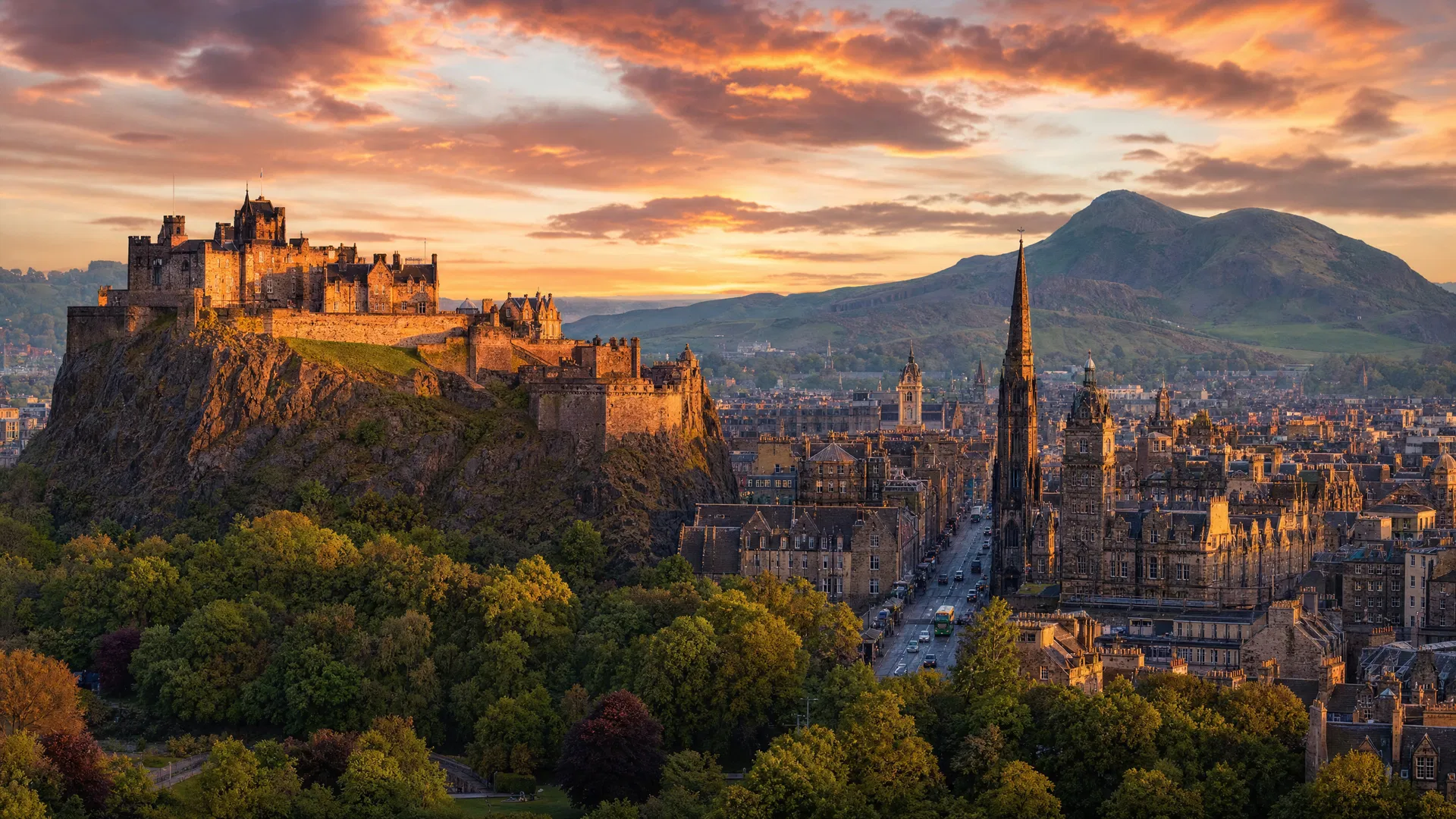
But what you don't expect — what nobody tells you before you go — is the wildness of it. The way Arthur's Seat rises from the middle of the city like a sleeping giant, a 251-meter hill of ancient lava that you can climb in 45 minutes from the city center and stand on top of and see, on a clear day, the Firth of Forth and the Highlands and the North Sea and the whole improbable drama of Scotland laid out below you. The way the city changes character every hundred meters — from the medieval Old Town to the Georgian New Town to the Victorian suburbs to the post-industrial waterfront at Leith — as if it couldn't decide what century it wanted to inhabit and chose all of them simultaneously. The way the light falls in October, low and golden and sideways, turning the sandstone buildings amber and the castle walls the color of old whisky.
Come to Edinburgh ready to be surprised. Come ready to walk uphill. Come ready to drink well and eat better than you expected and talk to strangers who will tell you things about their city with a pride that is not boastful but simply factual: this place is extraordinary, and they know it, and they want you to know it too.
The Castle: Where Scotland Begins
Every visit to Edinburgh begins at the castle, and every visit to the castle begins with the approach — the walk up the Royal Mile, the gradual revelation of the volcanic crag, the moment when the castle stops being a postcard and becomes a physical presence looming above you against whatever sky Scotland has decided to provide that day.
Edinburgh Castle has been occupied since at least the 2nd century AD and has served as a royal residence, a military garrison, a prison, and a national monument. It is not a ruin and it is not a museum piece — it is a working military installation that also happens to contain the Scottish Crown Jewels, the Stone of Destiny (returned from Westminster Abbey in 1996 after 700 years of English custody), and the National War Museum of Scotland. The Crown Room, where the Honours of Scotland are displayed, is one of the most emotionally charged rooms in any museum anywhere — the crown, scepter, and sword of state that were used at the coronation of Scottish monarchs for centuries, hidden under the floorboards of a church during the Cromwellian occupation and rediscovered by Sir Walter Scott in 1818, are displayed with a reverence that is entirely appropriate.
The One O'Clock Gun fires every day at 1 PM (except Sundays, Good Friday, and Christmas Day) from the castle's Mills Mount Battery — a tradition that began in 1861 as a time signal for ships in the Firth of Forth. The sound rolls across the city and down into the New Town and is, for residents, as natural and unremarkable as the ticking of a clock. For visitors, it is one of those small, specific pleasures that make a city feel inhabited rather than merely visited.
The view from the castle esplanade — particularly from the Half Moon Battery looking east over the Old Town and Arthur's Seat — is one of the great urban views in Europe. In August, the esplanade becomes the venue for the Royal Edinburgh Military Tattoo, a spectacle of military bands, massed pipes and drums, and theatrical performance that has been running since 1950 and sells out every year within hours of tickets going on sale.
The Old Town: A City Built Vertically
The Royal Mile — the collective name for the four streets (Castlehill, Lawnmarket, High Street, and Canongate) that run from the castle to the Palace of Holyroodhouse — is the spine of the Old Town, and the Old Town is the spine of Edinburgh. It is a medieval city built on a ridge, and because the ridge is narrow and the population was large, it built upward rather than outward — the tenements that lined the Royal Mile in the 16th and 17th centuries were among the tallest buildings in the world, 10 and 12 stories of stone housing thousands of people in conditions that were, by modern standards, almost incomprehensibly cramped.
The closes and wynds that run off the Royal Mile on both sides — narrow alleyways that descend steeply into the valley on either side of the ridge — are the Old Town's hidden network, its secret city. Advocates Close, with its view down to the New Town and the Firth of Forth beyond, is one of the most photographed spots in Edinburgh. Mary King's Close, now a visitor attraction beneath the Royal Mile, is a preserved section of a 17th-century street that was built over when the Royal Exchange was constructed in 1753 — a time capsule of medieval Edinburgh that is genuinely eerie and genuinely fascinating.
The Palace of Holyroodhouse at the foot of the Royal Mile is the official residence of the British monarch in Scotland — the place where Mary Queen of Scots lived, where her secretary David Rizzio was murdered in front of her in 1566, where Bonnie Prince Charlie held court during the Jacobite rising of 1745. It is a working royal palace, which means access is sometimes restricted, but when it is open the State Apartments and the ruins of the adjacent Holyrood Abbey are worth every minute.
The Scottish Parliament Building, completed in 2004 and designed by Catalan architect Enric Miralles, sits directly across from the palace and is one of the most controversial and most interesting pieces of architecture in Scotland — a building that attempted to express Scottish identity in stone and steel and glass, that went massively over budget and massively over time, and that has gradually, over two decades, been accepted as a genuine architectural achievement. The debating chamber, with its oak beams and natural light, is particularly striking.
Greyfriars Kirkyard — the 16th-century churchyard that surrounds Greyfriars Kirk — is where you go to understand Edinburgh's relationship with its own history. The kirkyard contains the graves of many of the signatories of the National Covenant of 1638, the document that defined Scottish Presbyterian resistance to royal interference in church affairs. It also contains the grave of Greyfriars Bobby, the Skye Terrier who allegedly guarded his owner's grave for 14 years after his death in 1858 — a story that is either deeply touching or a Victorian invention, depending on your disposition. The kirkyard is also, according to the city's ghost tour operators, one of the most haunted places in Edinburgh, which may or may not be relevant to your visit.
Arthur's Seat: The Wild Heart of the City
The thing that separates Edinburgh from every other capital city in Europe is Arthur's Seat — the ancient volcanic plug that rises 251 meters from the middle of Holyrood Park, a 640-acre expanse of wild landscape that sits within the city limits and feels, when you are in it, completely removed from the city surrounding it.
The walk to the summit takes 45 minutes from the park entrance at the foot of the Royal Mile. The path climbs through heather and basalt and past the ruins of an Iron Age hill fort, and the views expand with every step — first the Old Town, then the New Town, then the Firth of Forth, then the Highlands in the distance on a clear day. The summit is marked by a triangulation pillar and is usually occupied by a small crowd of people who have all just had the same experience: the realization that they are standing on a volcano in the middle of a capital city, looking out at one of the most dramatic landscapes in Europe, and that this is entirely normal here.
The park also contains Salisbury Crags — a dramatic line of dolerite cliffs that runs along the western edge of the hill and offers a slightly less strenuous walk with views that are, in some ways, even more dramatic than the summit. The path along the base of the crags is called the Radical Road, built in 1820 to provide employment for unemployed weavers from the west of Scotland, and the views from it across the city are extraordinary.
The New Town: Enlightenment in Stone
In 1766, the city held a competition to design a new town on the fields north of the medieval Old Town — a planned urban extension that would provide relief from the overcrowding and squalor of the medieval city. The winner was a 23-year-old architect named James Craig, and his plan — a grid of streets named after the Hanoverian royal family, centered on Princes Street and George Street and Queen Street — became one of the finest examples of Georgian urban planning in the world.
The New Town is a UNESCO World Heritage Site (along with the Old Town), and walking its streets is a lesson in what a city looks like when it is designed with intelligence and ambition. The proportions are perfect — the street widths, the building heights, the relationship between the grand terraces and the gardens behind them. Charlotte Square, at the western end of George Street, is the masterpiece — a perfectly preserved Georgian square designed by Robert Adam that contains the official residence of the First Minister of Scotland and the Georgian House museum, which recreates the interior of a New Town house as it would have appeared in 1796.
Princes Street Gardens, in the valley between the Old Town and the New Town, is one of the great urban parks in Britain — a long strip of garden that follows the line of the former Nor' Loch (drained in the 18th century) and provides, from its benches and lawns, the most dramatic view of the castle available from ground level. In summer it is full of people eating lunch and watching street performers. In winter it becomes the site of Edinburgh's Christmas market, one of the most atmospheric in Europe.
The Scottish National Gallery, at the foot of the Mound where the Old Town and New Town meet, contains one of the finest collections of European painting outside London — Raphael, Titian, Rembrandt, Velázquez, Vermeer, and an extraordinary collection of Scottish painting that is far better than most visitors expect. The adjacent Scottish National Portrait Gallery in the New Town is a Victorian Gothic building of extraordinary beauty that tells the story of Scotland through the faces of the people who made it.
Whisky: The Serious Business of Pleasure
Edinburgh is not a whisky-producing city — the distilleries are in the Highlands and Islands and Speyside — but it is the place where whisky is most seriously discussed, most expertly poured, and most thoroughly understood. The city has more specialist whisky bars per square mile than anywhere else in Scotland, and the quality of the pours in the best of them is extraordinary.
The Scotch Whisky Experience on the Royal Mile is the tourist introduction — a guided tour through the history and production of Scotch whisky that is genuinely informative and ends with a tasting. But the real education happens in the bars. The Bow Bar on Victoria Street is the institution — a Victorian pub with a gantry of over 300 whiskies, no music, no food, and a clientele that ranges from students to professors to visiting distillers who come to see their bottles on the shelf. Cadenhead's Whisky Shop on Canongate is the oldest independent bottler in Scotland, selling single cask whiskies that you will not find anywhere else. The Vaults at Leith, the former bonded warehouses where whisky was stored before it was shipped around the world, now house bars and restaurants where the connection between the liquid in your glass and the history of the city is palpable.
The whisky of Edinburgh is not a single thing — it is a conversation, an argument, a shared language. The question "what are you drinking?" in a good Edinburgh whisky bar is not small talk. It is an invitation to a discussion that might last the rest of the evening.
Leith: The Port That Built the City
A mile and a half north of the Old Town, down the Water of Leith, is Leith — Edinburgh's port, its working-class heart, its most rapidly changing neighborhood, and, increasingly, its most interesting place to eat and drink.
Leith was a separate burgh from Edinburgh until 1920, and it has never entirely forgiven the merger. It has its own identity — grittier, more maritime, less self-consciously historic than the Old Town — and it has become, over the past two decades, the center of Edinburgh's food revolution. The restaurants along The Shore — the cobbled street that runs along the Water of Leith through the heart of old Leith — include some of the best in Scotland. The Kitchin, Tom Kitchin's Michelin-starred restaurant, is the flagship, but the neighborhood around it has developed a density of excellent restaurants and bars that makes it worth an entire evening.
The Royal Yacht Britannia, moored at the Ocean Terminal shopping center in Leith, is one of Edinburgh's most visited attractions — the former royal yacht that served the British royal family from 1954 to 1997, preserved as it was on its final voyage and open for tours that give an unexpectedly intimate portrait of royal life at sea. The Queen's bedroom is smaller than you expect. The crew's quarters are smaller than that.
The Fringe: When Edinburgh Becomes the World
Every August, Edinburgh undergoes a transformation that is, by any measure, one of the most extraordinary cultural events on earth. The Edinburgh Festival Fringe — the world's largest arts festival, running for three weeks in August — brings 50,000 performances of 3,000 shows to 300 venues across the city. The venues range from the purpose-built Festival Theatre to converted churches to pub back rooms to the back of a van. The performers range from established names to first-time performers who have remortgaged their houses to bring their show to Edinburgh. The audiences range from theater professionals to tourists who wandered in off the street.
The Fringe is not a curated festival — anyone can bring a show, there is no selection process, and the quality ranges from the transcendent to the unwatchable. This is its genius. The sheer volume and variety of performance creates an atmosphere that is unlike anything else in the world — a city that has become, for a month, a stage, where every street corner has a performer and every conversation might turn into a show.
The Edinburgh International Festival, which runs concurrently, is the curated counterpart — a program of classical music, opera, dance, and theater that brings the world's great companies and performers to Edinburgh. The two festivals together, along with the Edinburgh International Book Festival, the Edinburgh International Film Festival, and the Royal Edinburgh Military Tattoo, make August in Edinburgh an experience that is simultaneously overwhelming and unmissable.
Day Trips: The Highlands Are Right There
Edinburgh's position at the edge of the Scottish Lowlands makes it an ideal base for day trips into some of the most dramatic landscape in Europe.
Loch Lomond and the Trossachs National Park is 90 minutes by car from Edinburgh — a landscape of lochs and mountains that is the closest thing Scotland has to a lake district, and that is far less visited than its southern equivalent. The drive through the Trossachs on the A821 — the Duke's Pass — is one of the great scenic drives in Britain.
Stirling, 45 minutes by train, has a castle that rivals Edinburgh's in drama and exceeds it in historical significance — the site of the Battle of Stirling Bridge (1297) and the Battle of Bannockburn (1314), the two battles that defined Scottish independence. The Wallace Monument on a crag above the town is a Victorian Gothic tower that contains William Wallace's two-handed broadsword and views that explain, better than any history book, why this particular stretch of ground was worth fighting for.
St Andrews, 90 minutes by car along the Fife coast, is the home of golf, the home of Scotland's oldest university, and the home of one of the most beautiful ruined cathedrals in Britain. The Old Course at St Andrews is the most famous golf course in the world, and you can walk across it — the 18th fairway is a public right of way — and feel the weight of 600 years of golf history under your feet.
The Highlands begin an hour north of Edinburgh, and the drive through Perthshire and into the Cairngorms National Park — the largest national park in Britain — is one of the great road trips in Europe. The landscape changes from rolling farmland to heather moorland to high plateau to mountain in the space of 50 miles, and the sense of entering somewhere genuinely wild and genuinely ancient is immediate and overwhelming.
Your Ask Leif Edinburgh Guides
Edinburgh is a city that rewards depth — the more you know before you arrive, the more you see when you're there. The Ask Leif team has built a comprehensive set of guides for every kind of Edinburgh trip:
The Edinburgh Adventure: 4-Day Hiking, Island & Highland Day Trip Guide is for the traveler who wants to experience Edinburgh as the gateway to the wild — Arthur's Seat, the Pentland Hills, day trips into the Highlands and to the islands of the Firth of Forth.
The 4-Day Edinburgh Family Adventure: Castles, Stories & Harry Potter Magic takes the city's extraordinary storytelling tradition — the castle, the closes, the literary history that runs from Robert Burns to Arthur Conan Doyle to J.K. Rowling — and makes it accessible and genuinely exciting for children.
The 5-Day Edinburgh Travel Guide: Castle, Old Town, Whisky & Highlands is the comprehensive introduction — five days that move through the Old Town, the New Town, Leith, and the surrounding landscape with enough time to actually understand what you're seeing.
The Edinburgh City Break: 4-Day Itinerary for Urban Explorers is for the traveler who wants to move through the city at pace — the essential Edinburgh in four focused days, from the castle to the Fringe to the whisky bars of the Old Town.
For those who want to eat and drink their way through the city, the Edinburgh Food & Whisky Guide: 4 Days of Haggis, Leith, and Scotch covers the full spectrum from traditional Scottish cooking at its best to the Michelin-starred restaurants of Leith to the whisky bars where the real education happens.
Solo travelers will find Edinburgh one of the most welcoming cities in Europe — the Edinburgh Solo Travel: 3-Day Castle, Whisky & Royal Mile Adventure is the guide for the traveler who wants to move through the city on their own terms, at their own pace, with the confidence of knowing exactly where to go.
And for couples, the Edinburgh for Couples: 4-Day Romantic Castle Walks & Whisky Tastings finds the romance in a city that offers it in abundance — in evening walks along the Radical Road with the city lit below, in shared drams in a candlelit whisky bar, in the particular pleasure of being in a place this beautiful together.
Before You Go: What Nobody Tells You
The weather is not as bad as you've heard. It is, however, exactly as changeable as you've heard. Edinburgh can deliver four seasons in a single day, and the locals dress accordingly — layers, a waterproof, and the philosophical acceptance that rain is not a reason to stay indoors. The city is beautiful in all weathers, and the low grey light of a cloudy day turns the stone buildings into something almost monochromatic and extraordinary.
August is extraordinary and overwhelming simultaneously. The Fringe transforms the city in ways that are both thrilling and exhausting — accommodation prices triple, the streets are packed, and the energy is unlike anything else in Europe. If you want the Fringe, book everything six months in advance. If you want Edinburgh without the crowds, go in October or November, when the light is extraordinary and the city is entirely itself.
The hills are real. Edinburgh is built on seven hills, and the Old Town in particular involves a significant amount of vertical movement. Wear comfortable shoes. The cobblestones are beautiful and unforgiving.
Haggis is good. This is not a controversial statement among people who have actually eaten it. The combination of offal, oatmeal, onion, and spices, cooked in a sheep's stomach and served with neeps and tatties (turnip and potato), is a genuinely delicious dish that has been unfairly maligned by people who have never tried it. Order it at a good Scottish restaurant and reconsider your assumptions.
The City That Made the Modern World
There is a book by Arthur Herman called The Scottish Enlightenment with the subtitle "The Scots' Invention of the Modern World." It is not an exaggeration. David Hume, Adam Smith, James Watt, Joseph Black, James Hutton — the men who invented modern philosophy, modern economics, the steam engine, modern chemistry, and modern geology — were all Scots, most of them Edinburgh men, most of them working within a few hundred meters of each other in the coffee houses and taverns and lecture halls of the 18th-century city.
That intellectual energy has never entirely left. Edinburgh has more bookshops per capita than almost any city in the world. It has a literary festival that is the largest in the world. It has universities that have been producing world-class scholarship for 450 years. It has a culture of argument and inquiry that is built into the stone of the place — the tradition of the Edinburgh flyting, the public intellectual debate, the willingness to take an idea seriously and follow it wherever it leads.
Come to Edinburgh for the castle and the whisky and the Fringe. Stay for the conversation. Leave with the unsettling feeling that this small, cold, magnificent city has been thinking harder and longer about the things that matter than almost anywhere else on earth — and that it has not finished yet.
Ready to start planning? Create your personalized Edinburgh itinerary with Ask Leif — built by travelers, for travelers.