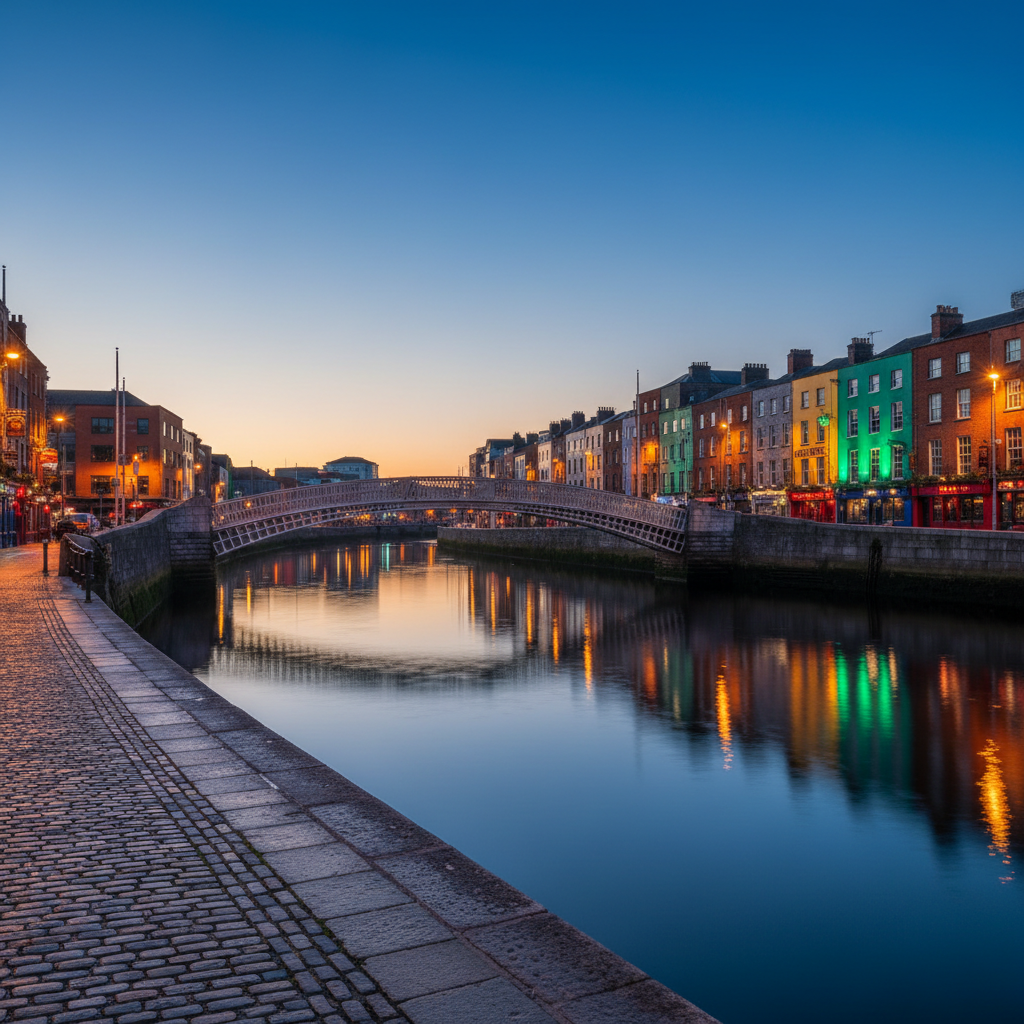
Four Nobel Laureates, a Million Pints, and the Best Craic in Europe: Dublin Uncovered
Destination: Dublin, Ireland
Category: Destination Guides
There are cities that ease you in. Dublin is not one of them.
You land, you take the bus into the city, and within forty minutes someone at a pub has asked you where you're from, told you a story that may or may not be true, laughed at their own punchline before they've finished telling it, and made you feel like you've known them for years. This is not a performance. It is not the Irish tourism board's idea of hospitality. It is simply how Dublin works — a city of 1.4 million people that operates, socially, like a village that got very tall and very expensive but never quite lost the habit of talking to strangers.
Dublin is also, by any honest measure, one of the most literarily dense cities on earth. Four Nobel Prize winners in literature. Joyce, Beckett, Wilde, Yeats, Heaney, Stoker, Behan, Roddy Doyle, Sally Rooney — the list of writers who were formed by this city and then spent their careers trying to explain it is longer than most countries can claim. The streets here are not just streets. They are settings. Ulysses is set on a single day in this city, June 16, 1904, and every year on Bloomsday, people dress in Edwardian clothes and walk the route Leopold Bloom walked, stopping at the pubs he stopped at, eating the food he ate. The city has never quite shaken the feeling that everything that happens here might end up in a book.
And then there's the Guinness. Which is better here. This is not a myth.
The Literary City: More Than a Walking Tour
Most cities that claim a literary heritage have a plaque on a building and a gift shop. Dublin has an entire ecosystem. The Irish Writers Centre on Parnell Square hosts readings, workshops, and residencies. The Dublin Writers Museum, in a Georgian townhouse on the same square, has first editions, manuscripts, and personal effects that make the writers feel startlingly present — Beckett's phone, Behan's letters, the kind of objects that collapse the distance between a name on a book spine and a person who actually lived.
But the real literary Dublin is not in museums. It's in the pubs.
Davy Byrnes on Duke Street is where Leopold Bloom stopped for a gorgonzola sandwich and a glass of Burgundy in Ulysses. It has been a pub since 1889 and it still serves the sandwich. The Palace Bar on Fleet Street has been the unofficial headquarters of Irish journalism and literature since the 1940s — Patrick Kavanagh drank here, Flann O'Brien drank here, and the walls are covered with photographs of writers who look like they've been there for several hours longer than they intended.
Kehoe's on South Anne Street is the pub that appears on every "authentic Dublin pub" list, and it appears on those lists because it is, genuinely, an authentic Dublin pub — Victorian interior, snugs, no music, no televisions, and a pint of Guinness that arrives in the correct amount of time. Mulligan's on Poolbeg Street, established 1782, is the pub that Dubliners will tell you pours the best pint in the city. They have been saying this for generations and they are not wrong. Go on a weekday afternoon when it's quiet enough to actually sit and drink it properly.
The Dublin Literary Pub Crawl — actors performing scenes from Irish literature in the pubs where the writers drank — is one of the few tourist activities in any city that is genuinely worth doing. It runs every evening from the Duke pub on Duke Street, and it is funny and moving and educational in a way that doesn't feel like education.
Trinity College and the Book of Kells
You cannot come to Dublin and not go to Trinity College. This is not negotiable.
The Book of Kells — an illuminated manuscript of the four Gospels created by Celtic monks around 800 AD — is housed in the Old Library, and it is one of the most extraordinary objects in the world. The level of detail in the illuminations, created with quill pens and natural pigments by monks who had no magnifying glasses and no electric light, is so fine that scholars still debate how it was physically possible. The spirals within spirals within spirals. The interlaced figures. The colors that have not faded in 1,200 years.
The Long Room — the library above the Book of Kells exhibition — is 65 meters of barrel-vaulted ceiling, 200,000 of the oldest books in Ireland, and marble busts of great thinkers lining the shelves. It is one of the most beautiful rooms in Europe, and it smells like old paper and wood polish and time. Go early, before the tour groups arrive.
The Trinity College campus itself is worth an hour of wandering — Georgian squares, cobblestones, the cricket pitch, the Campanile. It is the kind of place that makes you understand why people spend their entire lives in universities.
The Neighborhoods That Define the City
Temple Bar is the neighborhood that Dublin's tourism industry built, and it is worth understanding what it is before you decide how much time to spend there. The cobblestone streets are genuine. The Viking history is genuine. The pubs are real pubs. But Temple Bar has also become, over the past thirty years, a place that exists primarily for stag parties and tourists, and the prices reflect this. Go for the atmosphere, the street performers, and the Temple Bar Market on Saturday morning. Don't go for a quiet pint.
The Liberties is the oldest part of the city and the most historically layered. This is where Dublin's textile industry was, where the Huguenot refugees settled in the 17th century, where the distilleries were. Teeling Whiskey Distillery and Pearse Lyons Distillery are both here, and both offer tours that are more intimate and interesting than the Jameson Distillery experience. The Iveagh Markets building — a magnificent 1906 market hall — is worth a look from the outside.
Stoneybatter is the neighborhood that Dubliners move to when they want to stay in the city but stop paying Temple Bar prices. Old terraced houses, good coffee shops, a handful of excellent pubs, and a pace of life that feels genuinely residential. Walk the backstreets between Arbour Hill and Smithfield on a weekend morning and you'll see Dublin as it actually lives.
Merrion Square is the heart of Georgian Dublin — four sides of perfectly proportioned 18th-century townhouses surrounding a park where Oscar Wilde grew up (his family home is at number 1) and where his statue now reclines on a rock in the corner, painted in vivid colors, looking amused by everything. The square is also surrounded by the National Gallery, the Natural History Museum (free, Victorian, extraordinary, and barely changed since 1857), and the National Museum of Ireland (also free, and home to the Bog Bodies — Iron Age human remains preserved in Irish peat bogs for 2,000 years, haunting and unforgettable).
Portobello and the Grand Canal area are where Dublin's young professional population has settled, and the canal itself — lined with trees, houseboats, and benches — is one of the city's great underrated pleasures. Walk from Portobello to Baggot Street on a summer evening and you'll understand why Dubliners are so attached to their city despite everything it costs them.
The Guinness Question
Yes, Guinness tastes better in Dublin. This is not sentiment. There are several reasons: the water, the freshness of the kegs, the fact that the barmen here have been pouring it their entire lives and know exactly what they're doing. A pint of Guinness in Dublin is a different object than a pint of Guinness in London or New York or anywhere else, in the same way that a croissant in Paris is a different object than a croissant in an airport.
The Guinness Storehouse — the official visitor experience at the St. James's Gate Brewery — is impressive in scale and worth doing once, particularly for the Gravity Bar at the top, which has a 360-degree view of the city and a free pint included in the ticket price. But if you want to understand what Guinness actually means in Dublin life, skip the Storehouse and go to The Gravediggers (John Kavanagh's pub) beside Glasnevin Cemetery instead. It has been there since 1833. The gravediggers from the adjacent cemetery really did drink here between shifts. The pint is poured without ceremony or explanation, and that is the point.
Other pubs worth knowing: The Long Hall on South Great George's Street (Victorian interior, excellent staff, no music, the kind of pub that makes you want to stay for three hours). Toner's on Baggot Street (Yeats drank here, and it is the only pub he is known to have visited). The Stag's Head on Dame Court (1895, stained glass, mahogany, and a pint that arrives correctly).
Beyond the Pubs: Dublin's Surprising Depth
Dublin is not only a literary city and a pub city, though it is very much both of those things. It is also a city of surprising natural beauty, excellent contemporary art, and a coastline that most visitors never see.
Killiney Bay — accessible by DART train in about 30 minutes from the city center — is one of the most beautiful bays in Ireland, with views that are regularly compared to the Bay of Naples. Walk the cliff path from Dalkey to Killiney on a clear day and you'll understand why Bono and Van Morrison and half the Irish music industry have chosen to live here.
Howth — on the northern end of the DART line — is a fishing village with cliff walks, fresh seafood, and a harbor full of boats. The cliff walk from Howth to the Baily Lighthouse takes about two hours and offers views of Dublin Bay, Ireland's Eye (a small island just offshore), and, on clear days, the Wicklow Mountains to the south. Eat at Beshoff Bros for fish and chips, or at any of the seafood restaurants along the harbor.
Marsh's Library — beside St. Patrick's Cathedral, which is why most people miss it — is the oldest public library in Ireland, built in 1707 and barely changed since. Dark wooden alcoves with caged reading spaces (scholars were locked in to prevent book theft), 25,000 books from the 16th to 18th centuries, and a silence that feels earned. It is one of the few places in Dublin where the city seems to pause.
14 Henrietta Street — a Georgian townhouse that was subdivided into tenements in the 19th century and housed up to 100 people in conditions of extreme poverty — is now a museum that tells the story of working-class Dublin with extraordinary care and honesty. It is not the Ireland of soft-focus mythology. It is the Ireland that most of the country's emigrants were running from, and it is essential.
The Food Scene: Better Than You've Been Told
Irish food has a reputation problem that it no longer deserves. Dublin's food scene in 2026 is one of the most interesting in Europe — not because it is trying to be Paris or Copenhagen, but because it has finally figured out what it actually is: a cuisine built on extraordinary raw ingredients (the beef, the lamb, the seafood, the dairy) that is now being treated with the same seriousness that those ingredients deserve.
The Pig's Ear on Nassau Street does modern Irish cooking with a lightness of touch that makes the food feel both familiar and surprising. Bastible in the Liberties has been one of the most talked-about restaurants in the city for several years, and the tasting menu is worth the price. Dax on Pembroke Street is the French-influenced Irish restaurant that has been quietly excellent for twenty years while louder places opened and closed around it.
For something more casual: Fallon & Byrne on Exchequer Street is the food hall that actually works — good cheese, good wine, good prepared food, and a restaurant upstairs that is better than it needs to be. The Fumbally in the Liberties does the best brunch in the city, in a converted warehouse, with a menu that changes daily based on what's available.
The Guides That Will Help You Plan It
Dublin rewards the traveler who comes with a plan but holds it loosely — who knows where they want to go but is willing to be redirected by a conversation at a bar. These guides will give you the structure:
- Dublin, Ireland: 4-Day City Break Guide — The full Dublin experience: Trinity, the Liberties, the DART coast, and the pubs worth knowing.
- Dublin, Ireland: 4-Day Solo Travel Guide — For independent travelers who want to find the city's quieter corners and its best conversations.
- Dublin, Ireland: 4-Day Food & Drink Guide — The markets, the restaurants, the pubs, and the fish and chips at Howth harbor.
- Dublin, Ireland: 4-Day Couples Romantic Getaway Guide — The Georgian squares, the cliff walks, the candlelit restaurants, and the evening walks along the Grand Canal.
- Dublin, Ireland: 4-Day Family Guide — Castles, Vikings, coastal adventures, and the city's best family-friendly spots.
When to Go, Where to Stay, How to Move
When to go: May and June are the sweet spot — long evenings (it stays light until 10 PM in June), mild temperatures, and the city at its most alive before the summer crowds arrive. September and October are excellent for the same reasons. July and August are peak season and the city is busy, but Dublin handles crowds better than most European capitals. Winter is cold and wet but the Christmas markets are good and the pubs are at their best.
Where to stay: The area around Merrion Square and St. Stephen's Green for Georgian atmosphere and proximity to everything. Stoneybatter or Smithfield for a more local feel and lower prices. Temple Bar if you want to be in the middle of the action and don't mind the noise.
Getting around: Dublin is a walking city. Most of what you want to see is within a 20-minute walk of the city center. The DART (coastal rail line) is excellent for day trips to Howth, Dalkey, and Killiney. Taxis and Ubers are available but the city's traffic can be slow.
Practical notes: The Irish weather is not a myth. Bring a waterproof layer regardless of what the forecast says. Tipping is appreciated but not mandatory in the way it is in the US; 10-15% in restaurants is standard.
The Thing About Dublin
Dublin is a city that has been through things. The famine. The Rising. The Civil War. The decades of economic stagnation. The Celtic Tiger and its collapse. The housing crisis that is still ongoing. The city carries all of this — not heavily, not performatively, but in the way that people who have been through things carry them: with humor, with irreverence, with a willingness to talk about it at length to anyone who asks.
The Irish relationship with their own history is one of the most complicated and interesting things about the country. They can be furious about it and funny about it in the same sentence. They can tell you about the famine and the British occupation and then buy you a drink. The bitterness is real. The generosity is also real. Both things are true simultaneously, and Dublin is the place where you feel this most acutely.
What the city gives you, if you let it, is the feeling that you have actually been somewhere — not just passed through a set of attractions, but spent time in a place with a specific character and a specific way of being in the world. Dublin will talk to you. It will tell you things. It will make you laugh at the wrong moments and feel things you weren't expecting to feel.
It will hand you a pint and tell you to keep up.
Plan your Dublin trip at askleif.com — tell us how you travel, and we'll build you the itinerary that fits.