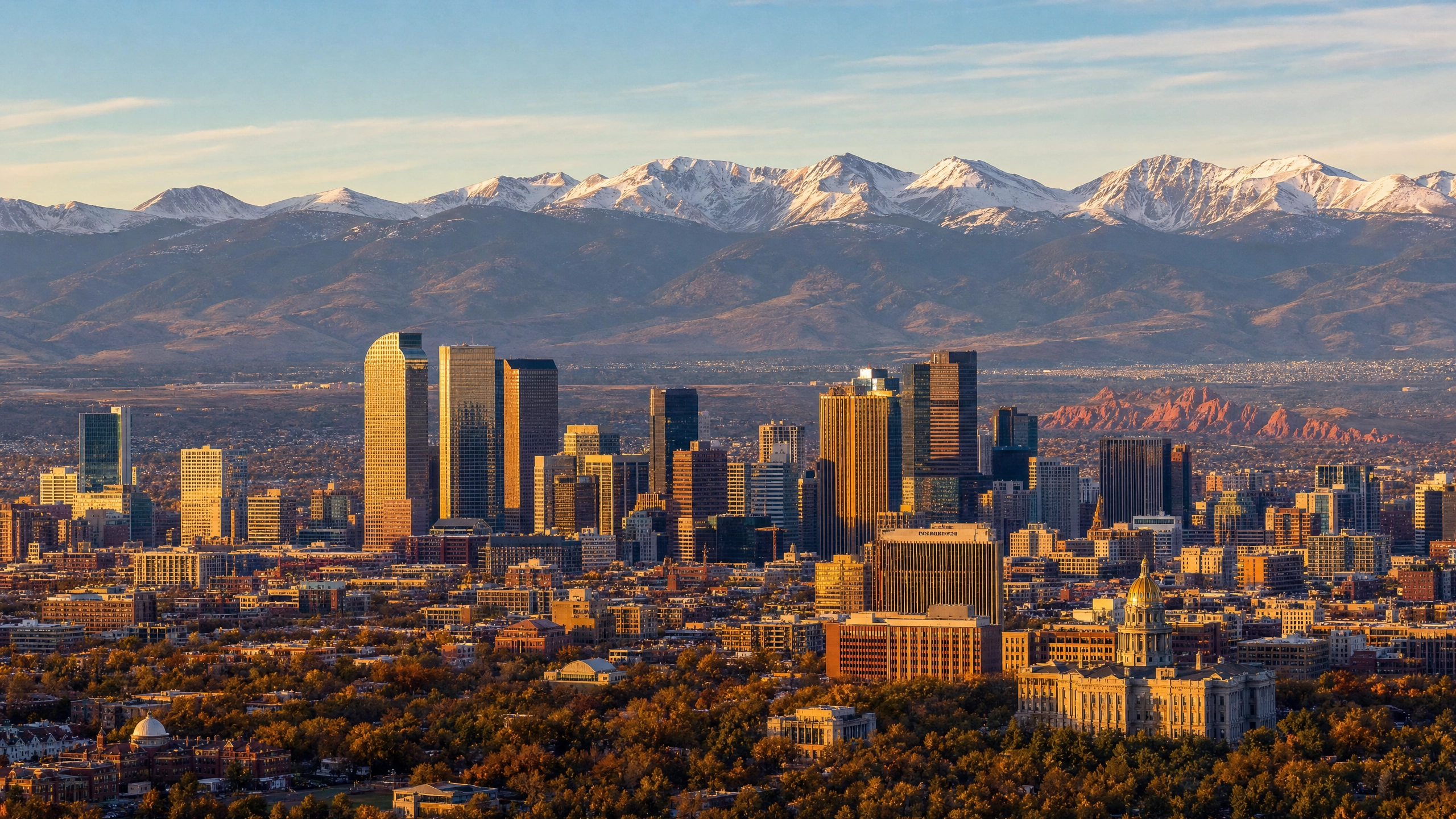
Denver Doesn't Care If You're Impressed. But You Will Be.
Destination: Denver, Colorado
Category: Destination Guides
Denver Doesn't Care If You're Impressed. But You Will Be.
There is a particular kind of city that doesn't try to sell itself to you. It doesn't need to. Denver is that city — a place so quietly, stubbornly extraordinary that it tends to catch visitors completely off guard. You arrive expecting mountains in the background and a decent craft beer scene. You leave wondering why you didn't book a longer trip.
This is the thing about Denver that the travel brochures get wrong: they lead with the Rockies, as if the city is merely a staging ground for something better happening forty-five minutes west. But Denver is not a gateway. It is a destination. It is a city of 300 days of sunshine a year, a skyline that glows amber at altitude, a food scene that has quietly become one of the most exciting in the American West, and a cultural identity so particular — so genuinely its own — that it resists easy comparison to anywhere else.
Denver sits at exactly 5,280 feet above sea level. One mile. The 13th step of the Colorado State Capitol building is engraved with a marker noting the precise elevation, and locals will tell you, with a kind of civic pride that borders on religious devotion, that this number matters. It matters in the way the air feels — thinner, crisper, carrying a faint electric quality on clear days that makes everything seem slightly more vivid than it should. It matters in the way your first beer hits harder than expected. It matters in the way the sunsets paint the Front Range in colors that photographers drive from across the country to capture. The Mile High City is not a marketing slogan. It is a physical reality, and you feel it the moment you step off the plane.
The City That Reinvented Itself
Denver has a complicated origin story. It was founded in 1858 as a gold rush settlement — a rough, transient town built on speculation and ambition at the confluence of Cherry Creek and the South Platte River. For much of the 20th century, it was a city with an identity problem: too big to be a mountain town, too Western to be a proper metropolis, too landlocked to have the coastal cool that cities like San Francisco and Seattle wore so effortlessly.
And then, somewhere in the 1990s and accelerating through the 2000s, something shifted. The craft beer revolution found its spiritual home here. A generation of chefs who had trained in New York and San Francisco came back to Colorado and opened restaurants that had no business being this good in a city this size. The arts scene, long underestimated, began to produce work that demanded national attention. The River North Art District — RiNo, as everyone calls it — transformed a post-industrial stretch of warehouses north of downtown into one of the most vibrant creative neighborhoods in the country.
Today, Denver is a city in full bloom. It has more craft breweries per capita than almost any city in America. Its restaurant scene has produced James Beard Award nominees and winners. The Denver Art Museum houses one of the most significant collections of Native American art in the world. Red Rocks Amphitheatre — fifteen miles west of downtown, carved into ancient geological formations — is, by virtually every measure, the greatest outdoor music venue on earth. And the mountains are still there, still staggering, still accessible in a way that no other major American city can claim.
Red Rocks: The Venue That Ruins All Other Venues
Let's get this out of the way immediately, because if you visit Denver and don't make the drive to Red Rocks, you have made a significant error. Red Rocks Amphitheatre is not merely a concert venue. It is a geological miracle that happens to have excellent acoustics and a capacity of 9,525 people. The two massive sandstone monoliths that flank the stage — Ship Rock and Creation Rock — are 300 million years old. The natural bowl they create produces sound quality so perfect that engineers have studied it for decades trying to understand why no artificial structure has ever replicated it.
Rolling Stone magazine has called it America's best amphitheater. The Beatles played here. Jimi Hendrix played here. The Grateful Dead played here so many times that the venue became synonymous with their mythology. U2 filmed their iconic Under a Blood Red Sky live album here in 1983, and the footage of Bono silhouetted against those ancient red formations at dawn is one of the most recognizable images in rock history.
But here is what the casual visitor misses: Red Rocks is not just a concert venue. It is a public park. You can drive up any morning, park for free, and hike the trading post trail through the formations. You can do yoga at sunrise on the amphitheater steps — a practice that has become so popular that organized sunrise yoga sessions sell out weeks in advance. You can watch the light change on those red rocks as the sun comes up over the plains and understand, viscerally, why the Ute people considered this place sacred for thousands of years before anyone thought to put a stage in it.
If you're visiting during concert season (May through October), check the schedule before you book your trip. A night at Red Rocks — any night, any artist — is an experience that will recalibrate your understanding of what live music can be.
RiNo: Where Denver Gets Weird (In the Best Way)
The River North Art District is what happens when artists move into a neighborhood that nobody else wanted and refuse to leave even after the developers arrive. RiNo is Denver's most electric neighborhood — a grid of converted warehouses, loading docks turned into beer gardens, and building facades covered in murals so large and technically accomplished that they stop traffic.
The street art here is not decoration. It is the point. Artists from around the world have painted in RiNo, and walking the neighborhood is a legitimate art experience — one that costs nothing and changes constantly as new pieces go up over old ones. The Denver Mural Festival has made RiNo its home, and the neighborhood's commitment to public art is written into its identity in a way that feels permanent.
The brewery scene in RiNo is equally serious. Bierstadt Lagerhaus produces German-style lagers with a precision and patience that would make a Munich brewer nod in approval — their Slow Pour Pils takes six weeks to make and is worth every day of the wait. Ratio Beerworks has a taproom that doubles as an event space, with a back patio that fills up on warm evenings with the kind of crowd that makes you want to stay for one more round. Our Mutual Friend is a neighborhood institution, small and unpretentious and consistently excellent.
But RiNo is not just about beer. The food scene here has developed its own gravity. Safta brings modern Israeli cuisine to a space that feels like it was designed by someone who studied both brutalist architecture and the art of hospitality. Work & Class serves the kind of no-nonsense, deeply satisfying food — smoked meats, roasted vegetables, cocktails that don't apologize for being strong — that makes you understand why Denver locals are so insufferably enthusiastic about their city.
The Food Scene Denver Deserves More Credit For
Denver's restaurant scene suffers from a perception problem. People assume that a landlocked Western city can't compete with the coastal food capitals, and they are wrong in a way that becomes immediately obvious the moment they sit down to eat.
The city's food identity is genuinely its own — shaped by its proximity to the mountains, its agricultural heritage, its large Latino population, and a generation of chefs who came here specifically because the cost of opening a restaurant was lower than in New York or Los Angeles and the quality of local ingredients was exceptional. Colorado lamb, Rocky Mountain trout, Palisade peaches, Olathe sweet corn, Pueblo chiles — the pantry that Colorado's farms and ranches provide is extraordinary, and Denver's best chefs have built careers around it.
Alma Fonda Fina, consistently ranked among the city's best restaurants, serves modern Mexican cuisine with a sophistication and depth that would earn it a Michelin star in any city that had them. Barolo Grill has been a Denver institution for decades, serving Northern Italian food with a wine list that rivals anything in the country. Blackbelly, the farm-to-table restaurant from chef Hosea Rosenberg, sources almost everything from Colorado producers and serves it in a way that makes the provenance feel like the point, not the marketing.
For a more casual experience, the taco scene in Denver is exceptional — a reflection of the city's deep connections to Mexican culinary tradition. The taqueria trucks that cluster in the Westwood and Barnum neighborhoods serve some of the best tacos in the country, full stop. And the green chile — Colorado's signature contribution to American food culture — appears on everything from breakfast burritos to smothered fries, and it is always worth ordering.
The Great Outdoors, Literally Out Your Door
Here is the statistic that defines Denver's relationship with the outdoors: Rocky Mountain National Park is 65 miles from downtown. Breckenridge ski resort is 80 miles. Hiking trails begin at the edge of the city. The 16th Street Mall, Denver's pedestrian spine, is lined with people in trail running shoes who have just come from a morning run in the foothills and are stopping for coffee before heading to the office.
Denver is the only major American city where the outdoor lifestyle is not an aspiration or a weekend hobby — it is the baseline. The city has more than 200 parks and over 80 miles of off-street bike paths. The Cherry Creek Trail runs from downtown all the way into the mountains. Washington Park, the city's beloved green heart, hosts pickup volleyball games, kayakers on its lake, and runners on its 2.5-mile perimeter path every single day of the year, regardless of weather.
For visitors who want to push further into the mountains, the options are staggering. Rocky Mountain National Park offers everything from easy valley walks to technical alpine climbs, with Trail Ridge Road — the highest continuous paved road in the United States — providing access to tundra ecosystems above 12,000 feet. Mount Evans, accessible by the highest paved road in North America, puts you at 14,130 feet with a drive rather than a hike, and the views from the summit on a clear day extend for hundreds of miles in every direction.
If you're visiting in winter, Denver's position as the gateway to Colorado's ski resorts is unmatched. World-class skiing at Breckenridge, Vail, Keystone, Arapahoe Basin, and Loveland is all within 90 minutes of downtown. The Ski Train from Denver's Union Station to Winter Park — a 67-mile journey through the Rockies on a historic rail line — is one of the great travel experiences in the American West, a morning commute that passes through tunnels and over trestles and deposits you at the base of a ski mountain with your gear already on.
For those ready to plan the mountain adventure, our 4-Day Denver Outdoor Adventure guide covers Rocky Mountain National Park, Mount Evans, and the Flatirons in detail — with day-by-day itineraries built for every fitness level.
The Denver Art Museum and the Cultural Mile
Denver's cultural institutions are consistently underestimated, which means they are consistently delightful. The Denver Art Museum, housed in a building designed by Daniel Libeskind that looks like a crystalline geological formation erupting from the earth, holds one of the most significant collections of Native American art in the world — over 18,000 objects spanning thousands of years of indigenous creativity. The collection is not a footnote here; it is the centerpiece, treated with the seriousness and curatorial care it deserves.
The museum's collection of Western American art is equally remarkable — not the romanticized cowboy paintings of lesser institutions, but serious, complex work that grapples with the full history of the American West. And the contemporary collection, housed in the Frederic C. Hamilton Building, includes major works by artists who have shaped the last half-century of American art.
Nearby, the Denver Botanic Gardens occupies 24 acres in the Capitol Hill neighborhood and is, in the estimation of many who have visited, one of the most beautiful urban gardens in the country. The Japanese Garden, the Rock Alpine Garden, and the Monet-inspired water garden are all exceptional, but the real secret is the Chatfield Farms satellite campus — 700 acres of working farm and natural area in the foothills that most visitors never find.
The Clyfford Still Museum, dedicated entirely to the work of one of the most important Abstract Expressionist painters of the 20th century, is a hidden gem that rewards the curious visitor. Still donated his entire estate — nearly 94% of his lifetime output — to a city that would build a permanent museum for it, and Denver won. The result is an intimate, extraordinary experience with a body of work that rarely leaves the building.
Neighborhoods Worth Getting Lost In
Denver's neighborhoods have distinct personalities that reward exploration on foot. Capitol Hill — the dense, walkable neighborhood just east of downtown — is the city's most eclectic district, a mix of Victorian mansions, independent bookstores, coffee shops with strong opinions about their pour-overs, and a music venue scene that has launched more Colorado bands than anywhere else in the state.
The Highlands, across the South Platte River from downtown, is where Denver's young professional class has settled, and the result is a neighborhood of exceptional restaurants, boutique shops, and a walkability that feels almost European. The view of downtown from the Highland Bridge at sunset is one of the city's great free experiences.
Cherry Creek is Denver's upscale shopping and dining district, anchored by the Cherry Creek Shopping Center but defined by the independent restaurants and galleries that line the surrounding streets. The Cherry Creek Farmers Market, running from May through October, is one of the best in the country — a genuine community gathering that happens to also sell exceptional produce, flowers, and prepared food.
LoDo — Lower Downtown — is the historic heart of the city, centered on Union Station, which was restored in 2014 into one of the most beautiful transit hubs in America. The Great Hall of Union Station is now a hotel lobby, a food hall, and a gathering place for the city, and the building's Beaux-Arts grandeur makes it worth visiting even if you're not catching a train.
Planning Your Denver Trip: Every Kind of Traveler Covered
Denver's guide library at Ask Leif covers every angle of a trip to the Mile High City:
If you're coming for the craft beer, the food scene, and the general pleasure of a city that knows how to have a good time, the Denver 5-Day Adventure: Craft Beer, Mountains & Foodie Delights is your starting point — five days built around the city's best breweries, restaurants, and neighborhoods, with mountain day trips woven in.
Traveling with kids? Denver is one of the best family destinations in the American West, with the Denver Zoo, the Denver Museum of Nature and Science, the Children's Museum of Denver, and easy access to mountain experiences that children remember for decades. The Denver Family Vacation: 5-Day Itinerary with Kids covers all of it, including the logistics of getting to Rocky Mountain National Park with children in tow.
For couples looking for a romantic escape, Denver delivers in ways that surprise people. The combination of world-class restaurants, mountain scenery, and a city that feels genuinely alive makes for an exceptional romantic trip. The Romantic Denver Weekend: A 3-Day Couples' Escape to the Mile High City is built around the city's most memorable experiences for two.
Traveling on a budget? Denver is more accessible than most people assume. The city's free attractions — the 16th Street Mall, the Denver Art Museum's free community days, Red Rocks as a hiking destination, the Cherry Creek Trail — are genuinely excellent, and the Denver on a Dime: 4-Day Budget Travel Guide (Under $65/Day) proves that you can experience the best of the city without spending a fortune.
And for those who came specifically for the mountains — the skiers, the hikers, the people who booked their flights because they saw a photo of Red Rocks at sunrise and couldn't stop thinking about it — the 4-Day Denver Outdoor Adventure takes you through Rocky Mountain National Park, Mount Evans, and the Flatirons with the kind of detail that makes the difference between a good mountain trip and a great one.
For winter ski trips, don't miss our day-trip guides to Loveland Ski Area and Winter Park Resort — two of Colorado's most beloved mountains, both accessible from Denver in under 90 minutes.
When to Go (And What Nobody Tells You)
Denver's weather is one of its best-kept secrets. The city averages 300 days of sunshine per year — more than Miami, more than Los Angeles. Winters are cold but frequently interrupted by warm, sunny days that locals call "Chinook days," when temperatures climb into the 60s in January and the whole city seems to exhale with relief. Summers are warm but rarely oppressive, with afternoon thunderstorms that roll in from the mountains most days between June and August, cooling everything down by evening.
The shoulder seasons — May and September/October — are arguably the best times to visit. Spring brings wildflowers to the mountain trails and the first warm evenings on RiNo's patios. Fall turns the aspen groves in the high country to gold, and the light on the Front Range in October has a quality that photographers describe as almost unfair in its beauty.
One thing nobody tells you: drink water. Seriously. Denver's altitude and low humidity will dehydrate you faster than you expect, and the symptoms — headaches, fatigue, a general sense that something is slightly wrong — are easy to mistake for jet lag. Drink twice as much water as you think you need, especially on your first day, and your body will thank you.
The Feeling You Leave With
Every city has a feeling — an emotional residue that stays with you after you've left. Paris leaves you with longing. New York leaves you with energy. Tokyo leaves you with a kind of reverent wonder. Denver leaves you with something harder to name: a sense of possibility, maybe, or a feeling that the world is larger and more beautiful than you remembered.
It is the altitude, partly — that thin air that makes colors more vivid and distances seem both closer and more vast. It is the mountains, always visible on the western horizon, a reminder that something genuinely wild and ancient is never far away. It is the people, who have a directness and warmth that feels earned rather than performed. And it is the city itself, which has figured out how to be modern and rooted at the same time, how to grow without losing what made it worth growing into.
Denver doesn't care if you're impressed. But you will be. And you'll be back.
Ready to start planning? Build your perfect Denver itinerary at askleif.com — personalized to your travel style, budget, and dates in under 60 seconds.