Dallas Doesn't Owe Its Existence to Geography. It Owes It to Nerve.
Destination: Dallas, TX
Category: Destination Guides
There is no good reason Dallas exists.
Not geographically, anyway. The Trinity River — the modest, frequently dry waterway that bisects the city — was never navigable. There was no port, no mountain pass, no mineral deposit worth fighting over, no harbor where ships could shelter from a storm. Every other great American city has a geographic alibi: New York has the Hudson and the harbor, Chicago has the Great Lakes, New Orleans has the mouth of the Mississippi, San Francisco has the bay. Dallas has flat, hot, clay-heavy North Texas and a river that barely qualifies as one. By every rule of geography that governed where cities were supposed to grow, Dallas should not exist at all.
And yet here it is: the ninth-largest city in the United States, the anchor of the fourth-largest metropolitan area in the country, a city of 1.3 million people that has grown faster in the last twenty years than almost anywhere else in America. Dallas didn't happen because the land demanded it. Dallas happened because a critical mass of people decided it would, and then refused to stop deciding that until it did. That foundational act of will — the city's original and defining gesture — runs through everything here. The skyline that keeps adding floors. The arts district that became the largest contiguous urban arts district in the nation not because Dallas had a centuries-old artistic tradition but because the city decided it wanted one and funded it into existence. The food scene that went from chain-restaurant punchline to James Beard territory in a single generation. The music that produced Stevie Ray Vaughan, Erykah Badu, and Post Malone from the same few square miles of South Oak Cliff and Deep Ellum.
Dallas is a city that made itself. That's not a marketing line. It's the only explanation for why it's here.
The Geography That Wasn't There — and What Grew Instead
Most American cities were shaped by what they were given. Dallas was shaped by what it lacked.
Without a navigable river, Dallas couldn't become a trading port. So it became a railroad hub instead, persuading two rail lines to cross here in the 1870s through a combination of lobbying and outright bribery — the city literally paid the Houston and Texas Central Railroad to route through Dallas rather than a more logical path. Without natural resources, Dallas couldn't become an extraction economy. So it became a financial center, then a telecommunications hub, then a technology corridor, accumulating industries the way other cities accumulate geological strata: layer by layer, each one built on the ambition of the last.
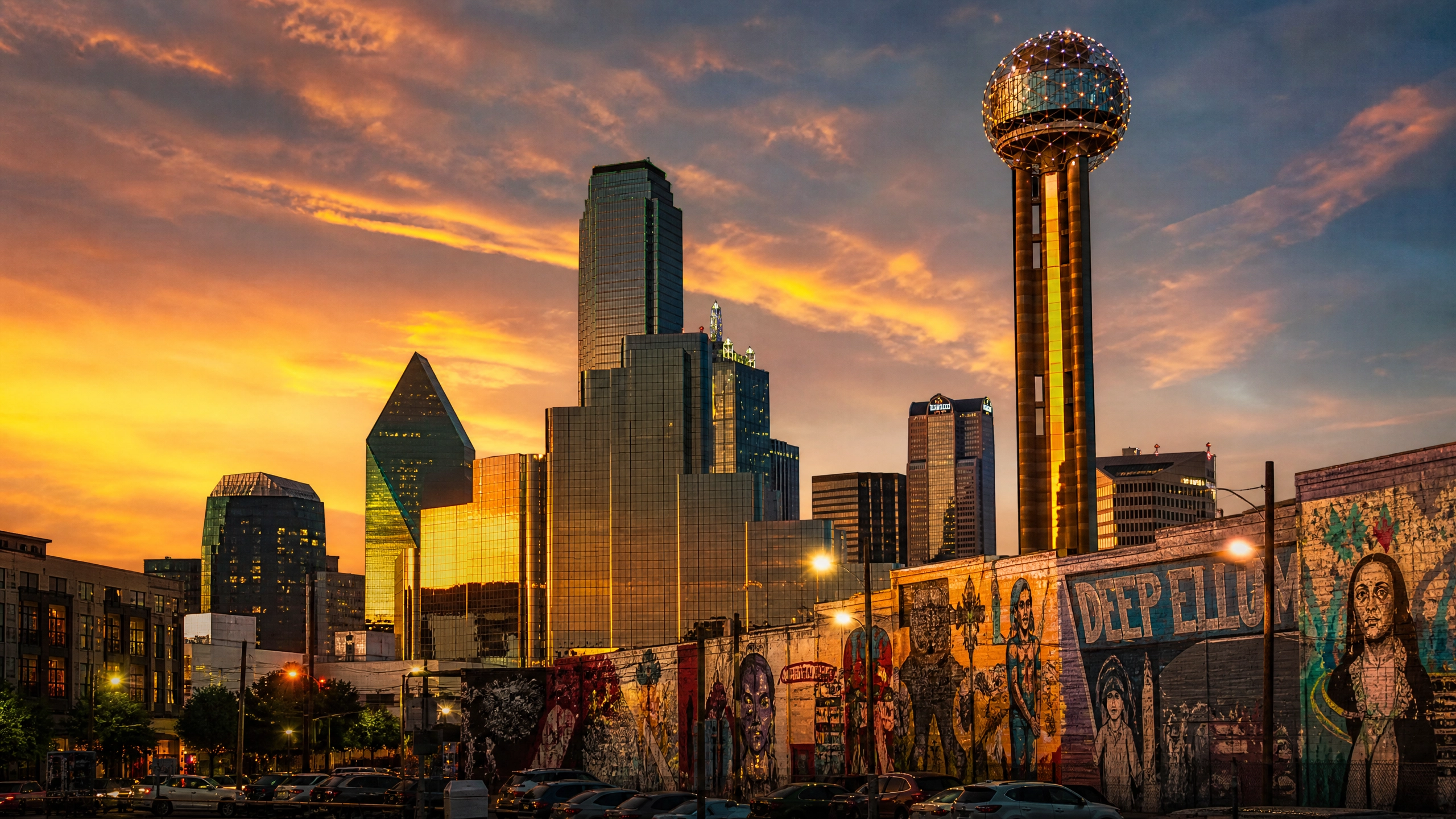
The result is a city that doesn't look like it was grown — it looks like it was decided. The downtown skyline, visible from thirty miles away on a clear day, has the quality of a statement rather than an accumulation. The buildings aren't clustered around a natural feature; they're clustered around the idea of a downtown, which is a different thing entirely. The I.M. Pei-designed City Hall, the Reunion Tower globe, the Perot Museum of Nature and Science — these are buildings that announce themselves. They were meant to. A city that had to argue for its own existence learned early that architecture is a form of argument.
What this means for the visitor is that Dallas rewards a different kind of attention than most cities. You don't come here looking for what the land gave it. You come here looking for what the people built in spite of the land. And what they built, it turns out, is considerable.
Deep Ellum: The Neighborhood That Keeps Surviving
Deep Ellum sits just east of downtown, and it has been dying and refusing to die for a hundred years.
In the 1920s, it was the beating heart of Dallas's Black cultural life — a neighborhood of juke joints, blues clubs, and barbershops where Blind Lemon Jefferson played for tips and the music that would eventually become rock and roll was being assembled from its constituent parts. The neighborhood was called Deep Ellum because "Elm" in the Texas accent of the era became "Ellum," and the street ran deep into the Black commercial district that white Dallas preferred to ignore. It was segregated, it was underserved, and it produced music that the rest of the country would spend decades trying to understand.
The neighborhood declined, was written off, came back in the 1980s as a punk and alternative rock scene, was written off again, came back in the 1990s as a grunge and hip-hop corridor, was written off again, and has spent the last decade in its most recent resurrection as a live music and mural district that draws more visitors on a Friday night than any other neighborhood in the city. The Bomb Factory — a former industrial space on Commerce Street that now holds 4,000 people — books national acts in a room that feels like a secret even when it's sold out. Trees, on Elm Street, has been a live music venue since 1989 and has the kind of institutional memory that most cities build monuments to.
But what Deep Ellum actually is, on any given Tuesday afternoon, is a neighborhood of murals and food trucks and coffee shops and bars that haven't opened yet, where the street art changes faster than the city can map it. Blues Alley, a stretch of Commerce Street near Malcolm X Boulevard, has murals honoring Blind Lemon Jefferson, Stevie Ray Vaughan, Jimmie Vaughan, and Erykah Badu — four artists who came from these streets and between them invented or reinvented four different genres of American music. Standing in front of those murals on a quiet afternoon, you understand something about Dallas that the skyline doesn't tell you: the city's ambition isn't only financial. It's cultural. It's personal. It's the ambition of people who grew up somewhere that the rest of the country didn't take seriously and decided to make something undeniable.
The best way to do Deep Ellum is to arrive around 4 PM, before the evening crowds, and walk east from Good 2 Go Taco on Elm Street — the breakfast tacos here are $3 and the line moves fast — through the mural district toward the Bomb Factory. Stop at Cane Rosso for Neapolitan pizza that has no business being this good in Texas, or at Angry Dog, a bar with a patio the size of a parking lot that has been serving cold beer and burgers since 1991. Come back after 9 PM if you want the music. Come at 4 PM if you want the neighborhood.
Fair Park: The Art Deco Secret That Dallas Barely Talks About
Every October, 2.5 million people descend on Fair Park for the State Fair of Texas, eat fried everything, watch football at the Cotton Bowl, and leave without understanding what they were standing in.
Fair Park is the largest collection of 1930s Art Deco exposition architecture in the United States. When Dallas hosted the Texas Centennial Exposition in 1936, architect George Dahl designed a complex of buildings — the Hall of State, the Esplanade, the Women's Building, the Tower Building — in a style that was simultaneously monumental and modern, all limestone and bronze and geometric ornament, built to announce that Texas was not a frontier anymore. The Esplanade, a 700-foot reflecting pool flanked by Art Deco buildings and bronze sculptures, is one of the most architecturally significant public spaces in the American South. It is also, for eleven months of the year, almost completely empty.
This is the insider's Dallas: Fair Park on a weekday in March, when the State Fair is six months away and the grounds are open and free and you can walk the Esplanade with nobody else around. The Hall of State, which houses the Texas Hall of Fame and a collection of murals depicting Texas history, charges no admission and receives a fraction of the visitors it deserves. The Dallas Museum of Natural History, the African American Museum of Dallas, and the Dallas Aquarium are all here, all on the same grounds, all within walking distance of each other.
The State Fair itself — held every year from late September through mid-October — is a different experience entirely. It's the largest state fair in the country by attendance, and it operates at a scale that has to be experienced to be believed: 277 acres of midway, livestock shows, concert stages, and food vendors competing to see who can deep-fry the most improbable thing. The Big Tex figure, a 55-foot talking cowboy that greets visitors at the main entrance, burned down in 2012 and was rebuilt bigger. That is a very Dallas story.
The Arts District: What Happens When a City Decides to Have Culture
The Dallas Arts District didn't evolve organically over centuries the way the arts districts of older cities did. It was planned, funded, and built in a concentrated burst of civic ambition between the 1980s and the 2000s, and it is now the largest contiguous urban arts district in the United States — 118 acres of museums, concert halls, performance spaces, and parks in the northeast corner of downtown.
The Nasher Sculpture Center, designed by Renzo Piano, is the kind of museum that makes you reconsider what a museum can be. The building is a series of vaulted glass and steel bays that filter natural light onto the sculpture garden below, and the garden itself — where works by Rodin, Matisse, Picasso, Giacometti, and de Kooning sit among trees and water features — is one of the most genuinely peaceful places in Dallas. Admission is $10 on most days, $8 if you arrive on DART light rail, and free on the first Saturday of every month. The free Saturday crowds are worth knowing about: arrive at 10 AM when the doors open, before the families with strollers arrive, and you'll have the garden largely to yourself.
The Dallas Museum of Art, just across Flora Street, is free every day — a policy that the museum adopted in 2013 and that has made it one of the most visited art museums in the country. The collection runs from ancient Egyptian artifacts to contemporary American painting, and the building's atrium, designed by Edward Larrabee Barnes, is worth the visit on its own. But the specific thing to know about the DMA is that its late-night programming — the museum stays open until midnight on the third Friday of every month for "Late Nights at the DMA," with live music, cocktails, and gallery access — is one of the best things Dallas does that almost no visitor knows about.
Between the Nasher and the DMA, Klyde Warren Park sits on top of a recessed freeway — a 5.4-acre green space that connects the Arts District to Uptown and functions as the city's living room. On weekend mornings, it fills with food trucks, yoga classes, dog walkers, and families. The park was built over the Woodall Rodgers Freeway in 2012, which is another very Dallas story: the city had a freeway cutting through the middle of its cultural district, so it built a park on top of the freeway. Problem identified. Problem solved. Move on.
The Food: From Chain Restaurant Capital to Something Else Entirely
For most of its history, Dallas was known as the chain restaurant capital of America — the city where Chili's, TGI Fridays, and dozens of other national chains were born and where the suburban strip mall dining model was perfected. That reputation was accurate and, to anyone paying attention to what was happening in the independent restaurant scene, increasingly irrelevant.
The frozen margarita was invented in Dallas in 1971, when Mariano Martinez modified a soft-serve ice cream machine to produce the drink at scale at his restaurant on Greenville Avenue. The original machine is now in the Smithsonian. This is not a minor footnote — it's the kind of origin story that tells you something about the city's relationship to food: inventive, practical, and not particularly interested in whether the result is considered sophisticated.
What Dallas has become, in the last decade, is a city with a legitimate claim to being one of the best food cities in the country. The Bishop Arts District in Oak Cliff — a neighborhood south of the Trinity River that was long overlooked by the north Dallas money — has become a concentration of independent restaurants, bars, and coffee shops that rivals anything in Austin or Nashville. Lucia, a small Italian restaurant on West Davis Street, has a waiting list measured in months and a pasta program that has been written about in national publications as among the best in the country. Emporium Pies, two blocks away, makes the kind of pie that makes you reconsider whether you've ever actually eaten pie before.
But the specific Dallas food knowledge that doesn't appear in the top Google results is this: the best Tex-Mex in the city is not in the tourist-facing neighborhoods. It's on Maple Avenue in Oak Lawn, where Ojeda's has been serving enchiladas and margaritas since 1969 in a room that hasn't changed much since then, and where the combination plate costs less than fifteen dollars and tastes like it was made by someone who learned the recipe from their grandmother, because it was. Mia's, also on Maple, has been a Dallas institution since 1981 and is the kind of place where the mayor and the line cook eat at adjacent tables and nobody thinks anything of it.
The Dallas BBQ scene is real but requires navigation. Pecan Lodge, which started as a food truck in the Farmers Market and now has a brick-and-mortar in Deep Ellum, is the name you'll see in every guide, and the brisket justifies the line. But the specific thing to know is that the line is shortest on Tuesday and Wednesday mornings, when it opens at 11 AM, and that the burnt ends — not always on the menu, ask when you arrive — are the thing to order if they're available.
Dealey Plaza and the Weight Dallas Carries
There is a moment, standing at the corner of Elm and Houston in Dealey Plaza, when you understand why Dallas has the chip on its shoulder that it does.
John F. Kennedy was assassinated here on November 22, 1963. The city was called "City of Hate" in the days that followed — a label that stuck for decades, that shaped how the rest of the country thought about Dallas, that the city has been arguing against ever since. The Sixth Floor Museum, in the former Texas School Book Depository building at the corner of Elm and Houston, tells the story of the assassination with a restraint and seriousness that the subject demands. The museum is on the sixth floor, in the corner room where Lee Harvey Oswald fired the shots. The window is preserved behind glass. The view down Elm Street is exactly what it was that day.
Visiting the Sixth Floor Museum is not a pleasant experience. It's not meant to be. But it is one of the most important historical sites in the United States, and the museum does something that most historical sites don't: it acknowledges the weight of what happened without trying to resolve it. You leave the museum with the same questions you arrived with, which is the correct outcome for a site like this.
What the museum doesn't tell you — what you have to find on your own — is that Dealey Plaza itself is a small, almost intimate space. The grassy knoll is shorter than you imagined. The distance from the Book Depository to the motorcade route is shorter than you imagined. The whole thing happened in a space you could walk across in ninety seconds, and that compression of geography makes the event feel both more real and more incomprehensible. Dallas has been living with this for sixty years. The city didn't choose to be the place where this happened. It has chosen, repeatedly and deliberately, to be honest about the fact that it did.
South Oak Cliff: The Dallas That Made the Music
Erykah Badu was born in Dallas in 1971 and has refused to leave. Despite millions in the bank and offers to relocate to cities with more industry infrastructure, she still lives in South Dallas, still shops local, still shows up at community events in the neighborhood where she grew up. She has said, in various interviews, that South Dallas is where she understands herself. That is a very specific kind of loyalty, and it points toward something that the tourist-facing version of Dallas tends to skip over.
South Oak Cliff — the neighborhood south of downtown, across the Trinity River, that produced Badu, Stevie Ray Vaughan, and the Vaughan Brothers — is not on most Dallas itineraries. It is not particularly easy to navigate without a car, and the neighborhoods that border it have the kind of complexity that doesn't photograph well. But the music that came out of South Oak Cliff is the most significant cultural contribution Dallas has made to American life, and understanding that music means understanding something about the city that the Arts District and the Nasher and the frozen margarita don't tell you.
The Great Trinity Forest, which runs along the Trinity River through South Dallas, is the largest urban bottomland hardwood forest in the United States — larger than Central Park, larger than any urban green space in the country that isn't a reservoir. Most Dallas residents north of Interstate 30 have never been there. The Trinity River Audubon Center, at the edge of the forest, offers guided hikes and bird-watching programs and sits in a landscape that feels nothing like the city around it: old-growth cottonwoods, herons, the quiet of a floodplain that has been left largely alone. It is one of the most genuinely surprising places in Dallas, and it is almost entirely unknown to visitors.
When to Go and How to Move
Dallas in summer is not for the faint of heart. The heat index regularly exceeds 105°F from June through September, and the city's relationship with air conditioning is the relationship of a desert people with water — total, absolute, non-negotiable. If you visit in summer, you will spend a significant portion of your time moving between air-conditioned spaces, which is fine, because the air-conditioned spaces in Dallas are excellent. The DMA is free. The Nasher is $10. The Sixth Floor Museum is $18. You can spend three days in Dallas in August and never be uncomfortable, as long as you plan your outdoor time for early morning and late evening.
The best months are October through November and March through April. October brings the State Fair of Texas, which runs for 24 days and is worth building a trip around if you've never experienced it. The fair is simultaneously the most Texas thing in Texas and the most Dallas thing in Dallas — enormous, loud, fried, and completely sincere about all of it. The Big Tex figure greets you at the entrance. The Cotton Bowl hosts college football. The midway runs for what feels like miles. The food competition, in which vendors compete to produce the most improbable deep-fried creation, is a genuine annual event that generates national coverage. The 2023 winner was deep-fried butter pecan cheesecake. The 2022 winner was deep-fried Kool-Aid. These are real things that happened.
For getting around: rent a car or use rideshare. The DART light rail is useful for the airport-to-downtown trip and for reaching a few key destinations, but Dallas is a city built for cars, and the distances between neighborhoods require either a car or a willingness to spend money on Uber. The parking situation in Deep Ellum on weekend nights is genuinely terrible — arrive early or use rideshare. In the Arts District and Uptown, street parking exists but is competitive; the parking garages are reasonably priced and worth using.
Planning Your Dallas Trip
Dallas is a car city, and there's no point pretending otherwise. The DART light rail system connects the airport to downtown and runs to several key neighborhoods, but the distances between the things worth seeing require either a car or a willingness to use rideshare for every movement. Plan accordingly.
The best time to visit is October through November, when the heat has broken and the State Fair is running, or March through April, when the weather is mild and the city is in the period between winter and the summer that arrives in May and doesn't leave until October. June through August is survivable but requires air conditioning as a constant companion.
If you're building a Dallas itinerary from scratch, the structure that works best is: first day in the Arts District and Uptown (Nasher, DMA, Klyde Warren Park, dinner in Uptown), second day in Deep Ellum and the Farmers Market (morning at the market, afternoon in Deep Ellum, live music at night), third day in Oak Cliff (Bishop Arts District, Lucia or Emporium Pies, the Great Trinity Forest if you have a car). That's three days and you'll have seen the city that Dallas has become, not just the city it used to be.
AskLeif's Dallas guides can help you build this out in detail — the 4-day Dallas arts and BBQ guide covers the full city, the Dallas couples guide has the best romantic dining and experiences, and the Dallas solo travel guide is built for the traveler who wants to move at their own pace and eat at the bar. The itinerary generator can take your specific dates, budget, and interests and build you something that fits, which is worth doing before you arrive — Dallas rewards planning because the distances between the good things are real, and a day spent driving between neighborhoods you could have walked between in a different city is a day spent in traffic.
The Honest Version
Dallas will not charm you the way San Antonio does. It won't seduce you the way New Orleans does. It won't make you feel like you've stumbled into someone else's dream the way New York does on the right night. What Dallas will do, if you let it, is impress you — and then, slowly, convince you that the impression was earned.
The city has a chip on its shoulder the size of the Cotton Bowl, and it has been earning the right to that chip for 150 years. Every building that went up without a geographic reason to go up, every restaurant that opened in a neighborhood that wasn't supposed to have restaurants, every musician who made something undeniable from a city that the coasts weren't paying attention to — these are all the same gesture, repeated across generations. The gesture is: watch this.
Dallas doesn't owe its existence to geography. It owes it to nerve. And nerve, it turns out, is a better foundation than a harbor.
Plan Your Dallas Trip
The guides below cover every way to experience Dallas — from the full city itinerary to couples weekends and solo adventures.