Hygge, Nyhavn, and the Best Smørrebrød of Your Life: The Real Copenhagen
Destination: Copenhagen, Denmark
Category: Destination Guides
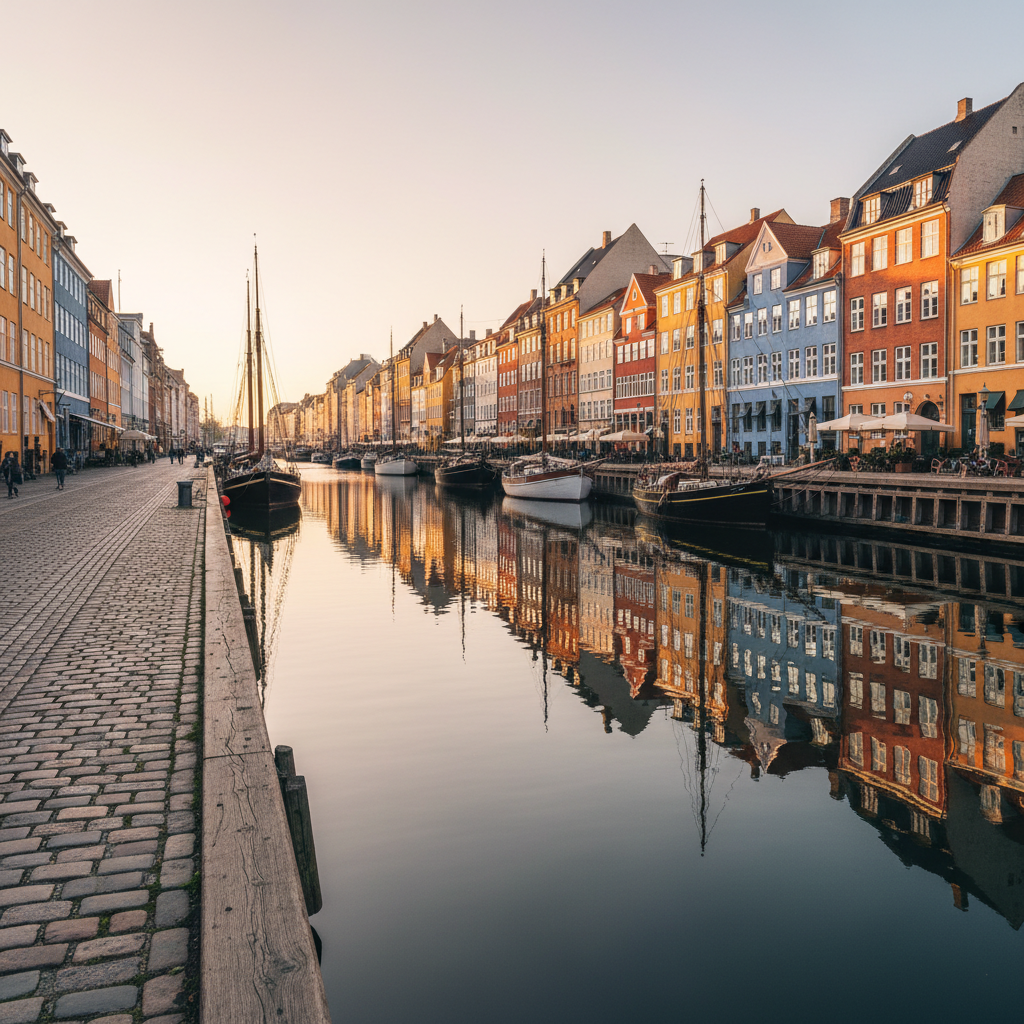
There's a moment that happens to almost every first-time visitor to Copenhagen, usually on the second day, when the city stops being a place you're visiting and starts being a place you're living in. You've rented a bicycle. You're cycling along the harbor, past the colorful houses of Nyhavn that you've seen in a thousand photographs and that are somehow more vivid in person, and you realize that the person cycling next to you is wearing a suit and carrying a briefcase and is clearly on their way to work, and the person on the other side is a mother with two children in a cargo bike, and none of them are wearing helmets because in Copenhagen you don't need to perform safety — the infrastructure has already taken care of it. You're not a tourist in a cycling city. You're just a person cycling in a city. And the city, without making any particular effort, has made you feel like you belong there.
This is Copenhagen's superpower, and it's one that no amount of urban planning can fully explain. The city is objectively expensive, objectively grey for much of the year, and objectively lacking in the kind of landmark-density that makes cities like Rome or Paris feel like they're constantly performing their own greatness. Copenhagen has Nyhavn and Tivoli and the Little Mermaid (which you should skip, and we'll get to that). What it has in abundance is something harder to quantify: a quality of life so high, a food culture so extraordinary, and a design sensibility so deeply embedded in everything from the street furniture to the coffee cups that the city feels like it was built by people who thought very carefully about what it means to live well — and then built that.
The Danes have a word for it: hygge. It's been translated as "coziness" and "conviviality" and "the art of creating intimacy," and none of these translations quite captures it because hygge is less a concept than a practice. It's the candles lit in the middle of the afternoon in a café because the light is better that way. It's the blankets left on the outdoor chairs at restaurants so that you can eat outside in October without being cold. It's the way a dinner party in Copenhagen tends to last four hours because nobody is in a hurry to be anywhere else. Hygge is the operating system that runs underneath Copenhagen's efficiency and design and food culture — the reason why a city that is dark for 17 hours a day in December is consistently ranked among the happiest places on earth. The Danes figured out that the quality of an experience matters more than its convenience, and they built a city around that insight.
Then there's the food. Copenhagen's food scene is not merely excellent — it is historically significant. When René Redzepi opened Noma in 2003 and started serving fermented vegetables, foraged herbs, and live ants on a plate, he didn't just create a restaurant. He created a movement that changed how chefs around the world thought about ingredients, technique, and the relationship between a kitchen and its landscape. Noma has been named the World's Best Restaurant five times. The alumni of Noma's kitchen have gone on to open restaurants across Copenhagen and around the world, creating a density of extraordinary cooking in a city of 800,000 people that is unmatched anywhere in Europe. Copenhagen has 26 Michelin stars. That's more per capita than Paris. The city that invented the open-faced sandwich on dark rye bread has become the city that is defining what European fine dining looks like in the 21st century.
The Neighborhoods: Copenhagen Beyond the Postcard
Nørrebro is where Copenhagen's soul lives, and it is nothing like the postcard. This is the city's most multicultural neighborhood — a dense, vibrant, occasionally chaotic mix of Danish families, immigrant communities, students, and the creative class that has been priced out of everywhere else. Jægersborggade, the street that runs through the heart of Nørrebro, is one of the great short streets in Europe: independent coffee roasters, natural wine bars, a bakery that sells out of its sourdough by 9am, a florist that arranges flowers like they're contemporary art. The street was a drug market 20 years ago. Now it's the most interesting street in the city. Nørrebro is the Copenhagen that the city's own residents love most, and it's the neighborhood that rewards the traveler who is willing to get on a bicycle and go somewhere without a plan.
Vesterbro was Copenhagen's red-light district until the 1990s, when the artists and the young families moved in and the neighborhood transformed with the speed and completeness that only post-industrial urban neighborhoods can manage. The Meatpacking District — Kødbyen — is now the city's nightlife center, with bars and restaurants occupying the old slaughterhouse buildings in a way that preserves the industrial aesthetic while filling it with the warmth of good food and good company. Vesterbro is also where you'll find the Carlsberg Brewery, founded in 1847 and now a museum and cultural center that tells the story of a company that was, for most of the 20th century, Denmark's largest employer and most recognizable brand.
Frederiksberg is technically a separate municipality entirely surrounded by Copenhagen, which gives it a slightly different character — quieter, more residential, more given to the kind of Sunday afternoon that involves a long walk through Frederiksberg Have (the palace gardens, which are free and extraordinary) and a late lunch at a neighborhood restaurant that doesn't appear in any guidebook. The Cisternerne, an underground reservoir beneath Frederiksberg Hill that has been converted into an art gallery, is one of the most extraordinary spaces in Copenhagen — a vast, dark, dripping cavern of Victorian engineering that hosts contemporary art installations that use the space in ways that would be impossible anywhere else.
Christianshavn is the canal district, Copenhagen's answer to Amsterdam, with the added attraction of Freetown Christiania — the self-proclaimed autonomous neighborhood that has been operating outside normal Danish law since 1971, when a group of squatters occupied an abandoned military base and declared it a free city. Christiania is now home to about 1,000 residents, a thriving arts community, and the most famous stretch of cannabis sales in Northern Europe. It's also genuinely interesting as a social experiment — a community that has been governing itself by consensus for over 50 years, with its own rules, its own architecture, and its own relationship to the city around it. The colorful murals, the cozy cafes, and the sense of a community that has decided to live differently are worth experiencing regardless of your views on the substance being sold there.
The Food: From Smørrebrød to Noma's Legacy
The open-faced sandwich — smørrebrød — is the foundation of Copenhagen's food culture, and it is worth taking seriously. The name translates as "buttered bread," which undersells it considerably. The base is a slice of dense, dark rye bread — rugbrød — that has been fermented and baked in a way that gives it a complexity of flavor that ordinary bread simply doesn't have. On top goes a carefully composed arrangement of ingredients: pickled herring with dill and capers, or roast beef with remoulade and crispy onions, or smoked salmon with cucumber and horseradish, or the liver pâté with pickled beets that is the most Danish thing on the menu. The best smørrebrød in Copenhagen is at Selma (which holds a Michelin Bib Gourmand for its meticulous approach to the form) and at Meyers i Tårnet inside Christiansborg Palace, where you can eat traditional Danish food in a room with views over the city that make the meal feel like an occasion.
The street food scene has its own landmark: Reffen, a street food market built inside upcycled shipping containers on the industrial harbor, is one of the most Copenhagen things that exists. It's sustainable, it's design-forward, it's multicultural, it's affordable, and the food is genuinely excellent — global flavors prepared by vendors who take their craft seriously, with mains starting at 70 DKK (roughly $10 USD) and a harbor view that costs nothing. Reffen is the food market as urban living room, and on a summer evening with the light lasting until 10pm and the harbor glittering behind the container stalls, it's one of the best places to eat in Europe.
For those who want to understand what the New Nordic movement actually means in practice, the Noma alumni restaurants are the place to start. Restaurant Barr, opened by former Noma co-owner Thorsten Schmidt, serves Nordic food with a focus on fermentation and seasonal ingredients in a beautifully converted warehouse on the waterfront. Sanchez, opened by Noma alum Rosio Sanchez, serves Mexican food made with the same obsessive attention to sourcing and technique that defined Noma — and is one of the most surprising and delicious restaurants in the city. The point of the Noma legacy is not that every restaurant in Copenhagen serves foraged herbs and live ants. The point is that a generation of chefs learned to think about food differently, and that thinking has permeated the entire city's restaurant culture in ways that make even the casual neighborhood bistro in Copenhagen better than most restaurants in most cities.
The Experiences That Define Copenhagen
The Rosenborg Castle is the best castle in Copenhagen, and it's not close. Built in the early 17th century by King Christian IV — who was, by any measure, the most interesting Danish monarch in history — the castle is a Renaissance fantasy of copper roofs and intricate spires set in the King's Garden, the oldest royal garden in Denmark. The interior is a progression through the tastes and personalities of successive Danish monarchs, each room decorated in the style of its occupant. The Danish Crown Jewels are in the basement, and they are genuinely spectacular — the collection includes some of the largest cut diamonds in Scandinavia and a crown that has been used in Danish coronations since 1596. Buy tickets in advance; the line without them can be substantial.
The Christiansborg Palace Tower is free to climb and offers the best view in Copenhagen — better than any paid observation deck, because it puts you at the center of the city's history rather than above it. The tower rises from the palace that houses the Danish Parliament, the Prime Minister's Office, and the Supreme Court, and the view from the top takes in the entire city: the copper roofs of the old town, the harbor, the green spaces, and on a clear day the bridge to Sweden. The tower is free. The view is extraordinary. This is a combination that Copenhagen manages repeatedly, which is one of the reasons that travelers who come expecting an expensive city leave feeling like they got more than they paid for.
Tivoli Gardens, the amusement park that opened in 1843 and inspired Walt Disney to build Disneyland, is one of those places that sounds like a tourist trap and turns out to be genuinely magical. The vintage aesthetic — a mix of 19th-century romanticism and mid-century modernism — is maintained with obsessive care. The rides are genuinely thrilling. The food is better than it has any right to be. At night, when thousands of lights turn the park into a fairytale landscape and the Saturday fireworks go off over the lake, Tivoli is one of the most beautiful urban spaces in Europe. It's also the most visited attraction in Scandinavia, which means it can be crowded — go on a weekday evening in the shoulder season for the best experience.
The harbor swimming is perhaps the most Copenhagen experience available to visitors, and it's completely free. The harbor has been clean enough to swim in since 2002, when decades of industrial cleanup finally paid off, and the Danes responded by building a series of harbor baths — floating platforms with diving boards and ladders — that fill with swimmers from June through August. Islands Brygge, the most popular harbor bath, is directly across the canal from the city center and accessible by bicycle in five minutes. On a warm summer day, the sight of hundreds of Copenhageners swimming in the harbor in the middle of the city — office workers on lunch breaks, families with children, elderly couples who have been coming every summer for decades — is one of the most vivid expressions of what it means to live in a city that has been designed around the quality of its residents' lives.
The Little Mermaid: Skip It
The Little Mermaid statue is the most visited tourist attraction in Denmark and the most disappointing. The statue is small — 1.25 meters tall, seated on a rock in the harbor — and the experience of visiting it involves joining a crowd of tour groups who have been bused in specifically to photograph it. The statue itself is fine. The experience of visiting it is not. The far more interesting Kastellet fortress is a five-minute walk away — a perfectly preserved 17th-century star-shaped fortification that is now a serene waterfront park with a historic windmill, tree-lined avenues, and almost no tour groups. Visit Kastellet. Skip the mermaid. This is the advice of every person who has lived in Copenhagen for more than a month.
When to Go and How to Get Around
The best time to visit Copenhagen is May through September, when the city is at its most alive — the harbor baths are open, the outdoor restaurants are full, and the daylight lasts until 10pm in June. The city is genuinely beautiful in winter too, particularly around Christmas when the hygge factor reaches its annual peak and Tivoli Gardens transforms into a Christmas market of extraordinary quality. The shoulder seasons of April and October offer good weather, smaller crowds, and the full range of the city's cultural programming.
Getting around by bicycle is not just possible — it is the correct way to experience Copenhagen. The city has 390 kilometers of dedicated cycling lanes, a flat topography that makes cycling effortless, and a culture that treats cyclists as the primary road users rather than an afterthought. Donkey Republic and other bike-share services make rentals easy. The Metro is clean, frequent, and covers the city comprehensively for the days when you don't want to cycle. The city is compact enough that most major attractions are within a 20-minute cycle of each other.
Copenhagen is expensive by most standards — plan for DKK 1,000–1,500 per day ($140–210 USD) for a comfortable mid-range experience that includes good meals, the major attractions, and a decent hotel. Budget travelers who are willing to eat at Reffen and the city's excellent food markets, stay in hostels or budget hotels, and take advantage of the many free attractions (Christiansborg Tower, Kastellet, the harbor baths, the King's Garden) can manage on DKK 500–700 per day.
The Copenhagen Itinerary Guides
We've built a full library of Copenhagen guides to help you plan every kind of trip — from a long weekend focused on food and design to a full week that takes in the city's neighborhoods, day trips, and the full range of its cultural life.
For first-time visitors, our Copenhagen in 4 Days: Castles, Canals & the World's Best Food City covers the essential circuit — Nyhavn, Rosenborg Castle, Christiania, Tivoli, and the Nørrebro neighborhood — in a sequence that gives you the city's full range without feeling rushed.
Solo travelers will find Copenhagen one of the safest and most welcoming cities in Europe for independent exploration. Our Solo Copenhagen: 3-Day Itinerary of Cycling, Smørrebrød & Scandinavian Design covers the solo-friendly coffee shops, the cycling routes that take you through every neighborhood in a single afternoon, and the harbor baths where you'll inevitably end up talking to your neighbors.
Budget travelers will appreciate our Copenhagen on a Budget: 4-Day Itinerary, which proves that Europe's most expensive city can be done remarkably well without breaking the bank — free towers, harbor swimming, Reffen street food, and cycling everywhere.
For couples, our Copenhagen for Two: A Romantic 4-Day Design, Food & Hygge Itinerary weaves together the city's most atmospheric experiences — the candlelit restaurants of the old town, the harbor at sunset, the Tivoli fireworks on a Saturday night — into a trip that uses Copenhagen's warmth and design sensibility to its full romantic advantage.
Families traveling with children will find Copenhagen surprisingly accommodating — the city is clean, safe, and full of experiences that work for all ages. Our Copenhagen with Kids: 4-Day Family Itinerary covers Tivoli Gardens (genuinely magical for children), the Rosenborg Castle Crown Jewels, the harbor baths, and the troll hunt in the forests outside the city that has become one of the most beloved family activities in Denmark.
What Copenhagen Quietly Teaches You
The cities that change you are rarely the ones that try to. Rome overwhelms you with beauty. New York overwhelms you with energy. Tokyo overwhelms you with precision. Copenhagen does something subtler: it shows you what a city looks like when it has been designed, over generations, around the actual experience of living in it rather than the experience of visiting it. The cycling infrastructure exists because the Danes decided that cycling was better than driving, and then built a city that made cycling the obvious choice. The food culture exists because the Danes decided that eating well was a right rather than a luxury, and then built a restaurant scene that makes extraordinary food available at every price point. The hygge exists because the Danes decided that the quality of time spent with other people mattered more than the quantity of things accomplished, and then built a culture that protects that time.
None of this happened by accident, and none of it can be easily exported. You can copy the cycling lanes. You can copy the smørrebrød. You can put candles on the tables and call it hygge. But the thing that Copenhagen actually has — the deep, structural commitment to the idea that a city should make its residents happy — is not a design choice. It's a value system. And spending time in Copenhagen, really spending time in it rather than passing through, is one of the most effective ways available to a traveler to understand what a city built around that value system actually feels like to live in.
Most people leave Copenhagen wanting to move there. The ones who don't are the ones who haven't been yet.