Cinque Terre Was Built by People Who Had No Other Choice. That's Why It Looks Like That.
Destination: Cinque Terre, Italy
Category: destination
There is a wall above Riomaggiore that has been standing for nine hundred years.
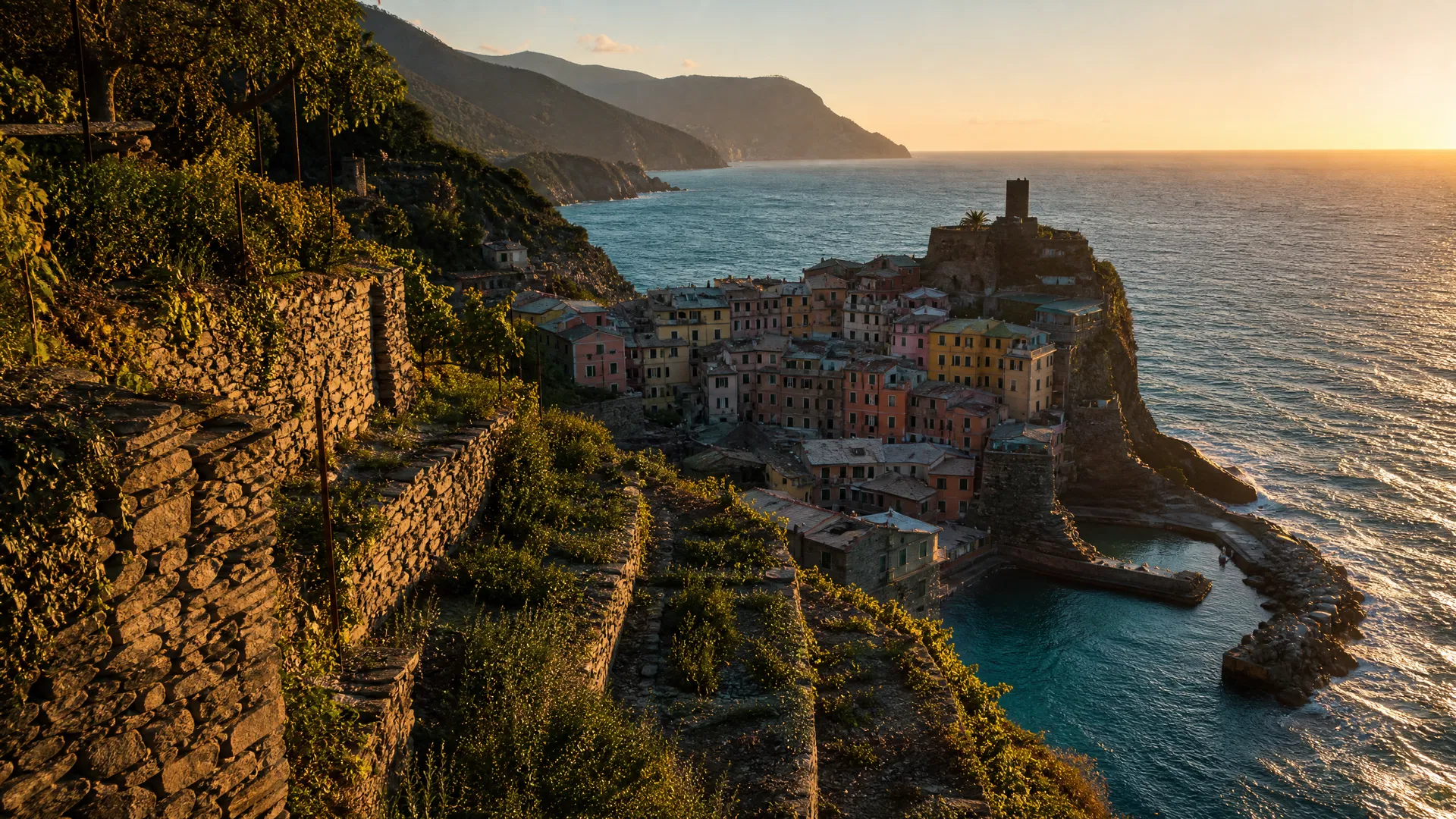
It is not a famous wall. It does not appear in any photograph you have seen of Cinque Terre. It is a dry-stone retaining wall, about a meter high, built without mortar from the same grey-green slate that makes up the cliff it holds back. Someone laid those stones by hand in the twelfth century, and someone has been maintaining them ever since — clearing the vegetation, replacing the ones that shift in winter storms, pressing them back into the hillside after the rains. The wall does not hold up a building. It holds up a terrace. The terrace holds up a vineyard. The vineyard holds up a family. The family holds up a village. The village is what you came to photograph.
This is what Cinque Terre actually is: not five beautiful villages on a cliff, but seven thousand linear kilometers of dry-stone walls, built over a thousand years, that happen to have five beautiful villages growing on top of them. The walls came first. The beauty is a consequence. And the walls — unlike the beauty — are in serious trouble.
Understanding this does not make Cinque Terre less worth visiting. It makes it more worth visiting, and more worth visiting correctly, which is a different thing entirely.
What Cinque Terre Actually Is
The five villages — Monterosso al Mare, Vernazza, Corniglia, Manarola, and Riomaggiore — have been inhabited since the Bronze Age. The Romans knew this coast. But for most of their history, the villages were effectively sealed off from the rest of Italy by the mountains behind them. There were no roads. There was no railway. The only connections were by sea, and the sea here is not gentle.
The railway tunnel came in 1875. Before that, the people of Cinque Terre had been farming these cliffs in isolation for centuries, and they had done it not because the cliffs were beautiful but because the cliffs were what they had. The terraces were cut by hand from near-vertical rock faces. The walls were built from stone pulled out of the same rock. The vines were planted in soil that had to be carried up in baskets because there was no other way to get it there.
Giancarlo Gariglio of Slow Wine Italia has spent years studying what this labor actually costs. His number is 2,000 hours per hectare per year to cultivate a Cinque Terre vineyard. In Napa Valley, the same hectare takes 250 hours. The difference is not skill or dedication. It is geography. In Cinque Terre, you harvest on your knees. You carry the grapes down by hand, or by monorail if you are lucky enough to have one, because no road reaches the vines. Every bottle of wine from this coast is, in a literal sense, the product of someone's back.
Ninety-five percent of the terraces have been abandoned in the past century.
The people who built them left. They went to the shipyards of La Spezia and Genoa, where the work was hard but not this hard. They went to the hotels and restaurants of the villages below, where the work was easier and the tourists paid well. The vines grew over. The walls began to crack. And when the walls crack, the terraces slide, and when the terraces slide, the land goes into the sea.
This is not a metaphor. On October 25, 2011, it happened literally.
The Flood
On that day, torrential rains triggered landslides that buried Vernazza and Monterosso under four meters of mud and debris. Thirteen people died. The water reached second-floor windows. Roads and rail were cut. Vernazza was left without water, gas, or electricity. Homes and businesses were destroyed.
The village was dug out by hand. Not by machines — the streets are too narrow for machines. By people: the residents who refused to leave, and strangers who came from across Italy and beyond because they had heard what happened and could not stay away. They worked in shifts, passing buckets of mud up the narrow caruggi, the alleyways, for months.
When you walk through Vernazza now and find it beautiful — and you will find it beautiful — you are looking at something that was dug back out of four meters of mud by human hands. That is worth knowing while you take your photograph. It is worth knowing because the flood was not an accident of weather. It was, in part, the consequence of abandoned terraces. The walls that had held the hillside for nine centuries were no longer being maintained. When the rain came, the land had nothing left to hold it.
Heydi Bonanini, owner of Possa Farms in Riomaggiore, has been rebuilding the stone walls on his family's land since 2004. He is one of a small number of people who chose the vines over the easier work. He shares the story of what the walls mean with local schoolchildren and visitors alike. He deserves more than a mention in a travel blog. He deserves a monument.
The Five Villages
Every guide to Cinque Terre lists the five villages. Most describe them the same way: Monterosso is the biggest, Vernazza is the most photogenic, Corniglia is the quietest, Manarola is the most dramatic, Riomaggiore is the most colorful. This is accurate and almost entirely useless.
Here is what the guides do not tell you.
Vernazza has the only natural harbour in all of Cinque Terre. Its Latin name was Vulnetia. Until the Republic of Genoa, there was no beach and no square — the sea came right up to the buildings of what is now Via Roma, and boats tied up against the houses. A small, salty Venice. The Doria Castle above it was built in the eleventh century, and its walls are completely irregular because they simply follow the shape of the cliff. The best arrival in all of Cinque Terre is on foot from Corniglia, coming around the headland to see Vernazza from above. Arrange your day around it.
The village has its own dialect, which is not Italian and not quite Ligurian. The shaded side of Via Roma is called Lùvegu — dank. The sunny, flowering side is Sciuiu. The little square under the old Belforte bastion, where the salt smell is most concentrated and the fishermen sit in the off-season, is Ventegà. The alley that is now Via del Santo used to be called Caruggiu dell'axéu — vinegar alley — because people waited for rainy days to wash out their wine casks, and the dregs ran down the stone into the street. Nobody has smelled that alley in a hundred years. Silvia, who grew up in Vernazza, says she has spent her life imagining it.
Corniglia is the only village that does not touch the sea. It sits on a promontory 100 meters above the water, reached from the train station by 377 steps. Most day-trippers skip it. This is the correct reason to go. Osteria de Mananan, on the main street, serves ravioli in walnut pesto that is worth the climb alone. Pair it with a glass of the local dry white and sit there until the light changes.
Manarola is where the wine culture is most visible. The village is built along the course of an old stream, now covered and transformed into the main street, and it develops like an amphitheatre toward the sea. At Nessun Dorma, above the village on the cliff path, you can drink an aperitivo with a view that is, without exaggeration, one of the most extraordinary in all of Liguria. Go at sunset. Stay until the village lights come on below you. At Trattoria dal Billy, the family has been fishing these waters for generations, and the fish on your plate was in the sea this morning. You will taste the difference.
Monterosso al Mare is the largest and the most resort-like — the only village with a proper sandy beach, the most hotels, the most restaurants. It is also where the anchovies come from. Monterosso anchovies are salted in arbanelle, glass jars weighted with flat round stones, and they are among the finest in Italy. In the caruggi of the old town, the smell of them — sharp brine, oregano drying on windowsills, fresh laundry strung between the buildings — is the true perfume of the village. Buy a jar. Eat them on focaccia with a glass of white wine. Do this before you do anything else.
Riomaggiore is the southernmost village and the most dramatically situated — the houses stacked up the cliff like a vertical city, the shaggy rocks at the waterline contrasting with the painted facades above. In summer, the port fills with children diving from the rocks. From the sea — rent a small boat, or swim just beyond the shore — the red, orange, and pink tones create a view that no photograph adequately captures, because photographs flatten the depth.
The Wine
Boccaccio wrote about it in the Decameron in the fourteenth century. The bandit Ghino di Tacco serves a prisoner "a large glass of Vernaccia di Corniglia" — a wine from these cliffs, named in a work of literature that has been read continuously for seven hundred years. Petrarch wrote about Monterosso wine in his poem Africa. The bottle maker of Pope Paul III Farnese, writing in the sixteenth century, noted that the Pope did not drink this wine throughout his meals but reserved it for special occasions — for the season of the good fig, for moments worth marking.
The wine is still here. It is called Cinque Terre DOC, a dry white made from Bosco (60%), Albarola (20%), and Vermentino (20%) grapes, and it has been certified since 1973 — one of the first DOC wines in Italy. It is mineral in a way that is not a wine writer's affectation but a measurable fact: spectrographic analysis has shown that the white wine of Cinque Terre is unusually rich in salts, deposited by the winds that blow from the sea. It tastes like the cliff it grew on.
And then there is the sciacchetrà.
The word itself has a history. It appears to have entered the written record in the late nineteenth century, coined by the Macchiaiolo painter Telemaco Signorini in his memoir Riomaggiore, recalling summers spent in the village: "in September, after the harvest, the best grapes are spread in the sun to obtain the sciaccatras." The wine is made from the best bunches of Bosco and Albarola, hung in the cellar for fifty days, the grains selected one by one to make a concentrated must with an alcohol content of around 17 degrees. It is not bottled until November of the year following the harvest. The production is small enough that it is sold only in 0.375-liter bottles. The taste is honey and almonds and candied orange peel, with something underneath that is harder to name — the specific sweetness of a thing that cost everything to make.
Families drink it at weddings. Pope Paul III served it at banquets in Rome. You should drink it in Volastra, above Manarola, at Cantina Capellini, where Luciano and Giuseppina offer tastings in their vineyard in summer, with the sea visible through the vines.
Volastra
Almost no one goes to Volastra.
It sits above Manarola, a fifteen-minute climb up through the terraced vineyards — or a short minibus ride if you prefer — and it is what Cinque Terre looked like before the railway came. A small village of stone houses, working vineyards, olive groves, the smell of the macchia mediterranea underbrush. The view from here is the reverse of every photograph you have seen: instead of looking up at the villages from the sea, you look down at them from the hills, and you understand for the first time the scale of what was built here.
At Locanda Tiabuscion, the kitchen serves tagliolini with anchovies, pine nuts, and capers, paired with the local white wine. The restaurant is small. The food is serious. The tourists are almost entirely absent.
The path from Manarola to Volastra to Corniglia is the one that Christine Godfrey — an American who married a local and stayed — considers the finest in the Cinque Terre. It follows the stone staircases and mule trails that the vintners have used for centuries, through vineyards and over walls that are, in some places, still being rebuilt. Godfrey organizes an annual ultra-marathon called the SciaccheTrail that follows this route, ending with a wine tasting. The event is a fundraiser for the walls. The walls are always the point.
The Food
The food of Cinque Terre is Ligurian, which means it is the food of a coast that had very little flat land and learned to make extraordinary things from what it had. Pesto was invented here — not as a sauce for pasta but as a way to preserve basil through the winter, pounded with pine nuts and olive oil and Parmigiano in a marble mortar. Trofie, the twisted pasta that is its natural partner, is a Ligurian shape, designed to hold the sauce in its spirals. Farinata is a flatbread made from chickpea flour, baked in a wood-fired oven in a copper pan, eaten hot with nothing on it, or with a smear of pesto, or with a glass of the local white. It is one of the simplest things you will eat in Italy and one of the best.
The anchovies from Monterosso are worth a separate paragraph. They are caught in the waters just offshore, salted in layers in the arbanelle jars, pressed under flat stones for months, and then eaten on everything — on focaccia, on pasta, in the cappon magro salad that is the great Ligurian feast dish, on their own with a glass of wine. At Cappun Magru in Manarola, the owner's son will tell you that the minerality of the local wine goes with the anchovies in a way that no other wine does. He is right.
When to Go
The honest answer is: not in July or August, and not on a weekend in June or September. Cinque Terre in peak season is not a travel experience. It is a queue. The villages are small — Vernazza has five hundred permanent residents — and they fill up very quickly with people who have come to collect the postcard image and leave.
Come in October. The light is extraordinary, the crowds are gone, and the harvest is happening. The sciacchetrà grapes are being brought down from the vineyards. The restaurants are cooking for people who live here, not for people passing through. The trails are open and quiet. The villages exhale.
If you can only come in summer, come early. The first ferry from Monterosso to the other villages leaves at 9:00 AM. Before that, the villages belong to the people who slept in them. The light at 7:00 AM on Vernazza's harbour is the light that made Boccaccio write about the wine and Petrarch write about the hills. It has not changed.
Getting There and Around
The gateway is La Spezia, served by high-speed rail from Florence (1 hour) and Genoa (1 hour). From La Spezia Centrale, the Cinque Terre Express runs every 15 minutes, stopping at all five villages. The journey from La Spezia to Monterosso takes about 25 minutes. A single fare covers the whole line.
The Cinque Terre Card (€7.50/day) covers the train between villages and the national park trails. Buy it at any station. The trails between villages are the correct way to move — not because they are scenic (they are scenic) but because the walk is the argument. You cannot understand what the walls cost until you have climbed alongside them.
Do not bring a car. There is nowhere to put it and no road that makes sense of it. The train is the logic of this place.
Planning Your Visit
Two nights is the minimum to feel the place rather than collect it. Three nights is better. Stay in one village and walk to the others — the train is for the days when your legs have had enough.
For couples, the Cinque Terre 4-day itinerary is built around the specific rhythm of the place: early mornings in the village before the ferries, midday hikes between Vernazza and Corniglia, afternoon wine in Volastra, evenings in Manarola when the lights come on. For a shorter visit, the 3-day Cinque Terre itinerary covers the essential architecture of the place without feeling rushed.
The best base is Vernazza or Manarola. Monterosso is the most comfortable — the most hotels, the most beach — but it is also the most like a resort, and a resort is not what you came for. Riomaggiore is the easiest to reach from La Spezia and a good choice if you are arriving late. Corniglia is the quietest and the most local, but the 377 steps from the station are a commitment at the end of a long day.
Book accommodation months in advance for summer. In October, you can often find rooms a week out.
The Closing Argument
There is a photograph that almost everyone takes in Cinque Terre. It is taken from the path above Vernazza, looking down at the village and the harbour and the sea. The olive grove in the foreground is the one that Silvia, who grew up in Vernazza, used to visit with her grandfather as a child. He grew peaches and apricots and pears there. She ate them straight from the trees. The grove is still there. The photograph is still taken. The grandfather is gone.
The beauty of Cinque Terre is real. The photographs are not lying to you. But the photographs are showing you the surface of a thing that has a very specific and very fragile interior, and the interior is what you will remember after the photographs have faded.
The walls are the point. The walls were built by people who had no other choice, and they are being maintained — barely, not enough, but still — by people who have chosen to stay when they could have left. When you walk through Vernazza and find it beautiful, you are walking through the consequence of that choice. When you drink the sciacchetrà and taste the honey and the almonds and the thing underneath that is harder to name, you are tasting the thousand years of labor that made the cliff into a vineyard.
Go. Go before you understand why it matters. You will understand why it matters once you are there, and then you will be glad you went, and you will want to go back, and that is the correct response to a place that has been built by people who had no other choice and has somehow, against all probability, not run out of reasons to stay.
Ready to plan your visit? The Cinque Terre couples itinerary and the 3-day Cinque Terre escape are built for the pace this place deserves.