Chicago Doesn't Want Your Sympathy. It Wants Your Full Attention.
Destination: Chicago, Illinois
Category: Destination Guides
Chicago Doesn't Want Your Sympathy. It Wants Your Full Attention.
There is a particular kind of civic pride that belongs only to cities that have had to earn it. Not the easy pride of a city that was always beautiful, always wealthy, always the center of things. The hard pride of a city that burned to the ground and rebuilt itself taller. That was written off as a second city and responded by becoming the most architecturally significant city in the world. That was told it was too cold, too flat, too Midwestern, and answered with a food scene that has produced more James Beard Award winners than anywhere outside of New York, a music tradition that gave the world the electric blues and house music, and a lakefront that is, by any objective measure, one of the great public spaces in America.
Chicago doesn't ask you to love it. It doesn't need to. It knows what it is.
What it is, specifically, is this: a city of 2.7 million people on the southwestern shore of Lake Michigan, built on a swamp that was drained and filled and built upon with a speed and ambition that was, in the nineteenth century, the most dramatic urban story in the world. It burned down in 1871 — the Great Chicago Fire, which destroyed roughly a third of the city in two days — and then rebuilt itself so quickly and so ambitiously that architects from around the world came to watch. The skyscraper was invented here. The steel-frame building was invented here. Modern architecture, as a discipline, was essentially invented here. The city is a living museum of architectural history, and it knows it, and it is not modest about it.
But Chicago is also a city that eats extraordinarily well, drinks with genuine enthusiasm, argues about its sports teams with a passion that borders on the theological, and maintains, despite everything, a warmth and directness that is distinctly Midwestern — a quality that visitors from the coasts consistently underestimate until they experience it and then can't stop talking about.
This is Chicago. Pay attention.
The Architecture: The Reason Everything Else Exists
You cannot understand Chicago without understanding its architecture, because the architecture is not decoration — it is the city's founding myth, its central argument, its reason for being taken seriously. When the city burned in 1871, it created a blank slate on which the most ambitious architects in America could experiment. What they built changed the world.
The Chicago School of Architecture, which emerged in the 1880s and 1890s, established the principles that still govern tall building design: the steel frame, the large plate-glass window, the curtain wall, the elevator as the enabling technology of vertical urbanism. Louis Sullivan, Daniel Burnham, William Le Baron Jenney, John Wellborn Root — these are not names that most tourists know, but they are the people who built the modern city. Every skyscraper in every city in the world is, in some sense, a descendant of what they built in Chicago in the decades after the fire.
The Chicago Architecture Center, on the Riverwalk, is the best starting point for understanding all of this. Their river architecture cruise — a ninety-minute boat tour of the Chicago River — is one of the finest introductions to any city's built environment available anywhere in the world. You see the buildings from the water, which is the way they were meant to be seen, and you understand the relationship between the river, the lake, and the grid in a way that walking the streets alone cannot give you.
The Loop, Chicago's downtown, is an outdoor museum. The Rookery Building (1888), with its light court redesigned by Frank Lloyd Wright in 1905. The Monadnock Building (1891), the last great masonry skyscraper before steel frames made masonry obsolete. The Marquette Building (1895), with its lobby mosaics depicting the history of the Great Lakes region. The Sullivan Center (1899), with its cast-iron ornament that is among the most beautiful decorative work in American architecture. These buildings are not behind glass. You walk into them. You use them. They are offices and shops and restaurants, and they have been continuously occupied for over a century.
Beyond the Loop: the Prairie Avenue Historic District, where the Glessner House and Clarke House preserve the domestic architecture of Chicago's Gilded Age. The Frank Lloyd Wright Home and Studio in Oak Park, a short train ride from downtown, where Wright developed the Prairie Style that would make him the most famous American architect in history. The Baha'i House of Worship in Wilmette, one of the most beautiful religious buildings in North America. The Illinois Institute of Technology campus, designed by Mies van der Rohe in the 1940s and a masterpiece of modernist planning.
Chicago takes its architecture seriously enough to have created an entire civic infrastructure around it — tours, museums, preservation organizations, an annual architecture biennial that draws practitioners from around the world. This is not a city that treats its buildings as backdrop. It treats them as argument.
The Lakefront: The Gift Chicago Gave Itself
In 1836, before Chicago was even a city, a group of commissioners set aside the land along the lake as "public ground — common to remain forever open, clear and free." This was either an act of extraordinary foresight or an accident of history, depending on who you ask, but the result is one of the great urban gifts in American history: eighteen miles of continuous public lakefront, from Edgewater in the north to South Shore in the south, with no private development between the city and the water.
The Lakefront Trail runs the entire length of this shoreline, and cycling or running it on a clear day — with the skyline to the west and the lake to the east, blue and enormous and more oceanic than any inland body of water has a right to be — is one of the great urban experiences in America. The lake is not a backdrop. It is a presence. It has moods. In summer it is warm enough to swim in and the beaches — North Avenue Beach, Oak Street Beach, 31st Street Beach — fill up with the entire city. In winter it freezes at the edges and produces ice formations that look like something from another planet, and the wind off it earns the city its nickname with a ferocity that has to be experienced to be believed.
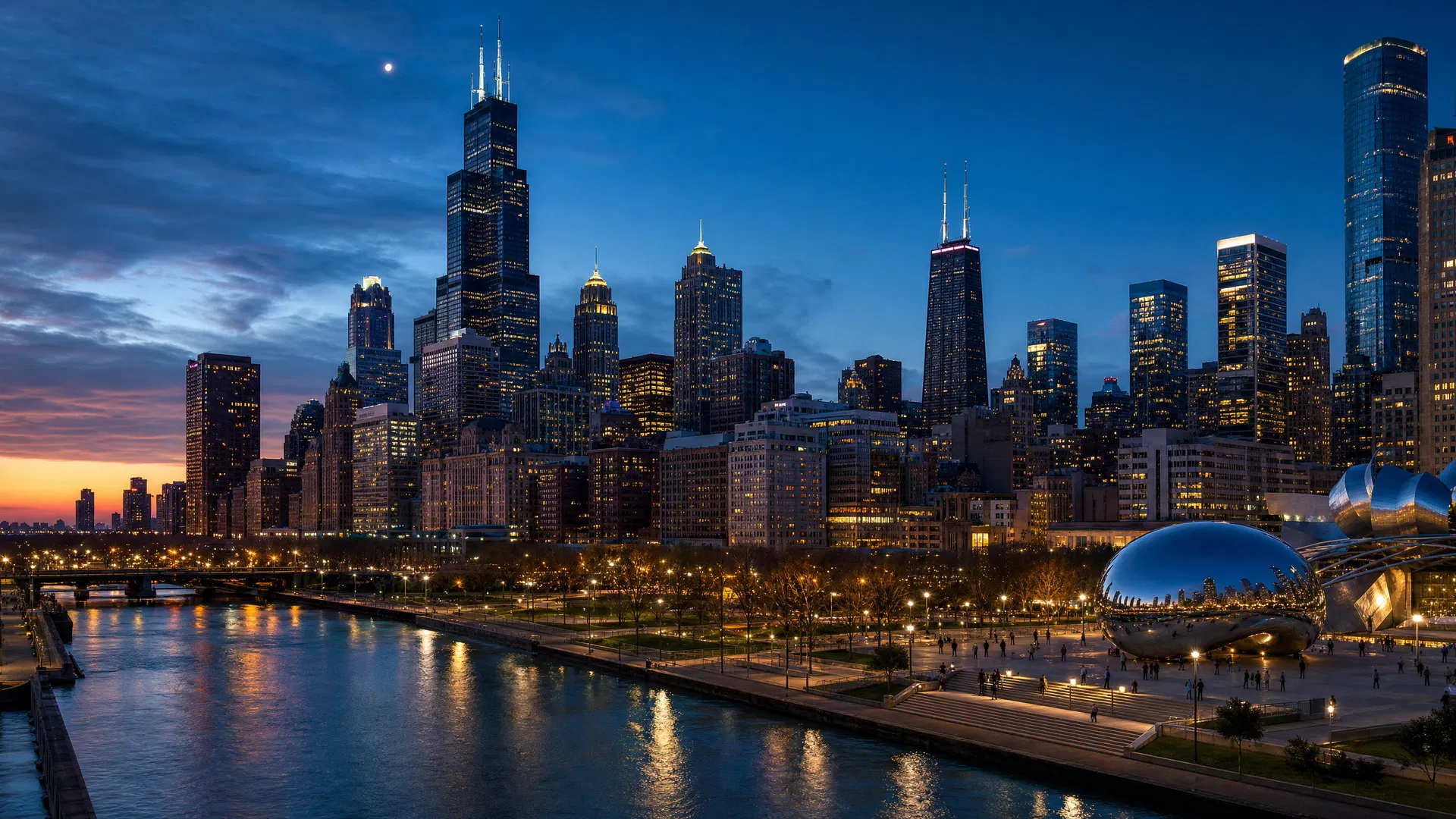
Millennium Park sits at the northern end of the lakefront, and it contains two of the most successful pieces of public art in America: Anish Kapoor's Cloud Gate — universally known as "the Bean" — a 110-ton elliptical sculpture of polished stainless steel that reflects the skyline and the sky and the people standing in front of it in ways that are endlessly surprising; and Jaume Plensa's Crown Fountain, two fifty-foot glass towers that project video images of Chicago residents' faces and periodically release water from their mouths in a fountain that children have been playing in since 2004. The park also contains the Jay Pritzker Pavilion, a Frank Gehry-designed outdoor concert venue that hosts the Grant Park Music Festival every summer — free classical concerts on the lawn, with the skyline as backdrop.
Grant Park, which extends south from Millennium Park, contains the Art Institute of Chicago — one of the finest art museums in the world, with a collection that includes the largest collection of Impressionist and Post-Impressionist paintings outside of Paris, Grant Wood's American Gothic, Georges Seurat's A Sunday on La Grande Jatte, and Edward Hopper's Nighthawks. The Modern Wing, designed by Renzo Piano and opened in 2009, is itself a masterpiece of museum architecture. The Art Institute is not a destination you visit on the way to something else. It is the destination.
The Food: The Most Underrated Food City in America
Chicago's food reputation has a problem, and the problem is the deep-dish pizza. Not because the deep-dish pizza is bad — it isn't, and at places like Lou Malnati's or Pequod's, it is genuinely excellent — but because it has become the city's culinary shorthand in a way that obscures everything else. Chicago is not a deep-dish pizza city. Chicago is one of the most sophisticated, most diverse, most exciting food cities in America, and it has been for decades.
The James Beard Foundation, which gives the most prestigious awards in American food, has recognized Chicago chefs more consistently than any city outside New York. Grant Achatz's Alinea, which opened in 2005, is regularly cited as one of the best restaurants in the world — a three-Michelin-star experience that treats a meal as a complete theatrical and sensory event, with courses served on the table, on the ceiling, on edible surfaces, in ways that challenge every assumption about what a restaurant can be. It is not cheap, and it requires advance planning, but it is a genuinely singular experience.
But Chicago's food greatness is not limited to the avant-garde. The city has one of the most vibrant and diverse neighborhood food scenes in America, rooted in its history as a city of immigrants. The Polish community in the Northwest Side. The Mexican community in Pilsen and Little Village, which has some of the best tacos and tamales outside of Mexico City. The Vietnamese community in Argyle Street. The Ethiopian and Eritrean restaurants on the North Side. The Korean barbecue in Koreatown. The Puerto Rican food in Humboldt Park. Chicago's food is the food of a city that has been absorbing immigrants for two centuries and has been transformed by each wave.
The Chicago hot dog deserves its own paragraph. It is not a hot dog. It is a philosophical position. A Vienna Beef frankfurter in a poppy seed bun, topped with yellow mustard, chopped white onions, bright green sweet pickle relish, a dill pickle spear, tomato slices, pickled sport peppers, and a dash of celery salt. No ketchup. Never ketchup. The prohibition on ketchup is not a preference. It is a law. The Chicago hot dog is available at hundreds of stands throughout the city, and eating one at a counter stool at a place like Portillo's or Gene & Jude's, while watching the city go by, is one of the most authentically Chicago experiences available.
The Italian beef sandwich — thin-sliced beef, slow-roasted in its own juices with Italian seasonings, piled onto a long Italian roll and dipped in the cooking juices — is the other Chicago food that deserves global recognition and hasn't quite gotten it yet. Get it "wet" (dipped in the juice) at Al's Beef or Johnnie's Beef and eat it standing up, because it will drip.
The bar scene is equally serious. The Chicago cocktail culture, centered on places like The Violet Hour in Wicker Park and Scofflaw in Logan Square, is among the most sophisticated in America. The craft beer scene, anchored by breweries like Revolution Brewing and Half Acre Beer Company, is excellent. And the dive bar — the unpretentious neighborhood tavern where everyone knows everyone and the Old Style is cold and the conversation is good — remains a Chicago institution that no amount of gentrification has managed to eliminate.
The Neighborhoods: Chicago Is Not One City
Chicago is a city of neighborhoods, and the neighborhoods are not interchangeable. Each one has its own character, its own history, its own relationship to the city as a whole, and understanding Chicago means understanding that the Loop is not Chicago any more than Midtown is New York.
Wicker Park and Bucktown, on the Northwest Side, are where Chicago's creative class has been concentrated for three decades — galleries, independent bookstores, vintage clothing shops, music venues, restaurants that are serious about the food without being serious about themselves. The neighborhood around Milwaukee Avenue and North Avenue is one of the best urban strolling environments in the city.
Logan Square, further northwest, has been the next Wicker Park for about fifteen years and has now become its own thing — a neighborhood with a strong Mexican-American heritage that has been overlaid with a dense concentration of excellent restaurants and bars without losing its original character entirely. The Logan Square Farmers Market, held on Sundays from May through October, is one of the best in the city.
Pilsen, on the Lower West Side, is the heart of Chicago's Mexican-American community and one of the most visually striking neighborhoods in the city — the murals on the buildings are extraordinary, the National Museum of Mexican Art is one of the finest ethnic museums in America, and the food, particularly on 18th Street, is excellent. It is also a neighborhood in transition, with the gentrification pressures that have transformed Wicker Park and Logan Square now beginning to arrive, which makes it worth visiting now, while it still feels like itself.
Hyde Park, on the South Side, is the neighborhood of the University of Chicago — one of the great research universities in the world — and it contains the Museum of Science and Industry, the largest science museum in the Western Hemisphere, and the Obama Presidential Center, currently under construction. It is also the neighborhood where Barack Obama lived before he became president, and the house on Greenwood Avenue where he lived is a quiet landmark in a neighborhood that wears its history without making a fuss about it.
The South Side more broadly — Bronzeville, Chatham, Woodlawn — is where Chicago's African American history is concentrated, and it is a history of extraordinary cultural richness: the Great Migration, the Chicago Blues, the development of house music, the literary tradition of Richard Wright and Gwendolyn Brooks and Lorraine Hansberry. The DuSable Black History Museum and Education Center in Washington Park is the oldest and largest institution of its kind in the country, and it is essential.
The Music: Chicago's Greatest Export
Chicago has given the world two of the most important musical forms of the twentieth century, and it has done so with a consistency and depth that no other American city can match.
The Chicago Blues is not the Delta Blues. It is what happened when Mississippi sharecroppers moved north during the Great Migration and plugged their acoustic guitars into amplifiers in the clubs on the South Side. Muddy Waters, Howlin' Wolf, Little Walter, Buddy Guy, Koko Taylor — these are the people who created the electric blues, and the electric blues is the foundation of rock and roll. Buddy Guy's Legends, on South Wabash, is the living link to this tradition — Guy himself still plays there regularly, and the club has hosted virtually every major blues and rock musician of the past forty years.
House music was born in Chicago in the early 1980s, in a club called the Warehouse on South Jefferson Street, where a DJ named Frankie Knuckles began mixing disco records with a drum machine and synthesizer in ways that created something entirely new. The music spread from Chicago to Detroit (where it became techno), to New York, to London, to the world. Chicago house is the foundation of virtually all electronic dance music that followed. The Warehouse is gone, but the tradition it created is alive in clubs throughout the city.
Beyond blues and house: Chicago has a serious jazz tradition (the Jazz Showcase, in the South Loop, has been presenting jazz since 1947); a classical music scene anchored by the Chicago Symphony Orchestra, which is one of the finest orchestras in the world and performs at Symphony Center on Michigan Avenue; and a live music scene that ranges from the Ravinia Festival (an outdoor classical and popular music festival in Highland Park, north of the city, that has been running since 1904) to the Pitchfork Music Festival (an indie rock festival in Union Park that has been one of the most important music festivals in America since 2006).
The Guides That Will Help You Plan It
The Ask Leif guide library has Chicago covered from every angle — food, architecture, outdoor adventure, family travel, and budget-conscious exploration:
- Chicago Architecture, Food & Music: A 5-Day Itinerary for Couples & Solo Travelers — the comprehensive guide covering the Loop, the neighborhoods, the food scene, and the music.
- Chicago Culinary Quest: A 4-Day Food Lover's Itinerary — for anyone who wants to eat their way through one of America's great food cities, from deep-dish to Michelin-starred.
- 5-Day Chicago Family Vacation: Kids' Adventures & Iconic Sights — the Museum of Science and Industry, the Shedd Aquarium, Millennium Park, and everything else that makes Chicago one of the best family destinations in America.
- 4-Day Chicago Outdoor Adventure: Dunes, Canyons & Lakefront Cycling — the lakefront trail, the Indiana Dunes, Starved Rock State Park, and the outdoor Chicago that most visitors never find.
- Chicago on a Budget: 4-Day Itinerary for Under $70/Day — proof that Chicago's world-class museums, public spaces, and food scene are accessible without spending a fortune.
- Romantic Chicago Weekend: A 3-Day Couples' Escape to the Windy City — architecture cruises, rooftop bars, the best restaurants in the city, and the particular romance of a city that takes everything seriously.
The Cold, the Wind, and Why None of It Matters
Chicago is cold. This is not a rumor or an exaggeration. The winter wind off Lake Michigan is a physical force — it comes around the corners of buildings and hits you in the face with a directness that feels almost personal. The temperature in January averages around 25°F (-4°C), and wind chill can push the effective temperature well below zero. There have been winters when the Chicago River froze solid enough to walk on.
None of this matters as much as you think it will, for two reasons. First, Chicago has built an entire indoor infrastructure for winter — the Pedway, an underground network of tunnels and skyways connecting dozens of downtown buildings, allows you to move through much of the Loop without going outside; the restaurants and bars are warm and welcoming in a way that is specifically winter-warm, the kind of warmth that only exists in cold cities; and the cultural institutions — the Art Institute, the Chicago Symphony, the Lyric Opera — are at their most active in winter, when the city turns inward.
Second, and more importantly: Chicago in winter is beautiful. The lake freezes at the edges and produces ice formations of extraordinary complexity. The skyline reflected in the ice is one of the great urban images in America. The city empties of tourists and fills with Chicagoans, who are, in winter, at their most themselves — direct, warm, slightly defiant about the weather, and deeply proud of the city they've chosen to live in through it.
The best time to visit Chicago is a genuinely difficult question. Summer — June through August — is when the city is at its most alive: the lakefront, the festivals (Lollapalooza in Grant Park, the Chicago Jazz Festival, the Blues Festival, the Taste of Chicago), the outdoor dining, the general sense of a city making the most of the good weather before it ends. But summer is also when the city is most crowded and most expensive. September and October are arguably the best months — the weather is still good, the crowds have thinned, the trees in Lincoln Park and along the lakefront are turning, and the city has a particular quality of light in autumn that is worth coming for on its own.
Spring, when it arrives, is a collective exhale. The city comes back to life with a speed and enthusiasm that is one of the most joyful things about living in a cold-climate city.
Why Chicago Rewards the Curious
There is a version of Chicago that most visitors see: the Bean, the deep-dish pizza, the architecture tour, the Navy Pier. This version is fine. It is not wrong. But it is not Chicago.
The Chicago that rewards the curious is the one you find when you take the Red Line south to Hyde Park and walk through the University of Chicago campus on a grey October afternoon. When you go to Buddy Guy's on a Tuesday night and find yourself three feet from a man who learned to play guitar from Muddy Waters. When you eat a plate of tacos al pastor at a counter in Pilsen at midnight and understand that this is what a great food city actually is. When you stand on the 96th floor of the John Hancock Center at dusk and watch the sun set over the lake and the city spread out below you in every direction and think: this is one of the great cities on earth, and nobody told me.
Nobody told you because Chicago doesn't tell you. It waits for you to figure it out.
Figure it out.