Charlotte Was Built by Money. Now It's Building Something Else.
Destination: Charlotte, North Carolina
Category: destination-guide
Charlotte Was Built by Money. Now It's Building Something Else.
By the AskLeif Team
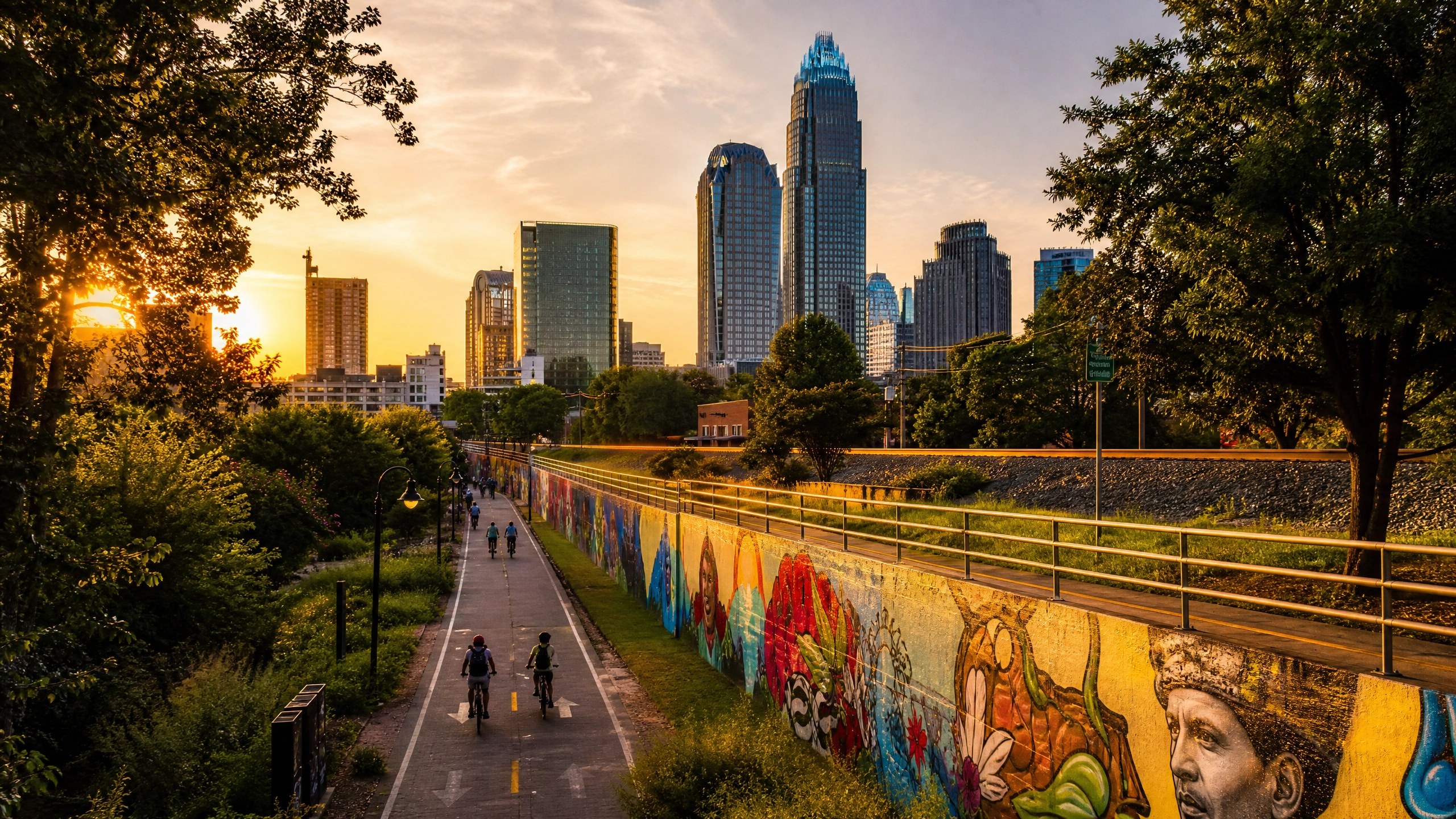
There is a building in Uptown Charlotte that tells you everything you need to know about this city. The Bank of America Corporate Center rises 60 stories above the street, its crown lit at night in a blue that you can see from 30 miles away on a clear evening. It is, by any measure, an extraordinary piece of architecture — a skyscraper that would be remarkable in New York, that would anchor the skyline of any city in the country. And it sits in Charlotte, North Carolina, a city that had no particular reason to exist here, no river to speak of, no natural harbor, no mountain pass, no geographic logic that demanded a city rise from this particular patch of Piedmont clay.
Charlotte was built by money. Not by geography, not by history, not by the slow accumulation of culture that gives cities like New Orleans or Charleston their particular gravity. By money. By the decision, made in the 1970s and 1980s, to turn a mid-sized Southern city into a financial capital — to recruit the banks, build the towers, lay the light rail, and grow at a pace that made Charlotte the fastest-growing large city in the United States in 2025. The result is a city that is, in many ways, still figuring out what it is. And that process — the active, ongoing, sometimes awkward work of building a culture to match a skyline — is the most interesting thing about Charlotte right now.
Most travel content about Charlotte gets this exactly backwards. It leads with the NASCAR Hall of Fame, with the Whitewater Center, with the standard-issue craft beer tour. These are fine things. But they miss the actual story, which is that Charlotte is a city in the middle of a genuine identity formation — a place where the money came first and the culture is catching up, and where the catching up has produced something genuinely worth seeing.
What follows is an honest account of what Charlotte actually is, what it has built, what it is still reckoning with, and why it is worth more than a weekend.
The Banking Capital Nobody Talks About (and Why It Matters)
Bank of America was founded in Charlotte. Wells Fargo's East Coast operations are headquartered here. Charlotte is the second-largest banking center in the United States, behind only New York City — a fact that almost never appears in travel writing about the city, because it doesn't fit the narrative of Charlotte as a NASCAR-and-barbecue Southern city, which is the narrative that most travel content defaults to.
The banking identity matters for a traveler because it explains the city's physical form. Charlotte's Uptown — the local term for downtown, used by everyone and never explained to visitors — is a collection of towers that would be at home in any major financial center. The streets are wide and clean and slightly empty in the way that financial districts are always slightly empty, because the people who work in them leave at 5 PM and go somewhere else. The restaurants in Uptown are good but expensive and oriented toward expense accounts. The bars close early by the standards of cities that have a nightlife culture.
This is not a criticism. It is a description. And understanding it is the key to understanding Charlotte, because the interesting parts of the city are not in Uptown. They are in the neighborhoods that grew up around it — NoDa, Plaza Midwood, South End — and in the deliberate, self-conscious effort that Charlotte has made to build a culture that can stand alongside the financial infrastructure.
The banks built the towers. The towers brought the workers. The workers wanted restaurants and music and neighborhoods with character. And Charlotte, with the resources that come from being a financial capital, built those things. The result is a food scene that is genuinely world-class, a music scene that is small but serious, and a set of neighborhoods that have more personality than the city's reputation suggests.
NoDa: The Arts District That Survived
NoDa — North Davidson, the neighborhood north of Uptown along North Davidson Street — is the oldest arts district in Charlotte, and the one that has most successfully resisted the forces that have erased arts districts in other American cities. It began as a textile mill neighborhood, became an arts enclave in the 1980s and 1990s when the mills closed and artists moved into the cheap spaces, and has spent the last decade navigating the tension between the authenticity that made it interesting and the development pressure that threatens to make it expensive.
The Evening Muse is the anchor of NoDa's music scene — a listening room that holds about 100 people, that books artists who are serious about their craft, and that has been doing this since 2002 without becoming a tourist attraction. The shows start on time. The crowd pays attention. The bar is good. It is the kind of music venue that cities with real music cultures have and that Charlotte has in NoDa and almost nowhere else.
Haberdish is the restaurant that NoDa built to prove it could cook. It is a Southern food restaurant in the specific sense — not the generic sense of fried chicken and sweet tea, but in the sense of a kitchen that takes the ingredients and techniques of the American South seriously and does something precise and original with them. The chicken and waffles are the thing everyone orders. The thing worth ordering is whatever the kitchen is doing with the seasonal vegetables, which changes and is always better than you expect.
The Gold Line streetcar — free, running from NoDa through Uptown to South End — is the piece of Charlotte infrastructure that nobody in travel content mentions and that every visitor should know about. It runs along the old streetcar route that connected these neighborhoods before the automobile made them feel disconnected. It is free. It runs every 20 minutes. It is the easiest way to move between the three neighborhoods that matter most in Charlotte, and it is the clearest evidence that Charlotte is thinking seriously about what kind of city it wants to be.
The Excelsior Club and What Charlotte Is Still Reckoning With
There is a building on Beatties Ford Road in the West End neighborhood of Charlotte that most visitors never see and that every visitor should know about. The Excelsior Club opened in 1944 as a jazz and blues venue in Charlotte's Black community — a place where Duke Ellington played, where James Brown performed, where the Black professional class of Charlotte gathered during the decades when segregation made the rest of the city inaccessible to them. It was the most important cultural institution in Black Charlotte for 40 years.
The club closed in 2017. The building sat vacant. By 2025, it had deteriorated to the point where preservation was impossible — the structure was unsound, the roof had failed, the walls were compromised. The city and county have committed $3 million to demolish the existing building and construct a historically accurate replica that will include a museum and a performance space. The plan is to rebuild what Charlotte allowed to decay.
This story — the Excelsior Club story — is inseparable from the larger story of Brooklyn Village, the historically Black neighborhood in Second Ward that Charlotte demolished in the 1960s as part of an urban renewal project that displaced 1,000 families and erased a community that had existed for a century. The neighborhood is gone. The streets are gone. What replaced it is a convention center and a highway interchange. Charlotte has never fully reckoned with this, and the Excelsior Club project is, in part, an attempt to begin that reckoning.
A visitor who spends time in Charlotte without knowing this history is missing the most important context for understanding the city. The West End neighborhood — where the Excelsior Club sits, where the historically Black colleges are, where the civil rights history of Charlotte is concentrated — is not on the standard tourist itinerary. It should be.
Plaza Midwood and the City's Actual Personality
If NoDa is Charlotte's arts district, Plaza Midwood is its soul. The neighborhood runs along Central Avenue east of Uptown — a corridor of bungalows and craftsman houses built in the 1920s and 1930s, now occupied by the kind of people who made Charlotte interesting: artists, musicians, chefs, the independently employed, the deliberately unconventional.
Thomas Street Tavern is the oldest bar in Charlotte, and it operates on the principle that the best bars don't need signs. There is no sign on Thomas Street Tavern. The door is unmarked. The interior is dark and comfortable in the way that bars that have been in the same location for 40 years are dark and comfortable. It is cash only. The regulars know each other. The beer is cold and cheap. It is the kind of bar that Charlotte's financial district cannot produce and that Plaza Midwood has preserved through the simple act of not changing.
Dish is the restaurant that Plaza Midwood built for itself — a neighborhood restaurant in the specific sense, meaning that it serves the people who live nearby and has been doing so since 1997 without becoming a destination restaurant. The menu is American comfort food executed with care. The pimento cheese is made in-house. The service is the kind of service you get from people who have been working at the same restaurant for a decade.
The neighborhood's commercial strip — Central Avenue between The Plaza and Pecan Avenue — is the best walking street in Charlotte. It has the density and variety that Uptown lacks: coffee shops, record stores, vintage clothing, tattoo parlors, bars that open at noon, restaurants that don't take reservations. It is the Charlotte that Charlotte's residents actually inhabit, and it is almost entirely absent from the city's official tourism narrative.
The Food Scene Charlotte Built to Prove a Point
Charlotte's food scene is the clearest evidence of what happens when a city with money decides to build a culture. The restaurants here are not the restaurants of a mid-sized Southern city. They are the restaurants of a city that has been recruiting chefs, investing in food infrastructure, and building a dining culture for 20 years with the resources that come from being a financial capital.
The specific restaurants worth knowing: Kindred in Davidson (30 minutes north, worth the drive — the bread program alone justifies the trip), Leah & Louise in Camp North End (the best Southern food in the city, in a converted industrial space that is one of the most beautiful dining rooms in the Southeast), Supperland in Plaza Midwood (a former church converted into a restaurant, the architecture is extraordinary, the food matches it), and Bardo in South End (the cocktail bar that Charlotte's food community goes to when they're not working).
The craft beer scene is real and serious. NoDa Brewing — founded in the neighborhood it's named after — makes a hop drop and roll IPA that has won national awards. Sycamore Brewing in South End has a taproom that is one of the best places to spend an afternoon in Charlotte. The Olde Mecklenburg Brewery in the South End is the oldest craft brewery in Charlotte and the one that most feels like it belongs to the city rather than to a trend.
What Charlotte's food scene does not have is the kind of iconic, singular restaurant that defines a city's culinary identity — the way that Pecan Lodge defines Dallas, or the way that Chez Panisse defined Berkeley. The scene is excellent and broad but not yet anchored by a single institution that everyone in the country knows. That institution is probably being built right now, in a kitchen somewhere in NoDa or Plaza Midwood or Camp North End, by a chef who moved here because the rents were still manageable and the city was paying attention.
South End and the Rail Trail
South End is Charlotte's newest neighborhood in the sense that matters — not new in years, but new in identity. It was a warehouse district 20 years ago. It is now the most densely developed neighborhood in Charlotte, lined with breweries and restaurants and residential towers and the light rail that connects it to Uptown in 10 minutes.
The Rail Trail runs through South End — a 3.5-mile greenway built on a former rail corridor, lined with murals commissioned from local artists, connecting South End to the Whitewater Center and to the neighborhoods to the south. It is Charlotte's answer to Atlanta's BeltLine, smaller and less ambitious but built with the same logic: that a city's quality of life is determined by how well it connects its neighborhoods on foot and by bike, and that the infrastructure for that connection can be beautiful.
The murals on the Rail Trail are the best public art in Charlotte. They are not the murals of a city that commissioned public art as an afterthought — they are the murals of a city that decided the Rail Trail was a canvas and found artists who treated it as one. The work changes regularly. Walking the trail on a weekday morning, when the commuters have thinned out and the light is right, is one of the better experiences Charlotte offers.
The U.S. National Whitewater Center and the Outdoor Identity Charlotte Is Building
The U.S. National Whitewater Center sits on 1,300 acres on the Catawba River, 15 minutes west of Uptown. It is the largest outdoor recreation facility in the United States — a place where Olympic kayakers train alongside weekend paddlers, where the mountain bike trails are serious enough to host national competitions, where the climbing walls and zip lines and flatwater kayaking exist alongside the whitewater channels that give the center its name.
The Whitewater Center is the clearest evidence of Charlotte's outdoor ambitions. The city that built itself on banking has decided, in the last 20 years, that it also wants to be a city where people come to be outside — and it has invested in the infrastructure to make that possible. The Whitewater Center is the flagship of that investment, but it is not the only evidence. The Greenway system — 37 miles of paved trails connecting the city's parks and neighborhoods — is one of the most extensive urban trail networks in the Southeast. Freedom Park, with its 98 acres and its lake and its amphitheater, is the park that Charlotte's residents actually use, not the parks that appear in the tourism brochures.
What Charlotte is building, in parallel with its financial infrastructure, is an outdoor identity — a reason to come here that has nothing to do with banking or NASCAR. The Whitewater Center is the most visible piece of that identity, but the greenways and the parks and the Rail Trail are equally important. They are the infrastructure of a city that has decided its quality of life is worth investing in, and that investment is visible in ways that make Charlotte a better place to visit than it was 10 years ago and will make it a better place still in 10 years more.
For a visitor, the Whitewater Center is worth a half-day — long enough to do one activity (the flatwater kayaking is the easiest entry point; the beginner whitewater channels are genuinely accessible) and to walk the trails along the river, which are beautiful in the morning before the crowds arrive. The center is free to enter; activities are priced individually. The brewery on-site is operated by NoDa Brewing and is the best place in Charlotte to drink a beer outdoors.
When to Go and How to Move
Charlotte's best months are April, May, October, and November. The summers are hot and humid in the way that all Piedmont cities are hot and humid — manageable but not pleasant, and the outdoor culture that makes Charlotte interesting in spring and fall retreats indoors. The winters are mild by the standards of the American South — temperatures in the 40s and 50s, occasional ice storms that shut the city down for 48 hours and then melt, a general unwillingness to deal with cold that is charming if you come from somewhere colder.
The light rail (LYNX Blue Line) connects the airport to Uptown to South End. It is reliable, inexpensive, and the correct way to arrive in the city from the airport. The Gold Line streetcar connects NoDa to Uptown to South End for free. Beyond these two corridors, Charlotte is a car city — the neighborhoods are connected by roads that were designed for automobiles, and the distances between them are too large for comfortable walking. Ride-share is the practical solution for moving between Plaza Midwood, NoDa, and the Whitewater Center.
The Charlotte Douglas International Airport is a major hub, which means that flights from almost anywhere in the country connect through it. This is both a convenience and a reason that Charlotte gets underestimated — people pass through it constantly without stopping, which means the city's reputation is shaped by the airport rather than by the neighborhoods.
Planning Your Charlotte Trip
Here is how I would build three days in Charlotte, and I would build them the same way every time.
Start in NoDa. Walk North Davidson Street from the southern end to the northern end, which takes about 20 minutes and covers the full range of what the neighborhood offers: galleries, coffee shops, the Evening Muse marquee, Haberdish for lunch. Spend the afternoon at Camp North End — the converted industrial campus north of NoDa that has become the most interesting mixed-use development in Charlotte, with food halls and art studios and Leah & Louise for dinner. Take the Gold Line streetcar back to Uptown in the evening, which costs nothing and takes 15 minutes. That's day one.
Day two belongs to Plaza Midwood. Walk Central Avenue from the streetcar stop east toward The Plaza, stopping at whatever coffee shop looks right, then spend the morning at the Bechtler Museum of Modern Art in Uptown (the best art museum in Charlotte, housing a serious permanent collection that includes Warhol, Calder, and Giacometti). Lunch at Dish. Afternoon in the neighborhood — the vintage shops, the record stores, Thomas Street Tavern in the late afternoon when the light comes through the windows and the regulars start arriving. Dinner at Supperland, which requires a reservation made weeks in advance and is worth the planning.
Day three: drive to the West End in the morning and spend time at the Excelsior Club site and the surrounding neighborhood, which is the part of Charlotte's history that the official tourism narrative doesn't cover. Then south to Freedom Park — the park Charlotte actually uses, a 98-acre green space in the Myers Park neighborhood that is beautiful in the way that parks built with serious money and serious intention are beautiful. Afternoon at Sycamore Brewing in South End. Walk the Rail Trail before dinner.
AskLeif's Charlotte guides can help you build this out in detail. The Charlotte 4-Day City & Culture Guide covers the full city with day-by-day structure. The Charlotte Solo Travel Guide is built for independent travelers who want to move at their own pace. The Charlotte Couples Guide covers the romantic side of the city — Lake Norman, the rooftop bars, the restaurants that require reservations.
The Honest Version
Charlotte is not a finished city. It is a city in the middle of becoming something, and the something it is becoming is genuinely interesting — more interesting than its reputation, more interesting than the NASCAR Hall of Fame narrative, more interesting than the banking capital narrative.
What Charlotte has figured out is that money is necessary but not sufficient. The towers are there. The light rail is there. The food scene is there. What is still being built is the connective tissue — the sense of place that comes from a city knowing its own history and deciding what to do with it. The Excelsior Club project is part of that. The Rail Trail murals are part of that. The fact that Charlotte is having a public conversation about Brooklyn Village, about what was erased and what might be restored, is part of that.
The city that was built by money is in the process of building something that money can't buy. That process is worth watching. And the best way to watch it is to spend time in the neighborhoods where it's happening — NoDa, Plaza Midwood, the West End, South End — and to pay attention to what the city is doing with the resources it has accumulated.
Charlotte doesn't owe you a great time. But if you show up with the right expectations — not Nashville, not Atlanta, not a city with a century of cultural infrastructure — you will find something more interesting than you expected: a city that is working, visibly and ambitiously, on becoming itself.