Cairo Doesn't Contain Its Past. It Lives Inside It.
Destination: Cairo, Egypt
Category: destination
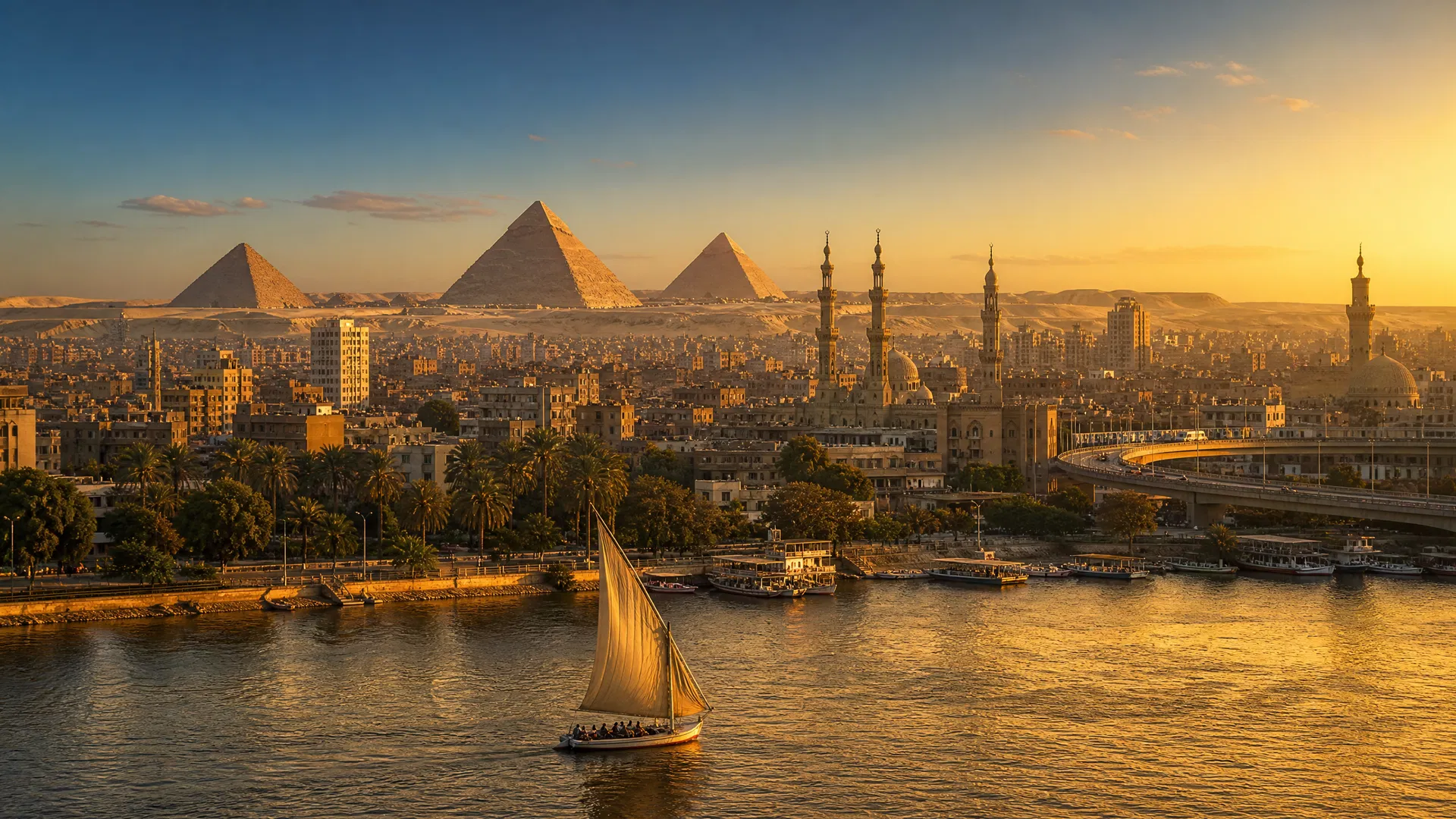
The first time you see the Pyramids from a Cairo taxi, you will not be ready for it. Not because the Pyramids are unexpected — you came here specifically to see them — but because the frame is wrong. You are not standing in the desert looking at ancient monuments against an empty sky. You are sitting in traffic on the Cairo Ring Road, and the Pyramids are right there, rising above a Pizza Hut and a row of apartment blocks, as matter-of-fact as a water tower. The ancient and the contemporary are not in dialogue in Cairo. They are in the same sentence.
This is the thing that no travel guide adequately prepares you for, and it is the thing that makes Cairo unlike any other city on earth. Most cities with ancient history keep it at a remove — in museums, in designated historic districts, in carefully managed archaeological zones that exist apart from the living city. Cairo does not do this. The Pyramids of Giza are inside the city's urban fabric. The City of the Dead — a 4-mile Islamic necropolis — is a living neighborhood where hundreds of thousands of people have built homes among the Mamluk tombs. The medieval mosques of al-Muizz Street are lit up at night for Instagram. The 5th-century Hanging Church is sandwiched between a metro station and a fruit stand. Cairo doesn't preserve its past. It lives inside it, and the collision between what it was and what it is now is the only thing worth understanding before you arrive.
This is not a guide to Cairo's top attractions. It is an argument for how to read the city — because Cairo, more than almost any other destination on earth, requires a framework before it makes sense.
The Pyramids Are Not What You Think They Are
Every visitor to Cairo has the same experience at the Pyramids of Giza: they are larger than expected. Not slightly larger — dramatically, disorienting larger. The Great Pyramid of Khufu is 146 meters tall. The base covers 5.3 hectares. Each of the 2.3 million limestone blocks weighs between 2.5 and 15 tons. These numbers mean nothing until you are standing at the base and the structure simply does not fit in your field of vision. You have to turn your head.
But the experience that most visitors miss is not at Giza. It is 30 kilometers south, at Saqqara, where the first pyramid ever built still stands — the Step Pyramid of Djoser, constructed around 2650 BC, predating the Great Pyramid by nearly a century. Saqqara receives a fraction of Giza's visitors, which means you can walk the complex in something approaching solitude. The Step Pyramid is not as tall as Khufu's, but it is older, and the site contains something Giza does not: the Serapeum, an underground gallery of 24 massive granite sarcophagi built to hold the sacred Apis bulls. Each sarcophagus weighs between 60 and 80 tons. They are taller than a person. The underground galleries are dimly lit and largely empty of tourists, and the experience of standing next to a 3,000-year-old granite box the size of a shipping container, in near-silence, is more affecting than anything on the Giza plateau.
Fifteen kilometers further south, at Dahshur, the Red Pyramid offers something neither Giza nor Saqqara can: you can walk inside it, almost alone. A 55-meter descending corridor leads to the burial chamber, and the descent requires you to stoop and move slowly through the narrow passage. The air inside is warm and still. There are no crowds, no hawkers, no camel rides. There is only the stone and the dark and the specific silence of a space that has been sealed and unsealed and sealed again for 4,600 years. The Nat Geo guide calls Dahshur a "perfect add-on." It is, in fact, the better pyramid experience — not despite being less famous, but because of it.
If you are planning a Cairo trip and want to understand the full arc of pyramid architecture — from the first experimental stepped structure at Saqqara to the perfected form at Giza — the Cairo 5-Day History & Culture Itinerary builds this sequence into the itinerary deliberately, pairing Saqqara and Dahshur on a single day before the Giza plateau, so the evolution of the form is legible rather than just impressive.
The Grand Egyptian Museum: What It Actually Contains
The Grand Egyptian Museum opened fully in 2023 after two decades of construction, and it is the largest archaeological museum in the world. The building alone — a vast triangular structure of translucent stone panels, connected to the Giza plateau by an elevated walkway — is worth the visit. But the collection is the argument.
Most visitors come for the Tutankhamun galleries, which contain the complete contents of his tomb: the gold funerary mask, the inner gold sarcophagus, the throne, the jewelry, the canopic jars, the chariots. The collection spans 5,000 objects and fills an entire wing. It is extraordinary, and it is exactly what you expect.
What you do not expect is the Hetepheres collection. Queen Hetepheres was the mother of Khufu — the pharaoh who built the Great Pyramid — and her tomb was discovered intact in 1925 by archaeologist George Reisner. The collection includes her bed, her chair, her canopy, her jewelry box, her carrying chair. These are not ceremonial objects. They are furniture. They are the things a woman used in her daily life, 4,500 years ago, and they survived because they were sealed in a shaft tomb and forgotten. The bed has gilded legs. The chair has a cushioned seat. The jewelry box still contains her bracelets. The Hetepheres collection is, in some ways, more moving than the Tutankhamun galleries — not because it is more spectacular, but because it is more intimate. It is the domestic life of a person, not the ceremonial death of a king.
The museum also contains the Royal Mummies Hall, where 22 royal mummies — including Ramesses II and Hatshepsut — are displayed in climate-controlled cases. The mummies are not presented as curiosities. They are presented as people, with their names and their histories and the specific details of their faces, which are still, after three thousand years, recognizably individual.
Islamic Cairo After Dark: Al-Muizz and the Tannoura
Most visitors to al-Muizz Street go during the day, when the medieval mosques and mausoleums are open and the light is good for photographs. They are missing the better version of the street.
Al-Muizz Street — the major thoroughfare of medieval Cairo, built in 969 AD and lined with palaces, mosques, madrasas, and mausoleums — is floodlit every evening from around 6pm to 10pm. The monuments are illuminated with warm light that makes the carved stone facades glow against the dark sky. The street is pedestrianized in the evenings, and the crowds are different — more local, more relaxed, more interested in the shisha cafés and the street food than in the monuments themselves. Walking al-Muizz at night, with the 11th-century Mosque of al-Hakim on one side and the 14th-century Madrasa of Sultan Barquq on the other, both lit from below, is one of the specific sensory experiences that Cairo offers and that no other city can replicate.
Two hundred meters from al-Muizz, inside the 15th-century caravanserai of Wekalet el-Ghouri, a free performance takes place every Wednesday and Saturday evening. Doors open at 7:30pm; the show begins at 8pm. This is the El Tannoura Egyptian Heritage Dance Troupe — not the Turkish whirling dervishes of popular imagination, but the Egyptian tannoura tradition, in which performers spin for extended periods in colorful layered skirts, holding objects aloft and changing the skirts' configuration while in continuous rotation. The performance is accompanied by live Egyptian folk music — drums, mizmar (a double-reed instrument), and call-and-response vocals — and takes place in the open courtyard of the caravanserai, under the stars, surrounded by 15th-century stone walls. It is free. It is not in the top-five Google results for Cairo. It is one of the best things you can do in the city.
The Citadel of Saladin, on the Muqattam Hills above the city, is where Cairo's scale becomes legible. The Mosque of Muhammad Ali — the Ottoman-era mosque that dominates the Citadel's skyline — has a terrace that looks out over the entire city: the minarets of Islamic Cairo in the foreground, the Nile glinting in the middle distance, and the Pyramids of Giza visible on the western horizon, 15 kilometers away. At dusk, when the call to prayer begins from the mosque's minarets and echoes across the city below, the view makes the temporal argument explicit: you are looking at 5,000 years of human settlement in a single frame.
The City of the Dead Is Not a Tourist Attraction
Al-Qarafa — the City of the Dead — is a 4-mile stretch of Islamic-era cemeteries on Cairo's eastern edge, and it is one of the most unusual places in the world. The cemeteries contain the tombs of Mamluk sultans and their families, built between the 13th and 16th centuries: domed mausoleums, mosque complexes, carved stone facades. They are, by any measure, extraordinary examples of Islamic funerary architecture.
But the City of the Dead is not primarily a tourist attraction. It is a neighborhood. Over the past century, as Cairo's population expanded beyond its capacity to house its residents, people began moving into the cemetery — first as caretakers of the tombs, then as permanent residents. Today, hundreds of thousands of people live in al-Qarafa. There are schools, clinics, shops, tea houses, and a functioning community built around and between the tombs. Children play in the alleyways between mausoleums. Laundry hangs from lines strung between carved stone walls. The living and the dead occupy the same space, and the arrangement is not considered unusual by the people who live there.
The City of the Dead is not on most tourist itineraries, and it is not a place to visit as a spectacle. But it is the most honest expression of Cairo's relationship with its past: not preserved, not museumified, not kept at a respectful distance, but inhabited. The city does not treat its history as something separate from its present. It builds its present inside its history, and the City of the Dead is the most literal version of that.
What Cairo Eats
Egyptian food is one of the great underrated cuisines of the world, and Cairo is where you eat it.
Koshary is the national dish, and it is not a tourist concession — it is what Cairenes eat for lunch. A bowl of rice, lentils, pasta, and chickpeas, topped with a rich tomato sauce, crispy fried onions, and two additional sauces (one garlicky, one spiced with chili), koshary is the product of Egypt's Coptic Christian fasting tradition, in which Christians fast for approximately 200 days per year on a strict vegan diet. The dish is the result of centuries of creative vegan cooking, and it is genuinely delicious. Koshary Abou Tarek, at 16 Marouf Street in the Qasr El Nil district of downtown Cairo, has been serving koshary since the mid-20th century. The restaurant is now three stories tall, open from 7am to midnight, and a bowl costs approximately $1 USD. The crispy onions are the key — they are not oily, not soft, not an afterthought. They are the texture that makes the dish.
Ful medames — slow-simmered fava beans dressed with olive oil, cumin, lemon, and garlic — is the Egyptian breakfast, eaten from street carts in the early morning alongside ta'amiya, the Egyptian falafel made with fava beans and coriander rather than chickpeas. The ta'amiya at Zooba (which has a location inside the Grand Egyptian Museum) is the version to try: crisp on the outside, bright green inside, served with pickled vegetables and tahini.
Molokhia is the dish that Cairenes are most homesick for when they leave. It is a soup made from jute mallow leaves, cooked in a rich chicken broth and finished with a garlic-coriander paste that is added with an audible gasp — the traditional technique that guarantees a good molokhia, according to every Egyptian grandmother who has ever made it. Seekh Mashwy Dokki, at 106 Nile Street in Dokki, overlooks the Nile from a long terrace of tables and serves molokhia poured tableside from a large pan into clay pots. The bread is freshly baked. The pita is whole wheat with a smoky flavor. It is the kind of meal that makes you understand why Cairenes who live abroad come home specifically to eat.
Fatta — slow-cooked beef in a garlic-vinegar sauce over toasted pita and basmati rice — is the dish of celebrations. Tante restaurant in Nasr City, started by Egyptian comedian Ashraf Abdel Baky using his aunt's recipes, serves fatta in tagines alongside a menu of dishes that taste like a Cairo home kitchen rather than a tourist restaurant. The restaurant is convivial and unpretentious, and it is the kind of place you find by asking a Cairene where they actually eat, not by searching Google.
For dessert, Mandarine Koueider at 5 Baghdad Street in the Heliopolis district is the institution. Travelers extending their trip beyond Cairo to Luxor and Aswan will find that the food changes dramatically as you move south — the Egypt 7-day itinerary covers the full culinary arc from Cairo's koshary carts to the grilled fish of Aswan. The basbousa — a semolina cake with ashta (clotted cream) filling, drenched in rose-scented syrup and topped with pistachios — is the specific thing to order. Cairenes make pilgrimages here. The shop has been operating for decades, and the quality has not declined.
Zamalek: The City's Breathing Room
Zamalek is a Nile island in the middle of Cairo, and it is the city's exhale. Tree-lined streets, embassies, art galleries, the Cairo Tower (which offers the best aerial view of the city), the Gezira Sporting Club, and a concentration of good restaurants and cafés make Zamalek the neighborhood where Cairo's most affluent residents live and where visitors go when they need a break from the city's intensity.
The contrast with the rest of Cairo is extreme. Zamalek has pavements. The traffic is manageable. The buildings are older and better maintained. The streets are shaded by trees. It is not a tourist district — it is a residential neighborhood that happens to be pleasant to walk through, which in Cairo is a specific and notable quality.
The Cairo Tower, a 187-meter concrete lattice tower built in 1961, offers a 360-degree view of the city from its observation deck. The view is useful not for its beauty but for its information: you can see the Nile bisecting the city, the Pyramids on the western horizon, the minarets of Islamic Cairo to the east, and the vast, undifferentiated sprawl of 20 million people in every direction. Cairo's scale is not comprehensible from street level. From the Cairo Tower, it becomes legible — and the legibility is, in its own way, overwhelming.
How to Actually Move Around Cairo
Cairo has 20 million people and a traffic system that operates on negotiation rather than rules. The absence of lane markings is not an oversight — it is a different social contract, in which drivers communicate through proximity, horn use, and eye contact rather than through painted lines. It is chaotic by the standards of most cities, and it is entirely functional by its own standards.
Use Uber. The app works perfectly in Cairo, the fares are extraordinarily cheap (most city trips cost $1-4 USD), and the established fare eliminates the negotiation that makes traditional taxis a source of friction. Uber drivers in Cairo are, by consistent traveler report, honest and reliable. Pay in cash if possible — some drivers prefer it, and the cash option is available in the app.
The Cairo Metro is functional and cheap, and it connects Coptic Cairo (Mari Girgis station on Line 1) to downtown and beyond. It does not reach the Pyramids or most of the Islamic Cairo sites, but for the specific journey to Coptic Cairo, it is faster and cheaper than Uber.
For the Pyramids, Saqqara, and Dahshur, hire a private driver for the day. The TripAdvisor Egypt forum maintains a thread of driver recommendations with WhatsApp numbers and verified reviews — this is the resource that experienced Egypt travelers use, and the prices are significantly lower than hotel-arranged tours. A full day covering Saqqara, Dahshur, and Giza typically costs $50-80 USD for the car, regardless of how many people are in it.
Visa on arrival is available for most Western passport holders at Cairo International Airport, costs $25 USD, and is straightforward. Buy the visa slip at one of the bank desks before the immigration queue, then present it with your passport at the immigration counter.
When to Go and What to Know
October through April is the right window. Cairo in summer reaches 110°F, and the combination of heat, pollution, and crowds at the major sites is genuinely punishing. October through April offers temperatures in the 60s-80s°F, clear skies, and the best light for photography at the Pyramids — which is best in the late afternoon, when the angle of the sun makes the stone glow and the shadows lengthen.
Ramadan changes the city. Restaurants close during daylight hours, the streets are quieter during the day and dramatically more alive after sunset, and the atmosphere in the evenings — particularly around the mosques and in the old city — is unlike anything Cairo offers at other times of year. Traveling during Ramadan is not a hardship; it is a different experience, and for visitors who want to understand Cairo's Islamic character rather than simply observe its monuments, it is arguably the best time to come.
Dress modestly at religious sites. Women should cover their hair when entering mosques — scarves are available at the entrance of most major sites. Both men and women should cover their shoulders and knees. Outside religious sites, Cairo is relaxed about tourist dress by regional standards, but modest attire is appreciated and reduces unwanted attention.
Alcohol is available in Cairo — Egypt produces its own beer (Stella, a lager) and wine, and international brands are available in hotel bars, some restaurants, and licensed liquor stores. It is not available everywhere, and it is not cheap by Egyptian standards.
The Egyptian pound has experienced significant devaluation in recent years. Prices in EGP go out of date quickly; prices quoted in USD are more stable. ATMs are ubiquitous and generally free for foreign cards. Tourist attractions — including the Pyramids, the Grand Egyptian Museum, and Saqqara — are card-only for ticket purchases.
Planning Your Cairo Trip
Cairo rewards time. A two-day visit is enough to see the Pyramids and the Grand Egyptian Museum and feel overwhelmed. Four or five days is enough to begin to understand the city — to move through its different neighborhoods, to eat properly, to see the Islamic Cairo sites at night, to make the day trip to Saqqara and Dahshur, to sit on a felucca on the Nile at sunset and watch the city from the water.
The 5-day Cairo itinerary is built around this logic — not a checklist of attractions, but a sequence that makes the city's layers legible: the ancient pyramid complex at Saqqara and Dahshur before Giza, so the evolution of the form is visible; the Grand Egyptian Museum before Islamic Cairo, so the chronological arc runs forward rather than backward; the City of the Dead as a neighborhood rather than a monument; al-Muizz at night rather than during the day.
For travelers who want to extend beyond Cairo into the rest of Egypt — to Luxor, Aswan, and the temples of Upper Egypt — the Egypt 7-Day Itinerary: Cairo, Luxor & Aswan builds the full arc of Egyptian civilization into a single trip, from the Pyramids in the north to Abu Simbel in the south, with the Nile connecting everything in between.
What Cairo Does to You
There is a specific experience that Cairo produces in almost every visitor, and it is not the experience that travel writing usually describes. It is not wonder, exactly, though wonder is part of it. It is something closer to recalibration.
Cairo makes you recalibrate your sense of time. Not because it is old — many cities are old. But because the old and the new exist in the same frame, simultaneously, without apology or curation. The Pyramids are visible from the Cairo Ring Road. The Sphinx has a KFC in its sightline. The City of the Dead is a living neighborhood. The medieval mosques of al-Muizz are lit up at night for Instagram. The Hetepheres collection in the Grand Egyptian Museum contains a woman's furniture from 4,500 years ago, and the furniture is beautiful.
Most cities manage their history. They put it in museums, or they restore it and rope it off, or they demolish it and build over it. Cairo does none of these things consistently. It lives inside its history the way a family lives inside an old house — not preserving it, not ignoring it, but using it, working around it, building additions onto it, hanging laundry from it, arguing in its rooms. The result is a city that is simultaneously the oldest and the most contemporary place you will ever visit, and the collision between those two things is what makes it unlike anywhere else on earth.
You will be overwhelmed. You will be frustrated. You will be moved in ways you did not anticipate. And you will, almost certainly, want to come back.
Planning a trip to Cairo? The 5-day Cairo guide builds the city's layers into a sequence that makes sense — from the pyramid complexes at Saqqara and Dahshur to the Grand Egyptian Museum, Islamic Cairo at night, and the specific food that Cairenes actually eat. For the full Egypt experience, the 7-day Egypt itinerary covering Cairo, Luxor and Aswan extends the journey south along the Nile to the temples of Upper Egypt.