The Best Winter Sun Destinations Are Not Escapes. They Are a Different Season Entirely.
Destination: Global
Category: comparison
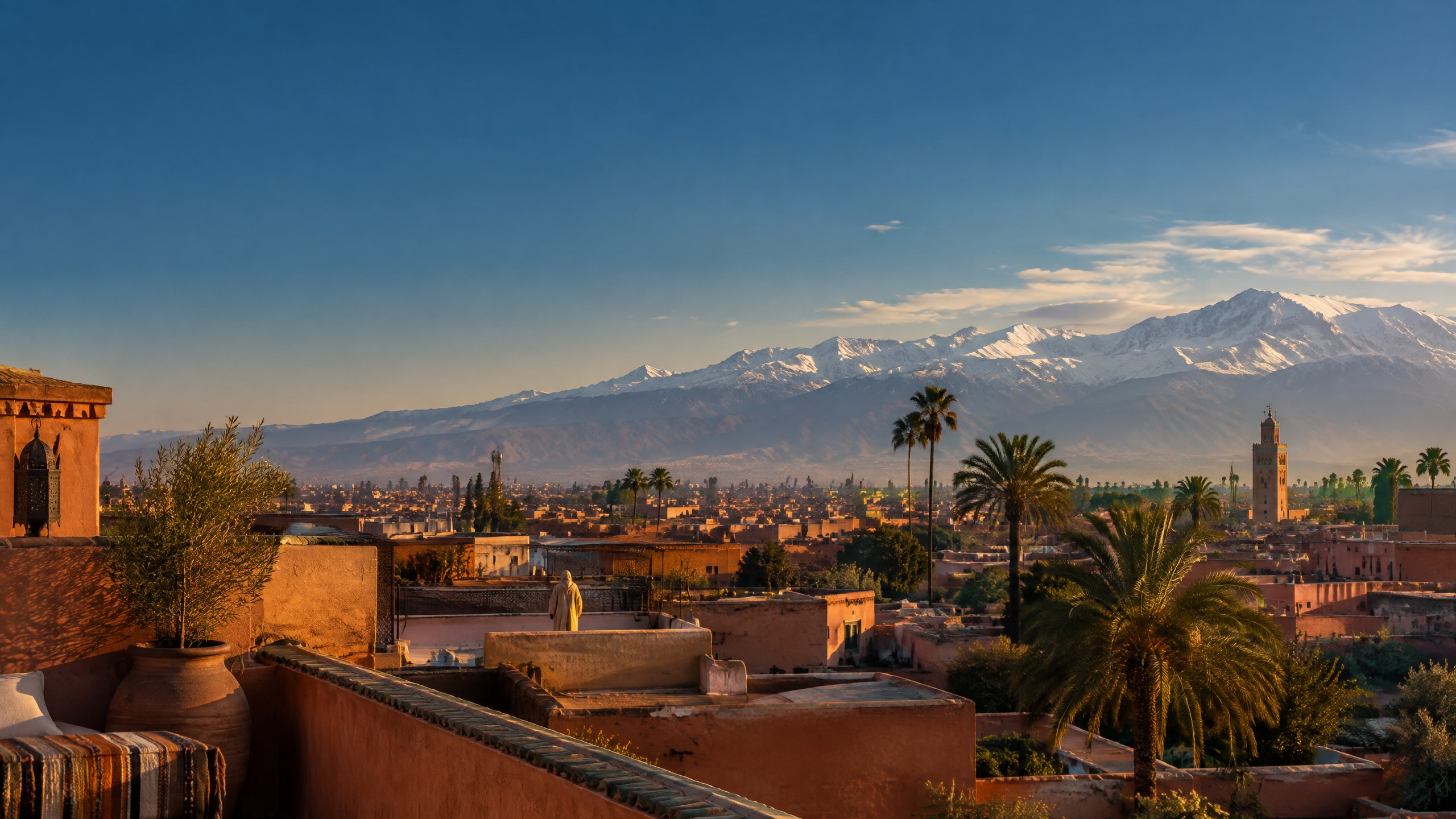
At 8:15 on a February morning in Marrakech, the air is cool enough for a wool layer and the Atlas range appears above the city in white. By lunch, the medina has warmed into its ordinary rhythm: shopkeepers lean into their doors, families cross Djemaa el-Fna with purpose, and the day belongs to people who can move through it on foot. That is not an escape from winter. It is winter doing something useful.
Most winter sun destinations lists begin with a temperature chart, then hand the reader a beach. The logic is understandable and incomplete. Plenty of places are warm from December through February. Far fewer become more legible because the heat has dropped, the light has changed, a migration has arrived, a cultural calendar has begun, or a landscape that would be punishing in July has become available to the body. Sunshine is the floor. What it illuminates is the decision.
This post argues that the best winter sun destinations are not the places that simulate summer while the north freezes. They are the places where winter produces the most truthful version of the destination: Marrakech when its medina becomes walkable, the Canary Islands when each island's climate becomes a choice rather than a resort package, Sri Lanka when monsoon geography rewards knowledge, Yucatán when low humidity exposes the ancient world beneath the coast, Madeira when its subtropical garden begins to flower, and Oman when the desert night becomes habitable. The cold is not the problem the trip solves. It is the condition that makes the trip make sense.
That standard rules out several obvious choices. The Maldives delivers a beautiful winter resort experience, but remove the overwater bungalow and the argument becomes thin; this is a list about places where the sun reveals a living landscape, city, or cultural system outside the resort boundary. Thailand's Andaman coast is genuinely excellent in this window, but Sri Lanka makes the more precise Indian Ocean argument: one island, two monsoons, and a traveler rewarded for understanding the map. Tenerife deserves its popularity, yet the Canary Islands offer a more interesting question than one developed beach island can answer. The right winter sun destination is not interchangeable. It has a reason to be itself now.
Winter Sun Destinations Need a Reason Beyond the Forecast
A warm destination becomes a winter destination only when the season changes the terms of access. That might mean temperature: a city that can be walked all day rather than survived between air-conditioned interiors. It might mean visibility: a clear sky over a volcanic field, a cloud inversion below an observatory, or a winter morning mist around an archaeological site. It might mean water, migration, flowering, harvest, or a local calendar that is happening for residents rather than for the seasonal tourist machine.
The distinction matters because it changes the way you plan. A traveler looking only for 28 degrees can book almost anywhere. A traveler looking for 28 degrees plus a particular whale route, an ancient irrigation network, a desert campsite, a cenote, or a medina at human scale is choosing a trip with a center. The six places below make six different claims. None can be swapped for another without losing the argument.
Marrakech: The Desert City in Its Most Honest Season
Marrakech warms because winter makes the city walkable enough to reveal the life that summer heat forces into the margins. December through February days commonly settle around 18–22°C, which changes the most basic experience of the medina. You can begin at the Mellah shortly after breakfast, move through the covered lanes toward Rahba Kedima, pause for tea, and arrive at Djemaa el-Fna without having turned the day into a sequence of retreats from the sun.
That physical ease changes the square itself. In the cooler months, Djemaa el-Fna is not only a nightly spectacle for visitors; it becomes more visibly a social room for Moroccan families, schoolchildren, vendors, and friends meeting before dinner. Go in late afternoon rather than at the first moment the food stalls light up. Start at the edge near the Koutoubia, watch the square gather, then choose one modestly busy stall over the loudest invitation. The value is not a claim of secret knowledge. It is enough time and temperature to notice how the square works before deciding what to eat.
A Marrakech culture-and-food itinerary is useful in winter because it can give the medina an entire day rather than condensing it into a hot, hurried orientation. Pair the city with the contrast no summer visitor gets: snow-capped Atlas peaks visible on a clear day, and a drive toward Oukaimeden, the high mountain resort roughly 90 minutes from Marrakech. The point is not to collect a ski resort novelty. It is to understand that a day can hold a warm courtyard lunch and a view of Africa's high winter terrain.
Winter also makes a riad intelligible. The courtyard is often described as decorative, but in a traditional house it is an environmental device: shade and air movement matter in summer; fireplaces, textiles, and the contained warmth of the interior matter in the cool season. A Marrakech couples guide can use that evening properly—tea by the fire, not a rushed rooftop photo—before the city sends you back into the night. Choose Marrakech over Dubai if the winter warmth needs to open a city rather than merely surround a hotel.
There is a second, slower winter line out of Marrakech toward the Atlantic. Argan production in the Essaouira region is active through the cooler months, when cooperatives are pressing and sorting rather than presenting a static explanation of the oil. It is not a reason to turn one week in Marrakech into a frantic loop. It is a reminder of what winter travel can do when it is planned around a seasonal process: the product on a market shelf becomes a landscape, a tree, and the work of the women who process it. Marrakech wins this category because its winter warmth does not isolate the traveler from Morocco's seasonal life. It puts that life within reach.
The Canary Islands: An Archipelago With a Different Winter for Each Island
Where Marrakech proves that winter can restore a desert city to human scale, the Canary Islands diversify the idea of winter sun across islands that refuse to behave like one destination. The lazy choice is Tenerife by default: convenient flights, developed resorts, a familiar package structure. The better question is which island gives your week a purpose.
La Palma is the answer for travelers who want winter sun to make the outdoors available after dark as well as during the day. Its high ridges rise above a frequent cloud inversion, and the Roque de los Muchachos Observatory sits at roughly 2,400 meters where the night sky has been carefully protected from light pollution. The island's Starlight designation is not a badge to collect. It is a practical invitation: sleep on the western side, drive up before sunset, watch the clouds turn into a level sea below, then let the temperature drop enough for the sky to take over.
A Canary Islands couples itinerary can serve as a useful logistics bridge even when the trip is not romantic. Treat the archipelago as a connected but non-identical set of decisions. Gran Canaria makes sense for a family that wants beach infrastructure plus the Maspalomas dunes, where winter temperatures turn a sand walk into an excursion rather than an endurance test. A Gran Canaria family guide helps place the dunes early or late in the day, when the low winter light gives their contours definition.
Lanzarote is the contrary option: black lava, whitewashed settlements, and César Manrique's insistence that architecture should not dominate the volcanic ground. Timanfaya's 1730–1736 eruptions created a field that the hard summer overhead light can flatten into spectacle. Winter's angled Atlantic light gives the dark surface depth. Choose the Canaries over a single-island beach holiday when the forecast is merely the entry ticket to geology, altitude, and an evening sky.
This is why Tenerife does not carry the argument by itself. It has excellent winter weather and an enormous amount of useful infrastructure, but it encourages travelers to mistake convenience for a reason. On La Palma, a day can move from a laurisilva path through cloud forest to a high lookout above the inversion; on Lanzarote, it can move from a lava tube to a Manrique-built space where art and terrain have been deliberately joined. The Canaries become a strong winter choice when the traveler decides what kind of island they need before booking the sun.
Sri Lanka: The Island That Has Two Seasons at Once
Where the Canary Islands ask which island fits the traveler, Sri Lanka asks whether the traveler understands that one island can contain opposite seasons at the same time. December through February is the right answer for the southwest coast: Galle, Unawatuna, and Mirissa sit in the drier, sunnier window while the northeast monsoon affects the Trincomalee side of the country. This is not a small planning distinction. It is the difference between accepting weather and choosing it.
Start in Galle rather than treating the coast as an interchangeable line of beaches. The Dutch-built fort, completed in the seventeenth century and still lived in, changes character in the late afternoon when the ocean-facing ramparts catch the northeast trade winds. Walk from the Main Gate to the old lighthouse before the sun drops, then move out of the main lanes for dinner. The fort's value is not colonial nostalgia. It is a place where walls, homes, cafés, mosques, churches, and cricket fields still make a working town inside a preserved structure.
A Sri Lanka adventure itinerary gives the coast a connection to the interior instead of leaving it as a resort add-on. Mirissa's blue whale season generally runs from December into April, when boats leave the harbor in the morning to meet a migration route that passes offshore. Go with a licensed operator that keeps distance rather than one that promises an encounter; the animals are the reason to take the trip, not a guarantee a company can responsibly sell.
The second winter advantage lies inland. Sigiriya at the 7am opening in December or January is not only cooler than its April version; morning mist can hold in the surrounding jungle below the fifth-century rock complex. The climb becomes a landscape reading rather than a queue. Sri Lanka belongs here instead of Thailand because the season rewards a traveler who reads monsoon geography and connects whale water, colonial coast, and ancient interior in one country.
Build the route in that order rather than treating it as a race: two nights around Galle or the south coast, enough time in Mirissa to accept that wildlife runs on its own schedule, then turn inland to the cultural triangle. The road distance is not the only transition. Salt air gives way to paddy fields, then to reservoirs and rock. That change is the specific winter-sun reward. In many warm destinations, the coast is the entire point. Sri Lanka gives a traveler the dry coast and then asks them to keep going.
Mexico's Yucatán Peninsula: The Winter Sun With the Ancient World Underneath It
Where Sri Lanka rewards the traveler who reads a monsoon map, the Yucatán Peninsula rewards the traveler who looks below the beach line. December through February brings lower humidity and days around 28–30°C, comfortable enough for cenotes, Maya sites, and colonial streets to form one trip rather than three unrelated excursions.
The peninsula's limestone is the real infrastructure. Cenotes are openings into a flooded underground system, and their water remains cool through the year; in winter, the contrast with the air makes a swim feel bracing rather than punitive. Take the road out of Valladolid early, choose one cenote before the buses arrive, and treat the descent as part of the experience: light narrowing, air cooling, the sound of water replacing the road. A Yucatán Peninsula road-trip guide makes the route work best when it slows down around Valladolid rather than sleeping only on the coast.
Valladolid is not a substitute for Mérida. It is a different base: compact, close to Chichén Itzá, and built around a daily civic center where the market, the cathedral, and Cenote Zací keep intersecting. From there, a winter-solstice visit to Chichén Itzá carries a useful caveat. The site's astronomy is real and deeply compelling, but travelers should resist turning every shadow into a miracle with a fixed date. What winter gives you more reliably is a cooler morning at a site whose scale needs time, not a single photograph of El Castillo.
Mérida provides the other half of the argument. On Sunday evening, Paseo de Montejo and central cultural programming return the city to residents as much as visitors; January's Festival Internacional de las Artes de Yucatán makes that civic energy especially visible. Use a Tulum cenotes adventure itinerary if the coast is essential, but do not let Tulum absorb the whole peninsula. Choose Yucatán over the Maldives when the sun needs to illuminate aquifers, Maya urbanism, and a living regional capital as well as the waterline.
The practical correction is simple: sleep at least two nights away from the coast. Stay in Valladolid if Chichén Itzá and the eastern cenotes matter most; stay in Mérida if food, museums, and western Maya sites matter more. In either case, put the archaeological site at the start of the day and the cenote after lunch, when the shade and water become part of the rhythm rather than a recovery operation. Winter lets the peninsula behave like an interconnected cultural landscape instead of a beach destination with optional excursions.
Madeira: The Floating Garden That Winter Makes Bloom
Where Yucatán shows the ancient world underneath a warm coast, Madeira turns winter sun into a botanical season rather than a beach promise. At 18–20°C, it is cooler than Marrakech, Sri Lanka, or Yucatán. That is exactly why it belongs. Winter in Madeira makes walking, flowering, and the Atlantic part of the same experience.
In Funchal, poinsettias are not potted Christmas props. They grow into shrubs and small trees, their red bracts catching against stone walls and gardens through December and January. Take the cable car to Monte in the morning, visit the hillside gardens before the day fills, then come down the old route in a wicker toboggan if you can accept the fact that it is both tourist-facing and historically specific. The carreiros in white uniforms are continuing a nineteenth-century transport tradition; the value is in knowing what the performance grew from.
A Madeira adventure guide should make the island's levadas central. These irrigation channels were built from the fifteenth century onward to move mountain water toward agricultural terraces. Their paths now create an unusually direct way to cross lush slopes at contour level. Winter rainfall keeps the channels moving and makes the Laurisilva forest feel fully alive, but it also calls for reliable footwear, a rain layer, and a willingness to change a route when conditions require it.
Madeira's New Year's Eve fireworks can pull the island toward spectacle, and for some travelers that is the right reason to arrive. The stronger winter argument is the day after: flowers, damp stone, green hills, and an Atlantic horizon that has not been designed into a resort strip. Choose Madeira instead of the Canaries when winter sun needs to mean bloom and walking, not a warmer version of a beach week.
Madeira also teaches a useful lesson about weather. A clear morning in Funchal does not guarantee a dry ridge, and rain on one side of the island can make another valley brighter. That instability is not a flaw in the plan. It is the reason to leave margin around the levada days, check conditions locally, and allow the island's microclimates to decide which coast you visit next. Winter makes Madeira vivid because water is present—in the channels, on the stone, in the forest canopy—not because it has disappeared.
Oman: The Winter Sun Destination That Makes the Desert Habitable
Where Madeira makes winter productive through rain and flowering, Oman reveals what dry winter can do when the desert finally gives the traveler a usable night. From roughly October through March, Muscat and the interior settle into a range that makes hiking, driving, and camping possible without organizing every hour around heat avoidance. The landscape is not a backdrop to a resort. It is the trip's central grammar: mountain, wadi, sand, sea.
Begin in Muscat with the Muttrah Corniche before the day warms. The souq behind it still requires judgment—there are souvenirs, imported goods, and the usual visitor economy—but frankincense, silverwork, halwa, and the pace of a working commercial district keep it from becoming a staged old town. Dress conservatively outside beach hotels, ask before photographing people, and let the place set terms that do not resemble a Dubai weekend. A Muscat and Oman adventure guide is valuable precisely because it connects the capital to the landscapes that make its winter light matter.
Wadi Shab is the next proof. The canyon lies south of Muscat and requires a short boat crossing, a walk through the gorge, and, for the final pools, swimming through a narrow opening. Go early, carry water, and do not assume a canyon is a playground merely because the weather is comfortable. The winter window makes physical effort possible; it does not remove the need for care.
Then sleep in Wahiba Sands. Winter evenings can fall into the high teens or low twenties, so a desert camp becomes a night under a sky rather than an air-conditioned enclosure. The dunes are not quiet because they are empty; Bedouin communities live across this sand sea, and responsible camps should speak plainly about who owns or works the land around them. Choose Oman over a generic Gulf resort when winter sun needs to create a desert night, a canyon swim, and a set of cultural expectations that demand your attention in return.
Oman works best when the route has intervals. Give Muscat a full day for the corniche, mosque architecture, museums, and meal rhythm; reserve another for Wadi Shab; then take the desert overnight seriously rather than treating it as a decorative sunset detour. The temperature shift after sundown is the point. A blanket, hot tea, and a quiet campfire make the physical fact of winter visible in a landscape that summer would largely close to this kind of unmediated evening. Oman reveals because its warmth still contains night.
How to Choose a Winter Sun Destination Without Turning It Into a Resort Search
These six destinations solve different winter problems. Marrakech is the choice for a city break with desert contrast and a dense urban rhythm. The Canary Islands work when you want to choose your terrain—dunes, volcanoes, high observatory, or a particular island rhythm—rather than accept one generic beach formula. Sri Lanka is for a longer trip that links coast, wildlife, and ancient interior through seasonal knowledge. Yucatán is for travelers who want water with geology and history beneath it. Madeira is for walkers who want green light and an Atlantic garden. Oman is for travelers willing to trade easy resort sameness for desert, wadi, and cultural particularity.
For a week, choose Marrakech, one Canary Island, Madeira, or Oman. For ten to fourteen days, Sri Lanka and Yucatán have the room to join contrasting regions without rushing. Budget follows the same split: Marrakech and parts of Sri Lanka can be more forgiving once you are there; Madeira and the Canaries are easiest from Europe but peak around school holidays; Yucatán costs more on the coast than inland; Oman asks more of transport and guided logistics, then pays you back in range.
Do not combine destinations merely because the map makes them look warm. Combine only when the trip gains a new sentence: Marrakech with the Atlas for city and altitude; Yucatán with Mérida and Valladolid for coast, aquifer, and Maya history; Sri Lanka's southwest with its cultural triangle for sea and stone. If the specific route depends on your dates, appetite for driving, desired pace, or whether the winter sun needs to include a city, a trail, or a beach, AskLeif can turn the framework into a day-by-day itinerary rather than a weather-based shortlist.
The Cold Was Always Part of the Argument
Marrakech warms. The Canaries diversify. Sri Lanka divides. Yucatán illuminates. Madeira blooms. Oman reveals.
That is not six versions of one escape. It is six ways winter changes access. The cold back home sharpens the contrast, certainly, but it does not explain why these trips matter. Their own winter conditions do: a clear Atlas view, an island sky above the clouds, a dry coast on a divided monsoon map, a cenote below the limestone, a levada carrying mountain water, a desert night you can finally sleep through.
The sun is not the prize at the end of the search. It is the light that lets each place tell the version of its story summer keeps obscured.