The Honest Guide to the Best Time to Visit Bali (Month by Month, No Fluff)
Destination: Bali
Category: Destination Guides
The Honest Guide to the Best Time to Visit Bali (Month by Month, No Fluff)
Everyone tells you Bali is magical year-round. That's true — and also completely unhelpful when you're trying to decide whether to book flights for March or September. This is the guide that actually tells you what to expect, month by month, crowd by crowd, wave by wave.
Bali has been described as a spiritual vortex, a surfer's paradise, a digital nomad mecca, and the world's most photogenic rice terrace. All of those things are accurate. What the travel brochures rarely tell you is that the version of Bali you experience depends enormously on when you show up.
Arrive in July and you'll share Uluwatu's clifftop sunset with a thousand other people who had the same idea. Come in late January and you might find the same spot draped in mist, the temple bells audible over the sound of distant rain, with a handful of other travelers who chose the road less traveled. Neither experience is wrong. They're just profoundly different islands.
This guide breaks down every month, every season, and every nuance — from the surf windows at Canggu to the sacred silence of Nyepi, from the shoulder-season sweet spots that frequent travelers guard like a secret to the honest truth about what "rainy season" actually means on the ground. By the end, you'll know exactly when to go based on what you want from Bali — not what the algorithm wants you to book.
Understanding Bali's Two Seasons (And Why It's More Complicated Than That)
Bali operates on two primary seasons: dry season (roughly April through October) and wet season (November through March). If you've read any travel content about Bali before, you've seen this framing. It's accurate but reductive.
The reality is more textured. Bali's wet season doesn't mean constant rain — it means afternoon downpours, often dramatic and brief, that clear to reveal skies so clean they look freshly washed. The dry season doesn't mean cloudless perfection — the southeast trade winds that keep the humidity down in July also kick up dust and chop the ocean surface in ways that matter if you're diving or paddleboarding.
What actually determines your experience is a combination of: rainfall patterns, wind direction, surf conditions, cultural calendar, crowd levels, and price. Let's go through all of it.
Month-by-Month: What Bali Actually Looks Like
January & February — Wet Season Peak, Surprisingly Underrated
January is statistically Bali's wettest month. The southwest monsoon is in full force, and you'll see daily rainfall, often arriving in the late afternoon with theatrical intensity. Temperatures stay warm — 27–30°C (80–86°F) — and the humidity is high.
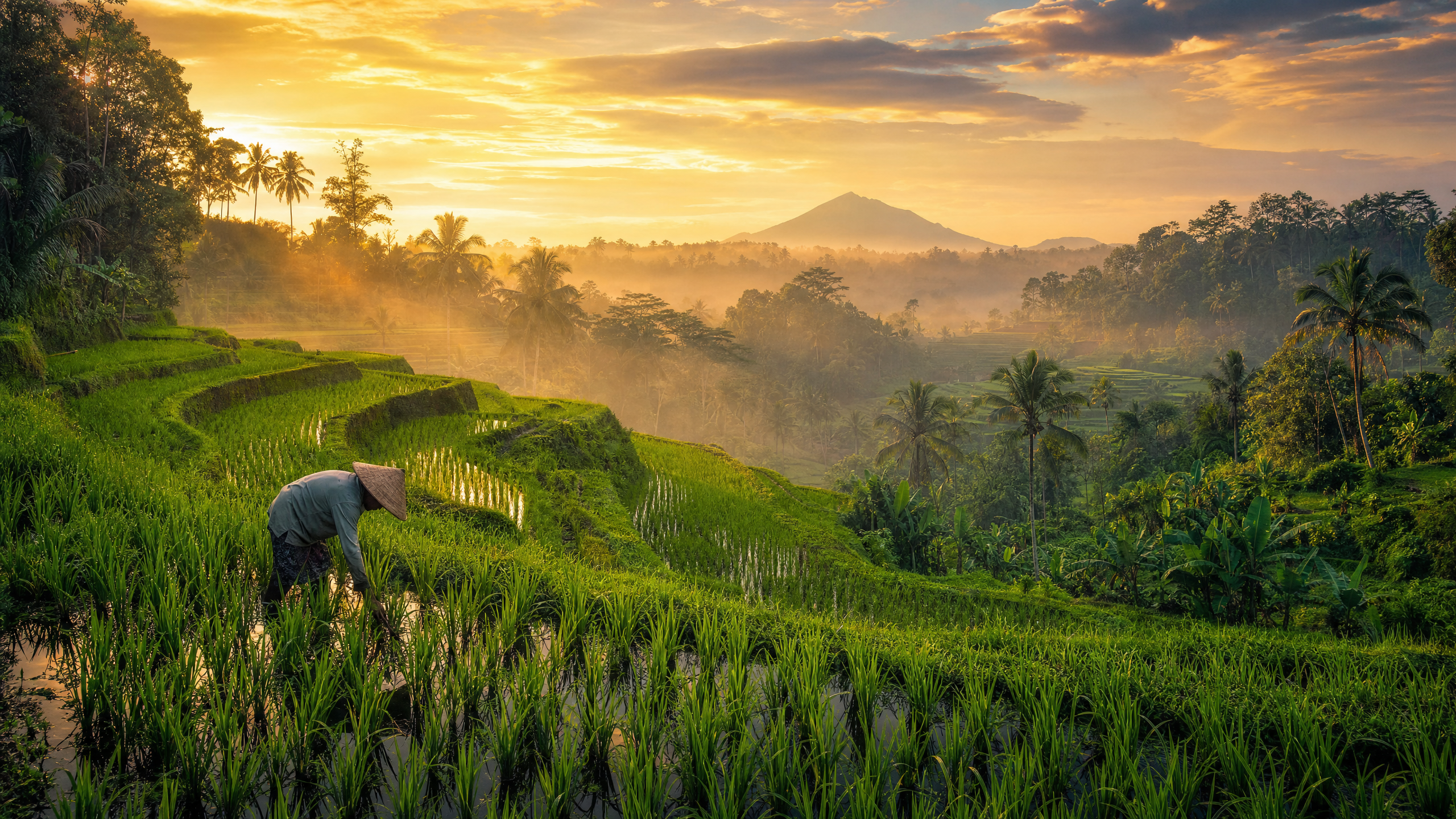
Here's what the "avoid wet season" crowd misses: January and February are genuinely beautiful months to be in Bali if you adjust your itinerary accordingly. The rice terraces around Ubud are at their most vivid green — the kind of green that doesn't exist in photographs, only in person. Waterfalls like Gitgit and Sekumpul run at full volume. The jungle is alive in a way it simply isn't in August.
Crowds are at their annual low. Seminyak villas that cost $400 a night in peak season go for $180. The famous Tegallalang rice terraces — usually a shoulder-to-shoulder Instagram scrum — become something closer to what they actually are: a working agricultural landscape of extraordinary beauty.
The tradeoff: surf on the south coast is inconsistent, some roads in the highlands flood, and outdoor activities require flexibility. But for travelers who want Ubud's spiritual core, cooking classes, temple ceremonies, and the slower rhythm of Balinese village life, wet season is not a deterrent — it's the point.
Wet season rain is not what you think. The Balinese themselves have a different relationship with the rain than most Western tourists expect. Rain typically arrives in the afternoon — often around 3–5pm — as a dramatic tropical downpour that lasts 1–2 hours and then clears completely. Mornings are frequently sunny and beautiful. If you're planning outdoor activities in wet season, schedule them in the morning. Sunrise at Mount Batur, morning temple visits, early surf sessions, morning rice terrace walks — all of these are entirely viable in wet season if you start early and plan your afternoons around the rain rather than against it.
If this sounds like your Bali: → Bali 10-Day Relaxation & Culture Itinerary
March — Wet Season Winding Down, Nyepi on the Horizon
March is a transitional month, and it contains one of the most extraordinary events in the Balinese calendar: Nyepi, the Hindu New Year and Day of Silence. In 2026, Nyepi falls on March 19th.
For 24 hours — from 6am on Nyepi Day until 6am the following morning — Bali goes completely silent. The airport closes. Roads are empty. Lights are extinguished. Tourists are required to stay in their accommodation. The island, for one day, becomes something it almost never is: quiet.
The night before Nyepi is the Ogoh-Ogoh parade, where enormous papier-mâché demon effigies are carried through the streets in a cacophony of drums and fire, meant to drive evil spirits from the island before the day of purification. It is one of the most visceral, alive cultural spectacles in Southeast Asia — the kind of event that travel journalists spend careers trying to describe and never quite capture.
If you're in Bali for Nyepi, embrace it. Bring books. Sit on your villa terrace and listen to the silence. Understand that you are witnessing something that has no equivalent anywhere else on earth — a modern island of 4 million people choosing, collectively, to stop.
If your trip requires airport access on Nyepi Day, plan around it carefully. Flights are cancelled. There are no exceptions.
April — The First Sweet Spot
April is when the dry season begins to assert itself, and it's one of the most underrated months to visit Bali. The rains are tapering off, the landscape is still lush from the wet season, and the crowds haven't yet arrived. Prices are mid-range — not wet-season low, but nowhere near peak.
The surf starts to come alive on the south and southwest coasts. Uluwatu, Padang Padang, and Bingin begin to see consistent swells. Water temperatures are warm, visibility is good for snorkeling and diving around Nusa Penida, and the roads are dry enough to explore the highlands comfortably.
April also marks the beginning of the cultural high season in a different sense: temple ceremonies proliferate as the Balinese calendar enters a busy period of religious observance. If you're traveling with genuine curiosity about Balinese Hinduism — its layered relationship with animism, its daily offerings, its extraordinary temple architecture — April gives you access to ceremonies that peak season crowds often miss entirely.
The shoulder months of April–May are cited by experienced Bali surfers as some of the finest surfing of the year — every surf area is simultaneously accessible, winds are light, and crowds are manageable.
For the adventure-focused traveler arriving in April: → Bali 5-Day Adventure Guide
May & June — The Shoulder Season Sweet Spot
Ask any frequent Bali traveler when they prefer to go, and a disproportionate number will say May or June. This is the shoulder season sweet spot: dry weather has fully established itself, but the European and Australian school holiday crowds haven't arrived yet.
May brings clear skies, low humidity, and temperatures in the comfortable 26–29°C range. The surf is building on the west coast — Canggu's Echo Beach and Old Man's are producing consistent, clean waves. Nusa Penida's crystal bay is at its most accessible. The rice terraces are in various stages of the agricultural cycle, which means you'll see some fields flooded and reflective, others bright green with young shoots, others golden and ready for harvest — a patchwork that changes week by week.
June extends all of this with slightly more crowd pressure as European summer holidays begin, but it remains significantly quieter and cheaper than July and August. Accommodation prices in Seminyak and Canggu are typically 20–30% lower than peak season.
For solo travelers, May and June are particularly compelling. The digital nomad community in Canggu is at full strength — the cafes along Batu Bolong are buzzing with laptops and conversation, the surf schools are running daily, and the social infrastructure of Bali's long-term expat scene is accessible in a way it isn't when the resort crowd overwhelms it in August.
Solo travelers, this is your window: → Bali 5-Day Solo Travel Guide | Bali 7-Day Solo Adventure
Budget travelers who want the best weather without peak prices: → Bali 5-Day Budget Guide
July & August — Peak Season: The Full Bali Experience (and Its Costs)
July and August are Bali's peak season, and they are peak season for a reason. The weather is as close to perfect as Bali gets: dry, sunny, temperatures in the mid-to-high 20s, low humidity, and the southeast trade winds keeping everything fresh. The surf at Uluwatu is world-class — consistent 4–8 foot swells drawing international surfers who plan their entire year around this window.
This is also when Bali is most expensive, most crowded, and most fully itself as a global tourism destination. The restaurants in Seminyak are full. The sunset at Tanah Lot requires arriving an hour early to get a decent vantage point. The famous Tegallalang rice terraces will have queues for the swing photos. Accommodation prices are at their annual peak — sometimes double the wet-season rate for the same villa.
None of this makes July and August bad months to visit. It makes them a specific kind of Bali experience: high energy, maximally social, with the best weather and the most activity. If you're traveling with a group, if this is your first trip to Bali, or if you specifically want the surf, the beach clubs, and the full Seminyak experience, peak season delivers.
What it doesn't deliver: solitude, bargains, or the feeling that you've discovered something. For that, you need to go earlier or later.
Couples looking for the romantic peak-season Bali: → Bali 7-Day Couples Guide | Bali 7-Day Honeymoon Guide
Families navigating peak season with kids: → Bali 7-Day Family Guide
September — The Best Month Most People Don't Book
September might be the single best month to visit Bali, and it's consistently overlooked because it sits just outside the peak season window that drives most booking decisions.
The weather in September is indistinguishable from July and August — dry, clear, warm, with the trade winds still present. The surf at Uluwatu and Padang Padang is still firing. But the crowds have thinned dramatically as European and Australian school holidays end. Accommodation prices drop 15–25% from their August peak. The restaurants have availability. The rice terraces have breathing room.
September also marks the beginning of the harvest season in many parts of Bali, which means the agricultural landscape is at its most golden and photogenic. The light in September — lower in the sky than in June, warmer in tone — is extraordinary for photography.
If you can only go once and you want the best weather combined with manageable crowds and reasonable prices, September is your answer.
October — Second Shoulder Season Sweet Spot
October mirrors April as the second shoulder season sweet spot. The dry season is winding down, the first rains of the wet season may appear (usually brief afternoon showers), and the crowds are thin. Prices are favorable.
October is particularly good for diving and snorkeling — visibility around Nusa Penida and Amed is excellent, the water is warm, and the mola mola (ocean sunfish) that Nusa Penida is famous for are at their most reliably present from July through October. If seeing a mola mola — one of the ocean's most bizarre and magnificent creatures — is on your list, October is your last reliable window of the year.
The Ubud Writers & Readers Festival typically takes place in October, drawing an international literary community to the cultural heart of Bali. If you're the kind of traveler who wants to engage with ideas alongside landscapes, this is a compelling reason to time your trip.
November — The Transition
November is when the wet season begins to reassert itself. Afternoon rains become more frequent and more sustained. The landscape starts to green up again. Crowds are low and prices are favorable, but you need to accept weather variability as part of the deal.
November is a good month for travelers who want Ubud — the spiritual and cultural center of Bali — without the crowds. The yoga retreats, cooking schools, and healing practitioners that define Ubud's identity are fully operational, and the town has a quieter, more contemplative energy. The famous Monkey Forest is at its least crowded. The morning market at Ubud's central market is a genuine local experience rather than a tourist performance.
December — Holiday Season Returns
December splits into two distinct periods. Early December (1st–20th) is actually one of the quieter months of the year — low crowds, good prices, and weather that's wet but not oppressively so. Then Christmas and New Year's arrive, and Bali transforms into one of the most festive destinations on earth.
The Christmas-to-New-Year's period sees Bali at its most international and most expensive. Seminyak and Canggu beach clubs host elaborate countdown events. Villas book out months in advance. The energy is celebratory and global.
If you're planning a December trip, either go early (before December 20th) for the quiet version, or go all-in on the festive period and book everything well in advance.
For the full Bali food and culture experience any time of year: → Bali 7-Day Food Guide
For those planning 10 days and wanting to see it all: → Bali 10-Day Itinerary: Ubud, Seminyak, Uluwatu & Nusa Penida
The Surf Calendar: When to Go Based on Where You're Riding
Bali's surf geography is one of its most underappreciated features. The island's orientation means different coasts receive swell from different directions, which translates to a surf calendar that's more nuanced than "dry season good, wet season bad."
South Coast (Uluwatu, Padang Padang, Bingin, Impossibles): These world-class left-handers receive southwest swell and are at their best from April through October, peaking in June–August. These are not beginner waves — Uluwatu in particular is a powerful, hollow reef break that demands experience. The cave entry and exit at Uluwatu is a rite of passage; the wave itself is one of the finest in the world.
West Coast (Canggu, Echo Beach, Old Man's): Canggu works year-round but is best from May through September. Old Man's is the beginner-friendly option; Echo Beach is for intermediate to advanced surfers. The beach break here is more forgiving than the reef breaks of the Bukit Peninsula, and the surrounding cafe culture makes it the most social surf scene on the island.
East Coast (Keramas, Medewi): These spots receive different swell and can fire during the wet season when the south coast is flat. Medewi is a long, mellow left-hander that's excellent for longboarders and intermediate surfers, particularly from March through November. The village of Medewi itself is one of the most authentically Balinese surf communities remaining on the island — no beach clubs, no Instagram swings, just nasi goreng and good waves.
The shoulder months of April–May and September–October are often cited by experienced Bali surfers as the finest surfing of the year — every surf area is simultaneously accessible, winds are light, and crowds are manageable.
The Crowd & Price Matrix
| Month | Crowds | Price Level | Weather | Best For |
|---|---|---|---|---|
| January | Low | Budget | Wet | Culture, Ubud, budget travelers |
| February | Low | Budget | Wet | Waterfalls, rice terraces, yoga |
| March | Low–Med | Budget–Mid | Transitional | Nyepi, cultural events |
| April | Medium | Mid | Dry (building) | Surf, diving, shoulder season |
| May | Medium | Mid | Dry | Best all-around, solo travelers |
| June | Med–High | Mid–High | Dry | Surf, couples, first-timers |
| July | Peak | Peak | Dry | Beach clubs, groups, families |
| August | Peak | Peak | Dry | Best weather, peak experience |
| September | Medium | Mid | Dry | Best value dry season month |
| October | Low–Med | Mid | Transitional | Diving, Ubud, writers festival |
| November | Low | Budget–Mid | Wet (building) | Quiet Ubud, budget |
| December | Low → Peak | Mid → Peak | Wet / Festive | Early: quiet. Late: celebrations |
What Nobody Tells You About Bali's Rainy Season
The phrase "rainy season" conjures images of grey skies and cancelled plans. In Bali, the reality is more interesting — and for certain kinds of travelers, more appealing.
Wet season rain typically arrives in the afternoon as a dramatic tropical downpour that lasts 1–2 hours and then clears completely. The air after rain is clean and cool in a way that dry season never quite achieves. The rice paddies fill and reflect the sky. Waterfalls that are a trickle in August become something genuinely powerful. The jungle around Ubud smells of earth and flowers in a way that's impossible to replicate in dry conditions.
The Balinese agricultural calendar is tied to the wet season. The rice planting cycle that begins with the rains is the foundation of Balinese culture — the ceremonies, the offerings, the temple rituals are all connected to the land and the water. Traveling in wet season means traveling closer to the actual rhythm of the island rather than the tourist overlay that sits on top of it.
The practical implication for itinerary planning: schedule outdoor activities in the morning. Sunrise at Mount Batur, morning temple visits, early surf sessions, morning rice terrace walks — all viable in wet season if you start early. Use the afternoon rain as a natural break for a long lunch, a cooking class, or a spa treatment. This is how the Balinese themselves structure their days.
Nyepi: The Day That Changes Everything
If your travel dates overlap with Nyepi — the Balinese Day of Silence — you need to plan specifically around it. The airport closes for 24 hours. No flights in, no flights out. All roads are closed. You will be confined to your accommodation.
This is not a hardship. It is, for travelers who approach it with the right mindset, one of the most extraordinary experiences available anywhere in the world. Sitting in a Ubud villa listening to absolute silence — no motorbikes, no music, no construction, no engines — while the stars appear overhead with unusual clarity is the kind of travel memory that doesn't fade.
The night before Nyepi is the Ogoh-Ogoh parade: enormous papier-mâché demon effigies, some standing 10 feet tall, are paraded through the streets on bamboo platforms by teams of young men, accompanied by gamelan orchestras and torch-lit processions. The demons are then burned or dismantled at crossroads to purify the island before the silence begins. It is chaotic, beautiful, and unlike anything else in the travel world.
Nyepi requires planning. Check the date for your travel year before booking flights. Build a buffer day on either side. Choose accommodation that will make the 24-hour confinement pleasant — a villa with a pool and garden is infinitely preferable to a budget guesthouse room. And approach the day itself not as a restriction but as a gift: one day of enforced stillness on an island that otherwise never stops moving.
The Honest Answer: When Should You Actually Go?
First time in Bali, want the best weather and don't mind crowds: July or August. Accept the prices, book early, and enjoy the peak experience.
First time in Bali, want the best weather without peak crowds: September. No compromise required — same weather, fraction of the crowd, better prices.
Budget traveler who can work around weather: January or February. The savings are real, the landscape is beautiful, and you'll have a more authentic experience than most visitors ever get.
Surfer targeting Uluwatu and the Bukit Peninsula breaks: June, July, or August for the most consistent and powerful swell. April and September for the same quality with significantly fewer people in the water.
Spiritual or cultural traveler: March for Nyepi, or any time in Ubud outside of July–August. The temple ceremonies, the healing practitioners, the cooking schools — all of this is more accessible when the resort crowd isn't competing for the same space.
Couples or honeymooners: May, June, or September. The romantic infrastructure of Bali — the clifftop restaurants, the private villa pools, the sunset pura ceremonies — is at its best when you're not sharing it with a thousand other people.
Families: July or August for the most family-friendly infrastructure and guaranteed weather, or April for a quieter alternative with excellent conditions and lower prices.
Digital nomads and long-term travelers: May or October. The community is present, the prices are reasonable, and the island has room to breathe.
Planning Your Bali Trip: Start Here
The guides below are built around the specific rhythms and opportunities of Bali as it actually exists — each one matched to a travel style, a pace, and a set of priorities. Use them as your starting point, then build your own version with the exact dates, budget, and preferences that make it yours.
For the full Bali experience across 10 days:
For focused 7-day trips:
- 7-Day Bali Couples Guide
- 7-Day Bali Honeymoon Guide
- 7-Day Bali Family Guide
- 7-Day Bali Solo Adventure
- 7-Day Bali Food Guide
For 5-day trips:
Built by travelers, for travelers — Your Next Adventure Starts Here.