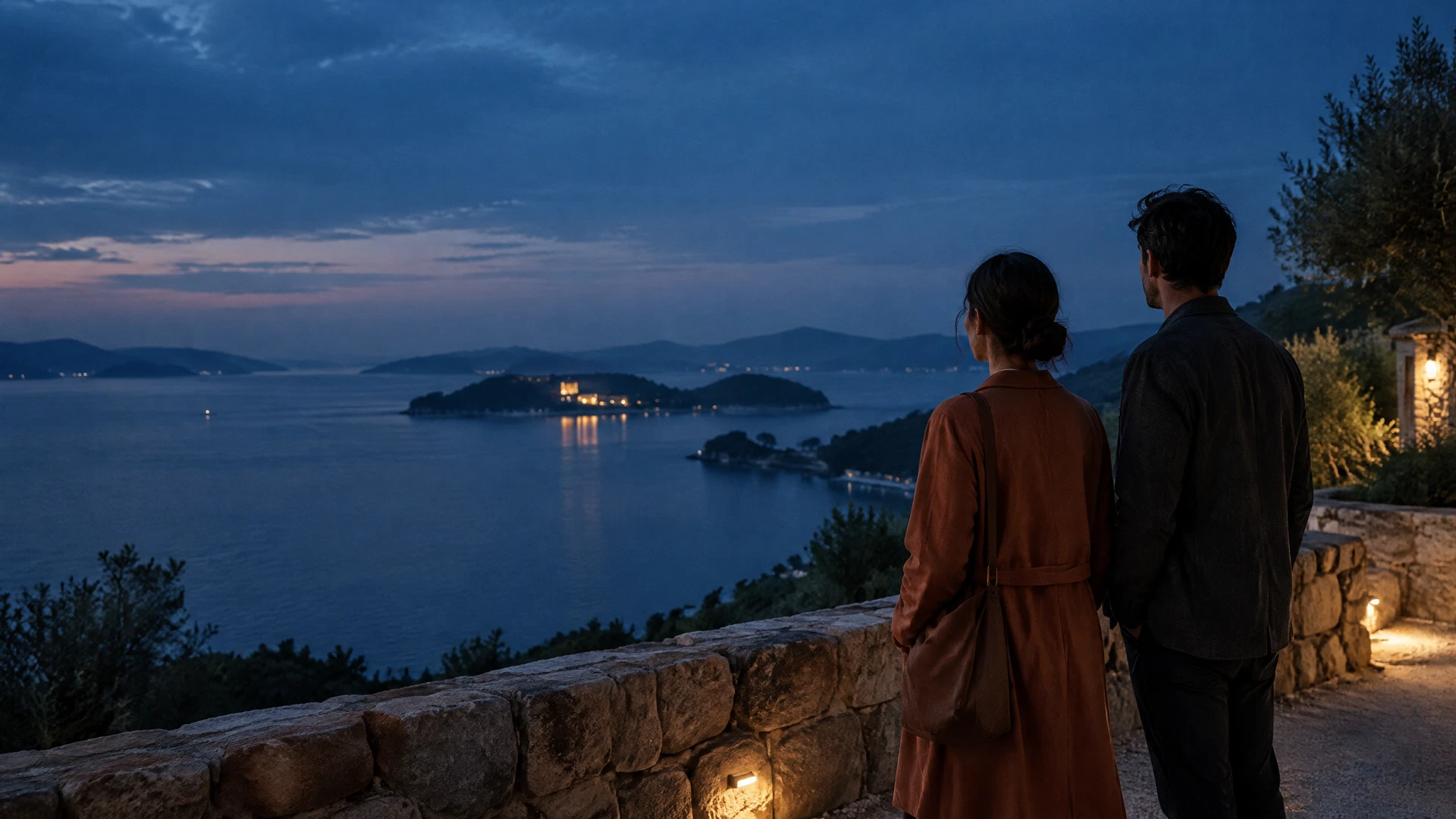
The Best Couples Trips Are Not About Romance. They Are About Recognition.
Destination: Global
Category: comparison
The best couples travel destinations do not work because they provide the correct light for a photograph. They work because, somewhere between a missed turn, a meal that runs late, a decision that cannot be delegated, and a silence that feels easy instead of empty, two people notice something newly true about each other. That is recognition. It is more durable than a view and far more useful than a perfect hotel room.
Most couples travel advice begins with a setting: Paris at night, Venice from a gondola, an infinity pool somewhere warm. The setting is real. So is the pleasure. But a destination can perform romance so efficiently that the couple never has to bring much of themselves to the experience. The right place reveals the parts of a relationship that ordinary circumstances leave unseen. These six are chosen for that reason. They arrive, consume the evidence, and leave with a familiar sequence of pictures. Nothing in that sequence asks how they make choices together, what they notice, how they handle quiet, or whether they can agree on the kind of afternoon worth losing.
The better question is not, “Where will we look most in love?” It is, “Where will we have to be most present with one another?” A good trip gives two people the time and conditions to become more legible to each other. It creates room for one person’s curiosity to meet the other person’s patience, for a shared appetite to become a plan, for an unfamiliar rule to become a small act of trust. The trip matters because ordinary life rarely makes those things visible.
This is why these six places belong together. Japan teaches couples a language for silence. Portugal brings two people down to the same speed. Colombia restores the feeling of discovery. Hokkaido refuses to stay one version of itself long enough for a couple to become complacent. Greece has spent millennia refining the social architecture of being together. Morocco asks two people to operate as a unit. The thesis is not that travel changes a relationship in some vague, cinematic way. It is that the right place reveals the parts of a relationship that ordinary circumstances leave unseen.
There are many beautiful places in the world. These are the places where two people become participants rather than spectators.
Japan: What the Best Couples Travel Destinations Teach About Silence
Japan teaches couples a new language for silence, which is why it belongs on this list before any place that simply supplies a romantic backdrop. The Japanese idea of ma is often translated as “space” or “pause,” but neither word catches the feeling of it. It is the interval that lets the rest of an experience breathe: the quiet before tea is poured, the unspoken courtesy of a train platform, the garden path that takes longer than it needs to because arriving is not its only purpose. Couples accustomed to filling every silence with a plan, a recommendation, or a phone screen encounter a different standard here. Presence has weight.
Start in Hakone, where the formalities of a ryokan are not decorative. They are a sequence two people enter together. Shoes come off. A yukata is tied in the room. The bath has rules that ask for attention. Dinner appears in small courses that slow the evening down rather than pushing it toward a reservation time. At a place such as Gora Kadan, the point is not to collect another luxury stay. It is to experience a form of hospitality where the room, the bath, and an in-room kaiseki dinner refuse to divide the evening into “activity” and “downtime.” They ask a couple to settle into the same frame.
For the practical route into that rhythm, use this Hakone itinerary for Fuji views and onsen time as the planning foundation. It gives the overnight stay a purpose beyond a checklist and makes room for the part that cannot be scheduled: the moment after dinner when there is nowhere else to be.
Tokyo offers a very different proof. At teamLab Borderless, rooms react to where bodies move, where a hand reaches, which threshold is crossed first. A group tends to fragment the experience into competing directions and camera angles. Two people can move through it as a shared act of attention: one notices a detail, the other follows it; one pauses, the other sees why. It is a small thing, until it is not. The most revealing travel moments are often made of these nearly invisible negotiations.
This is why Japan, rather than another hotel-and-dinner destination, is the opening argument. It does not outsource intimacy to a table with a view. It makes a couple practice attention. A Tokyo itinerary designed for two can carry the city side of the trip, but leave one evening intentionally unclaimed. Let the neighborhood decide it. Let the silence on the walk back matter.
Japan suits couples who want to discover whether they can be fully together without constant stimulation. The answer is not always immediate. That is precisely the point.
Portugal: Where Two People Learn to Move at One Speed
Where Japan teaches two people how to occupy silence, Portugal teaches them how to move at the same speed. That distinction is not cosmetic. Many couples travel with mismatched internal clocks: one wants the museum before opening, the next neighborhood before lunch, the sunset booked at 7:30; the other wants one coffee to become a morning and a walk to remain a walk. Portugal has a way of making the second instinct culturally legitimate. It gives both people permission to stop treating time as something to win.
Lisbon is the entry point, though it should not be approached as a hill-climbing contest. The city makes its case in the pauses between slopes: a bica at a counter in Chiado, the iron-and-glass quiet of the Avenida da Liberdade after the shops close, the view over the tiled roofs from Miradouro de Santa Catarina when the day gives way without announcing it. Saudade is frequently flattened into melancholy, but its usefulness for couples is subtler. It asks people to understand that a good moment can be complete while it is happening and still carry a little ache because it cannot be held.
Build the city portion around a Lisbon couples itinerary, then use it as a reason not to overfill the days. The correct Lisbon afternoon may be a long lunch in Campo de Ourique, a tram passed by because the next one will arrive, or a table where the conversation becomes more important than the order. Portugal is one of the few European countries where taking your time rarely feels like failing to see enough.
Then leave the capital. In the Douro Valley, the terraced hills do not reward urgency. A quinta stay places two people beside a river that moves at its own scale, with vineyard paths, a glass of wine, and late light doing more than any “romantic activity” could accomplish. The point of the valley is not the tasting note. It is the shared agreement to spend an afternoon with no outcome beyond being there. South of Lisbon, the cork oaks, olive groves, and whitewashed towns of the Alentejo make the same argument with longer roads and fewer interruptions.
Porto provides the city counterpart: older, steeper, and more willing to let a day unfold around a meal than a sight. Use a Porto guide for couples who want the city’s slower register as a route into it, then make time for the Ribeira after the river traffic thins and for a detour through the back streets above Rua das Flores. Portugal is better than Italy for this particular kind of trip not because it has less beauty, but because it asks less performance from the people inside it.
Portugal belongs here for the couple whose best moments begin when nobody is checking the clock. It does not prescribe closeness. It creates the pace in which closeness can happen.
Colombia: The Country That Gives Two People a Shared Discovery
Where Portugal synchronizes a couple’s pace, Colombia gives them the feeling of discovering something together before it has been turned into a finished product. That feeling matters. Exploration is not about claiming a place that others have missed; it is about arriving with assumptions, finding them insufficient, and working out a better understanding side by side. Colombia is especially good at this because it keeps refusing the simplified story many visitors bring with them.
Medellín is the immediate example. The city’s geography is impossible to understand from a map alone: neighborhoods climb the valley walls, weather alters the distance between them, and the Metro and Metrocable make movement part of the explanation. Ride Line K toward Santo Domingo together, not as a box to check but as an introduction to the city’s vertical logic. The cable car gives the two of you the same changing view—dense roofs, mountains, route lines, public space—and turns a conversation about the city’s remaking into something physical. You see why the city cannot be reduced to its past or to its rebrand.
Use this Medellín couples guide to give the days structure, but do not let the itinerary turn Getsemaní, Cartagena, or Medellín into interchangeable color palettes. In Medellín, a morning in the Museo Casa de la Memoria and an evening in Laureles produce a more useful contrast than a rush through every neighborhood on the map. One tells you what the city remembers; the other shows you how the city lives now.
The second proof lies in the coffee region. Around Salento, the path into the Cocora Valley moves through wax palms that do not look real until you are standing beneath them, trying to decide whether the mist is arriving or lifting. A finca stay is valuable because it makes the morning shared: coffee rows, damp paths, a quiet breakfast, the decision of whether to walk farther. It is not a staged private escape. It is a landscape that gives two people a common horizon and enough unstructured time to talk through what they are seeing.
Plan that part with a Colombia coffee-region couples itinerary, especially if you want the trip to move from city energy into agricultural scale without losing its thread. Colombia is preferable to a more polished Latin American circuit for the couple who enjoys being slightly ahead of their certainty. It rewards curiosity, good questions, and the willingness to revise a first impression together.
That is the behavior Colombia produces: discovery. Not the shallow pleasure of saying you found something, but the deeper pleasure of realizing that you now share a more complicated map of the world.
Hokkaido: The Island That Keeps Surprising a Couple
Where Colombia makes two people explorers, Hokkaido surprises them by refusing to remain the same destination from one season to the next. This is Japan without the expectation that a first visit must include Tokyo, Kyoto, and Osaka in sequence. It is an island for couples who have already done the obvious route—or who want their shared memories to be tied to a place that cannot be summarized by one season’s version of itself.
In winter, Sapporo fills with snow sculpture and light while Niseko offers days built around powder, fatigue, hot water, and the strange intimacy of helping each other out of ski boots. In early summer, the island is quieter and green, with long drives through agricultural country and a cooler air that makes being outside feel like an invitation rather than a test. By July, Farm Tomita near Furano becomes a field of lavender, and Biei’s Blue Pond shifts between turquoise and milky blue according to weather and light. Autumn arrives early enough to make the island a different answer to foliage travel altogether.
The point is not that every couple should chase all four seasons. The point is that seasonal contrast prevents a trip from becoming a repeatable fantasy. You choose the version that suits the two of you now: snow and motion, flowers and long roads, cool summer walks, or early color. A five-day Hokkaido adventure guide gives the geography a useful backbone, but the best decisions here are not the most efficient ones. They are the ones that make room for weather to edit the day.
Take Biei Blue Pond early, before buses establish the day’s rhythm. Take the Furano road with no obligation to turn every stop into a photo. In Niseko, choose an afternoon when one person can make the last run and the other can go back to the onsen without either choice becoming a referendum on the trip. This is one of Hokkaido’s quiet lessons: couples do not need to want the same thing every hour in order to be traveling well together. They need to make room for difference without losing the shared shape of the day.
Hokkaido earns its place over a standard alpine resort because its seasonal changes are not an accessory. They alter the entire encounter. A couple comes back to the same island in a different month and learns that their shared way of traveling has changed, too. Surprise is not novelty for its own sake. It is evidence that there is still more to notice.
Greece: A Country That Has Been Hosting Two People for 3,000 Years
Where Hokkaido makes room for seasonal surprise, Greece hosts couples through a social language that has been practiced for more than three millennia. The genius of Greece is not that it invents romance on demand. It is that it understands how two people should occupy a table, a harbor, a late afternoon, and a short walk between them. The country has always known that companionship needs scale: a place small enough to cross together, open enough to keep surprising you, and social enough that you never have to manufacture an atmosphere alone.
The island version of this begins on the water, not at a clifftop viewpoint. Santorini is often treated as a test of whether a couple can tolerate crowds for a famous sunset. The more complete experience is a small catamaran sailing around the caldera, where the geology finally makes sense because the cliffs rise in one continuous curve and the old volcanic basin becomes visible from the only angle that explains it. The point is not privacy as a luxury product. It is the shared act of seeing the island’s shape rather than merely standing in front of it.
For a route that connects Athens and the Cyclades without reducing either to a backdrop, start with this Athens and Santorini couples itinerary. It lets the trip have two registers: the city’s layers of argument and the island’s scale. Athens offers a dinner that proceeds through shared plates rather than individual orders; Santorini offers a harbor or boat where the conversation has nowhere to go except farther.
Milos makes the counterargument to Santorini’s familiar image. At Sarakiniko, white volcanic rock drops into water so clear it seems to erase distance. Kleftiko’s sea caves require a boat, which means a day must be chosen, weather must be accepted, and the route has a beginning and an end. In the Peloponnese, the Mani Peninsula adds stone tower villages, dry hills, and roads that make a couple feel briefly alone with a large landscape. Greece is not one thing; that is why it works. Its islands, cities, and mainland each host togetherness differently.
Use a Santorini guide built for a couples escape for the practical decisions, then resist the urge to make Oia the whole story. Greece is better than another Mediterranean island escape for the couple who wants the trip to have a social center. The best evenings are not private because they are isolated. They are shared because a carafe of local wine, grilled fish, and a table near the harbor make it natural to stay longer than intended.
Greece hosts. It has the light, the food, the scale, and the practiced confidence to let two people feel well received by the world without asking them to perform for it.
Morocco: The Country That Requires Two People to Function as a Unit
Where Greece hosts a couple generously, Morocco requires them to function as a unit—and that demand is the reason it completes this list. Morocco is not difficult for difficulty’s sake. It is simply alive with decisions. A medina offers three directions where a map shows one. A souk presents a price that needs a response. A riad appears behind an unmarked door. A long road toward the Atlas or the desert requires the day to be read as it unfolds. One traveler can handle all of this alone. Two people can make it into a practice of collaboration.
Marrakech gives the behavior its most immediate form. In the medina, agree on an orientation point before you enter the denser lanes. Decide together whether a stall deserves a second look or whether the better move is to keep walking. The shared work is small, but constant. It becomes oddly revealing: who sees the exit, who starts conversations, who negotiates, who notices when the pace has become too fast. A riad is useful because it gives the day a quiet center to return to after all that motion.
Start with a Marrakech itinerary for couples, then leave space for the city’s unscripted negotiations. Book a hammam that feels comfortable for both of you. Eat on a rooftop only after walking enough of the medina to know why the view feels earned. If Dar Yacout is part of the evening, book ahead; its setting above the city works because the approach through the lanes has already reset your sense of direction.
Fes takes the argument further. Fes el-Bali is not a maze to conquer; it is a living district where navigation works differently than it does in a grid city. The Chouara tannery is best encountered early, before the middle of the day intensifies the smell and crowd. The University of al-Qarawiyyin, the medersa courtyards, and the workshops around the souks give the old city a density that requires patience. A Fes couples guide will keep the first days from becoming needlessly chaotic, but it should not remove every uncertainty. A little shared disorientation is the evidence.
Then take the road outward. The Atlas foothills and a Toubkal base-camp trek offer a more physical version of the same lesson: pace, encouragement, water, turning back, going on. Not every couple needs the summit attempt. The value is that two people must make the same mountain-day decisions together, with the weather and their bodies participating in the conversation.
Morocco belongs here instead of Bali because it cannot be reduced to a ready-made couple’s retreat. It requires attention, mutual trust, and a willingness to decide. When the two of you find the riad again after getting turned around, settle on the right price without making it a contest, or reach the end of a mountain path together, the trip has shown you something ordinary life had not asked to reveal.
Why Paris, Venice, and Bali Are Not on This List
The exclusions matter because Paris, Venice, and Bali are not bad couples destinations. Each has earned the desire it creates. Paris has the Seine, late dinners, museum rooms that quiet a conversation. Venice has impossible water, narrow passages, and the strange sensation of a city detached from the usual rules. Bali can offer rest, warmth, and beautifully designed places to stay. None of that is in dispute.
They are absent because this list is not measuring romance infrastructure. Paris can make a couple feel like they have entered a ready-written story; Venice can make the setting so complete that the people inside it become decorative; Bali’s couples experience is increasingly sold as a resort package with a prescribed mood. Those trips may be exactly right for a proposal, an anniversary, or a deliberate pause. But they do not necessarily create the six behaviors this article is trying to identify.
Japan asks for shared attention. Portugal gives two people a common tempo. Colombia rewards curiosity. Hokkaido makes room for difference. Greece provides a social world in which companionship feels natural. Morocco turns decisions into a joint practice. The destination does not do the relationship’s work. It gives the relationship a better kind of work to do.
How to Choose Among the Best Couples Travel Destinations
Choose Japan if you want shared attention, ritual, and the pleasure of learning unfamiliar rules together. Choose Portugal if one or both of you needs a trip that lowers the pressure to optimize. Choose Colombia if the two of you are energized by surprises and by places that complicate your assumptions. Choose Hokkaido if you want a season to determine the trip’s character. Choose Greece if your ideal days are social, sunlit, and organized around the table. Choose Morocco if you are looking for a trip that makes teamwork visible.
| What you want to discover together | Choose | Best trip length | Operational note |
|---|---|---|---|
| Whether silence can feel full rather than empty | Japan | 7–10 days | Reserve a Hakone ryokan months ahead, especially for an in-room kaiseki dinner. |
| Whether you can let a day remain open | Portugal | 7–10 days | Douro quinta rooms are limited during harvest; book early if a vineyard stay is central. |
| Whether shared curiosity is your best travel energy | Colombia | 8–12 days | Pair Medellín with the coffee region rather than trying to add every Colombian region at once. |
| Which version of the same place suits you now | Hokkaido | 5–7 days | Decide the season first; Niseko, Furano, and Biei answer different questions. |
| How much a meal and a harbor can hold | Greece | 7–10 days | Reserve a Santorini sailing day in peak months; use weather as the final authority. |
| How you make decisions when the route is not obvious | Morocco | 7–10 days | Use a riad as a fixed base and keep the Atlas or desert leg deliberately unhurried. |
The sensible way to plan a couples trip is not to begin with a list of attractions. Begin with the behavior you want more of in your shared life. Maybe you need to slow down together. Maybe you need to remember that surprise still exists. Maybe you want to see how the other person responds when the map is unhelpful, the dinner is late, or the trail is longer than expected. Build the route around that answer, then let AskLeif turn the broad instinct into a sequence with the right pace, stays, and breathing room.
Six Behaviors, One Clearer Way of Seeing Each Other
Japan teaches. Portugal matches pace. Colombia discovers. Hokkaido surprises. Greece hosts. Morocco requires.
None of those verbs can be swapped without losing something essential. Japan’s quiet is not Portugal’s ease. Colombia’s discovery is not Hokkaido’s seasonal instability. Greece’s welcome is not Morocco’s demand. That is why the destinations belong together: each produces a different condition under which two people can become easier to read.
The right couples trip does not need to prove that you are in love. It gives you a few days in which love has to operate differently—more patiently, more collaboratively, more openly—until you see the person beside you with a little more clarity than you had before.