Bangkok Doesn't Ease You In. It Grabs You by the Collar and Never Lets Go.
Destination: Bangkok, Thailand
Category: Destination Guides
Bangkok doesn't ease you in. The moment you step outside Suvarnabhumi Airport into the thick, warm air — the smell of jasmine garlands and exhaust and something frying in oil somewhere nearby — the city grabs you by the collar and makes its intentions clear. This is not a place that will wait for you to get comfortable. Bangkok moves at its own frequency, and your job, as a visitor, is to tune in as fast as possible and hold on.
It is, by almost any measure, one of the most extraordinary cities on earth. The most visited city in the world for most of the past decade, according to Mastercard's Global Destination Cities Index. A city of 11 million people that somehow feels simultaneously overwhelming and navigable, chaotic and deeply hospitable, ancient and relentlessly modern. A city where a 200-year-old royal palace complex sits at the geographic center, surrounded by a tangle of expressways and skytrain tracks and street food carts that have been feeding the same neighborhoods for generations. A city where a bowl of boat noodles costs less than a dollar and a rooftop cocktail at a five-star hotel costs fifty times that, and both are worth every baht.
Bangkok is also, crucially, a city that rewards curiosity. The travelers who love it most are the ones who stopped trying to see it and started trying to feel it — who got lost in the lanes of Chinatown, who took the wrong canal boat and ended up somewhere they didn't expect, who said yes to the street food vendor who gestured at something unidentifiable and pointed at their mouth. The city has an almost infinite capacity to surprise, and it never runs out of new things to show you.
This is the guide to all of it.
Why Bangkok Belongs on Every Serious Traveler's List
There's a certain type of traveler who dismisses Bangkok — too crowded, too touristy, too chaotic. These are people who have either never been, or who spent three days on Khao San Road and concluded they'd seen the city. They haven't.
Bangkok is one of those rare cities that has something genuinely extraordinary to offer every type of traveler. The temples are among the most beautiful religious architecture in the world. The food — at every price point, in every context — is world-class in a way that very few cities can claim. The nightlife is legendary and genuinely diverse, from rooftop bars with views that make your chest tighten to underground jazz clubs to the kind of late-night street food scene that makes you question why you ever go to restaurants. The shopping ranges from luxury malls that rival anything in Hong Kong or Singapore to the chaotic, wonderful sprawl of Chatuchak Weekend Market, the largest market in Asia. The day trips — Ayutthaya, the floating markets, the ancient temples of the surrounding provinces — are among the best in Southeast Asia.
And then there's the hospitality. The Thai concept of sanuk — the idea that everything should be fun, that life is too short for unnecessary seriousness — permeates every interaction in Bangkok. The city smiles at you. Not performatively, not for tips, but because that's genuinely how the culture operates. It's disarming in the best possible way, and it's one of the things that makes Bangkok so easy to fall in love with.
The Temples: Bangkok's Sacred Heart
Bangkok has over 400 Buddhist temples — wats — and while you cannot and should not try to see all of them, the handful that define the city are among the most spectacular religious sites in the world. They are not optional. They are the reason Bangkok exists.
Wat Phra Kaew (the Temple of the Emerald Buddha) and the Grand Palace complex that surrounds it is the single most important site in Thailand. Built in 1782 when Bangkok became the capital of the Chakri Dynasty, the Grand Palace is a 218,000-square-meter complex of throne halls, ceremonial buildings, and sacred temples that is still used for royal ceremonies today. The Emerald Buddha — actually carved from jade, seated on a golden throne high above the altar — is the most sacred religious object in Thailand, and the reverence with which Thai people approach it is palpable. The complex is overwhelming in scale and detail; give it at least three hours and come early to beat the crowds and the heat.
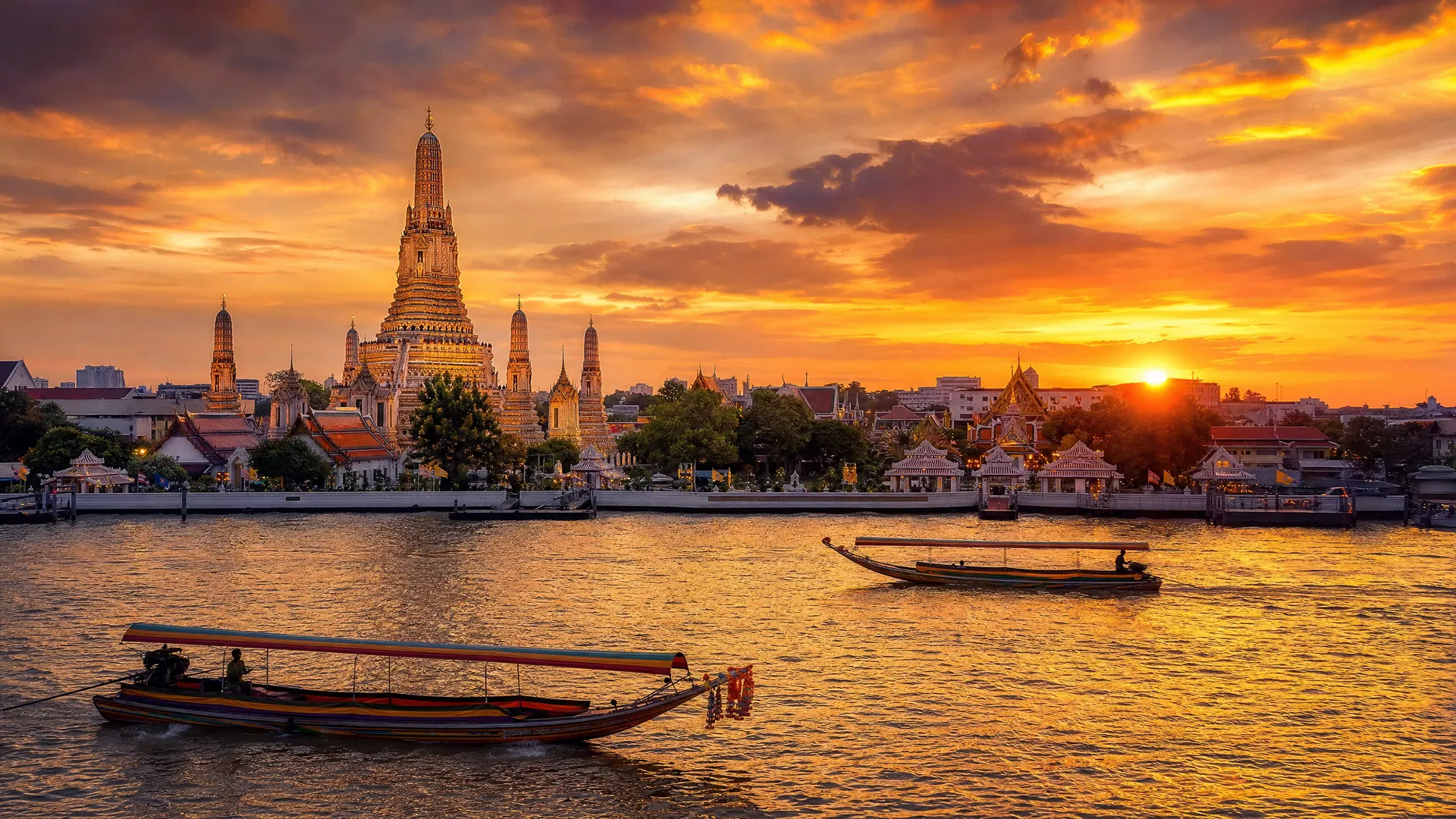
Wat Arun — the Temple of Dawn — is the image that defines Bangkok for most of the world, and it earns every photograph. Rising 86 meters above the western bank of the Chao Phraya River, its central tower encrusted with millions of fragments of Chinese porcelain that catch the light differently at every hour of the day, Wat Arun is most spectacular at sunrise (when the light comes from behind you, illuminating the tower in gold) and at sunset (when the tower glows amber against a darkening sky and the river traffic creates a moving foreground). Cross the river from the Tha Tien pier for 5 baht — one of the great travel bargains on earth.
Wat Pho, immediately south of the Grand Palace, houses the famous Reclining Buddha — a 46-meter-long, 15-meter-high gilded statue that is so large it fills the entire building constructed around it. The soles of the Buddha's feet are inlaid with 108 mother-of-pearl panels depicting the 108 auspicious characteristics of the Buddha. Wat Pho is also the birthplace of traditional Thai massage, and the massage school on the temple grounds is one of the most legitimate places in the city to experience it.
Wat Saket (the Golden Mount) offers something the other temples don't: a 360-degree view of the city from the top of an artificial hill, reached by a spiral staircase lined with bells. It's less visited than the Grand Palace complex and more atmospheric for it — particularly at dusk, when the city lights begin to emerge and the temple bells ring in the evening breeze.
All of these temples — and the logical sequence for visiting them — are woven throughout our Bangkok 5-Day Itinerary: Grand Palace, Street Food & Ayutthaya Adventure, which structures the temple visits alongside the markets and neighborhoods for a first-time visitor who wants to see the essential city without feeling rushed.
The Food: Bangkok Is One of the Great Eating Cities on Earth
This is not a claim made lightly. Bangkok belongs in the conversation with Tokyo, Mexico City, and Hong Kong as one of the places on earth where food is a full-time cultural practice, where the quality at every price point is extraordinary, and where eating is genuinely one of the primary reasons to visit.
Street food is where Bangkok's soul lives, and it is extraordinary. The pad thai from a wok-wielding vendor on Khao San Road at midnight, the khao man gai (poached chicken over rice with ginger broth) eaten at a plastic table on a Silom side street at 7am, the mango sticky rice from the cart outside Or Tor Kor Market — these are not consolation prizes for travelers on a budget. They are the real thing, made by people who have been cooking the same dish for twenty or thirty years and have achieved a level of mastery that most restaurant chefs will never reach.
Chinatown (Yaowarat) is Bangkok's most intense eating experience. The main street — Yaowarat Road — transforms every evening into one of the great street food spectacles in Asia: vendors grilling seafood on open flames, woks sending columns of fire into the night air, tables spilling onto the sidewalk, the smell of roasting duck and frying garlic and steaming dim sum creating a sensory experience that is almost physically overwhelming. The hoi tod (crispy oyster omelette) from the vendors near the Odeon Circle roundabout is a Bangkok essential. So is the khao tom (rice porridge with pork and ginger) from the 24-hour shops that serve the neighborhood's night workers. Come hungry, come late, and bring cash.
Or Tor Kor Market, near Chatuchak, is where Bangkok's middle class shops for produce and prepared food, and it is one of the most beautiful food markets in Asia — immaculately clean, extraordinarily well-organized, and stocked with the finest quality Thai ingredients available. The prepared food section, where vendors sell everything from green curry to grilled river prawns to elaborate desserts made from pandan and coconut milk, is a revelation. This is not the chaotic, photogenic street food of Yaowarat — it's the refined, quality-obsessed food culture that exists alongside it.
Fine dining in Bangkok has exploded over the past decade. The city now has multiple restaurants on the World's 50 Best list, and the Thai fine dining scene — led by restaurants like Nahm, Bo.lan, and Gaggan Anand's various ventures — is doing things with Thai ingredients and techniques that have no precedent. But the real discovery is the mid-range: the family-run restaurants in Silom and Sathorn that serve extraordinary regional Thai food — the fiery, herb-heavy cuisine of the northeast (Isan), the coconut-rich curries of the south, the delicate, complex flavors of royal Thai cuisine — at prices that would be considered budget dining in any Western city.
For travelers who want to eat their way through Bangkok systematically — from Yaowarat night markets to Michelin-starred Thai restaurants to the regional cuisines most visitors never encounter — our Bangkok Foodie's Paradise: 4-Day Street Food & Culinary Adventure is the definitive starting point.
The Neighborhoods: Bangkok's Many Personalities
Bangkok is not a city with a single center. It's a collection of distinct neighborhoods, each with its own character, its own food culture, its own reason for existing — and understanding this geography is the key to experiencing the city properly.
Rattanakosin Island — the old city, surrounded by the Chao Phraya River and a series of canals — is where Bangkok began and where its most important temples and palaces are concentrated. The streets here are narrow and chaotic, the architecture a mix of crumbling colonial shophouses and gleaming temple rooftops, the pace slower than the rest of the city. The neighborhood around Tha Tien pier, where the ferry crosses to Wat Arun, is one of the most atmospheric in the city.
Chinatown (Yaowarat) is the city's oldest commercial district, established by Chinese merchants in the late 18th century and still operating with the same intensity it always has. By day it's a labyrinth of gold shops, dried seafood vendors, and wholesale merchants. By night it becomes the street food spectacle described above. The lanes that branch off Yaowarat Road — particularly Soi Nana, which has become one of the city's most interesting bar and restaurant streets — reward exploration.
Silom and Sathorn are Bangkok's financial district by day and one of its most interesting dining and nightlife neighborhoods by night. Silom Road is home to some of the city's best street food (the lunchtime vendors who set up along the road and in the lanes off it are extraordinary), and the area around Patpong — Bangkok's most famous red-light district, now largely a night market — is one of the most densely interesting square kilometers in the city.
Sukhumvit is Bangkok's most international neighborhood — a long, traffic-choked boulevard lined with shopping malls, international restaurants, rooftop bars, and the city's largest concentration of expatriates and long-term visitors. It's not the most authentically Thai part of the city, but it's where you'll find the best rooftop bars (Vertigo at the Banyan Tree, Sky Bar at Lebua — the one from The Hangover Part II), the most reliable international food, and the most convenient access to the BTS Skytrain.
Ari and Thonglor are the neighborhoods where Bangkok's creative class lives — the designers, the chefs, the artists, the people who set the city's cultural agenda. Ari, in the north of the city, is a neighborhood of independent coffee shops, natural wine bars, and restaurants doing interesting things with Thai ingredients. Thonglor, on Sukhumvit Soi 55, is where the city's wealthiest young Thais eat and drink — the restaurants here are among the most design-forward in the city, and the bar scene is genuinely excellent.
Khao San Road is the backpacker district that everyone has an opinion about. It's loud, it's chaotic, it's full of tourists, and the food is overpriced and mediocre. It's also genuinely fun in a way that's hard to explain — the energy is infectious, the people-watching is extraordinary, and the bars that stay open until dawn have a particular kind of magic that you either love or hate. Don't base yourself here, but don't skip it entirely either.
The Chao Phraya: Bangkok's Original Highway
Before the expressways and the Skytrain and the MRT, Bangkok moved by water. The Chao Phraya River and the network of canals (khlongs) that branch off it were the city's arteries, and the communities that grew along their banks were the city's neighborhoods. Much of that water-based life has been replaced by roads and concrete, but enough remains to make the river one of Bangkok's most rewarding experiences.
The Chao Phraya Express Boat is the most practical and most atmospheric way to move between the old city and the modern center. For 15–30 baht, you ride a public ferry that stops at piers along both banks, passing Wat Arun, the Grand Palace, the Flower Market, and the towers of the financial district in a single journey. It's the best value transport experience in Bangkok.
The canal boats that run along Khlong Saen Saep — a canal that cuts through the heart of the city from the old town to the eastern suburbs — are faster and more chaotic: long, narrow boats that race through the narrow waterway at alarming speed, stopping briefly at each pier while passengers leap on and off. They're used almost exclusively by locals and are one of the most genuinely immersive transport experiences in the city.
A longtail boat tour of the Thonburi canals — the network of smaller waterways on the western bank of the river — takes you into a Bangkok that most visitors never see: wooden houses on stilts, children swimming in the canal, monks collecting alms from boats, the occasional floating market. It's a reminder that the city's water-based past is still present, just hidden from the main roads.
Bangkok for Every Type of Traveler
For the first-time visitor who wants to see the essential Bangkok — the temples, the markets, the river, the street food, and a day trip to the ancient capital of Ayutthaya — our Bangkok 5-Day Itinerary: Grand Palace, Street Food & Ayutthaya Adventure is the definitive starting point. It sequences the major sights logically, minimizes transit time, and includes the Ayutthaya day trip that transforms the Bangkok experience from a city visit into a journey through Thai history.
For solo travelers, Bangkok is one of the most solo-friendly cities in the world. The ease of getting around, the warmth of the people, the abundance of cheap and excellent food, and the city's enormous backpacker infrastructure make it a natural home base for independent travelers. Our Bangkok Solo Travel: 5-Day Backpacker's Guide to Temples, Street Food & Khao San Road covers the city from a solo perspective — including the best guesthouses, the safest neighborhoods to walk at night, and the experiences that are best done alone. For a shorter trip with a more local focus, our Bangkok Solo Travel Guide: 4 Days of Street Food, Rooftops & Day Trips is the ideal companion.
For couples, Bangkok is more romantic than its reputation suggests. The combination of river sunsets, rooftop bars with city views, candlelit dinners at riverside restaurants, and the intimate ritual of sharing Thai food — the communal dishes, the shared experience of navigating a menu you don't fully understand — creates an atmosphere that's genuinely memorable. Our Bangkok for Couples: 5-Day Riverside Luxury & Local Charm Itinerary and Bangkok for Couples: A Romantic 4-Day Itinerary for Luxury & Love cover the city from every romantic angle, from the Mandarin Oriental's legendary Authors' Lounge to a longtail boat sunset on the Chao Phraya.
For families, Bangkok is surprisingly excellent with children — the temples are dramatic and visually spectacular, the food is endlessly adaptable (Thai fried rice and pad thai are universally beloved by kids), and the city's enormous shopping malls have dedicated children's entertainment areas that can absorb an entire afternoon. Our Bangkok Family Vacation: 5-Day Itinerary with Kids (Temples, Markets & Adventures) covers everything from the interactive exhibits at the National Museum to the weekend market at Chatuchak, with practical advice on navigating the heat and the crowds with children in tow.
For budget travelers, Bangkok is one of the best-value major cities in the world. The BTS Skytrain costs 17–59 baht per ride. Street food meals cost 40–80 baht. Excellent guesthouses in central neighborhoods run 400–800 baht per night. Our Bangkok on a Budget: 4-Day Street Food & Temple Hopping for Under $35/Day proves that experiencing the full depth of Bangkok — the temples, the markets, the river, the nightlife — doesn't require a large budget.
For luxury travelers, Bangkok is one of the best luxury destinations in the world — not because it has the most exclusive hotels (though it does: the Mandarin Oriental Bangkok is consistently ranked among the top ten hotels on earth), but because the combination of world-class hotels, extraordinary fine dining, and the city's inherent warmth creates a luxury experience that feels genuinely different from anywhere else. Our Bangkok Luxury Travel Guide: 5 Days of Mandarin Oriental & Rooftop Dining covers the city's finest hotels, restaurants, and experiences for travelers who want the best of everything.
The Day Trips: Bangkok as a Base
One of Bangkok's greatest assets is its position as a gateway to some of the most extraordinary destinations in Thailand. The city is within easy day-trip distance of several places that could justify a trip on their own.
Ayutthaya — the ancient capital of the Kingdom of Siam, destroyed by the Burmese in 1767 — is 80 kilometers north of Bangkok and one of the most haunting and beautiful historical sites in Southeast Asia. The ruins of its temples and palaces, spread across an island in the Chao Phraya River, are a UNESCO World Heritage Site, and the famous image of a stone Buddha head entwined in the roots of a bodhi tree is one of the most photographed images in Thailand. Take the train from Hua Lamphong Station (90 minutes, 15 baht) and rent a bicycle to explore the ruins at your own pace.
The Floating Markets — Damnoen Saduak, Amphawa, and Taling Chan — are within 1–2 hours of Bangkok and offer a glimpse of the water-based commerce that defined Thai life for centuries. Damnoen Saduak is the most famous and the most tourist-oriented; Amphawa, which operates on weekends, is more authentic and more atmospheric, particularly in the evening when fireflies light the canal banks. Taling Chan, the closest to the city, is the most local.
Kanchanaburi, two hours west of Bangkok, is where the Death Railway and the Bridge over the River Kwai are located — a sobering and important historical site that commemorates the Allied prisoners of war and Asian laborers who died building the railway during World War II. The JEATH War Museum and the Allied War Cemetery are among the most affecting historical sites in Thailand.
Practical Bangkok: What You Need to Know Before You Go
Getting there: Bangkok is served by two airports. Suvarnabhumi (BKK) handles most international flights and is connected to the city center by the Airport Rail Link (45 minutes, 45 baht to Phaya Thai station, where you can connect to the BTS Skytrain). Don Mueang (DMK) handles budget airlines and some regional flights; taxis to the city center cost 200–350 baht and take 30–60 minutes depending on traffic.
Getting around: Bangkok's traffic is genuinely legendary, and taxis and ride-hailing apps (Grab is the dominant platform) can be painfully slow during rush hours. The BTS Skytrain and MRT subway are fast, cheap, and air-conditioned — use them whenever possible. The Chao Phraya Express Boat is the best way to move along the river. Tuk-tuks are fun for short distances but negotiate the price before you get in.
When to go: November to February is the cool season — temperatures in the low-to-mid 30s Celsius, lower humidity, clear skies. This is the best time to visit. March to May is hot season — temperatures regularly exceed 40°C and the humidity is brutal. June to October is monsoon season — daily rain, lower prices, fewer tourists. The rain is usually heavy but brief, and the city is perfectly functional during monsoon season if you're prepared for it.
Money: Thailand is still significantly cash-based. Carry baht for street food, markets, temples, and tuk-tuks. ATMs are everywhere but charge a 220-baht foreign transaction fee — withdraw larger amounts less frequently. The currency is the Thai Baht (THB); at current rates, 35 baht is roughly $1.
Dress code: Temples require covered shoulders and knees. Carry a light scarf or sarong — many temples provide loaners, but having your own is more convenient. Remove your shoes before entering any temple building.
Safety: Bangkok is generally very safe for tourists. The main risks are petty theft in crowded areas (keep your bag in front of you in markets and on the Skytrain) and the famous tuk-tuk gem scam (any tuk-tuk driver who offers to take you to a "special sale" at a gem shop is running a scam — politely decline). Trust your instincts and you'll be fine.
The Feeling You Leave With
Every city leaves a residue. Bangkok's is particular: it's a kind of sensory memory that surfaces unexpectedly — the smell of lemongrass and fish sauce, the sound of temple bells at dawn, the image of Wat Arun's tower catching the last light of the day. It's the memory of a bowl of noodles eaten standing at a cart at midnight, of a conversation with a tuk-tuk driver who had opinions about everything, of a moment of silence inside a temple while the city roared outside.
Bangkok is not a city that asks you to slow down. It's a city that asks you to keep up — and rewards you enormously for doing so. The travelers who leave disappointed are almost always the ones who expected it to be something it isn't: quiet, orderly, easy. The ones who leave transformed are the ones who accepted it on its own terms: loud, chaotic, overwhelming, generous, and completely, irreducibly alive.
Go. Keep up. Let it change you.
Plan Your Bangkok Trip
Ready to experience everything Bangkok has to offer? Build your perfect itinerary with Ask Leif — personalized to your travel style, budget, and the experiences that matter most to you.
- Bangkok 5-Day Itinerary: Grand Palace, Street Food & Ayutthaya Adventure
- Bangkok Solo Travel: 5-Day Backpacker's Guide to Temples, Street Food & Khao San Road
- Bangkok Solo Travel Guide: 4 Days of Street Food, Rooftops & Day Trips
- Bangkok for Couples: 5-Day Riverside Luxury & Local Charm Itinerary
- Bangkok for Couples: A Romantic 4-Day Itinerary for Luxury & Love
- Bangkok Family Vacation: 5-Day Itinerary with Kids (Temples, Markets & Adventures)
- Bangkok on a Budget: 4-Day Street Food & Temple Hopping for Under $35/Day
- Bangkok Foodie's Paradise: 4-Day Street Food & Culinary Adventure
- Bangkok Luxury Travel Guide: 5 Days of Mandarin Oriental & Rooftop Dining