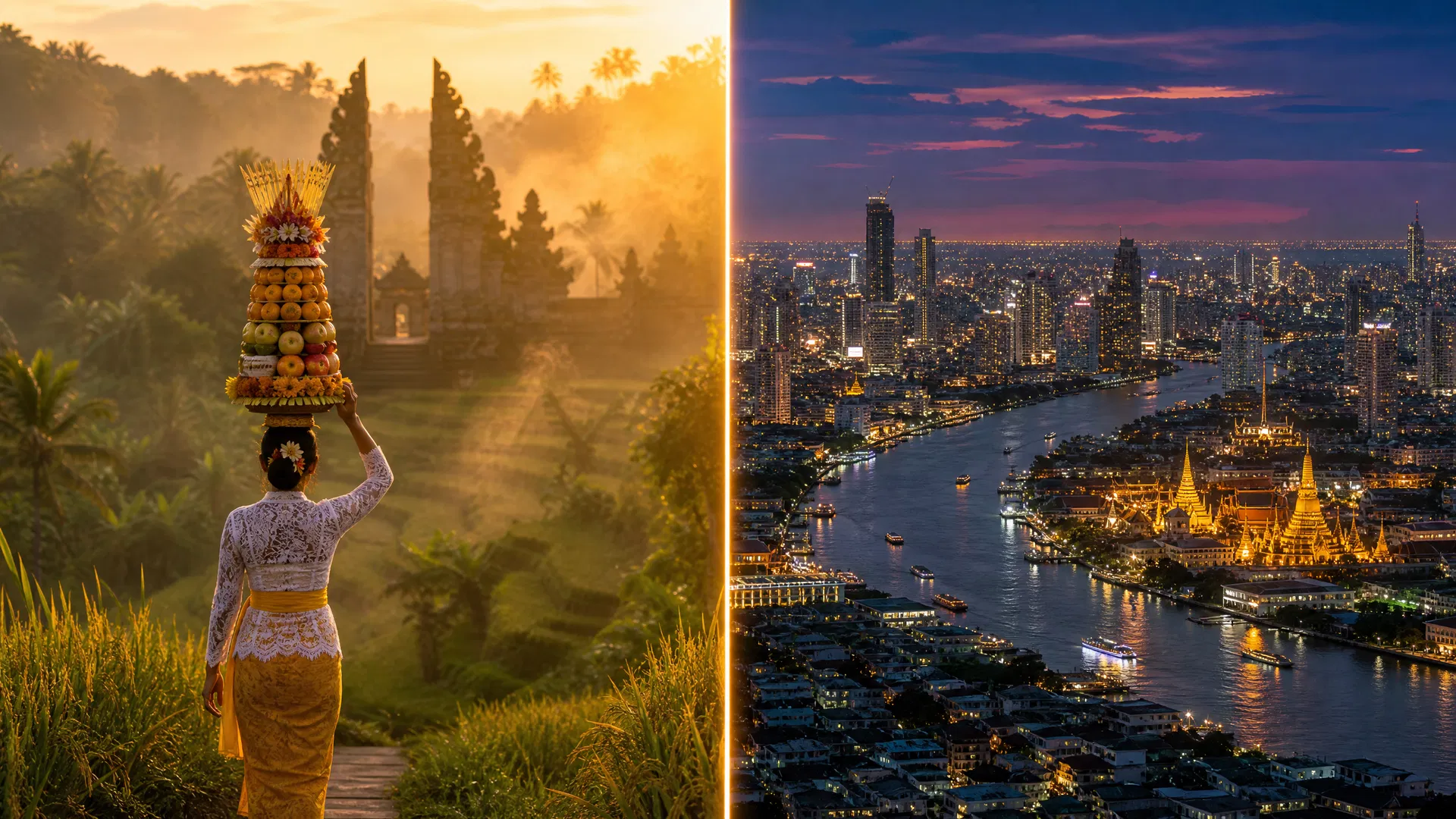
Bali Transforms You. Thailand Expands You. That's the Entire Difference.
Destination: Bali & Thailand
Category: comparison
The debate has been running for years on travel forums, in hostel common rooms, in the group chats of people who've been to one and are planning the other. Bali or Thailand? Which is better? Which should you go to first? The question is almost always framed as a competition — a ranking exercise, a pros-and-cons spreadsheet, a checklist of beaches and costs and things to do per square kilometer. That framing misses the point entirely.
Both destinations are extraordinary. That much is settled. But they are extraordinary in fundamentally different ways — ways that have nothing to do with which has better sand or cheaper street food. The real difference is what each place does to you. Bali operates on a single, coherent frequency. It is an island with a philosophy — a 5,780-square-kilometer argument about how human beings should relate to the divine, to each other, and to the natural world. Spend enough time there and the island starts to reorganize you from the inside. Thailand, by contrast, is not one thing. It is a country of 77 provinces, four distinct culinary traditions, mountain cities and island archipelagos and a capital that operates like a civilization unto itself. Thailand doesn't change you — it multiplies you. It shows you more versions of what travel can be than most people encounter in a decade of trips.
This is the thesis: Bali transforms you. Thailand expands you. Neither is better. They are different instruments, and the one you need depends entirely on what you're trying to do.
The comparison posts that dominate search results will tell you Thailand is bigger, Bali is more compact, Thailand has better beaches, Bali has better villas. All of that is true and none of it is the point. This post is about the six dimensions that actually determine which destination is right for you — and the honest answer about who should skip one of them entirely.
The Philosophy Dimension: One Island's Argument vs. a Country's Multiplicity
Every destination has a culture. Bali has a cosmology.
The Balinese Hindu tradition — distinct from mainland Hinduism in ways that took centuries of isolation and syncretism to produce — is not a backdrop to the island's tourism. It is the island's operating system. The philosophy at its center is Tri Hita Karana: three causes of well-being, three relationships that must remain in balance. Harmony between humans and the divine (parahyangan). Harmony between humans and each other (pawongan). Harmony between humans and the natural world (palemahan). This is not a slogan on a wellness retreat brochure. It is the framework that determines when rice fields are planted, how temples are oriented, why offerings appear on every doorstep every morning, and why the Subak irrigation system — a 9th-century network of water temples and cooperative farming arrangements — was inscribed as a UNESCO World Heritage Site in 2012. The Subak is not merely an engineering achievement. It is Tri Hita Karana made physical: a system in which water flows from the temple at the top of the mountain to the fields below, and the farmers who share that water are bound to each other by the same spiritual obligations that bind them to the water itself.
When you spend time in Bali, you are not visiting a culture. You are being immersed in a living argument about what a good life looks like. The daily canang sari offerings — small palm-leaf baskets filled with flowers, incense, and food — are not decorative. They are acts of maintenance. The Balinese believe the world requires constant tending, constant gratitude, constant acknowledgment of the forces that make life possible. Nyepi, the Balinese Day of Silence, takes this to its logical extreme: once a year, the entire island goes dark. No lights, no movement, no noise, no flights in or out. The airport closes. The streets empty. The island breathes. Travelers who happen to be in Bali on Nyepi describe it as one of the most disorienting and profound experiences of their lives — not because of anything they did, but because of what the island refused to do.
This is what people mean when they say Bali transformed them. They don't mean they took a yoga class or got a massage, though both are available in abundance. They mean the island's insistence on a different relationship between the human and the sacred started to feel, after a few days, like a correction. Like something they'd been missing without knowing it.
Thailand offers no equivalent singular philosophy. What it offers instead is range. Buddhism is the dominant tradition — 95% of the population identifies as Theravada Buddhist — but the expression of that tradition varies enormously between a gilded Bangkok temple complex and a forest monastery in Chiang Rai where monks practice strict asceticism in the hills. The Muslim communities of the deep south, the animist hill tribes of the northern mountains, the Peranakan Chinese culture of Phuket's Old Town — Thailand contains multitudes in a way that Bali, by design, does not. Bali's coherence is its power. Thailand's diversity is its power. They are not competing. They are different.
The Spirituality Dimension: Ceremony Access vs. Temple Variety
The practical expression of Bali's philosophy is that you will encounter ceremony constantly, and if you approach it correctly, you will be welcomed into it.
Balinese Hinduism is not a private religion. The ceremonies — odalan temple anniversaries, melasti purification rituals, cremation processions, tooth-filing rites — happen in public, in the streets, in the rice fields, in the courtyards of temples that have been standing for eight centuries. A traveler who spends two weeks in Bali and pays attention will witness more active religious life than in almost any other destination on earth. The key phrase is "pays attention." Bali rewards the traveler who slows down, who asks questions, who accepts the sarong at the temple gate and sits quietly at the edge of a ceremony rather than photographing it from a distance. The Bali 7-day couples guide builds in specific time for this — not as a tourist activity but as a way of understanding what the island is actually doing when it isn't performing for you.
The temple circuit that most visitors follow — Tanah Lot, Uluwatu, Besakih — is real and worth doing. But the competitive gap is in the village temples, the banjar community halls, the rice field shrines that have no entry fee and no tour group. These are the places where Bali's spiritual life is not a performance. The Pura Tirta Empul holy spring temple in Tampaksiring, where Balinese Hindus come for ritual purification, is one of the few places where visitors can participate directly — wading into the spring pools alongside worshippers, receiving the blessing of the holy water. It is one of the most affecting experiences available in Southeast Asia, and it costs nothing.
Thailand's spiritual landscape is different in character. The temple density is extraordinary — Bangkok alone has over 400 wats — and the variety ranges from the tourist-saturated grandeur of Wat Phra Kaew to the serene mountain monasteries of Chiang Mai's surrounding hills. A well-planned Bangkok temple circuit avoids the worst of the crowds while covering the essential architecture. But Thai Buddhism, as experienced by most visitors, is more observational than participatory. You watch the monks collect alms at dawn. You remove your shoes and sit quietly in the prayer hall. You make a donation and light incense. The experience is moving and beautiful. It is not the same as being inside a living ceremony.
Where Thailand's spiritual dimension genuinely surprises travelers is in the north. The Chiang Mai 5-day solo guide maps the forest monastery circuit in the hills above the city — places like Wat Pha Lat, tucked into a jungle ravine on the way to Doi Suthep, where the path is lined with moss-covered nagas and the monks have been there long enough that the forest has grown around them. This is a different kind of spiritual encounter than Bali's: quieter, more austere, less cosmologically dense. Both are genuine. Neither is a substitute for the other.
The Food Dimension: A Single Island's Cuisine vs. Four Regional Traditions
Balinese food is one of the most misunderstood cuisines in Southeast Asia, and the misunderstanding runs in both directions.
The first misunderstanding is that Bali has great food. It does — but not the food most tourists eat. The resort-adjacent restaurants serving generic "Asian fusion" and the Canggu cafes offering smoothie bowls and avocado toast are real, they are popular, and they have almost nothing to do with Balinese cooking. The second misunderstanding is that Balinese food is just Indonesian food. It is not. Bali's Hindu tradition means pork is not only permitted but central — a fact that distinguishes Balinese cooking from the Muslim-majority Indonesian archipelago around it.
Babi guling — spit-roasted suckling pig rubbed with a spice paste of turmeric, galangal, lemongrass, shrimp paste, and chili — is the dish that defines the island's cuisine. The best versions are found not at tourist restaurants but at the family warungs that have been roasting pigs since before dawn, serving the meat with rice, lawar (a salad of minced meat, vegetables, and grated coconut dressed with fresh blood and spices), and crispy skin that shatters when you bite it. Ibu Oka in Ubud is the famous name, but the Bali 7-day food guide covers the less-photographed warungs in Gianyar and Klungkung where the same dish costs a third of the price and tastes better. Bebek betutu — slow-cooked duck wrapped in banana leaves and buried in smoldering rice husks for up to 24 hours — is the other essential. The result is meat so tender it falls from the bone, infused with a spice paste that has been cooking into it for a day. This is not fast food. It is a dish that requires planning, patience, and a willingness to eat at a warung where the menu is written on a chalkboard and the plastic chairs are the only furniture.
Thailand's food argument is different and, in terms of sheer variety, impossible to beat. The four regional traditions — northern, northeastern (Isan), central, and southern — are so distinct that experienced food travelers treat them as separate cuisines. Northern Thai food, centered on Chiang Mai, is built around khao soi (a coconut curry noodle soup with crispy fried noodles on top), sai oua (herbal pork sausage), and larb (minced meat salad with toasted rice powder and fresh herbs). The Chiang Mai 4-day food guide covers the specific markets and restaurants where these dishes are made correctly — not the tourist-facing versions but the ones the city actually eats. Isan food, from the northeast, is the cuisine that has colonized Bangkok's street food scene: som tam (green papaya salad pounded in a mortar), gai yang (grilled chicken), sticky rice eaten with your hands. Southern Thai food is the most aggressive — coconut-heavy curries with a heat level that is not performative, fresh seafood cooked simply, khao yam (rice salad with dried shrimp and toasted coconut). The Bangkok 4-day food guide maps the neighborhoods where each regional tradition has its strongest representation in the capital.
The honest comparison: Bali offers a single, coherent, deeply specific cuisine that rewards the traveler who seeks it out. Thailand offers four cuisines, each of which could sustain a dedicated food trip on its own. If you are going for food specifically, Thailand is the more expansive choice. If you want to understand what one island eats and why, Bali is the more profound one.
The Accommodation Dimension: Private Villas vs. Every Category Imaginable
Bali invented the private villa as a travel category, and it has never been surpassed.
The specific product Bali pioneered — a walled compound with a private pool, an open-air living pavilion, a bedroom that opens directly onto a garden, staff who appear when needed and disappear when not — is available at price points that would be impossible in comparable destinations. The Bali 7-day honeymoon guide covers the villa regions: Seminyak and Canggu for the beach-adjacent villas with sunset views, Ubud for the jungle villas where you fall asleep to the sound of the river below and wake up to mist in the rice fields. A private villa with a pool in Ubud can be had for $150–200 per night. The equivalent in Tuscany or the Maldives would cost ten times that.
The villa culture shapes the entire Bali experience in ways that go beyond accommodation. Because most travelers are based in private compounds rather than hotels, the social dynamics are different. You are not in a lobby, not at a pool bar, not in a buffet line. You are in a space that feels like your own, staffed by people who know your name. This creates a particular kind of intimacy with the destination — a sense that you are living in Bali rather than visiting it. The Bali 10-day relaxation and culture itinerary is designed around this premise: that the accommodation is not where you sleep between activities but where the experience actually happens.
Thailand's accommodation range is simply broader. Bangkok has luxury hotels that rank among the finest in Asia — the Mandarin Oriental, the Peninsula, the Capella — at prices that are high by Thai standards but competitive globally. The islands offer everything from backpacker bungalows at $15 a night on Koh Tao to overwater villas on Koh Samui that rival the Maldives. Chiang Mai has a category of boutique guesthouses — converted teak houses in the Old City, small hotels in the hills above the moat — that represent some of the best value in Southeast Asia. The Chiang Mai 5-day couples guide covers the specific properties in the old city that combine authentic architecture with modern comfort. Koh Samui's quieter northern coast has beach villas that rival anything in the south, away from the resort strip.
The honest comparison: if you want a private villa with a pool, Bali wins on value and atmosphere. If you want to move between radically different accommodation styles — city luxury hotel, island bungalow, mountain guesthouse — Thailand wins on range.
The Practical Decision Framework: Who Should Go Where
This is the section most comparison posts skip, because it requires making an actual argument rather than listing pros and cons and leaving the decision to the reader.
Go to Bali if: You want a single destination that rewards depth over breadth. You are interested in a living culture that will actively challenge your assumptions about how to spend time. You want the private villa experience at a price point that makes it accessible rather than aspirational. You are happy to stay in one place for a week or more and let the island come to you. You are in a phase of life where you want to slow down, not speed up. The Bali 5-day solo guide is the right starting point for first-timers who want to understand the island rather than just see it.
Go to Thailand if: You want to cover ground. You want to experience the contrast between a capital city that operates at a different scale than anywhere else in Southeast Asia, a mountain cultural capital, and a tropical island in a single trip. You are traveling with people who have different interests — one person wants temples, one wants beaches, one wants street food markets — and you need a destination that can satisfy all of them simultaneously. You want the option to move quickly or slowly depending on how you feel. The Bangkok 5-day itinerary followed by a week in Chiang Mai followed by a week on the Koh Phi Phi islands is a three-destination trip that covers more experiential ground than most people manage in a year of travel.
The honest exclusion: If you are going for two weeks and you want to do both, you will do neither justice. Two weeks in Bali is enough to understand it. Two weeks in Thailand is enough to scratch the surface of one region. Trying to split the time — a week in each — produces a trip that is neither here nor there. The Bali-Thailand combination trip is a real thing, and it can work, but it requires either three weeks minimum or a clear decision about which destination is the main event and which is the add-on.
Who should skip Bali: Travelers who need constant novelty and get restless in one place. Travelers who are not interested in engaging with religious and cultural context. Travelers who want the most beach options per day of trip. Travelers who are going for two weeks and want to cover as much ground as possible.
Who should skip Thailand (for now): Travelers who are overwhelmed by choice and do better with a focused, coherent experience. Travelers who are specifically seeking a spiritual or wellness reset and want the environment to support that intention. Travelers who want the private villa experience as the centerpiece of the trip.
The Planning Dimension: One Base vs. Multi-City Logistics
The logistical difference between Bali and Thailand is significant enough to shape the entire experience.
Bali is a single island of 5,780 square kilometers. The main tourist areas — Seminyak and Canggu in the south, Ubud in the center, Amed and Candidasa in the east, Lovina in the north — are all reachable by car in two to three hours from any starting point. This means you can base yourself in one place and do day trips, or you can move every two to three days and cover the entire island in a week. The Bali 5-day adventure guide is built around this logic: a single Ubud base with day trips to the volcano, the rice terraces, the east coast temples, and the surf beaches of the south. The traffic in the south of the island — particularly around Kuta and Seminyak — is genuinely bad, and the roads are narrow. But the distances are short enough that even a slow journey is rarely more than 90 minutes.
Thailand requires a different planning approach. Bangkok, Chiang Mai, and the southern islands are not day-trip distances from each other. Bangkok to Chiang Mai is a one-hour flight or a 12-hour overnight train. Chiang Mai to Phuket is a two-hour flight. The islands themselves require ferries and speedboats. This is not a problem — Thailand's domestic transport network is excellent, and the overnight train from Bangkok to Chiang Mai is one of the great rail journeys in Southeast Asia — but it means you need to plan your movements in advance and accept that each destination requires at least three to four days to justify the transit time. The Bangkok-to-Phuket combination is one of Thailand's most reliable two-destination structures — the domestic flight is the pivot point, and the contrast between the two destinations is total.
The practical implication: Bali is easier to plan and harder to do wrong. You can arrive without a fixed itinerary and figure it out as you go. Thailand rewards planning. The traveler who arrives in Bangkok without a clear sense of where they want to go next will spend two days making decisions that could have been made at home. Chiang Mai and the Koh Lanta-Koh Tao island corridor are the two Thailand add-ons that most consistently surprise travelers who thought they'd seen enough of Southeast Asia — but you have to build them into the trip before you leave.
The Closing Argument: What You're Actually Choosing
The question "Bali or Thailand?" is really a question about what kind of traveler you are right now, in this specific moment of your life.
Bali is a destination that asks something of you. It asks you to slow down. It asks you to notice the offerings on the ground before you step over them. It asks you to sit with the discomfort of being in a place where the relationship between the human and the sacred is not private or optional but woven into the fabric of daily life. Travelers who resist this — who want to be entertained rather than confronted — often find Bali disappointing. Travelers who accept it often find it the most affecting place they've ever been. The transformation is not metaphorical. Something actually shifts. The island has been doing this to visitors for long enough that it has its own vocabulary for it: taksu, the divine energy that animates a place or a person. Bali has it in abundance. You either feel it or you don't, and the feeling tends to arrive when you stop trying.
Thailand, by contrast, asks nothing of you except that you show up. It will meet you wherever you are — exhausted and needing a beach, curious and wanting temples, hungry and ready to eat your way through a market. It is the most accommodating major destination in Southeast Asia, not in the sense of being easy or unchallenging, but in the sense of being genuinely capable of giving every type of traveler exactly what they came for. The expansion it offers is real: travelers who have done Thailand once almost always go back, because the first trip reveals how much they missed. Bangkok alone could sustain a dozen visits. The islands are different enough from each other that island-hopping Thailand is a legitimate multi-year project.
The honest answer to "which is better" is that they are not in competition. They are two different arguments about what travel is for. Bali argues that travel is for transformation — for the experience of being in a place so coherent in its values that it reorganizes your own. Thailand argues that travel is for expansion — for the experience of a world so varied that it multiplies your sense of what is possible. Both arguments are correct. The only question is which one you need right now.
Most people, if they're honest with themselves, already know the answer before they finish reading this sentence.