Australia Has Been Here for 3.5 Billion Years. New Zealand Is Still Deciding What It Wants to Be.
Destination: Australia & New Zealand
Category: comparison
The question comes up constantly, and the standard answer is always the same: Australia for the Great Barrier Reef, Uluru, and Sydney. New Zealand for the fjords, the Lord of the Rings landscapes, and the Maori culture. Both answers are accurate. Both answers completely miss what makes this comparison genuinely difficult.
The real question is not which country has better specific attractions. It is which country you are ready for. And that depends on something most travel comparisons never ask: what is your relationship with geological time?
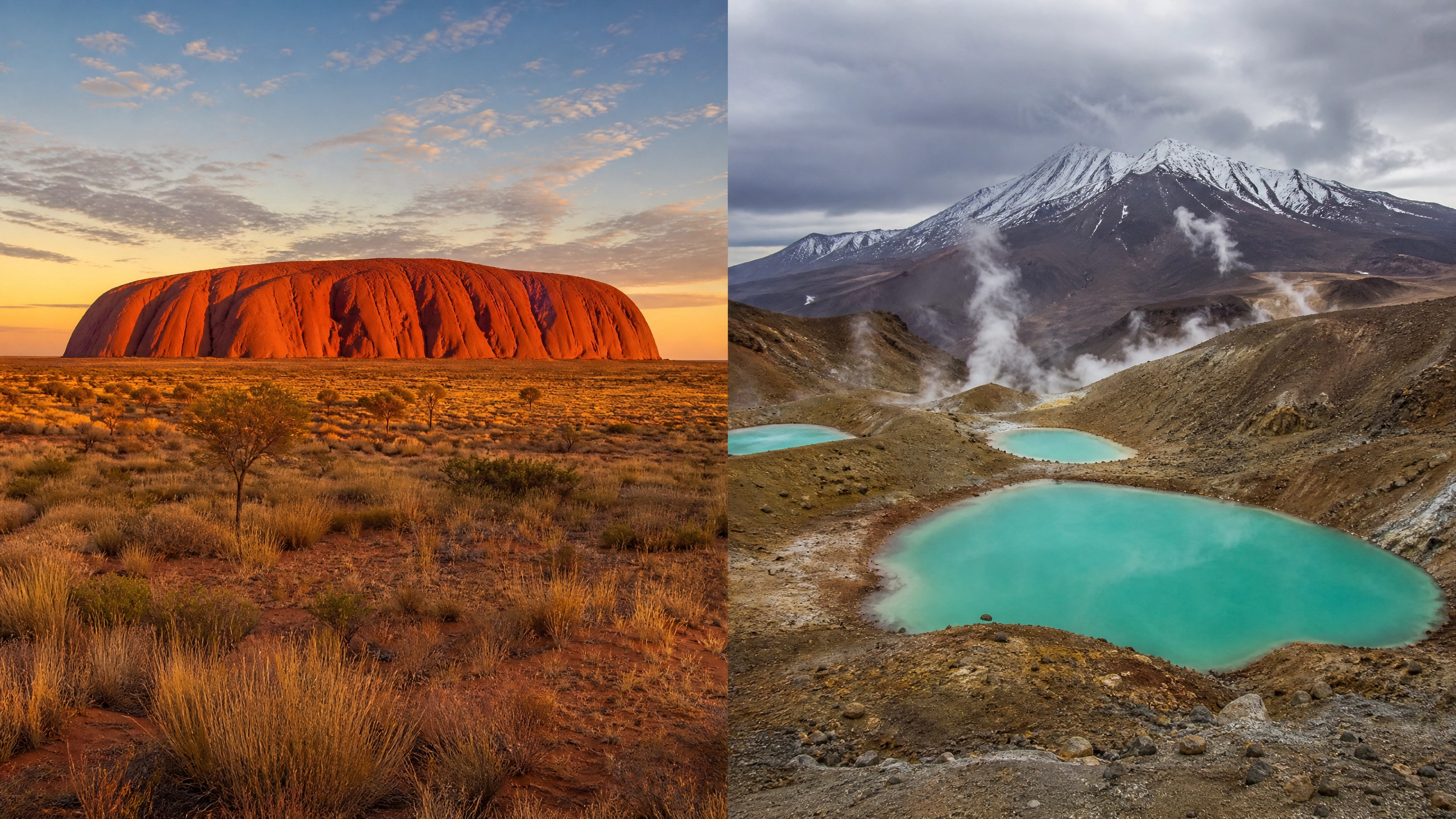
Australia is a continent that human civilization has been failing to fully comprehend for 60,000 years. The specific Pilbara region of Western Australia contains rock formations that are 3.5 billion years old — predating complex life on earth by two billion years. The landscape has been weathered and eroded for so long that Australia is now the flattest continent on earth. The red center, the ancient mountain ranges that were once the height of the Himalayas and have been ground down to gentle ridges over 350 million years, the desert that constitutes 70 percent of the continent — all of it is the specific consequence of incomprehensible age. Australia does not ask you to be impressed. It asks you to reckon with something that was here long before the conditions for your existence were established.
New Zealand is a landscape so young and so violent that the geological forces producing it are still visible in every direction. The Southern Alps are still rising at approximately ten millimeters per year. The volcanic plateau of the North Island produced the Taupo eruption 26,500 years ago — the most powerful volcanic eruption on earth in the last 70,000 years. The fjords of Fiordland were carved by glaciers that retreated only 10,000 years ago. New Zealand is not a finished landscape. It is a landscape in the process of becoming, and the traveler who arrives expecting a finished product will be disoriented in the best possible way.
That is the thesis. Australia incomprehends. New Zealand overwhelms. Australia humbles. New Zealand moves. Australia endures. New Zealand becomes. These are not equivalent experiences. They are not interchangeable nature destinations with different specific features. They are two fundamentally different arguments about what a landscape can do to a person.
Australia: The Landscape That Predates the Conditions for Your Existence
The single most important fact about Australia is that it is the oldest stable landmass on earth, and the specific consequence of that age is that the continent looks like nothing else on the planet.
The iron oxide that has been oxidizing in the Australian soil for billions of years produces the specific red that makes the outback look like a different planet — the same iron oxide chemistry that makes Mars red, present in the Australian earth because both surfaces have been exposed to oxygen for long enough. The specific Pilbara stromatolites at Shark Bay are living descendants of the organisms that produced the oxygen that made complex life on earth possible. Standing at Shark Bay is standing at the origin of the biological conditions that allowed every subsequent living thing — including the visitor — to exist. No travel guide adequately prepares you for what that means.
The specific consequence of Australia's geological age is not just visual. It is structural. The ancient mountain ranges of the Flinders Ranges in South Australia were once the height of the Himalayas and have been eroded over 350 million years to gentle ridges that glow red and ochre in the late afternoon light. The specific aridity of the continent — 70 percent desert — is not a failure of the landscape but the direct result of its age: a continent that has been weathered for so long that the soil has lost the specific nutrients that support dense vegetation. The Australian interior is not empty. It is the most specific expression of what happens to a landscape when it has been exposed to geological time for long enough to become something that no other continent has become.
The specific consequence of Australia's separation from Gondwana approximately 45 million years ago is the wildlife. Placental mammals replaced marsupials everywhere else on earth. In Australia, they never arrived. The platypus — a venomous egg-laying mammal with a duck bill, a beaver tail, and electroreception hunting — should not exist according to any reasonable evolutionary framework. It exists because Australia had 45 million years to produce things that nothing else on earth would have produced. The Great Barrier Reef snorkeling and dive guide covers the reef's specific marine biodiversity, but the reef is one expression of a broader pattern: Australia's isolation produced ecosystems that operate by different rules. The platypus alone — a venomous egg-laying mammal with a duck bill, a beaver tail, and electroreception hunting — should not exist according to any reasonable evolutionary framework. The specific Eungella National Park in Queensland is the most reliable location for platypus viewing, at dawn and dusk when they surface to feed, and the specific reason most visitors never see one is that platypus are acutely sensitive to human presence. The cassowary of the Daintree Rainforest — the most dangerous bird on earth, capable of disemboweling a human with its casque-helmeted head and dagger-shaped inner claw — is most reliably encountered in the Mission Beach area of Queensland. These are not zoo animals. They are the specific products of 45 million years of isolated evolution, and encountering them in their specific habitats is the most specific available argument for why Australia's wildlife is unlike anything else on earth.
The specific planning reality that every competitor comparison gets wrong: Australia is the sixth largest country on earth, and the flying distance from Sydney to Perth is the same as London to Tehran. The traveler who plans Sydney, the Great Barrier Reef, Uluru, and the Kimberley in two weeks will spend that trip in airports. The correct approach is regional depth. The Uluru and Red Centre guide covers three days in the red center — and three days in the red center, done properly, will change your understanding of what a landscape can be. The Tasmania road trip guide covers the island that is simultaneously Australia's most underrated destination and its most specific argument for regional commitment: a landscape that requires a week to begin to understand and rewards every day of that week.
The Aboriginal Australian culture that developed across this landscape is the oldest continuous human culture on earth — 60,000 years of unbroken occupation, which means 60,000 years of accumulated relationship with a specific geography. The Dreamtime narratives are simultaneously spiritual maps, navigational systems, and cultural archives of a continent. The specific rock art of Kakadu documents megafauna that inhabited Australia before the arrival of humans — a 20,000-year-old visual record of a world that no longer exists. The specific 2019 closure of the Uluru climb, after decades of the Anangu traditional owners requesting that tourists not climb their most sacred site, changed the relationship between visitors and the place in ways that are still being understood. The most significant aspects of Aboriginal culture are not available for tourist consumption. What is available rewards the traveler who arrives with preparation and humility.
New Zealand: The Landscape That Is Still Becoming
Where Australia asks you to comprehend something incomprehensibly old, New Zealand asks you to comprehend something incomprehensibly young — and the specific difference is that New Zealand's youth is visible and physical in ways that Australia's age is not.
The Southern Alps were pushed up by the collision of the Australian and Pacific tectonic plates beginning approximately 25 million years ago. They are still rising. The specific consequence of this ongoing geological violence is that New Zealand contains the most dramatic and most vertically varied landscape available in any comparable land area on earth. The New Zealand South Island road trip guide covers the specific driving circuit that takes you from subtropical coast to temperate rainforest to alpine glaciers to fjords in five days — a compression of landscape variety that exists nowhere else on earth at this scale.
The Tongariro Alpine Crossing on the North Island is the most specific available argument for New Zealand's geological youth. The Emerald Lakes — whose specific turquoise color is produced by minerals leached from volcanic rock by acidic water — sit in a landscape that looks like the earth's surface before it finished deciding what it wanted to be. Mount Ngauruhoe, used as the filming location for Mount Doom in the Lord of the Rings films, is a genuinely active stratovolcano that last erupted in 1975. The New Zealand North Island itinerary covers the volcanic plateau in detail, but the specific thing to understand before you go is that the landscape is not a backdrop. It is an argument.
The Franz Josef Glacier on the South Island's West Coast descends from the Southern Alps through temperate rainforest to within 300 meters of sea level — a combination that exists nowhere else on earth. Glaciers typically exist at altitude, above the treeline, in cold and barren environments. Franz Josef exists at the intersection of the specific rainfall produced by the specific Tasman Sea weather systems and the specific altitude of the specific Southern Alps, and the result is a glacier surrounded by ferns and nikau palms. The specific reason Franz Josef is retreating — approximately 70 meters per year over the last decade — is the same reason it is extraordinary: New Zealand's climate is not stable, because New Zealand's geology is not stable. The country is still deciding what it wants to be, and the glaciers are one of the most visible expressions of that ongoing negotiation.
New Zealand's wildlife is the most dramatic available consequence of the most specific isolation. The islands separated from Gondwana approximately 80 million years ago before the arrival of any land mammals, and therefore evolved an entirely bird-dominated ecosystem with no terrestrial predators. The kiwi has the bone density of a mammal and the gestation period of a mammal because evolution filled the mammal niche with a bird. The kakapo — the world's heaviest parrot, flightless and nocturnal — exists because New Zealand had 80 million years to produce things that no predator pressure would have allowed anywhere else. The introduction of rats, stoats, and possums by European settlers in the 19th century was catastrophic in ways that are still being reversed, and the specific conservation effort underway in New Zealand — the predator-free island sanctuaries, the kakapo recovery program, the kiwi breeding centers — is the most ambitious available attempt to undo the specific damage that introduced predators do to an ecosystem that evolved without any.
The Maori culture that arrived in New Zealand approximately 700 years ago is the most accessible and most integrated indigenous culture available in any major travel destination. The Treaty of Waitangi, signed in 1840, is still the constitutional foundation of New Zealand's government. Te reo Maori has been an official language since 1987 and appears on every road sign and government document. The haka is performed not as a tourist attraction but as a genuine expression of identity at sporting events and official ceremonies. The specific Maori cultural engagement available in Rotorua — the geothermal landscape that is simultaneously a geological phenomenon and a Maori cultural landscape, the hangi earth oven, the Te Puia cultural center — is the most specific available introduction to a culture that is still actively negotiating its relationship with the landscape it arrived in 700 years ago. The Queenstown adventure guide covers the South Island's most dramatic base, but the North Island's cultural depth is the part of New Zealand that most travelers underweight.
The Scale Question: What Each Country's Size Actually Means
The most common avoidable mistake in international travel planning is the multi-city Australian itinerary. Sydney, Melbourne, Cairns, and Uluru in two weeks is not an Australian trip. It is a series of airport experiences with brief intervals of looking at things from a distance.
The specific flying distances that make this mistake so consequential: Sydney to Cairns is the same distance as London to Moscow. Melbourne to Perth is the same distance as London to Istanbul. The traveler who builds an itinerary without understanding these distances will spend their trip in Qantas lounges and arrive home having seen Australia from 35,000 feet. The correct planning framework is not "what do I want to see in Australia" but "which part of Australia am I willing to commit to" — because the commitment is what the continent rewards. The traveler who spends two weeks in the Northern Territory — Darwin, Kakadu, and the red center — will understand something about Australia that the traveler who spent two weeks in four cities will not. The traveler who spends two weeks in Western Australia — Perth, Margaret River, and the Kimberley — will understand something different and equally irreplaceable.
Australia rewards the traveler who chooses one region and goes deep. The Great Ocean Road road trip guide covers three days of Victoria's coastline — three days that reveal more about what Australia is than a two-week multi-city sprint. The Perth adventure guide covers Western Australia's capital and its specific access to the Margaret River wine region and the Pinnacles Desert — a combination of landscape and food culture that most international visitors never reach because they have already committed to the east coast. The Kimberley region of northwestern Australia is the size of Germany with the population of a small town. The Bungle Bungle Range is one of the most dramatic landscapes in Australia and is visited by fewer international tourists per year than the single-day visitor count at the Sydney Opera House. It requires flying to Broome and driving 300 kilometers to access. That commitment is exactly the point.
New Zealand is the opposite argument. The New Zealand 14-day road trip guide covers the entire South Island in two weeks — a circuit that is genuinely achievable because the country is approximately the size of the United Kingdom but contains the landscape variety of a continent. State Highway 6 connects Queenstown to Franz Josef Glacier to Abel Tasman National Park in a single continuous road journey. The Great Walks system — nine multi-day hiking routes with the most accessible backcountry infrastructure available in any country — makes the most remote landscapes reachable without specialist equipment. The Milford Track requires booking six months in advance. The Kepler Track provides comparable landscape without the booking difficulty. New Zealand is the only country where you can drive from subtropical beaches to temperate rainforest to alpine glaciers to fjords in five days without flying. That compression is the specific New Zealand argument.
The Food and Culture: What Each Country Has Made of Itself
Australian food culture is the most underestimated in any major travel destination, and the specific reason is that it is the product of the most specific multicultural immigration history available in any comparable country.
The Vietnamese community of Cabramatta in western Sydney — established during the 1975–1985 refugee wave — produces banh mi and pho that many Vietnamese food writers consider superior to what is available in Vietnam, because the specific Australian ingredient quality is higher. The Italian community of Carlton in Melbourne has maintained the specific Italian coffee culture that makes Melbourne's café scene the most seriously coffee-obsessed available outside Italy. Pellegrini's Espresso Bar on Bourke Street has been serving the short black in its original 1950s interior since 1954. The flat white was invented in Melbourne, despite the competing claims from Auckland. The Melbourne food guide covers the specific neighborhoods and specific cafés that make Melbourne's food culture worth a dedicated trip.
The indigenous food renaissance is the most specific current development in Australian cuisine: Kakadu plum, which has the highest Vitamin C content of any food on earth, finger lime, and wattleseed are being incorporated into contemporary Australian fine dining in ways that connect the oldest continuous human culture on earth to the newest expression of Australian food identity.
New Zealand food culture is the most specifically place-expressive available in any small country. The lamb has been New Zealand's primary agricultural export for 150 years and is the specific result of the specific pasture quality produced by volcanic soil and temperate rainfall — grass-fed lamb as a direct expression of a specific terroir. The Marlborough Sauvignon Blanc defined the international understanding of that grape variety after the specific 1985 vintage changed the global wine market. The cellar door culture of the Wairau Valley during the February to April harvest season allows visitors to taste Sauvignon Blanc at a stage of fermentation that no exported bottle can replicate. The Auckland food guide covers the specific fish markets and the specific Pacific Islander food culture that makes Auckland's dining scene the most genuinely multicultural available in the Pacific. The Central Otago Pinot Noir produced in the Queenstown hinterland — grown at the southernmost commercial wine latitude on earth, in a continental climate that produces the most specific combination of heat and cold available in any New Zealand wine region — is the most specific available expression of New Zealand's terroir in a glass. The hangi earth oven, the rewena paraoa fermented potato bread, and the huhu grub are the most specific available introduction to the pre-European Maori relationship with the New Zealand bush — a food culture that is 700 years old and still actively practiced.
The Honest Answer: Australia or New Zealand?
Australia is right for you if you want to encounter something genuinely incomprehensible — a landscape so ancient and so vast that the correct relationship with it is humility rather than conquest. If you want to encounter the oldest continuous human culture on earth and to understand what 60,000 years of relationship with a specific landscape produces. If you want wildlife that should not exist according to any reasonable evolutionary framework. If you are willing to commit to regional depth rather than continental breadth and to discover that a single Australian region contains more specific landscape and cultural richness than most countries contain in their entirety.
New Zealand is right for you if you want to be physically overwhelmed by a landscape that is still becoming itself. If you want to drive from subtropical coast to alpine glacier in five days without flying and without running out of dramatic things to look at. If you want to encounter an indigenous culture that is more integrated into the national identity than any other available in a major travel destination. If you want the most managed and most accessible version of dramatic wilderness available — the Great Walks system, the Department of Conservation hut network, the road infrastructure that makes the most remote landscapes accessible without specialist equipment.
Both are right for you if you have five weeks. Fly into Sydney, spend two weeks in Australia choosing one region rather than attempting the continent, fly to Auckland, spend two weeks in New Zealand doing the South Island driving circuit. Come back understanding why these two countries are simultaneously the most similar and most different available in the same hemisphere.
The Christchurch itinerary covers the South Island's gateway city and its specific post-earthquake reinvention — a city that rebuilt itself after the 2011 earthquake with a specific combination of container architecture, public art, and botanical gardens that makes it the most specific available argument for what a city can become when it is forced to start over. When you are ready to plan, Leif can build the specific itinerary for the specific region you choose — whether that is three days in the red center or ten days on the South Island circuit.
Why Fiji and Tasmania Aren't in This Comparison
Fiji is the most common alternative to New Zealand for the Pacific island beach experience. It does not appear here because the New Zealand versus Australia comparison is between two countries with comprehensive travel infrastructures and geological arguments — not a resort island comparison. Fiji is an extraordinary destination. It is not evidence for this thesis.
Tasmania is the most underrated Australian destination and deserves its own dedicated coverage — the Tasmania road trip guide covers it properly. It appears in the Australia argument as evidence of the regional depth that the continent rewards rather than as a separate comparison destination. Tasmania's specific combination of temperate rainforest, dramatic coastline, and MONA — the Museum of Old and New Art, which is the most specific single argument for the proposition that Australia produces cultural institutions that cannot exist anywhere else — is the most specific available proof that going deep in one Australian region is always the right decision.
The Six Verbs
Australia incomprehends. New Zealand overwhelms.
Australia humbles. New Zealand moves.
Australia endures. New Zealand becomes.
These are not equivalent experiences. They are not interchangeable. They are two countries that make every other nature destination feel like a rehearsal — but for fundamentally different reasons, in fundamentally different directions, at fundamentally different scales of geological time.
The question was never which one is better. The question is which one you are ready for.
Explore Australia guides on AskLeif → | Explore New Zealand guides on AskLeif →