Austin, Texas: The City That Keeps Reinventing Itself — and Never Loses Its Soul
Destination: Austin, Texas
Category: Destination Guides
There is a bumper sticker you will see on every other car in Austin, Texas. It reads: Keep Austin Weird. It has been there since 2000, when a local bookstore owner named Red Wassenich coined the phrase to push back against the creeping homogenization of American cities. At the time, Austin was a mid-sized college town with a legendary music scene, a few beloved swimming holes, and an identity built around being the anti-Dallas — the Texas city that didn't care about being the biggest or the richest, only the most alive.
That was twenty-five years ago. Since then, Austin has become one of the fastest-growing cities in the United States. Tesla built its headquarters here. Oracle moved its corporate offices here. Dell, Apple, Google, and Amazon have all planted flags. The population has more than doubled. The real estate market has gone from "affordable" to "San Francisco prices, Texas heat." The traffic on I-35 is now genuinely apocalyptic.
And yet — somehow, improbably, stubbornly — Austin is still weird. The music is still there, louder and stranger than ever. The swimming holes are still cold and green and packed with locals on a Tuesday afternoon. The food trucks still line up on South Congress and East 6th and South Lamar, serving breakfast tacos at 7am and smoked brisket at midnight. The city has grown up, but it hasn't grown out of itself.
This is the thing about Austin that surprises first-time visitors more than anything else: it is simultaneously one of the most hyped cities in America and one of the most genuinely, authentically itself. It has absorbed an enormous amount of outside money and outside people and somehow metabolized them into something that still feels like Austin. That is a rare and remarkable thing. And it is the reason that once you visit, you will spend the rest of your life telling people they need to go.
The Music: Why "Live Music Capital of the World" Is Not a Marketing Slogan
Austin's claim to the title of Live Music Capital of the World is not a Chamber of Commerce invention. It is a fact backed by density: on any given Friday night, there are more live music venues per capita in Austin than in Nashville, New York, or New Orleans. Sixth Street alone — the legendary strip that runs through downtown — has dozens of bars and clubs with live bands starting at 9pm and playing until 2am. On weekends, the street closes to traffic and becomes a pedestrian corridor of sound, where you can walk from a country honky-tonk to a blues bar to a psychedelic rock club to a jazz lounge in the space of three city blocks.
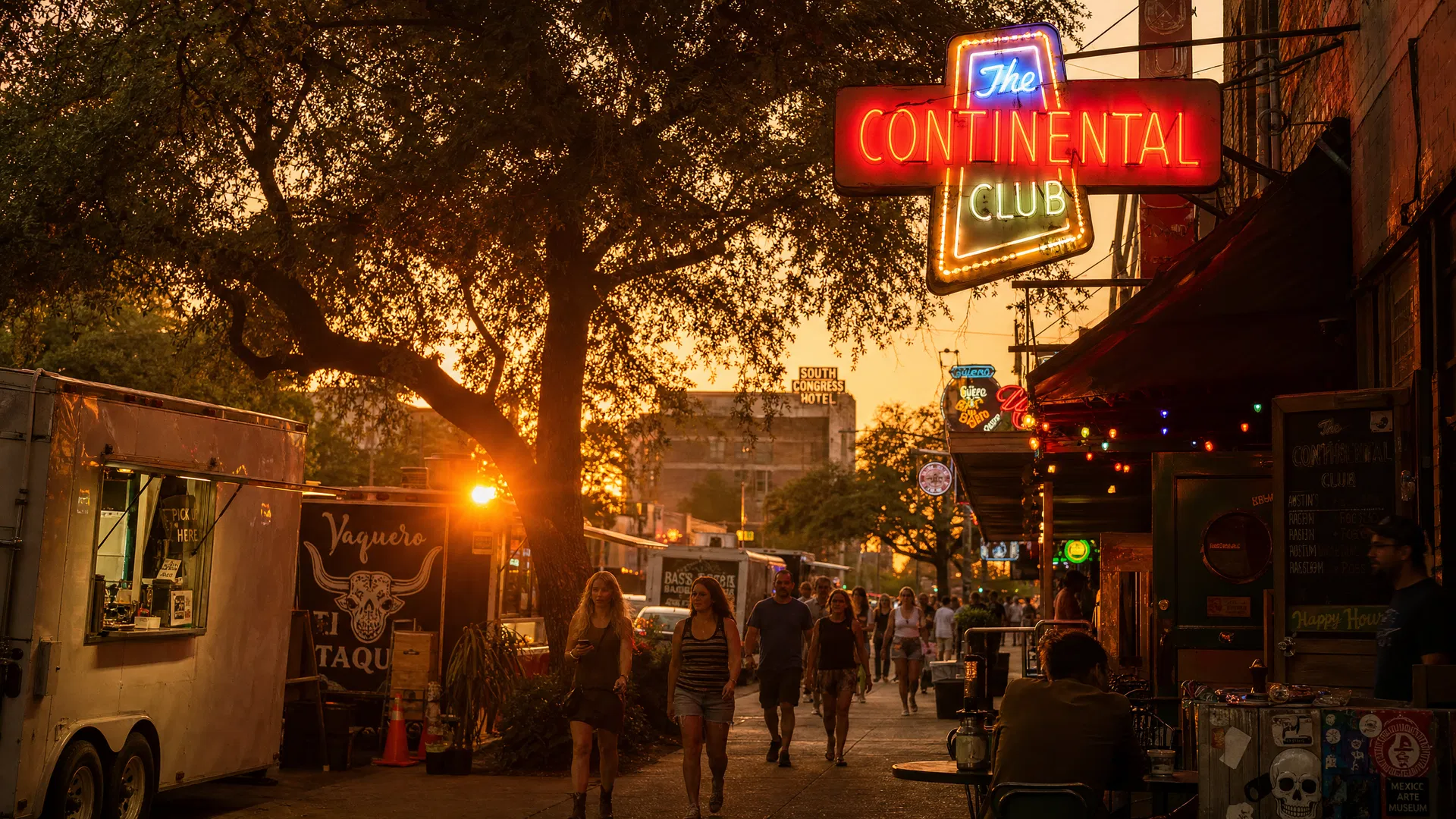
But Sixth Street is just the beginning. The real Austin music scene lives in the venues that locals actually go to: the Continental Club on South Congress, which has been hosting live music since 1957 and remains one of the finest small venues in the country. Stubb's Amphitheater, an outdoor stage built around a 19th-century limestone building, where you can watch a headlining act under the Texas stars with a Lone Star beer in your hand. The Saxon Pub on South Lamar, where the singer-songwriters who will be famous in five years are playing to crowds of forty people tonight. Emo's, which has been the anchor of Austin's alternative and punk scene for three decades.
The Austin City Limits Music Festival, held every October in Zilker Park, is one of the premier music festivals in the world — a three-weekend event that draws 75,000 people a day and has hosted everyone from Radiohead to Beyoncé to Willie Nelson. South by Southwest, held every March, is simultaneously a music festival, a film festival, and a technology conference, and it transforms the entire city into a venue for two weeks. If you can time your visit to either of these events, do it — but know that the city's music scene is extraordinary even on a random Tuesday in February.
For travelers who want to experience Austin's music culture at its most immersive — the late nights, the legendary venues, the crawl from Sixth Street to the East Side — our Austin Food, Music & Adventure Guide covers four days of the city's best beats and bites, from the Continental Club to the dive bars of East 6th to the rooftop bars of the Rainey Street Historic District.
The Food: Brisket, Tacos, and the Most Exciting Food Truck Scene in America
Austin's food culture is built on two pillars that could not be more different from each other, and the tension between them is what makes eating here so endlessly interesting.
The first pillar is barbecue. Texas barbecue is a religion, and Austin is its Vatican. Franklin Barbecue, on East 11th Street, has been called the best barbecue restaurant in the world by Bon Appétit, Texas Monthly, and the James Beard Foundation. Aaron Franklin's brisket — slow-smoked over post oak for 18 hours until the bark is black and the interior is a ribbon of pink smoke ring and rendered fat — is the standard against which all other brisket is measured. The line at Franklin starts forming at 7am for an 11am opening, and the restaurant sells out every single day. If you are serious about barbecue, you will wait in that line. It is worth every minute.
But Franklin is not alone. La Barbecue, Micklethwait Craft Meats, Leroy and Lewis, and Terry Black's all operate at a level that would be the best barbecue in almost any other city. Austin's barbecue scene is so deep that you could eat at a different legendary spot every day for a week and never repeat yourself.
The second pillar is tacos. Austin's taco culture is Mexican in origin but Texan in execution — a hybrid that has produced some of the most creative and satisfying breakfast tacos in the world. Veracruz All Natural, operating out of a trailer on East Cesar Chavez, makes a migas taco (scrambled eggs with crispy tortilla strips, jalapeño, tomato, and avocado) that has been called the best breakfast taco in Austin by virtually every food publication that has ever visited. Juan in a Million on East Cesar Chavez serves the Don Juan — a massive breakfast taco stuffed with potato, egg, cheese, and bacon — that has been a local institution since 1980. Tacodeli, with multiple locations, is the chain that Austin locals actually love rather than just tolerate.
Between the barbecue temples and the taco trailers, Austin has also developed one of the most exciting restaurant scenes in the country. Uchi, the Japanese-Texan fusion restaurant from chef Tyson Cole, has spawned a small empire and remains one of the most creative dining experiences in the South. Emmer & Rye, Lenoir, and Odd Duck have all earned national recognition for their farm-to-table approaches that take Texas ingredients seriously. The East Side has become a dining destination in its own right, with new restaurants opening monthly in converted bungalows and former warehouses.
And then there are the food trucks — hundreds of them, clustered in lots called "trailer parks" that have become social spaces as much as dining destinations. The Picnic on Barton Springs Road is a permanent food truck park with rotating vendors and picnic tables under live oak trees. South Congress has a strip of trailers that includes some of the most beloved spots in the city. East 6th Street has its own cluster. The food truck culture is so embedded in Austin's identity that even as the city has grown more expensive and more corporate, the trailers have remained — a democratic, accessible, genuinely local counterweight to the fine dining scene.
Travelers who want to eat their way through Austin properly — from the Franklin line to the Veracruz trailer to the best new restaurants on the East Side — should start with our Austin City & Culture 5-Day Itinerary, which builds the food scene into a comprehensive framework for experiencing the whole city.
The Outdoors: Swimming Holes, Greenbelt, and the Hill Country Beyond
One of the things that surprises visitors most about Austin is how thoroughly outdoor-oriented the city is. This is Texas, which most people associate with flat, hot, featureless terrain. But Austin sits on the Balcones Escarpment, the geological fault line where the flat coastal plains of East Texas meet the limestone hills of the Hill Country, and the result is a city threaded with creeks, springs, and green spaces that make outdoor life genuinely extraordinary.
Barton Springs Pool is the spiritual center of Austin's outdoor culture. A natural spring-fed swimming pool in Zilker Park, Barton Springs maintains a constant temperature of 68 degrees Fahrenheit year-round — cold enough to be refreshing in the brutal August heat, warm enough to swim in December. The pool is 900 feet long, surrounded by grass banks where Austinites sunbathe, read, and watch their dogs. It costs three dollars to get in. It is one of the great urban swimming experiences in the world.
The Barton Creek Greenbelt is a 12-mile trail system that runs through the limestone canyon carved by Barton Creek, connecting a series of swimming holes, cliff jumps, and rock scrambles. The Greenbelt is where Austin goes to escape — on a weekday morning, you can hike for an hour without seeing another person; on a Saturday afternoon in summer, it becomes a procession of locals with inner tubes and coolers. The swimming holes at Twin Falls, Sculpture Falls, and Campbell's Hole are cold, clear, and fed by springs that keep them running even in drought years.
Lady Bird Lake, the reservoir that runs through the heart of downtown, is the city's aquatic living room. Kayaks, paddleboards, and canoes can be rented from multiple outfitters along the shore. The 10-mile hike-and-bike trail that circles the lake is one of the most used urban trails in the country. At sunrise, the lake reflects the downtown skyline in a way that makes Austin look like a city that has figured out how to live with its natural environment rather than against it.
Beyond the city limits, the Texas Hill Country opens up into one of the most beautiful landscapes in the American South. Hamilton Pool Preserve, 30 miles west of Austin, is a collapsed grotto where a waterfall drops 50 feet into an emerald swimming hole surrounded by limestone overhangs draped in maidenhair fern. Enchanted Rock, 90 miles northwest, is a massive pink granite dome that rises 425 feet above the surrounding Hill Country — a sacred site for the Comanche and Tonkawa peoples, and one of the finest hikes in Texas. The Pedernales Falls State Park, the Guadalupe River, and the wine country around Fredericksburg are all within two hours of downtown.
For travelers who want to build their Austin trip around the outdoors — the Greenbelt, Hamilton Pool, Enchanted Rock, and the Colorado River — our Austin Outdoor Adventure Guide lays out four days of hiking, swimming, and kayaking that covers the best of both the city's natural spaces and the Hill Country beyond.
The Neighborhoods: Where Austin Actually Lives
South Congress (SoCo) is the neighborhood that most visitors discover first, and for good reason. The strip of South Congress Avenue between Oltorf and Riverside is lined with vintage clothing stores, independent boutiques, record shops, galleries, and some of the city's best restaurants and bars. The Hotel San José, a converted 1930s motor court, is one of the most stylish small hotels in the country. The Continental Club anchors the southern end of the strip. On weekend mornings, the sidewalks are full of people with coffee cups and dogs, and the whole neighborhood has the feeling of a city that has decided to take its time.
East 6th Street and the East Side have become Austin's most exciting neighborhood over the past decade. What was once a predominantly Latino working-class neighborhood has been transformed by an influx of bars, restaurants, coffee shops, and galleries — a transformation that has brought both energy and displacement, and that Austin is still reckoning with. The East Side is where you find the most creative restaurants, the most interesting bars, and the most authentic sense of what Austin is becoming. Whisler's, the cocktail bar on East 6th, is one of the best bars in Texas. The Violet Crown Social Club is a neighborhood bar that has somehow remained genuinely local despite being in the middle of the most gentrified stretch of the East Side.
Rainey Street is a single block of converted Victorian bungalows that has become one of the most popular bar districts in the city. Each bungalow is now a bar or restaurant, and the street has a front-porch, backyard-party energy that feels distinctly Austin — casual, friendly, unpretentious, with good drinks and live music spilling out onto the sidewalk. It is the kind of place where you go for one drink and stay for four.
The Domain is Austin's answer to the question of what happens when a tech city needs a luxury shopping and dining district. It is polished, expensive, and efficient — and it is where you will find the restaurants and hotels that cater to the corporate Austin that has grown up alongside the weird Austin. It is not the Austin that locals romanticize, but it is a real part of the city's identity now.
South Lamar connects SoCo to the Alamo Drafthouse Cinema (the beloved Austin-born movie theater chain that serves food and drinks during screenings), the Saxon Pub, and a string of restaurants and bars that feel like the neighborhood that Austin was before it became famous.
Austin for Every Type of Traveler
For couples: Austin is one of the most romantic cities in the American South, in the way that only a city with great food, great music, and great outdoor spaces can be. A weekend in Austin for couples means breakfast tacos at Veracruz, an afternoon at Barton Springs, dinner at Uchi, and a late night at the Continental Club. Our Austin Romantic Getaway Guide builds a three-day itinerary around the city's most intimate experiences — from sunrise kayaking on Lady Bird Lake to wine tasting in the Hill Country to the best rooftop bars for watching the sun go down over downtown.
For bachelor and bachelorette parties: Austin has become one of the premier bachelor and bachelorette party destinations in the country, and for good reason. The combination of great bars, live music, warm weather, and a genuinely festive culture makes it ideal for group celebrations. Our Austin Bachelor Party Weekend Guide covers three days of Sixth Street, BBQ, and nightlife, while our Austin Bachelorette Party Weekend Guide builds an itinerary around SoCo, rooftop bars, and the city's best brunch spots.
For families: Austin with kids is genuinely excellent. The Natural Science Center, the Austin Zoo, Barton Springs (kids love it), the Thinkery children's museum, and the sheer number of outdoor spaces make it one of the most family-friendly cities in Texas. Our Austin Family Vacation Guide covers four days of kid-friendly Austin — from the Barton Creek Greenbelt to the food trucks of South Congress to the nature centers of the Hill Country.
For budget travelers: Austin is more expensive than it used to be, but it is still possible to have an extraordinary visit without spending much money. Free live music is everywhere — the free stages at Stubb's, the outdoor venues on Sixth Street, the buskers on South Congress. Barton Springs costs three dollars. The Greenbelt is free. Breakfast tacos are still under five dollars at most trailers. Our Austin Budget Guide shows how to experience the best of the city for under $65 a day — free music, cheap tacos, and the neighborhoods locals love before Austin got expensive.
Practical Austin: When to Go, How to Get Around, What to Know
When to visit: March and April are the sweet spot — warm enough to swim, cool enough to be comfortable, and the city is alive with SXSW energy in March. October is also excellent, with the Austin City Limits Music Festival and temperatures that have finally dropped below 90 degrees. Avoid July and August if you can — the heat is genuinely brutal, with temperatures regularly exceeding 105 degrees and humidity that makes it feel worse. If you do visit in summer, build your days around early mornings and evenings, with a long afternoon at Barton Springs in between.
Getting around: Austin is a car city, and there is no getting around that. The public transit system is improving but remains limited. Rideshare is reliable and relatively affordable. If you are staying in the SoCo or East Side neighborhoods, you can walk or bike to a surprising amount — but the city is spread out enough that you will need a car or rideshare for anything beyond your immediate neighborhood.
Where to stay: The South Congress corridor (SoCo) puts you walking distance from the Continental Club, the best food trucks, and the most interesting shopping. The East Side puts you in the middle of the most exciting restaurant and bar scene. Downtown puts you close to Sixth Street and the convention center but feels less authentically Austin. For a splurge, the Hotel Saint Cecilia on Academy Drive is one of the finest boutique hotels in the country — a collection of bungalows and suites set in a lush garden, with a pool and a bar that feels like the Austin of the 1970s.
The heat: If you are visiting between May and September, take the heat seriously. Drink water constantly. Wear sunscreen. Plan outdoor activities for early morning or evening. The swimming holes are not just fun — they are essential infrastructure for surviving an Austin summer.
Why Austin Keeps Its Soul
The question that every Austin lover eventually has to answer is: can a city that has grown this fast, attracted this much money, and absorbed this many transplants still be itself? The honest answer is that it is a work in progress. The rents are too high. Some of the beloved old venues have closed. The traffic is a genuine quality-of-life problem. The displacement of longtime residents — particularly in the East Side's Latino community — is a real and ongoing harm.
But the music is still there. The swimming holes are still cold. The breakfast tacos are still extraordinary. The people who move to Austin — the musicians, the chefs, the outdoor enthusiasts, the weirdos of every description — still come because they want to be part of something that feels alive in a way that most American cities don't. And the city keeps producing new things worth loving: new restaurants, new venues, new neighborhoods, new reasons to stay.
Austin is not perfect. It is not trying to be. It is trying to be itself, which is a harder and more interesting project. And it is succeeding, improbably, in the face of everything that should have flattened it into just another Sun Belt boom town.
Keep Austin Weird is not just a bumper sticker. It is a civic commitment. And so far, against all odds, Austin is keeping it.
Ready to plan your Austin trip? Use our Austin City & Culture 5-Day Itinerary as your foundation, then layer in the Outdoor Adventure Guide for the Hill Country and swimming holes, the Food, Music & Adventure Guide for the best bites and beats, and the Budget Guide if you want to do it all without breaking the bank. Whether you're planning a romantic getaway, a family vacation, a bachelor party, or a bachelorette weekend, Austin has an itinerary waiting for you.