Every Other City Has a Civil Rights Story. Atlanta Has the Address.
Destination: Atlanta, Georgia, USA
Category: destination-guide
There is a house on Auburn Avenue in Atlanta, Georgia, that reopened to the public on July 4, 2026, after three years of restoration. It is a two-story Victorian home, painted yellow, with a front porch and a modest yard. Martin Luther King Jr. was born in that house on January 15, 1929. He lived there for the first twelve years of his life. His father preached at Ebenezer Baptist Church, four blocks away. His grandmother died in that house, and the shock of it was the first grief he ever knew.
Most American cities have a civil rights story. Atlanta has the address. It has the birth certificate, the church, the street, the neighborhood, the university where King studied, the organization he helped build, the grave where he was buried. The movement that changed the country did not merely pass through Atlanta. It was assembled here, piece by piece, by people who grew up on these streets and decided that the country they were living in was not the country they were going to accept.
Understanding this is not optional for understanding Atlanta. It is the foundation. Everything else — the Beltline, the food scene, the music, the neighborhoods, the way the city carries itself — sits on top of it. You can visit Atlanta and miss this entirely, spending your days at the Georgia Aquarium and Ponce City Market and the World of Coca-Cola, and you will have had a fine trip. But you will not have been to Atlanta. Not really. The city that exists today was made by what happened here, and what happened here was not incidental. It was the point.
Sweet Auburn and the World That Made the Movement
Auburn Avenue was once called "the richest Negro street in the world" by Fortune magazine. That was in 1956, and the description was both accurate and incomplete. Sweet Auburn — the neighborhood's informal name, used by everyone who lives there — was not just wealthy. It was a complete world. It had its own banks, its own newspapers, its own insurance companies, its own churches, its own professional class. It existed because it had to: segregation forced Black Atlanta to build parallel institutions, and what they built was extraordinary.
The Sweet Auburn Historic District runs roughly from Courtland Street to Randolph Street, a few blocks east of downtown. Walking it today, you pass the APEX Museum (African American Panoramic Experience), the historic Herndon Building, the Big Bethel AME Church, and then, on the south side of the street, the Martin Luther King Jr. National Historical Park — a collection of sites managed by the National Park Service that includes the Birth Home, Ebenezer Baptist Church, the King Center, and King's tomb.
The Birth Home tour, which resumed in July 2026 after a three-year restoration, is conducted in small groups of fifteen. Rangers lead visitors through the rooms where King grew up: the parlor, the kitchen, the bedrooms. The house has been restored to its 1930s appearance, and the effect is quietly devastating. This is not a monument. It is a house. A family lived here. The boy who would become the most important American of the twentieth century ate breakfast at that table and slept in that room and played in that yard. The ordinariness of it is the point.
Ebenezer Baptist Church, four blocks west, is where King's grandfather founded the congregation in 1886, where his father preached for decades, and where King himself was co-pastor when he was assassinated in 1968. The original church building, a red brick structure with white columns, still stands. Services are still held there. Sitting in a pew in Ebenezer Baptist Church is one of the most charged experiences available to a traveler in the United States — not because of what you are told, but because of what you feel.
The King Center, adjacent to the church, houses King's tomb alongside that of Coretta Scott King, set in a reflecting pool in an outdoor plaza. The center also contains an extensive archive and exhibit space. The National Center for Civil and Human Rights, a few blocks west in downtown Atlanta, provides broader context — its exhibits on the American civil rights movement and global human rights struggles are among the best museum experiences in the country. The lunch counter simulation, where visitors sit at a replica Woolworth's counter and experience a recorded version of what sit-in protesters endured, is not easily forgotten.
The Beltline: The City's Connective Tissue
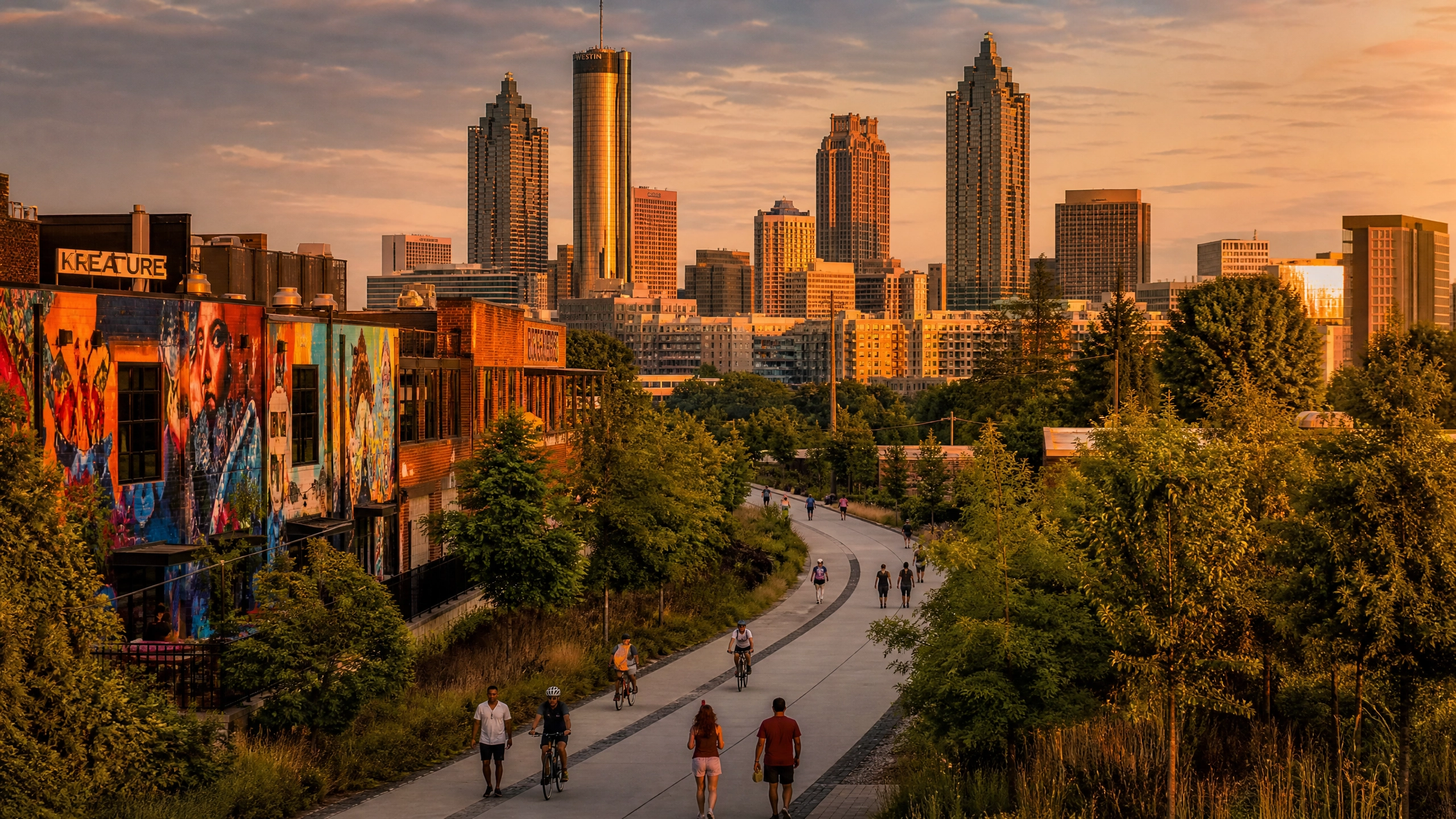
In 2001, a Georgia Tech graduate student named Ryan Gravel wrote a thesis proposing that Atlanta convert its 22 miles of abandoned railroad corridors into a network of trails, parks, and transit. The city eventually did it, and the Atlanta BeltLine is now the most ambitious urban redevelopment project in the country — a loop of paved paths, green space, and public art that connects 45 neighborhoods and has fundamentally changed how Atlanta moves and how it thinks about itself.
The Eastside Trail, running from Ponce City Market south through Inman Park and Reynoldstown, is the most developed and most visited stretch. On a weekend morning, it is dense with runners, cyclists, dog walkers, and families — a cross-section of Atlanta that you will not find anywhere else in the city. The trail passes through the backyards of neighborhoods that were disconnected from each other for decades, and the social mixing that results is visible and intentional.
Ponce City Market, the former Sears, Roebuck and Company distribution center that anchors the northern end of the Eastside Trail, is the most successful adaptive reuse project in Atlanta's history. The building is enormous — 2.1 million square feet of brick and steel — and it has been converted into a food hall, retail space, offices, and apartments, with a rooftop amusement park called Skyline Park that offers views of the city skyline and, on clear days, the distant ridge of Stone Mountain. The food hall on the ground floor is genuinely excellent: Botiwalla for Indian street food, H&F Burger, the original Minero for tacos, and rotating vendors that change seasonally.
Krog Street Market, a mile south on the Beltline, is smaller and more local in feel. The tunnel under Krog Street — the Krog Street Tunnel — is one of Atlanta's most photographed spots, its walls covered in constantly changing murals and graffiti that function as a kind of public bulletin board for the city's creative community. The market itself has a handful of excellent restaurants and a covered outdoor space that fills up on weekend evenings.
The Westside Trail, still developing but increasingly worth visiting, runs through neighborhoods that are less polished and more interesting — the West End, Adair Park, and the area around Lee + White, a food and beverage development in an old warehouse complex that houses Monday Night Brewing, Wild Heaven Beer, and a rotating cast of food vendors.
Buford Highway: The Most Underrated Food Corridor in America
Seven miles northeast of downtown Atlanta, running from the Buckhead area through Chamblee and Doraville into the suburbs, Buford Highway is one of the most extraordinary food corridors in the United States. More than 100 international restaurants line this stretch, representing cuisines from Vietnam, Korea, China, Mexico, El Salvador, Colombia, Ethiopia, and dozens of other countries. It exists because of immigration patterns: waves of Southeast Asian refugees in the 1970s and 1980s, followed by Latin American communities, followed by more recent arrivals from across the world, each group establishing restaurants that served their own communities and eventually attracted everyone else.
The Food Terminal, at 5000 Buford Highway, is an Asian food court and grocery that functions as a kind of orientation point for the corridor — a massive space with dozens of stalls serving dim sum, Vietnamese pho, Korean barbecue, and more, all at prices that feel implausible given the quality. Havana Sandwich Shop, at 2905 Buford Highway, has been serving Cuban sandwiches and ropa vieja to a loyal following for decades. Machu Picchu, at 2863 Buford Highway, is the best Peruvian restaurant in Atlanta and one of the best in the Southeast.
The Chamblee stretch of Buford Highway, around the Chamblee MARTA station, has become a destination in its own right. LanZhou Ramen, a Michelin Recommended restaurant serving hand-pulled noodles in rich broth, draws lines on weekends. Jebena Bistro, an Ethiopian restaurant where the vegetables are the main event, is the kind of place that regulars guard jealously. Mamak, a Malaysian restaurant, has developed a cult following among Atlanta food obsessives.
The honest advice about Buford Highway is this: rent a car, drive the corridor, stop wherever looks interesting, and eat more than you planned to. The restaurants are not in the guidebooks. They are not on the tourist maps. They are there because the communities that built them needed them, and they are extraordinary.
Old Fourth Ward: Where History and the Present Collide
The Old Fourth Ward neighborhood, east of downtown, is where Atlanta's past and present are most visibly in conversation. It is MLK's birthplace neighborhood — Sweet Auburn runs along its southern edge — and it is also home to Ponce City Market, the Eastside BeltLine, some of the city's best restaurants, and a density of creative energy that has made it the most written-about neighborhood in Atlanta for the past decade.
The tension between these two identities is real and unresolved. The neighborhood that produced the civil rights movement has been substantially gentrified, and the displacement of longtime Black residents is a fact that the city has not fully reckoned with. Walking through O4W, you will see the evidence of both: the historic markers and the new condominiums, the community gardens and the luxury apartments, the murals honoring civil rights leaders and the brunch spots with hour-long waits.
This is not a reason to avoid the neighborhood. It is a reason to pay attention while you are there. The restaurants worth knowing: Staplehouse, on Edgewood Avenue, which has become one of the best restaurants in the city under its current kitchen — the coconut rice with spiced beef is the dish that locals talk about in the way people talk about meals they remember for years. Talat Market, a Thai restaurant that has developed a following so devoted that reservations disappear within minutes of release. A Mano, an Italian restaurant near the Beltline that locals describe as "near Beltline but not Beltline" — meaning it has the quality without the tourist premium.
The Food Scene: What Atlanta Is Actually Eating
Atlanta's restaurant scene has undergone a transformation in the past decade that has not been fully registered outside the city. The combination of a large, affluent population, a significant immigrant community, a thriving creative class, and a food culture that takes both tradition and innovation seriously has produced a dining scene that competes with any American city.
The traditions worth knowing: Atlanta is a fried chicken city, and the debate over who makes the best version is ongoing and passionate. The city is also serious about its biscuits — Callie's Hot Little Biscuit, with locations in Ponce City Market and elsewhere, is the standard-bearer, but the competition is fierce. The soul food tradition runs deep: Busy Bee Café, on Martin Luther King Jr. Drive, has been serving fried chicken, collard greens, and sweet potato pie since 1947 and is one of the most historically significant restaurants in the city.
The innovation worth knowing: Staplehouse, already mentioned, operates on a model where a portion of profits supports the Giving Kitchen, a nonprofit that provides emergency assistance to food service workers — the restaurant's excellence is inseparable from its mission. Chirori Omakase offers a $100 omakase experience that locals describe as one of the best value fine dining experiences in the city. Tio Lucho's, a Peruvian restaurant in the Westside, has a halibut collar that has become the kind of dish people fly back to Atlanta to eat again.
The Misfitsss BBQ pop-up, operating out of Round Trip on Saturdays, deserves special mention: the team behind it was previously responsible for the restaurant that Texas Monthly ranked as the third-best barbecue outside of Texas. They are doing something genuinely new with the form, and finding them requires paying attention to Atlanta food Instagram in a way that rewards the effort.
East Atlanta Village and the City's Other Side
East Atlanta Village — EAV to everyone who goes there — is the neighborhood that Atlanta's creative community retreats to when Ponce City Market starts to feel like a mall. It is scruffier, louder, less polished, and considerably more interesting. The main commercial strip on Flat Shoals Avenue has dive bars, record stores, tattoo shops, and restaurants that have been there long enough to have regulars who remember when the neighborhood was genuinely rough.
Banshee, on Glenwood Avenue, is the restaurant that has put EAV on the serious food map — a place where the cooking is ambitious enough that locals describe their first meal there in the language usually reserved for religious experiences. The Flatiron, a bar that has been operating in various forms since the 1990s, is the kind of place where you end up staying three hours longer than you planned.
The neighborhood is also home to the East Atlanta Strut, an annual street festival that draws the city's music community, and a density of live music venues that makes it the best neighborhood in Atlanta for seeing local bands on a Friday night.
Cascade Heights and the West Side
Cascade Heights, in southwest Atlanta, is the neighborhood that most visitors never reach and that most Atlanta residents consider one of the city's best-kept secrets. It is historically one of Atlanta's most significant Black middle-class neighborhoods — notable Black leaders, entertainers, and professionals have lived here for generations — and it has the second-densest tree canopy of any neighborhood in the city, which means that in summer, when the rest of Atlanta is baking, Cascade Heights is shaded and cool.
The neighborhood's main commercial corridor, on Cascade Road, has been undergoing a quiet renaissance, with independent restaurants and businesses opening alongside the longtime institutions. The West End neighborhood, adjacent to Cascade Heights, is home to the Hammonds House Museum, which houses one of the most significant collections of African American art in the Southeast, and to the West End MARTA station, which makes it more accessible than its location might suggest.
When to Go and How to Move
Atlanta is a year-round city, but the best time to visit is March through May, when the dogwoods and azaleas are in bloom, the weather is mild, and the city is at its most beautiful. The heat of July and August is real — temperatures regularly exceed 95°F with high humidity — and while the city functions normally in the heat, it is not the most comfortable time to walk the Beltline or explore neighborhoods on foot. October and November are also excellent: the heat has broken, the leaves are turning, and the city's outdoor spaces are at their most pleasant.
Getting around Atlanta requires accepting that it is, fundamentally, a car city. MARTA, the rail system, connects the airport to downtown, Midtown, Buckhead, and a few other key points, and it is useful for those specific routes. But the Beltline, Buford Highway, Cascade Heights, East Atlanta Village, and most of the neighborhoods worth visiting are not well-served by transit. A rental car, or a combination of Uber/Lyft and walking, is the practical reality. The traffic is genuinely bad — Atlanta consistently ranks among the worst in the country — and the advice to leave earlier than you think you need to is not a cliché. It is a survival strategy.
The Music That Atlanta Made
Atlanta's contribution to American music is so large that it is easy to take for granted. The city produced the genre of hip-hop that dominated the 2000s and 2010s — trap music, which originated in Atlanta's Bankhead and Mechanicsville neighborhoods in the early 1990s and spread from there to every corner of the world. T.I., Gucci Mane, Young Jeezy, Lil Jon, and later Future, Young Thug, 21 Savage, and Gunna all came from Atlanta. Outkast — André 3000 and Big Boi, from the Eastpoint neighborhood — made two of the most critically acclaimed albums in hip-hop history and remain the most important act the city has produced.
But Atlanta's music history runs deeper than hip-hop. The city was a center of gospel music for most of the twentieth century — the tradition that produced the music of the civil rights movement, the music that was sung in Ebenezer Baptist Church, the music that King grew up hearing, came from Atlanta. The city produced Ray Charles, who grew up in Georgia and recorded some of his most important work here. It produced Gladys Knight, who was born in Atlanta and whose family gospel group was performing in the city's churches before she was a teenager. It produced the Atlanta Symphony Orchestra, which has been one of the finest regional orchestras in the country since the 1960s.
The music scene today is centered in several places. The Masquerade, which has been operating in various locations since 1989, is the venue that has hosted more important Atlanta shows than any other — it is currently in Underground Atlanta, the historic downtown complex that has been through multiple reinventions. The Variety Playhouse, in Little Five Points, is the mid-size venue where national touring acts play when they want an intimate room. The Fox Theatre, a 1929 movie palace on Peachtree Street with Moorish and Egyptian architectural details and a ceiling painted to look like a night sky, is one of the most beautiful performance spaces in the country and hosts Broadway touring productions, concerts, and events year-round.
Little Five Points itself — the neighborhood surrounding the Variety Playhouse, east of O4W — is worth an afternoon. It is Atlanta's bohemian neighborhood, the place where the city's independent record stores, vintage clothing shops, and counterculture businesses have concentrated for decades. Criminal Records, on Moreland Avenue, is one of the best independent record stores in the Southeast. The Junkman's Daughter, a sprawling alternative retail store that has been operating in L5P since 1982, is the kind of place that takes an hour to walk through and rewards the time.
Planning Your Atlanta Trip
Three days is the minimum to understand Atlanta. Four is better. Five lets you breathe.
Start in Old Fourth Ward and Sweet Auburn. Spend your first morning at the Martin Luther King Jr. National Historical Park — the Birth Home tour, Ebenezer Baptist Church, the King Center, and the National Center for Civil and Human Rights will take most of a day if you give them the time they deserve. Do not rush this. The afternoon is for the Beltline: walk the Eastside Trail from Ponce City Market south toward Inman Park, stopping at Krog Street Market for dinner.
Day two is for Buford Highway. Drive the corridor, stop at the Food Terminal for lunch, keep going. This is a day for eating too much and discovering things that are not in any guidebook. In the evening, come back toward the city and go to East Atlanta Village.
Day three is for the West Side — the Lee + White complex, Cascade Heights, the Hammonds House Museum — and for whatever you missed. If you have a fourth day, drive out to Decatur, a walkable suburb east of the city with excellent independent restaurants and a farmers market that is worth the trip.
AskLeif's Atlanta guides can help you build the specifics. The Atlanta Food, Music & History guide covers the full city across four days with day-by-day structure for couples and solo travelers. The Atlanta Family Vacation guide is built specifically for traveling with kids, with the Georgia Aquarium, the Children's Museum of Atlanta, and Stone Mountain woven into a practical itinerary.
The Honest Version
Atlanta is not an easy city to visit. The traffic is a genuine obstacle. The sprawl means that the things worth seeing are spread across a metropolitan area the size of a small state. The history is heavy in the way that important history always is — you cannot stand in Ebenezer Baptist Church or walk through the Sweet Auburn Historic District without feeling the weight of what happened here and what it cost.
But Atlanta rewards the effort in a way that few American cities do. The food is extraordinary and largely undiscovered by the national food press. The neighborhoods are varied and alive in ways that feel earned rather than manufactured. The civil rights history is not a museum exhibit — it is the living foundation of a city that is still, in many ways, working out what it means to be the place where the movement began.
There is a phrase that Atlantans use about their city, borrowed from the Atlanta rap tradition: "ATL." It is not a geographic designation. It is an identity claim. The city that produced Outkast and Goodie Mob and Lil Jon and T.I. and Childish Gambino and 21 Savage is the same city that produced Martin Luther King Jr. and John Lewis and Andrew Young. The through-line is not obvious until you spend time here. Then it becomes the only thing you can see.
The city is also, it should be said, genuinely fun. The food is extraordinary. The weather from October through May is among the best of any American city. The people are warm in the specific Southern way that is different from warmth elsewhere — more formal, more deliberate, more attentive to the rituals of hospitality. The cocktail scene, centered on places like Ticonderoga Club in Krog Street Market and the bar program at Kimball House in Decatur, is as good as any in the country. The Atlanta Hawks play at State Farm Arena downtown, and the Braves play at Truist Park in the suburbs, and both venues are worth visiting for the experience of watching a game in a city that takes its sports seriously.
But the fun is not the reason to go. The reason to go is the address on Auburn Avenue, and what happened there, and what it made possible. Everything else — the Beltline, the food, the music, the neighborhoods — is the city that grew up around that foundation. It is a remarkable city. Go find out why.
Every other city has a civil rights story. Atlanta has the address.