I Arrived Expecting One City. These Gave Me Another.
Destination: Global
Category: comparison
A city rarely surprises because it is better than the brochure promised. That is an improvement, not a revelation. The more consequential surprise happens when the mental model brought to an airport, a bus station, or a first walk through a new neighborhood proves inadequate before the afternoon is over. For travelers searching for the best cities that surprised me, the important question is not where the hotel rate is lower or the skyline cleaner. It is where a city makes the old category impossible to keep using. The traveler expected one kind of city and finds a different operating system: a former Soviet capital with a private culture that outlasted the state; a city rebuilding beauty out of violence; a Gulf capital that chose restraint over spectacle.
That kind of surprise is harder to find than a good view or a lower hotel rate. It requires a city with enough internal conviction to resist the categories outsiders bring with them. The first encounter may still be a street, a market, a cable car, a mosque, or a ferry terminal. But the realization happens when that detail makes the old assumption unusable.
The shift does not need to be dramatic on arrival. It often begins with an ordinary contradiction: a coffee ritual that carries a private history, a public transit line built as a civic promise, a market whose dominant scent is not the one expected, or a medieval street grid serving a government designed for digital life. The city begins by refusing to fit the familiar sentence, and the traveler leaves with a more exact one.
The best cities that surprised me are not cities that beat low expectations. They are cities that replaced the expectation entirely. Tbilisi makes the idea of a generic post-Soviet city collapse. Medellín turns an account of urban damage into an argument about what public beauty can repair. Muscat offers Gulf modernity without becoming a smaller Dubai. Sarajevo puts civilizational meeting on one walkable street. Tallinn makes medieval preservation and digital government feel like one coherent national choice. Chiang Mai proves that global connection and local character do not have to cancel each other out. These six cities are not here because they are “under the radar.” They are here because each forces a more precise idea of what a city can be.
This distinction also explains the exclusions. Belfast has made an extraordinary transition from the Troubles, but Sarajevo offers a more concentrated argument about war, faith, and urban coexistence. Almaty unsettles the stereotype of a former Soviet capital, yet Tbilisi provides the more culturally complete counterargument to it. Porto overturns expectations for travelers who reduce it to Lisbon’s smaller sibling, but its surprise remains a familiar European-city discovery; Tallinn and Sarajevo make a more radical claim about history being active in the present. The point is not to find less-visited substitutes. It is to find cities that make the substitute logic irrelevant.
What the Best Cities That Surprised Me Actually Changed
A useful city surprise changes the traveler’s vocabulary. After Tbilisi, “post-Soviet” is too blunt a category. After Medellín, “recovery” feels too passive. After Muscat, “Gulf city” stops being a skyline shorthand. After Sarajevo, the phrase “where East meets West” has a physical address. After Tallinn, old and advanced no longer look like opposites. After Chiang Mai, authenticity and international life stop acting like rival teams.
That is the selection standard here. Each city supplies one irreplaceable dimension of the argument, and each asks the traveler to arrive without demanding confirmation of what they already think they know.
Tbilisi: The City With No Equivalent Anywhere
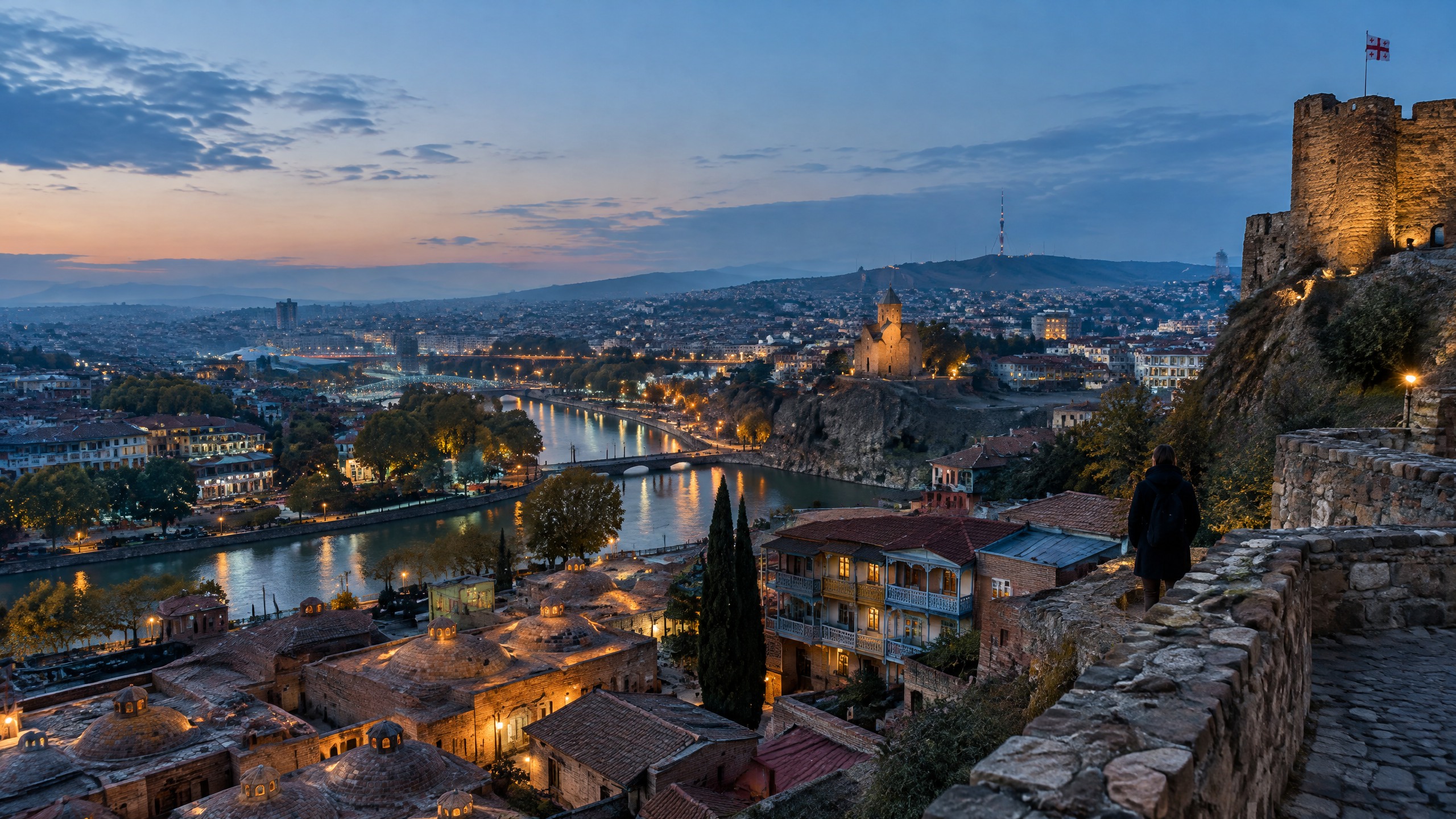
Tbilisi refutes the idea that a former Soviet city can be understood through a former Soviet framework. The expectation is concrete blocks, administrative gravity, a hard-edged transition economy, perhaps a few fashionable wine bars added for visitors. The reality is an older and more private cultural logic that survived because it was practiced in homes, kitchens, courtyards, and tables long before it could be displayed publicly. Tbilisi does not feel like a city that escaped one identity and adopted another. It feels like a city that kept a deeper one intact.
Abanotubani is where the surprise becomes physical. The sulfur-bath district sits under brick domes beside the Mtkvari River, and the city’s Georgian name is commonly connected to the warm springs beneath it. A traveler expecting a post-communist capital encounters an urban bathing tradition that predates the modern political categories used to describe the region. Book a private room at a bathhouse rather than treating the district as a photograph, then walk uphill toward Narikala before evening. From the fortress, the domes, balcony-lined Old Town, Metekhi Church, and the river appear in one frame—not as a preserved district, but as a city whose layers remain in active conversation.
A Tbilisi food and wine guide gives the right entry into the second correction: Georgia’s qvevri wine tradition. Amber wine fermented in buried clay vessels has none of the expected Eastern European bar-room logic. It changes the meal, and the meal matters because a supra is not simply dinner. The toastmaster, or tamada, directs a sequence of toasts that can move from ancestors and friendship to grief and the future without becoming performance. A four-day Tbilisi itinerary can help place the baths, Old Town, and wine bars, but leave one evening unstructured enough to accept an invitation if one is offered.
The decisive contrast is not old against new. Fabrika’s converted-Soviet-factory energy and the natural-wine scene are real, but they are not the whole argument. The balconies of Sololaki, the sulfur steam rising through the old district, and the domestic rules of a table tell the fuller story. Choose Tbilisi when the desired surprise is categorical: a city that makes the framework used to approach it feel too small.
The practical reward is a city that can be entered at walking speed. Cross the Dry Bridge market without assuming every object needs to become a purchase. Pause in a courtyard where laundry, grapevines, and repairs share a small private world. Take the funicular toward Mtatsminda only after the old streets have made the elevation meaningful. Tbilisi’s real correction is not that it contains more than a visitor expected. It is that its public disorder and private hospitality belong to the same civic temperament.
Medellín: The City That Made Beauty From Its Worst Starting Point
Where Tbilisi refutes a category, Medellín transforms the meaning of a civic comeback. Many travelers still arrive carrying the Escobar-era image: a city defined by danger, cartel violence, and an unmanageable geography. Medellín’s surprise is not a simplistic claim that its past disappeared. It is that the city responded to damage with public systems that made connection, learning, and dignity visible.
Ride Metrocable Line K from Acevedo toward Santo Domingo and the logic becomes clear from above. The cable cars were designed to connect hillside communities that had long been cut off by terrain and inequality to the metro network below. The fifteen-minute ascent is not an amusement-ride view over a city; it is an explanation of why movement through Medellín had to become social infrastructure. The city opens beneath the cabin in a way that makes its valley geography and its uneven history impossible to separate.
Use a Medellín urban-transformation itinerary to put that ride into a responsible sequence. Comuna 13 also belongs in the conversation, but it requires care. The neighborhood’s outdoor escalators, mural programs, and community-led cultural work exist beside the memory of Operation Orion and the violence that made reinvention necessary. Go with a local-led context, listen more than you perform recognition, and avoid reducing a community’s recovery to a background for photographs.
The city’s second surprise is softer and just as important. Parque de los Pies Descalzos, beside the EPM complex, invites people to move through sand, water, and bamboo barefoot in the middle of a dense urban setting. Laureles, with its circular streets, local restaurants, and cycling culture, offers a lived-in counterweight to the narrow choices outsiders often expect from Latin American cities: tourist enclave or danger zone. A Medellín food and culture guide can carry the traveler into that everyday city. Medellín belongs here because it made beauty an active public answer to trauma rather than a cosmetic cover for it.
That distinction is why the city deserves patience. Spend a morning in the center around Plaza Botero and the Museo de Antioquia, where Fernando Botero’s exaggerated bronze figures occupy a public square rather than a sealed gallery. Then take the metro back toward a neighborhood day that has no transformation story attached to it. Medellín does not ask a traveler to forget what happened here. It asks them to see how transport, art, libraries, parks, and daily life became tools for refusing to let the past dictate the city’s entire visual future.
Muscat: The Gulf City That Declined to Become Dubai
If Medellín makes civic reconstruction visible, Muscat makes restraint visible—a Gulf capital that chose continuity as its version of modernity. The expectation is a regional formula: towers competing for height, climate-controlled malls defining public life, neon announcing that the city has arrived. Muscat has airports, international hotels, a working port, and contemporary infrastructure, but it retains a coherent Omani architectural vocabulary of low-rise buildings, pale facades, domes, and mountains that remain present in the city’s sightlines.
Start before the heat gains authority. At Mutrah Corniche in the morning, fishing boats, dhows, the harbor, and the rough brown mountains establish a scale no skyline can reproduce. The Mutrah Souq holds spices and textiles, but its signature scent is frankincense: resin tied to Oman’s Dhofar region and to a trade history that made the Arabian Peninsula part of a much older global network. The point is not to declare the souq untouched by tourism. It is to notice that the city’s most recognizable sensory experience is rooted in a material culture that predates the regional development model outsiders expect.
The Oman and Muscat adventure itinerary is the guide anchor for this city and works best when it is used to connect urban days with the geography beyond them. The Sultan Qaboos Grand Mosque’s carved interiors and public gardens demonstrate the same commitment to a local visual language at a monumental scale. Al Alam Palace and the Portuguese forts at Old Muscat make the city’s coastal history visible without suggesting that every site must be consumed as heritage display.
Then leave the city. Wadi Shab, roughly 150 kilometers southeast of Muscat, begins with a short boat crossing and continues on foot through a canyon toward pools and a cave. The contrast matters: the traveler who expected desert, shopping, and engineered waterfronts encounters an Omani geography built around mountains, wadis, coast, and heat. Muscat belongs on this list because it proves that modernization can be an act of selection rather than replacement.
That choice is also visible in what the city declines to dramatize. The Hajar Mountains remain close enough to shape the horizon. The harbor is still legible as a harbor. Even the late-afternoon traffic along the corniche reveals a capital whose scale has not been surrendered to a single business district. Give Muscat time at dawn and after sunset, when the call to prayer, sea air, incense, family walks, and the mountain silhouette make its argument more persuasive than any landmark checklist could.
Sarajevo: Where East and West Meet on One Street
Where Muscat protects a deliberate architectural continuity, Sarajevo makes several continuities collide in a few hundred walkable meters. Travelers often arrive expecting a Balkan capital defined primarily by post-war fragility and unresolved tension. Sarajevo’s surprise is more exact: it is one of the few European cities where Ottoman and Austro-Hungarian urban systems do not sit in separate museum districts. They meet along the same daily route.
Begin in Baščaršija, the Ottoman-era bazaar quarter, with its low roofs, copper workshops, and the call to prayer carried over the surrounding hills. Walk west along Ferhadija and the facades begin to shift toward Austro-Hungarian proportion. Residents call the transition the Meeting of Cultures. It is not a slogan that needs much embellishment; the geometry of the street performs the explanation. Gazi Husrev-beg Mosque, the Sacred Heart Cathedral, a synagogue, and an Orthodox church sit within a compact city center that asks a visitor to understand coexistence as geography first.
A three-day Sarajevo guide can establish a measured first route, but the city must not be approached as a collection of trauma sites. The Tunnel of Hope at the Kolar family house in Butmir preserves a section of the tunnel dug beneath the airport runway during the siege of 1992–96. It is intimate precisely because it refuses abstraction: a low passage, photographs, practical objects, and the evidence of how a besieged city remained connected to the outside.
Sarajevo’s food makes the same meeting point edible. Bosnian coffee arrives in a džezva with a small cup and often rahat lokum; the ritual slows the table down. Ćevapi in somun and fresh burek from a bakery counter are not generic “Balkan food.” They belong to a city whose Ottoman inheritance was absorbed into a European urban life without becoming decorative. When the weight of the center requires a release, Vrelo Bosne at Ilidža offers spring water, plane trees, and weekend picnic culture that feels entirely ordinary. Sarajevo belongs here because it makes East and West a walk, a coffee, and a street corner rather than an abstraction.
Sarajevo also corrects the visitor who expects history to silence ordinary humor. In a café, on the tram, or at a bakery counter, the city can feel remarkably direct and social despite the gravity carried by its hillsides and memorials. That coexistence matters. A traveler who gives Sarajevo only a day will remember the siege. A traveler who stays long enough to return to the same coffee house, climb a side street, and take the tram toward Ilidža begins to understand why its residents insist on a fuller definition of the city.
Tallinn: The Medieval City That Kept Moving Forward
If Sarajevo makes historical layers touch, Tallinn makes them operate at the same speed. The expected Tallinn is a Baltic Old Town: walls, towers, merchant houses, and a brief stop on a northern-European circuit. The surprise is that the city’s medieval form and Estonia’s digital ambition do not feel like opposite identities. They are parts of a society that learned the cost of interrupted sovereignty and chose to make continuity practical.
Tallinn Old Town has endured Danish, Livonian, Swedish, Russian, Nazi, and Soviet rule with its street pattern still remarkably intact. Climb Toompea early, before the day’s group tours compress the lanes, and look down toward the red roofs, St. Olaf’s spire, and the harbor. The scale makes the preservation legible. Yet the city’s point is not to freeze there. Estonia’s digital state—online public services, secure data exchange, e-residency, and an unusually visible civic-tech culture—turns a small country’s administrative choices into part of its identity.
A Tallinn city guide helps connect the Old Town with the newer neighborhoods, while a solo Tallinn itinerary is especially useful for the independent traveler who wants time outside the medieval core. In Kalamaja, wooden workers’ houses give way to Telliskivi Creative City, a former industrial complex now occupied by studios, food counters, design shops, and cultural events. Nearby Balti Jaam Market makes the change feel less curated than lived: groceries, smoked fish, cafes, and ordinary errands share space with the visitor’s curiosity.
The Singing Revolution gives this coexistence its political depth. At the Tallinn Song Festival Grounds, Estonians gathered in huge numbers in the late Soviet period to sing national songs when public expression carried risk. The amphitheater can look modest when empty, which is part of the surprise; a structure built for collective voice holds a national memory that no medieval tower alone could tell. Tallinn belongs here because survival became a method for going forward, not a reason to remain still.
The city is especially good at making that future feel mundane rather than futuristic. Contactless transit, digital public services, and online civic tools are part of the background rather than a spectacle performed for visitors. That calm competence changes how the Old Town reads. The cobblestones are not an obstacle to overcome on the way to the modern city; they are evidence that a place can keep its physical memory while choosing administrative systems designed for movement, trust, and daily use.
Chiang Mai: The City That Learned to Be Two Things at Once
Where Tallinn keeps medieval form and digital ambition in one civic story, Chiang Mai maintains a more intimate simultaneity: a globally connected city that remains unmistakably northern Thai. The expectation is a tourist template—temples, night markets, cooking classes, and a few easy excursions—or a remote-work template of cafes and coworking desks. Chiang Mai contains both, but neither explains why it works. Its surprise is that the international layer has not fully displaced the local one.
Walk the old city between Wat Phra Singh, Wat Chedi Luang, and Wat Chiang Man rather than collecting temple names by vehicle. The density of Lanna Buddhist history changes the scale of the day; a shrine, a school, a market, and a small coffee counter can all exist on the same block. At Wat Suan Dok, monk chats—when sessions are offered—create a more reciprocal kind of encounter than a lecture. The visitor can ask questions, and novice monks practice English while explaining their own lives and traditions.
A Chiang Mai food guide supplies the right entry to the city’s northern-Thai character: khao soi, markets, grilling smoke, and the difference between a meal designed for a visitor and one with a local daily rhythm. A Chiang Mai solo guide is equally useful because the city’s accessible scale makes independent days feel possible without making them anonymous.
Nimman offers the modern half of the argument. It has concept cafes, contemporary Thai design, galleries, and a digital-worker population, but its most interesting feature is not its wireless signal. It is that this district can coexist with Wua Lai Road’s Saturday Walking Street, where silverwork, northern textiles, and local food carry a different economy into the same city. Use a five-day Chiang Mai itinerary to give each side room, then use a food-and-temples guide to avoid treating them as competing versions of Chiang Mai. Chiang Mai belongs on this list because it has learned that a city can host the world without dissolving into it.
The key is to let the city’s tempo change across the day. Morning belongs to temple grounds, coffee, and the quieter lanes inside the old walls. Afternoon can hold a gallery, a cooking class, or a work session in Nimman without pretending that any of those activities defines the place alone. Evening returns the question to food: a bowl of khao soi, a market table, or a neighborhood restaurant where the menu has no interest in performing a universal version of Thai cuisine. Chiang Mai’s surprise is sustained by that ordinary coexistence.
How to Plan a Trip to the Best Cities That Surprised Me
Do not use this list to build a six-city race. Each surprise depends on enough time for the first assumption to wear out. Four days works in Tbilisi, Sarajevo, Tallinn, and Chiang Mai if the itinerary protects unstructured hours. Medellín benefits from at least four or five days because the cable car, Comuna 13 context, Laureles, and a slower neighborhood day should not be compressed into one narrative. Muscat needs four or five days if the traveler wants both the corniche and souq rhythm of the city plus a wadi or coast day beyond it.
Choose Tbilisi if a private cultural tradition surviving public systems is the desired surprise. Choose Medellín if the question is whether urban change can feel generous rather than cosmetic. Choose Muscat if the Gulf needs to be understood beyond its loudest examples. Choose Sarajevo if history becomes meaningful only when it can be walked. Choose Tallinn if a city can preserve its past while engineering a different administrative future. Choose Chiang Mai if international ease and local life must both be true at once.
The costs and logistics differ. Georgia and Bosnia reward travelers willing to use walking, public transport, and a few carefully chosen local guides. Medellín requires an approach grounded in current neighborhood guidance and respectful context. Oman benefits from advance planning for a car, driver, or organized day beyond Muscat. Tallinn is easy to navigate on foot and by transit. Chiang Mai rewards time outside the most obvious temple-and-market loop. AskLeif can turn that choice into a day-by-day itinerary built around the specific surprise you want to understand, rather than the generic list of attractions someone else says you should complete.
The City You Expected Is Not the One You Remember
Tbilisi refutes. Medellín transforms. Muscat refuses. Sarajevo meets. Tallinn survives. Chiang Mai maintains.
Those verbs are the argument. Each city begins by making an outsider’s first assumption feel reasonable, then quietly makes it insufficient. The surprise is not that the traveler found a better version of what they expected. It is that the expected city no longer describes the place at all.