Cliffside Villages, Limoncello at Dusk, and the Road That Shouldn't Exist: The Amalfi Coast Unpacked
Destination: Amalfi Coast, Italy
Category: destination
There is a road on the Amalfi Coast called the SS163 — the Nastro Azzurro, the Blue Ribbon — that should not exist. It was carved into the face of a cliff in the 1850s, a single lane of hairpin turns and blind corners suspended between the limestone mountains and the Tyrrhenian Sea, connecting a string of villages that had previously been accessible only by boat. Engineers at the time called it impossible. The Neapolitan king who commissioned it called it essential. Both were right.
Driving it for the first time — or more accurately, being driven on it for the first time, white-knuckled in the passenger seat of a bus that seems too wide for the road by approximately one foot — is one of the most viscerally memorable experiences in European travel. Not because it is comfortable. Because it is not. Because every corner reveals a view that makes you forget to be afraid, and then the next corner arrives and the fear comes back, and then another view, and so on for forty kilometers until you arrive in Amalfi town with the particular euphoria of someone who has survived something beautiful.
That tension — between the difficulty and the reward, between the inconvenience and the spectacle — is the essential truth of the Amalfi Coast. It is not an easy destination. The roads are narrow, the parking is a myth, the summer crowds are genuinely oppressive, and the prices are calibrated for people who have decided that money is not the primary consideration. And yet, year after year, travelers return. Couples plan anniversaries around it. Photographers dedicate entire careers to it. Writers run out of adjectives trying to describe the light on the water at 6 PM in late September.
This guide is an attempt to help you experience the Amalfi Coast the right way — not the Instagram version, not the cruise-ship-day-trip version, but the version where you actually understand what you're looking at, where you stay long enough to see it change, and where you leave with the specific kind of memory that doesn't fade.
Understanding the Coast: The Map Before the Trip
The Amalfi Coast (Costiera Amalfitana) is a 50-kilometer stretch of the southern edge of the Sorrento Peninsula, in the Campania region of southern Italy. It runs from Positano in the west to Vietri sul Mare in the east, with the town of Amalfi roughly in the middle. The entire coastline is a UNESCO World Heritage Site, designated in 1997 for its "outstanding Mediterranean landscape" and the remarkable density of historical, cultural, and architectural significance packed into a relatively small area.
The coast is divided, loosely, into three sections. The western section — Positano, Praiano, and the Furore Fjord — is the most photographed and the most expensive. The central section — Amalfi town, Atrani, and the Valle delle Ferriere — is the historical heart, where the medieval Republic of Amalfi once controlled Mediterranean trade routes. The eastern section — Ravello, Minori, Maiori, Cetara, and Vietri — is the least visited and, for many travelers who make the effort, the most rewarding.
Understanding this geography before you arrive is not a minor point. The Amalfi Coast is not a destination you can navigate by instinct. The towns are connected by the SS163 (which is often gridlocked in summer), by ferries (which are the best way to move between towns in July and August), and by hiking trails (which are the best way to see the coast as it was meant to be seen, from above). A trip that doesn't account for the logistics is a trip spent in traffic.
The Towns: Where to Stay, Where to Day-Trip
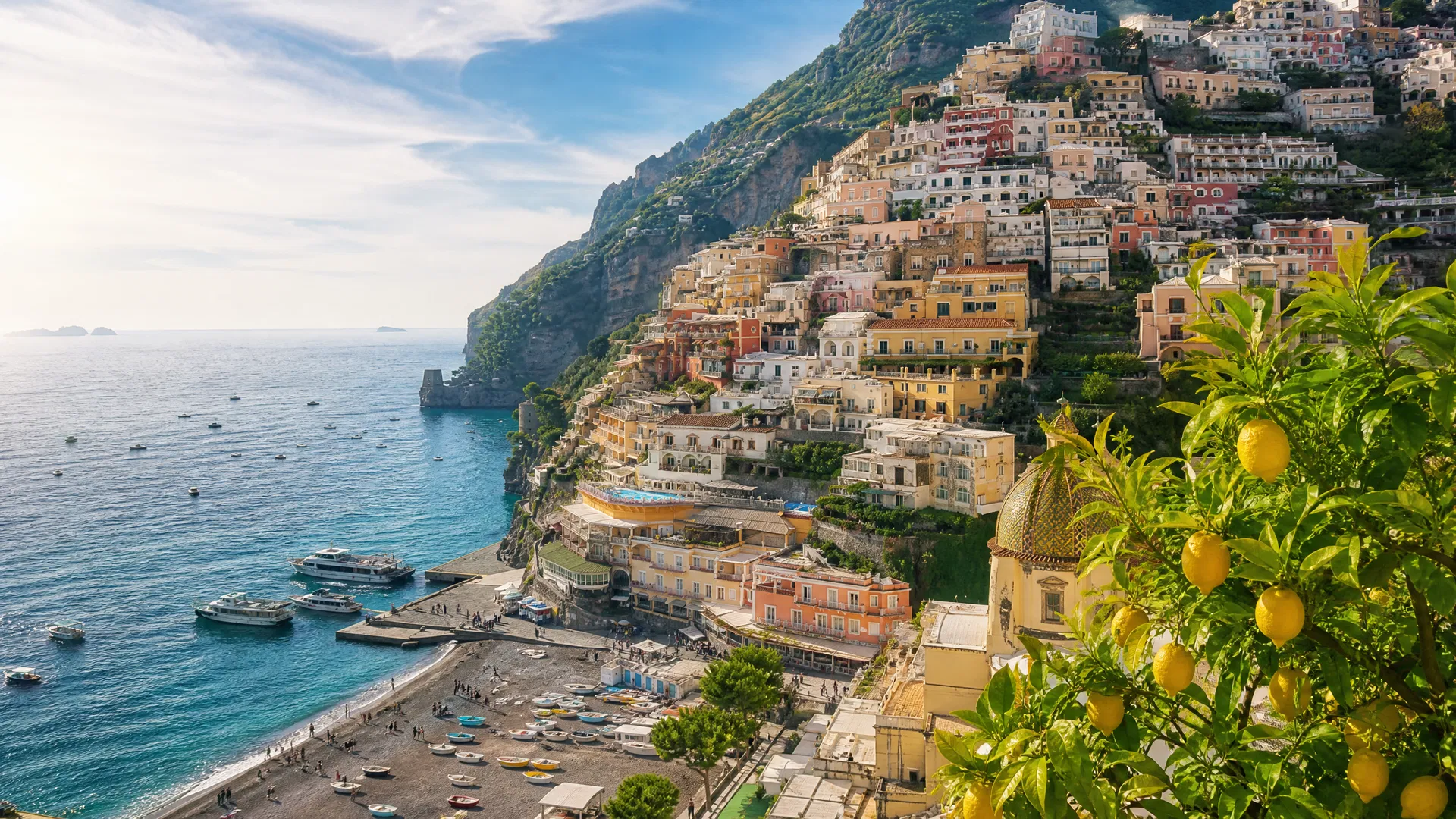
Positano is the cover image. The cascade of pastel buildings tumbling down the cliff to the small beach, the bougainvillea, the ceramic-tiled church dome, the boats in the harbor — this is the image that appears on every Amalfi Coast article ever written, and it is accurate. Positano is genuinely, almost aggressively beautiful. It is also, in July and August, genuinely, almost aggressively crowded. The main beach (Spiaggia Grande) is packed from 9 AM to 7 PM with sunbeds and tourists. The main shopping street (Via dei Mulini) is a slow-moving river of people. The restaurants are expensive and, in many cases, coasting on the view.
None of this means you shouldn't go to Positano. It means you should go in May, June, September, or October. Or you should arrive before 9 AM, when the light is extraordinary and the streets are empty. Or you should stay in Praiano, 10 minutes east by ferry, and day-trip to Positano for a morning and an evening, avoiding the midday crush entirely.
If you do stay in Positano, the upper village (above the main road) is quieter, cooler, and offers views down to the beach that are better than the beach itself. The hike to Nocelle, the village above Positano, takes about 90 minutes and rewards you with a perspective on the coast that no photograph has ever adequately captured.
Praiano is the answer to the question "what was Positano like before everyone found out about it?" Smaller, steeper, less visited, and genuinely charming in the way that Positano used to be before the boutique hotels arrived. The beach at Marina di Praia is a small cove accessible through a tunnel in the cliff — one of the most dramatic beach entrances on the coast. The church of San Gennaro, perched on the cliff above the main road, has a ceramic-tiled dome that rivals Positano's for beauty and is photographed by approximately one percent as many people. Praiano is the best base on the western coast for travelers who want proximity to Positano without the crowds or the prices.
Amalfi town is the historical center of the coast and the most practical base for exploring in multiple directions. The Duomo di Sant'Andrea, with its Arab-Norman facade and the bronze doors cast in Constantinople in 1066, anchors the main piazza and is one of the most significant medieval monuments in southern Italy. The Paper Museum (Museo della Carta), in a 13th-century paper mill in the Valle dei Mulini, tells the story of Amalfi's role in introducing paper-making to Europe — a fact that most visitors don't know and that reframes the town's historical significance entirely. The town is also the ferry hub for the coast, making it the most logistically convenient base if you plan to move around.
Ravello is the secret that isn't quite a secret anymore, but is still visited by far fewer people than it deserves. Perched 350 meters above the sea on a ridge between two valleys, Ravello is not a beach town — it is a hilltop village of extraordinary gardens, medieval architecture, and a quality of silence that is rare on the coast. Villa Cimbrone, whose Terrace of Infinity looks out over a drop to the sea that has been called the most beautiful view in the world (by Gore Vidal, among others), is not hyperbole. The gardens of Villa Rufolo, where Richard Wagner found the inspiration for the Flower Garden scene in Parsifal, host the Ravello Festival every summer — a series of classical music concerts performed on a stage that appears to float above the sea. Ravello is the place on the Amalfi Coast that makes you want to stay forever.
Atrani is the smallest municipality in Italy and the most overlooked town on the coast. It sits in a small cove immediately east of Amalfi town, connected by a footpath that takes five minutes to walk, and it has almost none of Amalfi's tourist infrastructure — no souvenir shops, no tour buses, one piazza, a handful of restaurants, and a beach that is genuinely local. It is the place where people who have been to the Amalfi Coast before tell you to go.
Cetara and Vietri sul Mare, at the eastern end of the coast, are the towns that most visitors never reach. Cetara is a fishing village famous for its colatura di alici — a fermented anchovy sauce that is the direct descendant of the ancient Roman garum and one of the great condiments of Italian cooking. The tuna fishing tradition here is centuries old, and the restaurants serve seafood with a directness and simplicity that is completely absent from the tourist-facing restaurants in Positano. Vietri is the ceramics capital of the coast, where the tradition of hand-painted maiolica has been practiced since the 16th century and where the workshops are still producing work of genuine quality alongside the tourist-grade souvenirs.
The Hiking Trails: The Coast From Above
The Amalfi Coast is not just a place to look at from below. The network of ancient mule paths that connected the coastal villages before the road existed — the sentieri — are still walkable, and they offer a perspective on the landscape that no road or ferry can match.
The Path of the Gods (Sentiero degli Dei) is the most famous trail on the coast, and the fame is deserved. Running along the ridge above Positano from Bomerano to Nocelle (or in reverse), the path traverses a landscape of terraced lemon groves, wildflowers, and limestone outcroppings with views down to the coast that are genuinely vertiginous. The trail is approximately 7.8 kilometers and takes 3–4 hours at a comfortable pace. The best direction is west to east (Bomerano to Nocelle), which puts the sun behind you in the morning and gives you the descent into Positano as the finale. Take the SITA bus from Amalfi to Bomerano, walk to Nocelle, and then walk or take the steps down to Positano for a late lunch.
The Valle delle Ferriere is the most underrated walk on the coast — a 4-kilometer trail from Amalfi town into a narrow valley of waterfalls, ferns, and the ruins of medieval paper mills. The valley is a nature reserve, and the microclimate created by the waterfalls supports plant species that are otherwise found only in tropical regions. It is cool, green, and almost entirely free of other tourists, even in August.
The Ravello to Minori trail descends from Ravello through the lemon groves of the Valle del Dragone to the beach town of Minori — a 4-kilometer walk that takes about 90 minutes and passes through some of the most beautiful agricultural terracing on the coast. The lemon groves here produce the sfusato amalfitano, the large, thick-skinned lemon that is the basis for the coast's limoncello and that is unlike any lemon you have tasted anywhere else.
The Food: What to Eat and Where
The Amalfi Coast is not a destination for adventurous eating — it is a destination for eating the same things repeatedly and never getting tired of them, because the things are that good.
Seafood is the foundation. The scialatielli ai frutti di mare — a thick, fresh pasta with mixed seafood — is the signature dish of the coast, and every restaurant has a version. The quality varies enormously. The best versions are in the smaller towns (Atrani, Cetara, Minori) where the seafood is genuinely local and the kitchen has no incentive to coast on the view. The worst versions are in the tourist-facing restaurants on the Positano waterfront, where the price is high and the pasta is often pre-made.
The lemons are not a cliché — they are a genuine agricultural product of extraordinary quality. The sfusato amalfitano is larger, more fragrant, and less acidic than standard lemons, and the limoncello made from its zest is a completely different product from the industrial version sold in airports. Buy a bottle from a local producer (look for "Limoncello di Amalfi IGP" on the label) and drink it cold, after dinner, as it was intended.
Pizza on the Amalfi Coast is not Neapolitan pizza — it is a slightly different tradition, with a thinner crust and a greater emphasis on local ingredients. The best pizza on the coast is in Amalfi town and in the smaller villages, not in Positano, where the restaurant economics favor quantity over quality.
Colatura di alici — the fermented anchovy sauce from Cetara — is worth seeking out specifically. A few drops over spaghetti with garlic and olive oil is one of the simplest and most extraordinary pasta dishes in Italian cooking. Buy a small bottle to take home.
When to Go: The Honest Seasonal Breakdown
July and August are the worst months to visit the Amalfi Coast, and the most popular. The roads are gridlocked, the beaches are packed, the restaurants are overpriced and understaffed, and the heat is oppressive. If you must go in summer, arrive by ferry from Naples or Salerno rather than driving, stay in Ravello or Praiano rather than Positano, and plan your days around the early morning and late evening.
May and June are the best months. The weather is warm but not brutal, the crowds are manageable, the lemon groves are in full bloom, and the coastal light has a quality that photographers specifically travel for. Hotel prices are 30–40% lower than peak summer. The ferries run on full schedules. The hiking trails are at their best.
September and October are the second-best option — the summer crowds have thinned, the sea is still warm enough to swim, and the harvest season brings a particular energy to the towns. The Ravello Festival runs through September. The light in October, when the angle of the sun changes and the shadows lengthen, is extraordinary.
November through April is the off-season, and it is not recommended for first-time visitors. Many hotels and restaurants close entirely. The ferry service is reduced. The weather is unpredictable. But for travelers who have been before and want a completely different experience — the coast in winter, with the villages to themselves and the mountains dusted with snow — it is one of the most beautiful places in Europe.
Getting There and Getting Around
From Naples: The most common approach. Naples to Sorrento by Circumvesuviana train (about 70 minutes), then ferry to Positano (about 40 minutes) or Amalfi (about 90 minutes). Alternatively, SITA buses run from Sorrento along the SS163 to all coastal towns, but the journey is slow and the buses are crowded in summer.
From Salerno: The eastern approach, less used but often faster. Salerno is a 60-minute train ride from Naples, and ferries from Salerno reach Amalfi in about 75 minutes and Positano in about 90 minutes.
By car: Possible, but not recommended in summer. The SS163 is a single lane in many sections, parking is extremely limited and expensive, and the stress-to-reward ratio is unfavorable. If you drive, arrive before 8 AM or after 7 PM.
By ferry: The best way to move between towns in season. Ferries connect Positano, Amalfi, Ravello (via Amalfi), Minori, Maiori, and Salerno. The ferry from Positano to Amalfi takes about 35 minutes and costs approximately €8–12. Schedules are available at the ferry docks and on the Travelmar and NLG websites.
By water taxi: Expensive but fast and spectacular. A private water taxi from Positano to Amalfi costs approximately €80–120 and takes 20 minutes. For couples celebrating an anniversary or travelers with limited mobility, it is worth every euro.
The Guides: Plan Your Amalfi Coast Trip with Ask Leif
The Amalfi Coast rewards careful planning — the difference between a trip that feels rushed and frustrating and one that feels like the best week of your life is almost entirely in the preparation. Ask Leif has built four Amalfi Coast guides to help you plan exactly the trip you want:
- Amalfi Coast 5-Day Itinerary: Positano, Ravello & the Cliffside Villages — The complete first-timer's guide, covering Positano, Amalfi town, Ravello, and the essential day trips, with ferry logistics and restaurant recommendations built in.
- Amalfi Coast Romantic Escape: 5 Days for Couples — Sunset terraces, private boat tours, candlelit dinners in Ravello, and the specific hotels and restaurants that make the coast one of the world's great romantic destinations.
- Amalfi Coast 7-Day Beach & Food Itinerary — A week structured around the best beaches (Marina di Praia, Atrani, Minori), the best seafood restaurants, and the lemon grove hikes that connect them.
- Amalfi Coast with Kids: 5-Day Family Itinerary — The coast with children, including the best family-friendly beaches, the Paper Museum, the Valle delle Ferriere walk, and the ferry logistics that make it manageable.
The Thing Nobody Tells You
The Amalfi Coast is one of those destinations where the experience of being there is almost impossible to communicate to people who haven't been. The photographs are accurate — the colors are that saturated, the views are that dramatic, the light at dusk is that specific shade of gold — but they don't capture the smell of the lemon groves in the heat of the afternoon, or the sound of the church bells echoing off the cliff face at 8 AM, or the particular quality of exhaustion that comes from a day of walking the sentieri and swimming in the sea and eating too much pasta.
It is also a destination that rewards patience in a way that few places do. The traveler who arrives for a single day and photographs the Positano waterfront and leaves has technically been to the Amalfi Coast. The traveler who stays for five days, who takes the ferry to Cetara on a Tuesday morning and eats colatura di alici at a table on the harbor, who hikes the Path of the Gods in the early light and descends to Positano for a late lunch, who sits on the Terrace of Infinity in Ravello at sunset and watches the light change on the water — that traveler has been somewhere.
The road that shouldn't exist leads somewhere worth going. Take it slowly.
If the Italian coast has you hooked, consider extending your trip to Monaco — 90 minutes by train from Ventimiglia along one of Europe's most spectacular coastal rail lines. Our 3-Day Monaco First-Timer's Itinerary covers the principality in full: Casino Square, the Prince's Palace, the F1 circuit walk, and where locals actually eat.