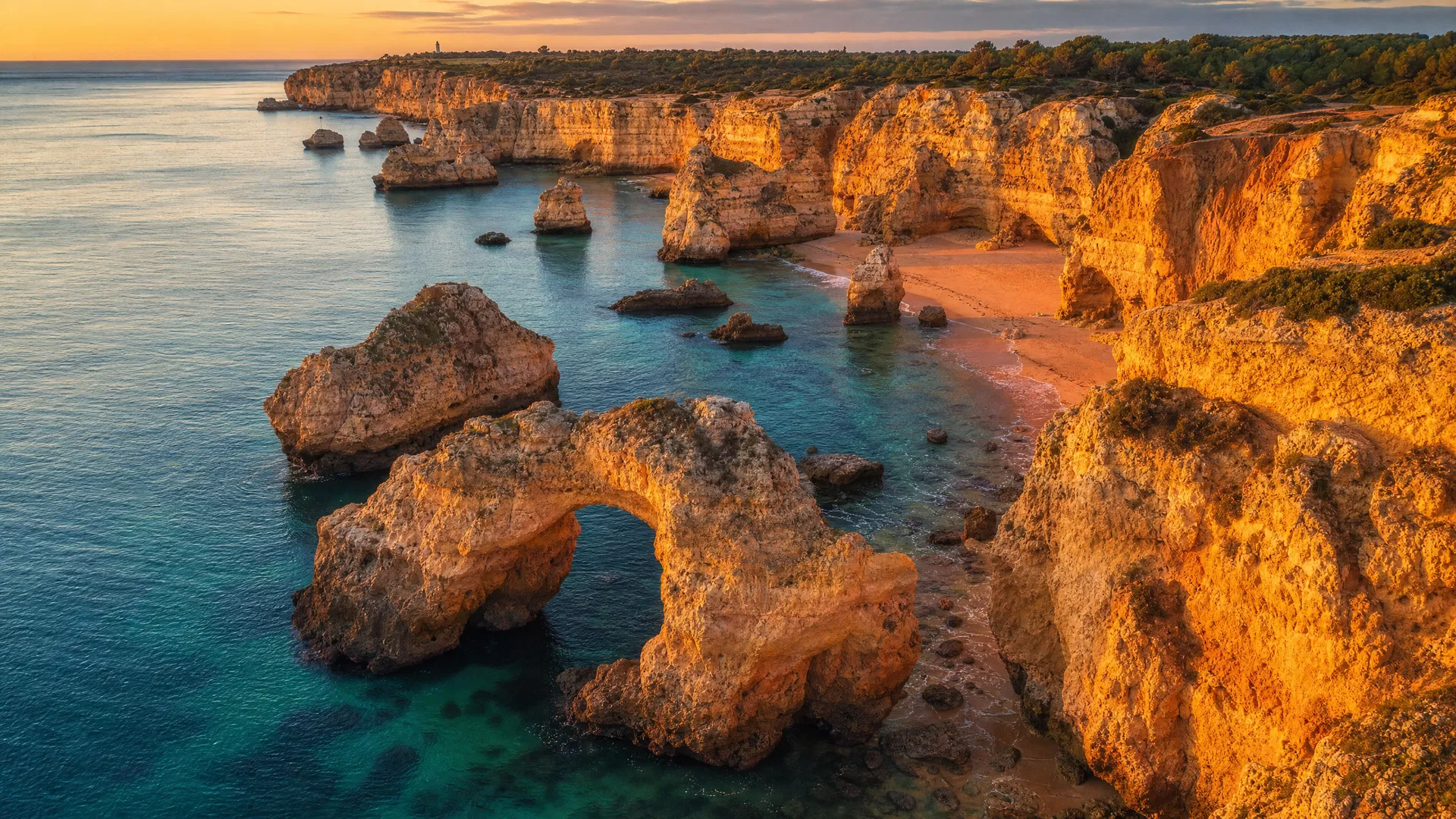
The Algarve: Golden Cliffs, Sea Caves, and the Atlantic
Destination: Algarve, Portugal
Category: Destinations
The first thing you notice is the light.
Not the beaches, not the cliffs, not the sea caves that look like they were carved by a sculptor with too much ambition and not enough restraint. The light. The Algarve sits at the southwestern edge of continental Europe, and the light here has a quality that photographers and painters have been chasing for centuries — warm and golden even at midday, almost amber by late afternoon, and at sunset, when the Atlantic catches it and throws it back against the limestone cliffs, it turns the entire coastline into something that doesn't look like it belongs in the real world.
Portugal's southernmost region stretches 155 kilometers along the Atlantic coast, from the Spanish border at Vila Real de Santo António in the east to Sagres and Cabo de São Vicente in the west — the southwestern tip of continental Europe, where the Atlantic begins in earnest and where, for centuries, Portuguese sailors launched themselves into the unknown. The Algarve has 300 days of sunshine per year. It has some of the most dramatic coastal scenery in Europe. It has a food culture built on fresh seafood, grilled fish, and a simplicity that makes everything taste better than it has any right to. And it has been, for the past three decades, one of the most popular holiday destinations in Europe — which means it has also been, for those same three decades, misunderstood.
Most visitors come for the beaches. They stay in the resort hotels of Albufeira or Vilamoura, spend a week on a sun lounger, eat at restaurants designed for tourists, and go home having seen approximately five percent of what the Algarve actually is. This guide is for the other ninety-five percent.
What the Algarve Actually Is (And What It Isn't)
The Algarve is not Albufeira. This needs to be said clearly, because Albufeira — the largest resort town in the region, with its strip bars and all-inclusive hotels and crowds that peak at genuinely overwhelming levels in August — has become, for many international visitors, synonymous with the Algarve itself. It is not. Albufeira is one town in a region that contains dozens of distinct places, each with its own character, its own coastline, its own food culture, and its own relationship with the Atlantic.
The Algarve divides naturally into three zones. The Barlavento (windward) in the west, from Sagres to Lagos, is the dramatic zone — the cliffs are highest here, the sea caves most spectacular, the waves most powerful, and the landscape most raw. This is where the serious surfers go, where the most photographed beaches are, and where the region's most compelling history lives. The Sotavento (leeward) in the east, from Faro to the Spanish border, is the quieter zone — long barrier islands, calm lagoons, salt marshes full of flamingos, and towns that feel genuinely Portuguese rather than tourist-facing. The Barrocal in the interior is the forgotten zone — rolling hills of almond, carob, and fig trees, whitewashed villages that haven't changed in decades, and a food culture that has nothing to do with grilled fish and everything to do with slow-cooked pork, wild herbs, and the kind of cooking that takes all day.
Most travel writing about the Algarve focuses almost exclusively on the Barlavento coast between Lagos and Sagres. This guide covers all three zones, because the Algarve you don't know about is often better than the one you do.
The Beaches: An Honest Ranking
The Algarve has over 150 beaches. They are not all equal. Here is the honest version of the ranking that most travel sites are too polite to give you.
Praia da Marinha (near Lagoa) is the most beautiful beach in the Algarve, and possibly one of the most beautiful in Europe. It sits at the bottom of a 60-meter cliff, accessible by a steep path that most people don't bother to descend. The beach itself is small — perhaps 200 meters of golden sand — but the rock formations that surround it are extraordinary: arches, sea stacks, grottos, and tunnels carved by the Atlantic over millennia. The water is clear enough to see the bottom at five meters. Come early or come late; at peak summer, even this hidden gem gets crowded.
Praia de Benagil is famous for one reason: the Benagil Cave, a sea cave with a natural skylight that has become one of the most photographed places in Portugal. The cave is accessible only by water — kayak, paddleboard, or boat tour from Benagil beach. The beach itself is tiny and gets extremely crowded in summer. The cave is worth it. Go by kayak if you're comfortable in the water; the boat tours are efficient but impersonal.
Praia da Rocha (Portimão) is the grande dame of Algarve beaches — wide, long, backed by dramatic cliffs, and close enough to Portimão to be genuinely accessible. It gets crowded in summer, but it's large enough that you can always find space. The cliff walk above the beach offers views that rival anything in the region.
Meia Praia (Lagos) is the anti-Algarve beach — four kilometers of flat, wide, relatively uncrowded sand stretching east from Lagos. No dramatic cliffs, no sea caves, no Instagram moment. Just a long, beautiful beach with calm water and space to breathe. Families love it. Windsurfers love it. People who are tired of fighting for a patch of sand love it.
Praia de Odeceixe is where the Algarve ends and the Alentejo begins, and it is one of the most dramatic beaches in Portugal. The Seixe River meets the Atlantic here, creating a sheltered lagoon on one side and open ocean on the other. The village of Odeceixe sits on the hill above, white and quiet. This is the beach for people who have been to the Algarve before and want something different.
Ilha de Tavira (Tavira) is the best beach in the eastern Algarve — a barrier island accessible only by ferry, with kilometers of undeveloped sand backed by dunes and the Ria Formosa lagoon. The water on the lagoon side is warm and calm; the ocean side has waves. The island has no cars, no development, and in the off-season, almost no people. It is extraordinary.
Praia do Camilo (Lagos) is the most dramatic small beach in the region — accessed by a wooden staircase descending through the cliffs, with rock arches and sea stacks that frame the water like a painting. It holds perhaps 100 people comfortably. In August, it holds significantly more than that.
Lagos: The Town That Has Everything
Lagos is the best base in the Algarve for most visitors, and it's not particularly close. The old town is enclosed by 16th-century walls, with cobblestone streets, whitewashed buildings, and a historic center that has managed to remain genuinely Portuguese despite decades of tourism. The marina is active and beautiful. The beaches — Praia do Camilo, Praia Dona Ana, Meia Praia — are within walking distance or a short drive. The food is excellent. The bars are lively without being oppressive. And the cliffs west of town, stretching toward Ponta da Piedade, are among the most spectacular coastal formations in Europe.
Ponta da Piedade is the non-negotiable Lagos experience. A 2-kilometer walk west of town along the cliff tops brings you to a headland where the limestone has been carved into a labyrinth of arches, grottos, sea stacks, and tunnels. The light in the late afternoon turns the rock orange and gold. Boat tours depart from Lagos marina and take you through the formations from the water — a completely different and equally extraordinary perspective. If you do one thing in Lagos, it is this.
The Slave Market Museum (Mercado de Escravos) is one of the most important and sobering historical sites in Portugal — the only remaining building from the 15th-century slave trade in Europe, where enslaved Africans were sold in what was then the first slave market in the Western world. It is not a comfortable visit. It is a necessary one.
The Old Town rewards slow walking. The Praça Gil Eanes, named after the Portuguese navigator who first sailed past Cape Bojador in 1434, is the central square. The Igreja de Santo António, with its extraordinary gilded interior, is one of the finest Baroque churches in the Algarve. The municipal market on Rua das Portas de Portugal is the best place to buy fresh fish, local cheese, and smoked sausage.
For food, A Forja on Rua dos Ferreiros is the Lagos institution — a small, unpretentious restaurant that has been serving grilled fish and cataplana (a traditional copper-pot stew) for decades. The line out the door at 8 PM is your quality indicator. Casinha do Petisco is the other essential stop — a tiny restaurant in the old town that does the best percebes (barnacles) and amêijoas (clams) in the region.
Sagres and Cabo de São Vicente: The Edge of the World
Sagres sits at the southwestern tip of Portugal, and it has a quality that's difficult to name — a combination of remoteness, historical weight, and raw Atlantic power that makes it feel like a place where something important happened and might happen again.
The Fortaleza de Sagres is a fortress built on a promontory above the Atlantic, where Prince Henry the Navigator is said to have established his school of navigation in the 15th century — the institution that trained the Portuguese explorers who mapped the African coast, found the sea route to India, and arrived in Brazil. Whether the school actually existed here in the form the legend describes is debated by historians, but the location is undeniably powerful: a flat-topped headland surrounded on three sides by 60-meter cliffs and the open Atlantic.
Cabo de São Vicente, 6 kilometers west of Sagres, is the southwestern tip of continental Europe — the last land before the Atlantic. The lighthouse here has been guiding ships since the 19th century. The cliffs drop 75 meters to the water. On a clear day, you can see the curvature of the earth. Sailors used to call this place "O Fim do Mundo" — the End of the World. Standing at the edge on a day when the Atlantic swell is running and the wind is strong enough to make standing upright an effort, you understand why.
The surf at Sagres is world-class. Praia do Tonel and Praia da Mareta are the town beaches, sheltered enough for swimming in summer. Praia do Beliche and Praia do Castelejo are the serious surf beaches — powerful, consistent, and not for beginners. The surf school scene in Sagres is excellent, with several reputable operators offering lessons for all levels.
Tavira: The Algarve That Time Forgot (In the Best Possible Way)
Tavira is the most beautiful town in the Algarve, and it is consistently overlooked by visitors who don't make it to the eastern end of the region. It sits on the banks of the Gilão River, 30 kilometers west of the Spanish border, and it has the feel of a town that peaked in the 18th century and has been quietly, contentedly existing ever since.
The town has 37 churches — an extraordinary number for a place of 26,000 people, a legacy of the wealth that flowed through here when Tavira was one of the most important fishing ports in Portugal. The Igreja de Santa Maria do Castelo is built on the site of a mosque, and the Moorish influence is visible throughout the old town — in the architecture, the street patterns, and the azulejo tile work that covers building facades throughout the historic center.
The Ria Formosa Natural Park begins at Tavira's doorstep. This 60-kilometer lagoon system, protected since 1987, is one of the most important wetland habitats in Europe — home to flamingos, spoonbills, purple herons, and dozens of other species. The barrier islands that separate the lagoon from the Atlantic are accessible by ferry from Tavira and Santa Luzia, and they offer some of the most pristine beaches in the region.
The Roman Bridge (actually medieval, despite the name) crosses the Gilão River in the center of town and is the visual heart of Tavira. Sit at one of the café tables on the riverbank at dusk and watch the light change on the water and the whitewashed buildings above it. This is the Algarve that most visitors never find.
For food, Tavira is exceptional. Quatro Águas is a cluster of seafood restaurants at the edge of the lagoon, where the fish comes directly off the boats. The Mercado da Ribeira is the covered market where locals shop — the best place to understand what the Algarve actually eats. O Pátio on Rua António Cabreira is the old-town institution, serving traditional Algarvian food in a courtyard that feels like it hasn't changed in fifty years.
The Interior: The Algarve Nobody Writes About
The Serra de Monchique is a mountain range that rises to 902 meters in the western Algarve, and it is one of the most underrated landscapes in Portugal. The mountains are covered in eucalyptus, pine, and the medronho (strawberry tree) that produces the local firewater — medronheira, a brandy made from the fruit that is simultaneously delicious and dangerous.
Monchique town sits at 450 meters and has a quiet, slightly melancholy beauty — a market town that serves the farming communities of the interior, with a weekly market, a handful of good restaurants, and views over the coastal plain to the Atlantic. The Fóia summit at 902 meters is the highest point in the Algarve, with views on a clear day that extend from the Spanish border to Cabo de São Vicente.
Alte is the most picturesque village in the Algarve interior — a cluster of whitewashed houses on a hillside above a stream, with a Manueline church, a waterfall, and a café where the owner will pour you a glass of medronho whether you asked for it or not. It is exactly what a Portuguese village is supposed to look like, and it is almost entirely free of tourists.
Silves was the Moorish capital of the Algarve — a city of 30,000 people when Lisbon was still a small town, and the seat of a civilization that was, by most measures, more sophisticated than the Christian kingdoms that eventually conquered it. The Castelo de Silves is the best-preserved Moorish castle in Portugal, with red sandstone walls that glow in the afternoon light and views over the orange groves and cork oak forests of the Barrocal. The town below the castle is quiet and genuine, with a cathedral built on the site of the mosque and a river that still runs through the center.
Food: What to Eat and Where to Find It
The Algarve's food culture is built on the Atlantic and the land behind it, and it is one of the great regional cuisines of Europe. Here is what you need to eat:
Cataplana is the defining dish of the Algarve — a stew cooked in a copper clam-shaped vessel that seals completely, creating a pressure-cooking effect that concentrates flavors. The classic version is clams with chouriço, white wine, garlic, and coriander. More elaborate versions add prawns, monkfish, or pork. Every restaurant in the Algarve serves cataplana; the quality varies enormously. Find a restaurant where the cataplana is made to order (it takes 20–30 minutes) and not pre-made.
Grilled fish is the other pillar. The Algarve's fishing boats bring in dorada (sea bream), robalo (sea bass), cherne (grouper), and sardines daily. The best grilled fish in the Algarve is found not in the tourist restaurants but in the simple, unfussy places near the fishing ports — Olhão, Portimão, Quarteira — where the fish goes from boat to grill in hours.
Percebes (barnacles) are the Algarve's great luxury ingredient — harvested from the rocks at low tide, boiled in seawater, and eaten with your hands. They taste like the ocean concentrated into a single bite. They are expensive and worth every cent.
Amêijoas à Bulhão Pato — clams cooked with garlic, white wine, lemon, and coriander — is the dish you will order at every meal and never tire of. The version at any decent seafood restaurant in the Algarve is better than anything you will find outside Portugal.
Pastel de nata is not Algarvian (it's from Lisbon), but the Algarve's version — slightly different, slightly crispier — is excellent. The local pastry to seek out is the Dom Rodrigo, a sweet made from egg yolks, almonds, and cinnamon that is specific to the Algarve and found in every pastelaria.
Practical Guide: The Honest Version
Getting There: Faro International Airport (FAO) is the main entry point, served by most European carriers and several North American ones with seasonal routes. Lisbon to Faro by train takes approximately 2.5 hours on the Alfa Pendular service. Driving from Lisbon takes about 2.5 hours on the A2 motorway.
Getting Around: A car is essential for exploring the Algarve beyond the main resort towns. The EN125 coastal road connects all the main towns from east to west, but it's slow and congested in summer. The A22 motorway (Via do Infante) is faster but has tolls. Rent a car at Faro airport — book in advance for summer visits, as availability is tight.
When to Go: May, June, and September are the sweet spots — warm enough for swimming, uncrowded enough to actually enjoy the beaches, and with long evenings that make the coastal towns come alive. July and August are peak season: hot, crowded, and expensive, but the sea is at its warmest and the nightlife is at its most active. October through April is the off-season — the Algarve empties dramatically after the summer, prices drop by 40–60%, and the landscape turns green from the autumn rains. The surf is at its best in winter. The almond blossoms in February are one of the most beautiful natural events in Portugal.
Where to Stay: Lagos is the best base for the western Algarve. Tavira is the best base for the eastern Algarve. Faro is the most practical base if you're flying in and out, with excellent transport connections. Avoid Albufeira as a base unless you specifically want the resort experience. For the interior, Monchique and Silves both have good accommodation options.
Budget: A week in the Algarve with accommodation, food, and activities runs approximately €1,200–2,500 per person depending on accommodation choices and season. Peak summer adds a significant premium. The off-season (October–April) is dramatically cheaper.
Language: Portuguese is the official language, and in the resort areas, English is widely spoken. In the interior and in smaller towns, Portuguese is essential. Learning a few phrases — obrigado/obrigada (thank you), por favor (please), uma cerveja, por favor (a beer, please) — will be received with genuine warmth.
The Algarve Nobody Told You About
Here is the version of the Algarve that most travel writing doesn't give you: it is a place of extraordinary depth, and the depth is almost entirely invisible from the beach.
The Algarve was the last part of Portugal to be reconquered from the Moors in 1249, and the Moorish influence — in the architecture, the place names, the food, the agricultural patterns — is still visible everywhere if you know what to look for. The word "Algarve" itself comes from the Arabic Al-Gharb, meaning "the west." The whitewashed buildings with their flat roofs and ornate chimneys are a direct inheritance from North African architecture. The cataplana is a cooking vessel with clear Moorish antecedents. The almond trees that bloom white and pink in February were brought by the Moors, who, according to legend, planted them to remind a Moorish king's Scandinavian queen of the snow she missed from home.
The Algarve is also a place of extraordinary natural diversity. The Ria Formosa is one of the seven natural wonders of Portugal. The Costa Vicentina, the wild Atlantic coast north of Sagres, is one of the least developed coastlines in Western Europe — protected as part of the Parque Natural do Sudoeste Alentejano e Costa Vicentina, it stretches 120 kilometers with almost no development, just cliffs, dunes, and the Atlantic. The Serra de Monchique is a microclimate of its own, receiving enough rainfall to support a lush, subtropical vegetation that is completely unlike the dry, sun-baked coast below.
And then there is the light, which we started with and which we should end with. The Algarve's light is not a cliché. It is a physical reality that changes how everything looks — the cliffs, the sea, the whitewashed walls, the faces of the people sitting outside the café at the end of the day. It is the reason painters have been coming here for a century. It is the reason that photographs of the Algarve, even good ones, never quite capture what it actually looks like to be there.
Go and see for yourself. The cliffs will be waiting.
Plan Your Algarve Trip with Ask Leif
Ready to build your Algarve itinerary? Our Algarve Family Adventure Guide covers seven days of sea caves, golden cliffs, and the best beaches in the region — ideal for families who want to see it all. For those exploring the full breadth of Portugal, our Lisbon & Porto 7-Day Itinerary pairs perfectly with an Algarve extension, and our dedicated Porto City Break Guide and Lisbon Couples Guide cover Portugal's two great cities in depth. If you're drawn to Portugal's wilder islands, our Madeira Adventure Guide and Azores Adventure Guide round out a complete Portuguese itinerary.
Use Ask Leif to build your personalized Algarve itinerary — tell us your travel dates, group size, and what you want to prioritize, and we'll give you a day-by-day plan in 60 seconds.