Dubai Built Itself to Be Seen. Abu Dhabi Built Itself to Mean Something
Destination: Abu Dhabi, UAE
Category: destination
The first thing you notice inside the Louvre Abu Dhabi is the light.
Jean Nouvel designed the dome with 7,850 unique star-shaped openings, each one cut at a different angle, so that when the sun moves across the sky, the light that falls through shifts and drifts across the galleries below. The effect has a name — "rain of light" — and it earns it. Standing underneath it between ten in the morning and two in the afternoon, when the sun is high enough to send shafts of light down through the layers of the dome, you feel like you're inside something that is both ancient and impossible. The geometry is Arabic. The scale is French. The building is on an island in the Arabian Gulf. A Vermeer hangs on one wall. A Magritte on another. A Byzantine icon across the room from a Tang dynasty horse.
This is not an accident. None of it is.
Abu Dhabi is the only city in the world that made a deliberate, expensive, architectural decision to become a place of culture — not by accident, not by accumulation, but by choice. Dubai built itself to be seen. The Burj Khalifa, the Palm, the indoor ski slope, the world's largest everything — Dubai is a city that wants you to photograph it, post it, be impressed by it. That project has been enormously successful. Dubai is one of the most visited cities on earth.
Abu Dhabi made a different bet. The capital of the UAE, sitting on an island at the edge of the Arabian Gulf with more oil wealth than almost any city on the planet, looked at what it wanted to be in a hundred years and decided: a place where the world's cultures sit down together and look at the same painting. The Louvre Abu Dhabi is the clearest expression of that argument. But it's not the only one. The Sheikh Zayed Grand Mosque is another. The Zayed National Museum, under construction on Saadiyat Island, will be another. The Guggenheim Abu Dhabi, also coming to Saadiyat, will be another.
The argument is still being made. Going to Abu Dhabi now means going while it's still in progress — while you can watch a city actively becoming what it decided to be.
The Mosque That Stops You
The Sheikh Zayed Grand Mosque is the largest mosque in the UAE and one of the largest in the world, and those facts tell you almost nothing useful about what it's like to stand inside it.
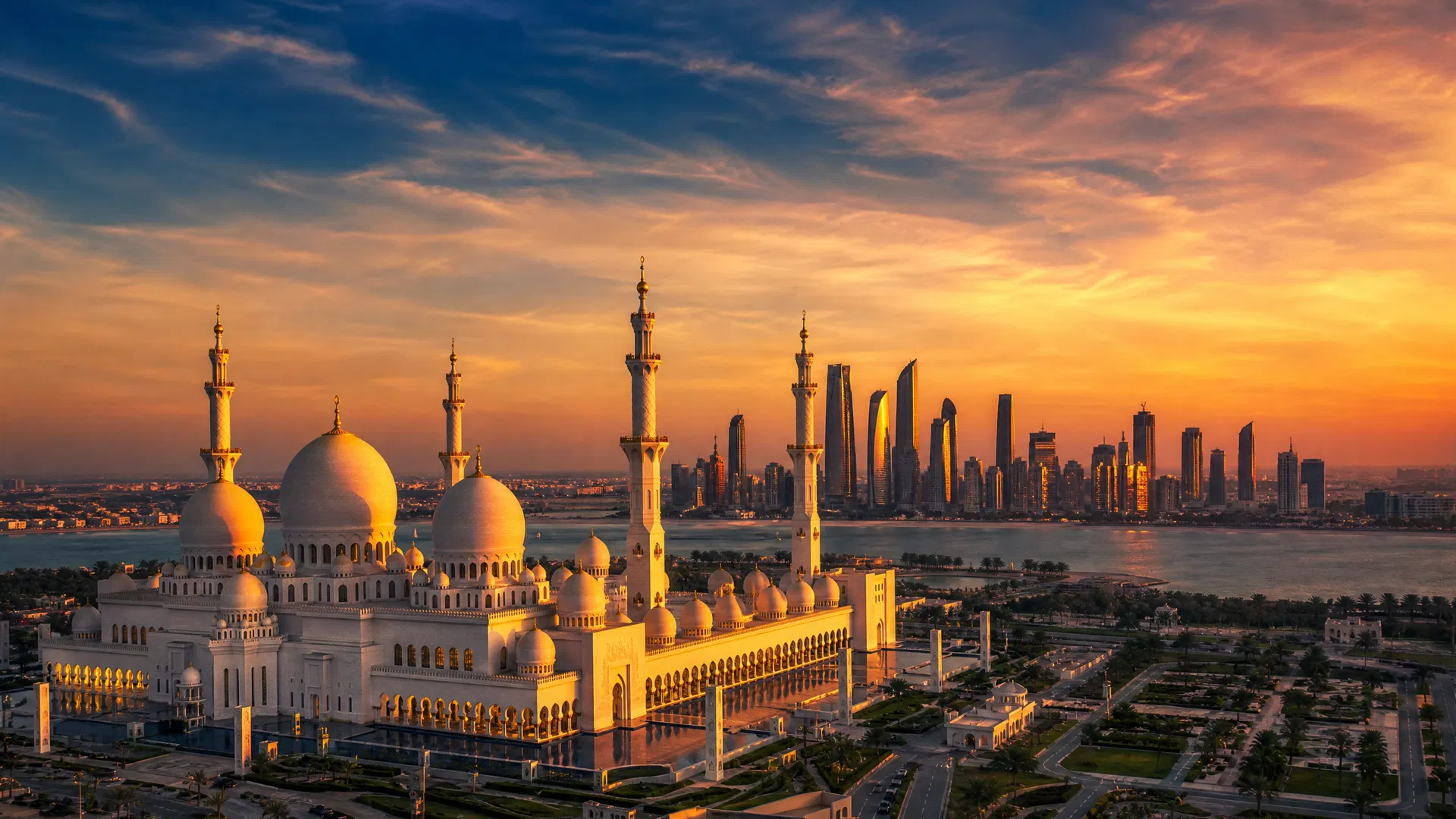
What the facts don't tell you: the entire structure is white marble, and the marble is not uniform — it was sourced from Macedonia, Greece, Italy, and China, and each variety has a slightly different quality of whiteness, so the building changes color as the light changes. At midday in summer it's blinding. At sunset it goes gold. After dark, when the mosque is lit from below, it glows against the black sky in a way that makes it look like it was built to be seen from space.
Most visitors go at midday. This is the wrong time. The right time is at sunset, when the light is doing something extraordinary to the marble, or after 8pm, when the crowds have thinned and the nighttime illumination is at full effect. The mosque is open to non-Muslim visitors until 10pm on most evenings, and the experience after dark — the white marble, the reflection pools, the quiet — is completely different from the daytime version that fills every travel photograph you've already seen.
The interior is equally disorienting in scale. The main prayer hall has one of the largest hand-knotted carpets in the world — 5,627 square meters, made by 1,200 Iranian artisans over two years. The chandeliers are Swarovski crystal. The columns are inlaid with mother-of-pearl floral patterns. The effect is not gaudy. It is overwhelming in the way that great religious architecture is supposed to be overwhelming — it makes you feel small in a way that feels like the point.
Modest dress is required. The mosque provides abayas for women at the entrance at no charge. Go at sunset. Stay until dark.
Saadiyat Island: Where the Argument Lives
Saadiyat Island is a ten-minute drive from central Abu Dhabi, and it is where the city's cultural project is most concentrated and most visible.
The Louvre Abu Dhabi opened in 2017. The Zayed National Museum, designed by Norman Foster, is under construction. The Guggenheim Abu Dhabi, designed by Frank Gehry, is coming. The Natural History Museum Abu Dhabi is also planned. When all of them are complete, Saadiyat will have a concentration of world-class cultural institutions that rivals any cultural district on earth — the Smithsonian Mall, the South Bank in London, the Museum Mile in New York.
That's the future. Right now, the Louvre is the reason to go to Saadiyat, and it deserves more time than most visitors give it.
The museum's permanent collection is organized chronologically and thematically rather than by culture or geography — which means a Mesopotamian figurine from 2500 BCE sits near an Egyptian relief from the same period, and the effect is to show how human beings across the ancient world were solving the same problems of representation and meaning in parallel, without knowing about each other. This is the curatorial argument the museum is making: that human creativity is universal, that the impulse to make art is not Western or Eastern but human. In Abu Dhabi — a city at the intersection of East and West, built on oil wealth, governed by Islamic tradition, hosting a French museum — that argument lands differently than it would anywhere else.
The dome's "rain of light" is best between 10am and 2pm. The museum is less crowded on weekday mornings. Budget three hours minimum; the permanent collection alone takes two.
After the Louvre, walk to Mamsha Beach — five miles of public white sand beach on the island's northern edge, free to access, far less crowded than the beaches closer to central Abu Dhabi. The water is warm, the sand is fine, and the view back toward the city skyline across the Gulf is one of the better views in the UAE.
The Mosque at the Center of Everything
Before there was the Louvre, before there was Saadiyat, before there was the cultural project — there was the Sheikh Zayed Grand Mosque, and it remains the single experience in Abu Dhabi that most consistently stops people in their tracks.
Sheikh Zayed bin Sultan Al Nahyan, the founder of the UAE, is buried in the mosque's courtyard. He commissioned it in 1996 and it opened in 2007, four years after his death. The building is both a religious site and a monument to the man who built the country — which gives it a weight that purely architectural descriptions don't capture. This is not just a beautiful building. It is the place where the founder of the UAE is buried, and the Emirati relationship to it carries that meaning.
For visitors, the practical details matter: enter from the south gate, not the main entrance — the lines are shorter. The best photographs of the reflection pools are from the upper level of the courtyard, not ground level. The carpet in the main prayer hall is so large that the pattern changes depending on where you're standing; walk to the far end and look back toward the entrance to see the full geometry of it.
Al Mina and the City That Locals Actually Live In
Every major city has two versions of itself: the one tourists see and the one that exists when the tourists aren't looking. In Abu Dhabi, the gap between those two versions is significant.
Al Mina Fish Market, on the southern edge of Abu Dhabi Island, is the honest version of the city. It opens at dawn and is busiest before 9am, when the fishing boats have come in and the catch is fresh. The market operates in three stages that most visitors don't know about: you buy the fish from the vendors at the stalls (haggle — the opening price is not the real price, and most vendors will come down 5 to 10 dirhams per kilogram without much resistance), then you pay the men in red — the cleaners — roughly 10 dirhams per kilogram to gut and prepare it, then you take it to one of the small restaurants at the back of the market to have it grilled. The entire process — buying, cleaning, cooking, eating — costs under 100 dirhams for two people and produces a meal that is better than anything you'll eat at a hotel restaurant.
The market is also where you see the city's actual demographic reality: the UAE's population is roughly 90% expatriate, and Abu Dhabi's workforce is predominantly South Asian. The fish market is where those communities shop, eat, and exist in a way that the Corniche and the cultural district don't show you.
The Corniche itself — the 8-kilometer waterfront promenade that runs along the northern edge of Abu Dhabi Island — is worth doing, but do it at 6am, not at noon. At dawn, before the heat arrives, locals walk and run the full length of it. The light on the water at that hour, the skyline behind you, the Gulf ahead — this is the city at its most unguarded. By 10am it's a different experience entirely.
The Heritage Village, at the western end of the Corniche Breakwater, is free to enter and worth an hour. It's a reconstructed traditional Emirati village — falaj irrigation systems, a working blacksmith, artisans demonstrating weaving and pottery — and while it's clearly built for visitors, it's built with enough specificity and care that it doesn't feel hollow. The view from the Breakwater back toward the Abu Dhabi skyline is one of the best in the city.
The Food Abu Dhabi Doesn't Advertise
Emirati cuisine is the least visible major cuisine in the world. The UAE has one of the highest concentrations of international restaurants per capita on earth — you can eat Japanese, Indian, Lebanese, Italian, and French within a half-mile radius of almost any hotel in Abu Dhabi — and the result is that the food of the country itself gets crowded out.
Machboos is the national dish: spiced rice cooked with chicken, lamb, or seafood, flavored with dried lime and a spice blend called bezar that varies by household. Harees is slow-cooked wheat and meat, the texture of porridge, the flavor deep and savory — it's Ramadan food but available year-round at traditional restaurants. Luqaimat are fried dough balls served with date syrup and sesame, sold at street stalls and eaten as a snack or dessert.
The place to eat all of this in Abu Dhabi is Mezlai, the restaurant inside the Emirates Palace hotel. It is the only restaurant in a five-star hotel in the UAE that serves authentic Emirati cuisine, and the setting — inside a palace that cost $3 billion to build — is surreal in a way that is specific to Abu Dhabi. The food is excellent. The machboos is the version to order. Reservations are recommended.
For a less formal version of the same food, the Heritage Village has a small café serving traditional Emirati dishes at reasonable prices. It's not Mezlai, but it's honest and the setting — a courtyard in a reconstructed traditional village — is more atmospheric than a hotel dining room.
Yas Island: The Other Abu Dhabi
Saadiyat Island is Abu Dhabi's argument about culture. Yas Island is Abu Dhabi's argument about entertainment. They are 20 minutes apart and they are completely different cities.
Yas Island is where the Formula 1 Abu Dhabi Grand Prix takes place every November, at the Yas Marina Circuit — the only Formula 1 circuit in the world where the track passes under a hotel (the W Abu Dhabi, which straddles the circuit on a bridge). Ferrari World Abu Dhabi is here, with the fastest roller coaster in the world. Warner Bros. World is here. Yas Waterworld is here. The Yas Mall is one of the largest shopping malls in the UAE.
If you're traveling with children, Yas Island is where you'll spend most of your time. If you're not, Saadiyat is where the city's most interesting work is happening.
The two islands represent the two things Abu Dhabi is trying to be simultaneously: a place of serious cultural ambition and a place of world-class entertainment. Most cities have to choose. Abu Dhabi is wealthy enough to pursue both at the same time, which is either admirable or excessive depending on your perspective, and probably both.
When to Go and How to Move
October through April is the window. The summer months — May through September — are genuinely dangerous for outdoor activity: temperatures regularly exceed 45°C (113°F), and the humidity from the Gulf makes it feel worse. The city functions in summer because everything is air-conditioned, but you will spend the entire trip moving between air-conditioned spaces and not experiencing the city as a city.
October and November are ideal: the heat has broken, the light is extraordinary, and the Formula 1 Grand Prix in November brings the city to life in a way that's worth experiencing even if you're not a racing fan. March and April are also excellent — warm but not brutal, and the city is fully operational.
Getting around Abu Dhabi requires a car or taxis. The public bus system exists but is not practical for tourists. Careem (the regional equivalent of Uber) is reliable, inexpensive, and works everywhere. Taxis from the street are also metered and honest. The distances between the main areas — central Abu Dhabi, Saadiyat Island, Yas Island — are significant enough that walking between them is not realistic.
Planning Your Abu Dhabi Trip
Here is how I would build three days in Abu Dhabi, and I would build them in this order every time.
Start at the Sheikh Zayed Grand Mosque — but go at sunset, not midday. Arrive around 4:30pm, walk the exterior and the reflection pools as the light changes, and stay until after dark when the illumination comes on. This single experience will reframe everything else you do in the city. From the mosque, drive to the Corniche for dinner — the waterfront has restaurants at every price point, and the evening walk along the water with the skyline lit up behind you is the best free thing in Abu Dhabi.
Day two belongs to Saadiyat Island. Give the Louvre Abu Dhabi three hours minimum — arrive at 10am when the dome's rain of light is at its best, work through the permanent collection slowly, and don't rush the galleries on the upper level where the Islamic art collection lives. After the Louvre, walk to Mamsha Beach and spend the afternoon there. In the evening, if your budget allows, book Mezlai at the Emirates Palace for dinner — the machboos, the harees, the luqaimat, the setting. It's the one meal in Abu Dhabi that is specific to the place in a way nothing else is.
Day three: set an alarm for 5:30am and walk the Corniche at dawn before the heat arrives. Then drive to Al Mina Fish Market — be there by 8am, before the best fish is gone. Buy something, watch the process, eat breakfast at the market. The afternoon is for Yas Island if you want the entertainment version of the city, or for the Heritage Village and the old city neighborhoods if you want to keep the register of the first two days.
AskLeif's 3-Day Abu Dhabi Romantic & Cultural Escape guide builds this out day by day with specific timing, restaurant recommendations, and the practical details that make the difference between a trip that works and one that doesn't. If you're traveling as a couple, it's the most direct path from reading about Abu Dhabi to actually being there.
What Abu Dhabi Is Still Becoming
The Guggenheim Abu Dhabi has been "coming soon" for nearly two decades. The Zayed National Museum has been under construction for years. The cultural district on Saadiyat Island is a project that has moved more slowly than its original timeline suggested.
This is worth knowing before you go, not because it diminishes what's already there — the Louvre alone justifies the trip — but because it means Abu Dhabi is a city you can visit multiple times over the next decade and find it meaningfully different each time. The argument the city is making is not finished. The institutions that will complete it are still being built.
There is something interesting about visiting a city in the middle of its own project. The Louvre is open and extraordinary. The beach on Saadiyat is public and free. The mosque is complete and overwhelming. The fish market has been there for generations. What's coming — the Guggenheim, the Natural History Museum, the full cultural district — will change the city's center of gravity in ways that are already visible in the architecture going up around the existing buildings.
Dubai is finished in the sense that it knows what it is and has built it. Abu Dhabi is still deciding. That incompleteness is not a flaw. It's the most honest thing about the place — a city that made a bet on culture and meaning, and is still in the process of proving it was right.
Go now. Come back in five years. The argument will be further along.
The contrast between the Louvre Abu Dhabi — the rain of light, the Vermeer, the Tang dynasty horse — and the Empty Quarter two hours south is the most Abu Dhabi thing about Abu Dhabi. A city that built a French museum on an island in the Arabian Gulf, surrounded by one of the most extreme landscapes on earth. The argument the city is making about culture and meaning is more interesting when you've seen what it was built on top of.